A model switched off across the planet, days after launch
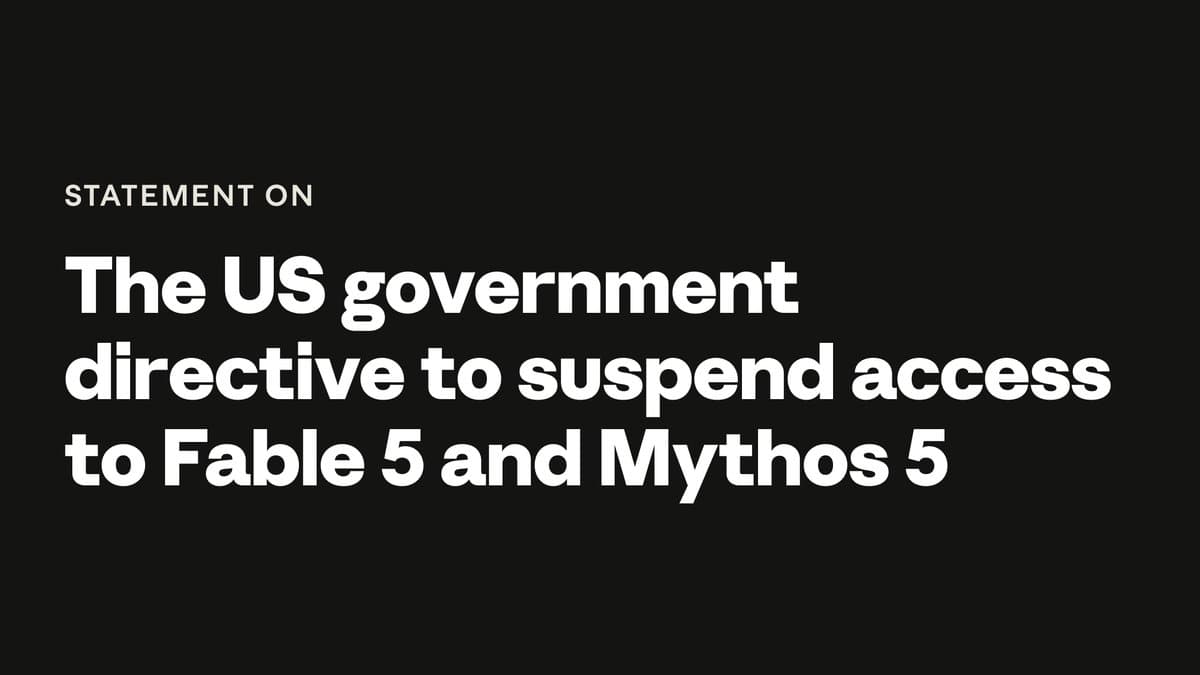
Here's the deal: on Friday, June 12, 2026, the US government issued an emergency export-control directive ordering Anthropic to immediately cut off access to two models — Claude Fable 5 and Claude Mythos 5. And not just for people overseas. The order covered every foreign national, inside or outside the US, including Anthropic's own foreign-national employees.
The catch is that there's no clean way to enforce "block only foreign nationals" on a global software service. To be sure it complied, Anthropic had basically one option: switch both models off for everyone, everywhere — paying enterprise customers and internal staff included. Models it had shipped only days earlier, its newest flagship generation, vanished from the market almost overnight.
What makes it stranger is that the government never said exactly why. The directive leaned on "national security" without spelling out the specific concern. Anthropic's own read: the worry centers on a jailbreak technique — a narrow path where you have the model read a specific codebase and fix its software flaws, a capability that could be repurposed for cyberattacks. In other words, the model got pulled partly because it's too good at coding. Awkward.
The players — Anthropic, the Trump administration, and a "supply-chain risk" label
The obvious lead is Anthropic. Claude is widely rated the front-runner in coding and enterprise work, and that very strength is what lit the fuse here. Fable 5 and Mythos 5 are the newest generation, shipped in early June — Mythos 5 had been the restricted, government-and-cybersecurity-grade model, while Fable 5 was the general/enterprise one. Anthropic pushed back hard, calling the order "legally unsound."
The second player is the Trump administration — and this clash isn't new. Back in March 2026, the administration designated Anthropic a "supply-chain risk." The root of the conflict: Anthropic had refused to let Claude be used for lethal autonomous weapons or mass surveillance of US citizens. The company's safety lines ran straight into the government's security and defense asks.
The third player is an unexpected one: David Sacks, Trump's former "AI czar" and now co-chair of the President's Council of Advisors on Science and Technology. He offered his own version of events, saying a "highly credible, trusted partner of both Anthropic and the US government came forward with a jailbreak." Who that "trusted partner" is becomes the hinge of the next chapter (we cover that in a separate piece).
What actually happened, in order
| When | Event |
|---|---|
| March 2026 | Trump administration labels Anthropic a "supply-chain risk" |
| Early June | Anthropic ships Fable 5 and Mythos 5 |
| Fri, June 12 | US issues emergency export-control directive — block all foreign nationals |
| June 12 | Anthropic disables global public access to both models to comply |
| June 13 | Anthropic publicly calls the ban "legally unsound"; signups surge |
| Shortly after | Federal judge Rita Lin issues a preliminary injunction on the "risk" label |
The first thing to notice is the scope. Export controls usually target shipments to a country. This one keyed off a person's nationality — foreign nationals anywhere, even Anthropic's own foreign staff. Treating an AI model like a controlled export item, and forcing nationality-based access gating onto a software service, is an unusual precedent.
The second is the jailbreak fight. Per Anthropic, the technique in question has the model read a codebase and patch vulnerabilities. Aimed defensively, that's great security. Flipped offensively — finding and exploiting flaws — it's a cyber weapon. So the real subject here is the double-edged nature of frontier models: strong coding ability is, functionally, strong cyber capability, and the government grabbed that blade by the handle.
The third is the reversal, just days later. US District Judge Rita Lin in California issued a preliminary injunction barring the administration (including Defense Secretary Pete Hegseth) from designating Anthropic a supply-chain risk — which let federal employees log back into Claude. The government's hard move hit a judicial wall fast.
Who actually came out ahead
Paradoxically, the biggest winner is Anthropic. The moment the government tried to switch its models off, the public stampeded toward Claude. Over a million people a day started signing up, pushing the Claude app to the top of both Apple's App Store and Google Play, overtaking ChatGPT. "The tool the government tried to ban" turned into the best marketing money can't buy — the classic halo a brand gets when it's cast as the censored party.
The open-source camp scored a talking point too. "Only a model nobody can switch off is a real tool" got fresh oxygen. That same week, a "Open source AI must win" post climbed Hacker News. Once it was proven that a closed frontier model can be killed by a single directive, un-killability re-emerged as open weights' core selling point.
The government, meanwhile, projected resolve in the short run but took on long-run baggage. With a shaky legal basis, the order was blocked within days and drew "Orwellian" criticism. Trying to fit a fast-moving technology into an old export-control frame exposed procedural and legal gaps in plain view.
Past parallels — wins and losses
Using "national security" to control technology isn't new. In the 1990s the US classified strong encryption as a "munition" and tried to control its export — the so-called Crypto Wars. The government effectively lost. Encryption was too universal and essential to bottle up, and the rules eventually loosened. It's the textbook case of how hard it is to draw borders around code, and the Fable 5 episode rhymes with it.
A closer-to-working example is the recent export controls on advanced AI chips to China. Blocking cutting-edge GPUs and tools had a concrete, physical target, so it bit to a degree. But a software model isn't a chip — it copies and transmits freely, and "is this user a foreign national?" is hard to adjudicate at the service layer. Port the hardware-control playbook onto software and you get exactly this kind of enforcement strain.
The lesson from the failures is clear: when control fights a technology's intrinsic tendency to spread, and when legal process can't keep pace with the tech, the control doesn't hold. The injunction landing within days wasn't luck — it was the price of choosing speed over procedure.
Competitor counterplay — how OpenAI, Google, and the open camp read it
OpenAI is in an awkward spot. Reporting suggests that after Sam Altman reached some kind of accommodation with the government, a slice of users soured on ChatGPT. While Anthropic got cast as "the company standing up to the government," OpenAI picked up the contrasting image of "the company that cut a deal." That a chunk of Claude's signup surge appears to be ChatGPT defectors is the painful part for OpenAI.
Google, Meta, and other big players mostly watched and took notes. With "closed frontier models are fully exposed to government risk" now demonstrated, they're recalculating their own safety/governance policies and how they manage relationships with Washington. Meta in particular got renewed justification for its open-model strategy.
The open-source and Chinese camps saw the most direct upside. Around the same window, open-weight releases like China's Zhipu GLM 5.2 and MiniMax M3 reinforced the "alternative that's free from control" story. "The West's closed models can be turned off by a government, but the open weights already on my disk can't be" is gaining traction with companies and developers.
So what changes — depending on who you are
If you're an enterprise or developer, recompute your model-dependency risk. It's now proven that even a top closed model can lose access overnight to a directive or regulation. Don't pin a core workflow to a single closed model — keep an alternate, an open-weight backup, a multi-provider plan. "Vendor lock-in" now includes "geopolitical risk."
If you're in policy or regulation, watch the nationality-based access precedent. An attempt to treat AI models as controlled exports has begun, and the courts pushed back. Where AI governance draws the line between "security" and "market freedom" is going to be litigated, and this injunction is the first case-law signal.
If you're a regular user, you can mostly keep using Claude (the injunction restored access). But the episode shows how exposed AI tools are to political and security shocks. Getting comfortable with several tools, in case one suddenly goes dark, matters more than it used to.
🥄 Three Things You're Probably Wondering
— So can I actually use Fable 5 right now? Too soon to say cleanly — it's moving fast. The models went dark worldwide under the directive, then days later a federal injunction blocked the "supply-chain risk" label and restored access for federal workers. But the export order and the injunction are both still being contested, so access status is fluid by model and region.
— Why is being good at coding a security threat? Because "read a codebase and patch its flaws" is the same muscle as "find flaws and exploit them." Defense and offense are two faces of one capability, and Anthropic believes that's the cyber concern the government had. Since officials never published specifics, whether the worry is substantive or overblown is genuinely unclear.
— Will this spread to other AI companies? Possibly — it's now proven a closed frontier model can be switched off by the state. But because the courts intervened so quickly, the government will think twice before playing the same card again. It really comes down to how the legal fight over "how far security authority reaches into AI" resolves.
Sources
- Anthropic suspends new AI models after government directive — NBC News
- Anthropic blocks all public access to Claude Fable 5, Mythos 5 — VentureBeat
- US export control order forces Anthropic to disable models worldwide — Tom's Hardware
- Anthropic disables Fable and Mythos following U.S. export ban — Fortune
- Judge temporarily blocks Trump administration's Anthropic ban — NPR
- More than a million users a day are signing up for Claude — TechRadar
Numbers and criteria are as of announcement and may change.