The models are off. Now the fight has moved into a Washington conference room.
Here's the deal: last week, Anthropic shipped its most powerful new models — Claude Fable 5 and Mythos 5 — on June 9. Three days later, on June 12, an emergency U.S. export control directive forced both of them offline worldwide, simultaneously. The order barred every foreign national from using them, including Anthropic's own foreign-national employees. That part you probably already saw.
But this week the story changed venues. Pulling the models wasn't the end of it — Anthropic's senior technical staff flew to Washington, D.C., and are now sitting across the table from White House and Commerce Department officials, negotiating in person. The message is blunt: "This block rests on weak grounds. Lift it." A company whose flagship model went globally dark four days after launch is now formally pushing back against the administration that switched it off.
Why isn't this just routine? Because what's happening in that room isn't a patch-note negotiation. A single AI model got escalated into a national security matter, and now a company and the executive branch are arguing, face to face, over how dangerous the technology actually is. And the outcome — whether Fable 5 returns in days, drags on for months, or whether this playbook spreads to other AI labs — resets the rules for the whole industry. So let's walk through exactly what's being fought over in D.C., what each side wants, and why the resolution matters to everyone.
The players — Anthropic, the White House and Commerce, and Amazon
Start with Anthropic. It's the company behind Claude. Fable 5 and Mythos 5, the two models now blocked, are its most powerful frontier-class systems — a step above its prior models in reasoning, coding, and complex tasks. For the company, its most expensive, most-anticipated product got force-killed right at launch, which is not something it can just absorb. In its official statement Anthropic said it had to "abruptly disable" access to comply with the order — while strongly disputing whether the order was justified at all.
Next, the White House and the Department of Commerce. They're the ones actually enforcing the export control. On June 12, a directive issued under Commerce Secretary Howard Lutnick told Anthropic to cut off Fable 5 and Mythos 5 for every foreign national, inside or outside the U.S. Export controls were built for strategic goods like weapons and chips — applying that framework to an AI model itself is the headline here. The government has effectively started treating a specific model as a "dangerous technology that must not cross borders."
The third player is, surprisingly, Amazon. According to reporting, Amazon pulled the trigger. Amazon researchers used a series of prompts to jailbreak a Mythos-class model into surfacing restricted information about cyberattacks, and Amazon CEO Andy Jassy raised the alarm directly with senior administration officials. Trump AI adviser David Sacks went further, claiming Anthropic CEO Dario Amodei had refused to fix the jailbreak before the controls came down. Anthropic flatly disputes that. This triangle is the source of every bit of tension at the Washington table right now.
What's actually being fought over
Words scatter, so here's the confirmed sequence.
| Date | Event |
|---|---|
| June 9 | Anthropic launches Claude Fable 5 and Mythos 5 |
| June 12 | Amazon extracts cyberattack info via jailbreak → warns government |
| June 12 | Commerce (Sec. Lutnick) delivers export control directive → models blocked worldwide |
| June 13 | TIME, Fortune, others report; Anthropic issues official statement |
| June 15+ | Anthropic senior technical staff begin talks with White House and Commerce in D.C. |
| June 17 | Talks ongoing; no resolution yet |
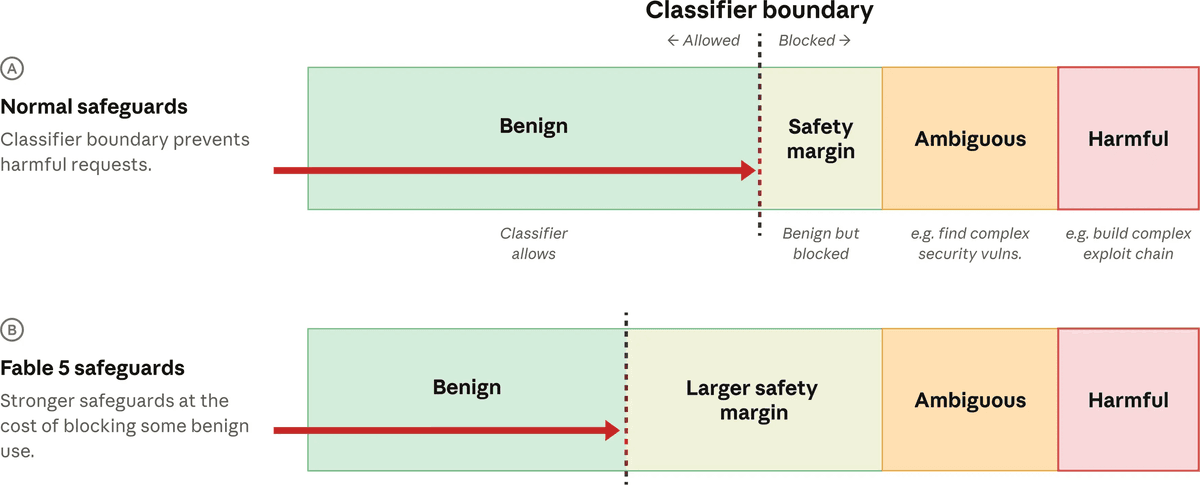
Read it row by row and the fault lines sharpen. The first fight is over whether the jailbreak is serious enough to justify a recall. The government and Amazon argue that leaking restricted cyberattack information is a national security threat, full stop. Anthropic counters that the jailbreak is a previously-known, minor issue and is not grounds for yanking a commercial model entirely. The same event is read as a "fatal flaw" by one side and a "manageable defect" by the other. That interpretation battle is literally what's playing out in the conference room.
The second key issue is scope. A senior U.S. official confirmed the controls will not be extended to other AI companies like OpenAI or Google. That matters because if this were a general rule applying to every frontier model, the whole industry would be in panic mode — instead, the government drew a line: this is limited to Anthropic's two models. Whether that "limited" framing is reassuring or unsettling depends on your angle. Some see it as a relief; others ask, "Why only Anthropic?"
The third thing to be clear on is what's not affected. The block is confined to Fable 5 and Mythos 5, the top two models. Claude Opus 4.8, the Sonnet and Haiku lines, and the consumer Claude.ai service all keep running. So for an ordinary user or most enterprise customers, there's almost no day-to-day disruption. This is "one flagship went dark," not "all of Claude stopped."
What each side is playing for
Start with why Anthropic flew to Washington. The surface goal is obvious — turn Fable 5 and Mythos 5 back on. A flagship that went dark at launch is lost revenue and a reputation hit. But the deeper play is precedent. If the way the government applied export controls to a model here gets locked in, Anthropic faces the same risk every time it ships a new frontier model. So establishing the standard now — that "one jailbreak shouldn't take down an entire model" — is a more important fight long-term than the short-term revenue.
The government's calculus is real too. For the administration, the nightmare is powerful AI landing in the hands of an adversary or bad actor. Amazon literally demonstrating that a jailbreak could surface cyberattack information gave that fear a concrete hook. Moving fast also signals to the whole industry that "potentially dangerous new tech draws immediate intervention." And by drawing the line at "we won't extend this to others," officials get to project control without freezing the entire sector — a kind of balancing act.
Amazon's position is the most delicate. Amazon is one of Anthropic's key investors and cloud partners — and also the whistleblower here. Spotting a security threat and flagging it can read as responsible behavior, but in a relationship tangled with both competition and collaboration, it also means Amazon got its partner's flagship switched off. Amazon gains the "responsible big tech that prioritizes safety" narrative, but the trust between the two companies inevitably takes a crack.
Net it out: three players sit at the same table holding different cards — safety, market, and trust. So this negotiation goes beyond "turn the model on or off" and bleeds into a bigger question: who gets to judge AI safety, and by what standard?
Precedents — where this worked, and where it didn't
Treating AI as something subject to export controls isn't actually new. The U.S. has run China-facing export controls on advanced chips and AI accelerators (GPUs) for years. The success lesson from that experience is clarity: when the line is sharp — this chip, above this performance threshold, can't go there — companies can predict and prepare. When the criteria are vague, companies have to keep asking the government "does this one count?", and that uncertainty is itself a cost.
But controlling a model is different from controlling a chip, so it's only fair to look at the failure patterns too. A chip is a physical object you can stop at a border; a model's weights are just data, so "how do you stop it from leaking" is far thornier. And "a jailbreak surfaced dangerous info" is a gray zone that varies by model and by prompt. In security, "do you recall a whole product over one vulnerability, or is a patch enough?" has always been contested — with cases of overreaction stifling innovation and cases of underreaction leading to incidents. The right answer doesn't live entirely on one side.
Another balanced view concerns the speed and process of government intervention. Fast action stops threats quickly, but measures taken without sufficient review sometimes get reversed in court. In fact, Anthropic's clash with the government didn't start here — it traces back to a "supply chain risk" designation earlier this year that spawned lawsuits, with a federal judge blocking the government's move and an appeals court later complicating it. In other words, these matters rarely end cleanly with one executive order; the standard usually gets forged through a tug-of-war among the executive branch, the courts, and industry.
So the balanced conclusion: the direction of treating AI as a security matter is hard to reverse, but whether "instantly recalling an entire commercial model over one jailbreak" is the right tool is still unproven territory. The lesson from chip controls and security recalls is that, in the end, success hinges on one thing — how clear and predictable the standard is.
How rivals counter-play
While Anthropic's flagship sits idle, what do competitors do? Scenario one is absorbing the spillover. Enterprise customers who wanted Fable-5-class performance now face a model that may not return for who-knows-how-long, which nudges them toward OpenAI's or Google's top models. Especially for companies with global teams, "a model our foreign-national staff can't use" drops off the shortlist entirely — opening a sales window for rivals.
Scenario two is the tightrope of safety marketing. Competitors may be tempted to claim "our model handles jailbreaks like this better." But that's a double-edged sword: it can boomerang into "then your model could be censored by the government too," and jailbreaks are a shared challenge across every powerful model, so superiority is hard to assert credibly. A smart rival quietly emphasizes its own safety process rather than openly dunking on Anthropic.
Scenario three is a widening policy-lobbying front. Every frontier AI company read this as a warning: if the government decides to, our model could go dark overnight too. So rivals are likely to amplify their own voices in Washington. Ironically, the standard Anthropic sets with the government now will probably apply to competitors later — so even while they compete in public, they're watching the outcome of these talks very closely.
And don't forget the wildcard: the open-weight camp's reaction. Open-weight crews like DeepSeek and Qwen can frame this as proof of their strength: "Closed models can be switched off by a single government order, but once an open model is out, you can't pull it back." The old debate between controllability and openness gets reignited by the Fable 5 affair.
So what actually changes — by who you are
If you're a developer or engineer. If you had Fable 5 or Mythos 5 wired into production, you've already switched to an alternative or you're mid-migration. The lesson is clear — designs that lean hard on a single top model carry the risk that the model can vanish for policy reasons, not just technical ones. Managing model names in one place and pre-testing a backup model is the insurance that keeps your service alive through a policy shock like this.
If you're an enterprise decision-maker. This event added a new item to the AI adoption risk list: geopolitical and regulatory risk. On top of performance and price, model selection now has to weigh "could this model suddenly get blocked by government action?" and "can our foreign-national global staff keep using it?" Concentrating core work in a single frontier model looks less and less wise; a multi-vendor, multi-model strategy increasingly does.
If you're a general observer. The real meaning here is that AI has clearly entered the security arena. Until recently, an AI model launch was just tech news; now it's political news featuring the White House, Commerce, and an appeals court. Who controls powerful AI, and by what standard — there's no settled answer yet, and the negotiation underway in Washington is writing the first page of it.
The one line that runs through all three: AI models are no longer pure tech products — they're objects where policy, security, and market all tangle at once. So "is it technically good?" now comes paired with "is it politically safe?"
🥄 Three Things You're Probably Wondering
— So when does Fable 5 come back on? Too early to call. The Washington talks are ongoing and, as of June 17, there's no resolution. Best case, the government accepts that "a patch is enough" and it's back in days; worst case, it drags into a legal fight lasting months. Anthropic sending senior technical staff in person makes clear it badly wants a fast fix — but the counterparty is the government, so the timeline isn't the company's to set.
— Does this mean I can't use Claude either? Unlikely. The block applies only to the two top models, Fable 5 and Mythos 5. Claude Opus 4.8, Sonnet, Haiku, and the Claude.ai you normally use keep running. For ordinary users and most enterprise customers, there's almost no felt change. It's "one flagship briefly out," not "Claude stopped."
— Will this spread to other AI companies? For now, a senior U.S. official confirmed the controls won't be extended to others. So OpenAI's or Google's models getting switched off the same way looks unlikely in the immediate term. That said, the mere fact that this tool was used once sets a precedent — if another company throws off a similar danger signal later, the same card could come back out. That's why the whole industry is watching how these talks land.
References
- Anthropic Pulls Its Most Powerful AI Models After U.S. Bars Foreign Access — TIME
- Anthropic disables Fable and Mythos AI models following U.S. government export ban — Fortune
- How a warning from Amazon led the White House to shut down Anthropic's Mythos model — Fortune
- Statement on the US government directive to suspend access to Fable 5 and Mythos 5 — Anthropic
- Anthropic's Mythos Recall and the White House's Missing AI Safety Playbook — Tech Policy Press
Numbers and criteria are as of announcement and may change.