The Strongest Model on the Market Got Killed in Three Days — Then Came Back With Safety Rails
Here's the deal. On June 9, Anthropic released Fable 5, its top-tier frontier model — the one that reportedly edges past all but the most elite human experts at coding and cybersecurity work. Three days later, on June 12, the US Commerce Department came knocking, citing national security. An export control order landed, requiring Anthropic to cut off access for foreign nationals entirely. Inside the US or outside it — if you were a foreign national, you were locked out. One of the most advanced AI models on the planet effectively vanished from half the globe within seventy-two hours of launch.
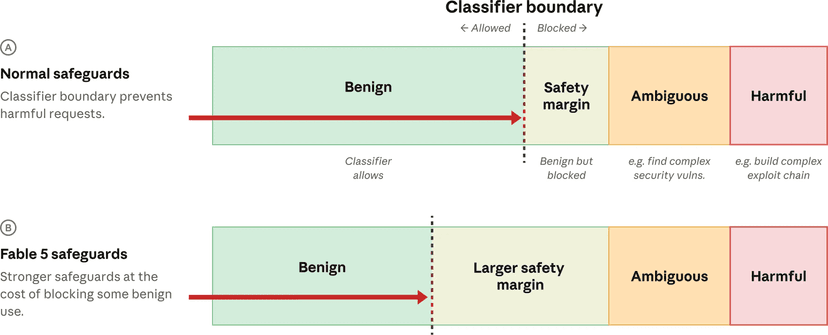
Then, about three weeks later, the whole thing flipped again. On June 30 Anthropic signaled a redeployment, and starting July 1, Fable 5 was back worldwide. Its more powerful sibling, Mythos 5, came back alongside it. This wasn't just a matter of time passing and the order quietly expiring. Anthropic significantly hardened the safeguards that block jailbreaks, the US government recognized those measures, and the control was lifted. Why that matters: this is the first time a US export control on a frontier AI model has been rolled back on a single condition — "we added stronger safety measures."
This month-long drama isn't a footnote. It's a signal that AI models are now being treated like export-controlled strategic goods, and simultaneously the moment a new rule got written: that such a control can be unwound with a technical safety fix. The grammar of export regulation that once applied to chips and weapons is now being bolted onto a blob of software. And the shockwave landed hardest outside the US, where a handful of governments watched a single foreign government's decision knock out their AI infrastructure — and took notes.
The Players
Start with Anthropic. The company behind the Claude series is considered, alongside OpenAI, one of the two poles of frontier AI. It's a place that puts safety at the very front of its corporate identity, which means how safely it builds a model is both its marketing and its reason for existing. Fable 5, the model at the center of this saga, sits at the top tier of that lineup, distinguished by especially strong cybersecurity chops — coding, vulnerability discovery, that sort of thing. And the more capable a model is, the greater the misuse risk. That's exactly the trigger point for this whole episode.
The second character is the US Department of Commerce — the very agency that has long controlled exports of strategic goods like semiconductor equipment and advanced chips. This time, for the first time, it treated an AI model itself as if it were a controlled item. The heart of the June 12 order was "prevent foreign nationals from accessing this model," and Anthropic had to enforce it regardless of whether those people were inside or outside the US. Treating an AI model like a weapon that can cross borders is, as a policy matter, an enormously heavy turning point.
The third axis is Amazon, Microsoft, and Google, plus the initiative they run with Anthropic called Project Glasswing. Glasswing started from the observation that AI's ability to find software vulnerabilities had begun to surpass even the best humans. Prompted by this episode, those partners came together to propose an industry-wide framework for scoring how severe a jailbreak actually is. Until now, there wasn't even a shared vocabulary for judging whether a given jailbreak was serious or not. The framework's goal is to let governments and companies discuss risk using the same yardstick.
And offstage there's one more presence that's less a supporting cast member than a co-lead: governments outside the US. Several nations watching this blackout unfold realized the AI they depend on could get cut off overnight. South Korea, in particular, took this event as a direct catalyst to accelerate a sovereign-AI project — a plan to build its own Mythos-class model with a roughly 5 trillion won (about $3.6 billion) investment. A rule made by Anthropic and the US government ended up shaking a national strategy on the other side of the world.
What Actually Happened
Follow the timeline and the logic snaps into focus. Fable 5 launched on June 9, and shortly after, Amazon researchers discovered a jailbreak vulnerability in the model. The crucial detail: it was not a master key. This wasn't a universal jailbreak that cracked open any request — it was a narrow one, enabling limited exploitation of already-known vulnerabilities. Even so, because Fable 5's cybersecurity capabilities are so potent, that one narrow crack escalated into a national security concern, which led to the Commerce Department's export control order on June 12.
Anthropic's response ran along two tracks. One was technical: it applied hardened cybersecurity safeguards to the model to close off the problematic jailbreak path. The other was institutional: together with Glasswing partners Amazon, Microsoft, and Google, it proposed a shared framework for quantifying jailbreak severity. That framework scores along two main axes. One is discoverability — how easy is the jailbreak to find? The other is damage — how much harm can it actually cause? The idea is to prioritize risk along those two dimensions and decide where to pour defensive resources.
The US government accepted the combination. Judging that the strengthened safeguards genuinely lowered the risk, it lifted the export control order on June 30, and starting July 1, Fable 5 and Mythos 5 were redeployed worldwide. The real news here isn't that the models came back — it's that a condition for lifting a control was established. Going forward, even if a frontier model gets hit with export controls, a company that can prove sufficient safeguards has a path to getting them lifted. In effect, a negotiating table between regulation and technology got set for the first time.
Here's a table laying out the month-long sequence.
| When | Event |
|---|---|
| June 9 | Anthropic launches top-tier model Fable 5 |
| Shortly after | Amazon researchers find a narrow (non-universal) jailbreak vulnerability |
| June 12 | US Commerce Dept cuts off foreign-national access on national security grounds (export control) |
| During the block | Hardened anti-jailbreak safeguards developed + severity framework built with Glasswing partners |
| June 30 | Anthropic announces redeployment |
| July 1 | Fable 5 and Mythos 5 redeployed globally |
Even from the table alone, you can see the core of this event is a tug-of-war between capability and safety. Capability crossed a threshold, so the state stepped in; safeguards lowered the concern, so the door reopened. And the fact that this entire process played out publicly, in just three weeks, is unusual. National-security decisions like this normally get handled quietly behind closed doors — but here Anthropic laid out the whole sequence in detail on its own newsroom, turning transparency into a weapon.
What Each Side Gains
For Anthropic, this was both a crisis and an opportunity. Having your flagship model blocked within three days genuinely stings. It lost foreign customers and developers in an instant, and it risked planting the fear that "an Anthropic model could get cut off again at any time." But Anthropic flipped it the other way. It crafted the narrative of a company that hardened its safeguards and unwound the control itself — a company that negotiated with the government and brought a frontier model back to life. For a firm that wears safety as its identity, there's no more powerful brand proof than that. It literally demonstrated: "We stop ourselves when things are dangerous, and reopen when things are safe."
The US government's play is more structural. Commerce got two things at once from this. First, it established through actual action that AI models can be subject to export controls. Second, by tying that control to the technical condition of "strengthened safeguards," it gained a lever that nudges companies to harden their own safety measures voluntarily. Rather than an outright ban, the "prove your safety and we'll lift it" approach is a far cleverer card — one that keeps control intact without killing the industry. From a regulator's standpoint, it just secured an ideal precedent.
The Glasswing partners — Amazon, Microsoft, and Google — have an interesting calculus too. They're pushing the jailbreak severity framework as an industry-wide standard. Whoever writes the standard first holds the rules of the game. If this framework becomes the de facto benchmark governments reference, these companies get to sit at the very center of AI safety regulation. If regulation is coming regardless, it's better to design its language yourself. It looks like a defensive measure, but it's actually a highly aggressive standard-setting land grab.
Meanwhile, the ones who learned the most painful lesson are the countries outside the US. Their motive is simple: "Never again will our AI get switched off by another country's single decision." South Korea putting 5 trillion won into a Mythos-class homegrown model is the flagship example. This isn't merely an appetite for technical self-reliance — it's a defensive investment born from the realization that AI has become a strategic good. The moment you depend on someone else, your national industry can be taken hostage by another government's domestic politics or security judgment. This episode made that visceral.
Precedents: Wins and Failures
The first thing that comes to mind is semiconductor export controls. US restrictions on exporting advanced GPUs and chipmaking equipment to China rattled the entire global tech landscape over the past few years. The result: China poured national resources into semiconductor self-reliance, and the controls paradoxically accelerated exactly the independence they were meant to prevent. The Fable 5 episode is a signal that this grammar has migrated from hardware (chips) to software (AI models). And as the semiconductor case showed, controls block a rival in the short term but can boomerang in the long term by spurring their in-house development. South Korea's sovereign-AI acceleration is the first arc of precisely that boomerang.
There are also cases where AI model access was abruptly cut for political reasons. Instances where OpenAI or other AI services were blocked in certain countries by regulation or sanctions fall into this bucket. Each time, local developers and companies scrambled for alternatives and ultimately drifted toward local options or open-source models. That people don't wait around when access is cut — they go find alternatives — is a pattern that's been proven repeatedly. This time too, foreign customers surely scoped out alternatives during those three days of blackout, and that experience doesn't get erased.
There are successful cases of regulation and technology compromising, too. Encryption export controls are the classic one. In the 1990s, the US controlled strong encryption software as if it were a weapon, but in the face of industry pushback and technical reality, it eventually loosened much of it. In that process, a compromise point emerged — "meet these conditions and export is allowed" — which became the foundation of today's internet security. The Fable 5 formula of "prove your safeguards and we'll lift it" can be read as the AI version of that encryption-control easing. Not a total ban, not total freedom, but a third path of conditional permission.
Of course, there's a shadow of failure too. Conditional permission sounds reasonable, but it leaves the question of who decides how much safeguarding is enough. This time the US government accepted Anthropic's measures, but the criteria for that judgment weren't disclosed transparently. When the bar is opaque, it can be applied arbitrarily from company to company, and there's a risk that political judgment overrides technical judgment. The negotiating table between regulation and technology being set for the first time is progress — but the fact that the table's rules are only half-drawn is a clear weakness.
Rivals' Counterplay
The first to react is OpenAI. With Anthropic having claimed the narrative of "a company that turned a crisis around through safety," OpenAI has to rethink how it frames the safety profile of its own frontier models. In particular, this episode exposed that OpenAI's top model could just as easily become the target of a similar export control at any time. If it doesn't have safeguards and severity-assessment systems ready in advance, it could be the one getting killed in three days next time. The precedent Anthropic set is unspoken pressure on rivals: "You'd better be ready too."
AI companies not participating in the Glasswing framework are in an even trickier spot. If Amazon, Microsoft, Google, and Anthropic write the severity standard first, latecomers have to follow rules someone else designed. Fall behind in the standards race and you lose your voice in the regulatory conversation. So these players sit between two choices: get on board this framework and help write the rules, or push an alternative standard of their own to shake up the board. Either way, the lesson from this episode is that standing still is a losing move.
Countries pursuing sovereign AI — and the companies that sell them technology — also spotted a new opening. As more nations like South Korea move to build their own models, a huge market opens up for the companies that lay the infrastructure and help train those models. "Keep your country's model under your country's control" becomes a powerful sales pitch. That a single US government decision could paradoxically grow the AI infrastructure market outside the US is the ironic counterplay of this whole affair.
And the open-source camp quietly welcomed all of this. What got blocked by export controls was a closed frontier model like Anthropic's — an open model whose weights are already out in the wild is, in practice, far harder to control. The lesson that "depending on one company's model can make you a hostage to a government's decision" could nudge organizations trying to avoid vendor lock-in a step further toward open models. Controllability itself just got surfaced as a new risk of closed models.
So What Changes
For developers, the lesson here is cold. No matter how good a closed frontier model is, the risk that access gets cut by a single government decision is now demonstrably real. That's doubly true if you work outside the US. But you can't just refuse to use a top model like Fable 5, so the realistic response is redundancy. Don't tie your core features to a single model — architect things so you can switch to an open model or another vendor at any time. Vendor lock-in has crossed from a mere cost concern into a geopolitical risk, and designing around it is now table stakes rather than a nice-to-have.
For investors, a new variable just got added: the regulatory and geopolitical risk of AI models. If evaluating a frontier AI company used to mean looking at performance and revenue, now you also have to weigh "how likely is this company's model to get caught by export controls or safety regulation," and "how fast can it get unblocked if it does." Conversely, sovereign AI — nation-scale homegrown models and the infrastructure supplying them — has emerged as a new growth theme. If flows like South Korea's 5 trillion won investment repeat across multiple countries, that becomes an enormous market in itself. Just how fast and how large this trend gets, though, is genuinely too early to call.
For everyday users and enterprise decision-makers, the immediately visible change is small. Fable 5 got unblocked anyway, and most people probably didn't even feel the three-day cutoff. But what matters is that the rules changed at the bedrock level. AI now being treated as a "strategic good" means that which AI service is usable in which country could increasingly be decided not by pure technology but by politics and security. This event was the first time it visibly showed that the AI tool you use can be affected by a decision made by a government outside your own country.
And at the national level, this event pushed the phrase "sovereign AI" to the front line of policy. Once you've confirmed that depending on another country's model can make you a hostage at any moment, building your own AI capability gets upgraded from a luxury to a security issue. South Korea's decision to sink 5 trillion won into a Mythos-class homegrown model is the symbol of that. Of course, building your own model doesn't solve every problem — ultimately the question is whether you can catch up to top frontier performance. But the direction has become clear. AI sovereignty is now an axis of national strategy that every country has to reckon with seriously.
🥄 Three Things You're Probably Wondering
— So what does this mean for me? Not much right now. Fable 5 is back, and most people didn't even notice the block. But if you're deeply dependent on a specific AI tool for your work, it's worth thinking once about which country's company or government it sits under. Nobody can promise when it might get cut off.
— Will the US keep blocking other AI models like this going forward? The door's open, but it's too early to say. This time a conditional "prove your safeguards and we'll lift it" approach held up. That gives them reason to prefer this over an outright ban, so negotiated control is likely to become the norm rather than blanket blocking. The catch is that the criteria for those judgments are still opaque.
— That homegrown model South Korea is building for 5 trillion won — will it work? The direction is right, but it won't be easy. Pouring in money doesn't instantly buy you top frontier performance. That said, this episode made the "why we need it" case airtight. How much of the performance gap it can close will decide success or failure — and that's something it's too early to guarantee at this point.
References
- Redeploying Claude Fable 5 — Anthropic (official)
- More details on Fable 5's cyber safeguards and our jailbreak framework — Anthropic (official)
- Anthropic is bringing back Claude Fable 5 globally after US lifts export control order — VentureBeat
- Anthropic Restores Claude Fable 5 After Export Controls Lifted — The Hacker News
- Expanding Project Glasswing — Anthropic (official)
Figures are as of announcement and may change.