A telecom just started recruiting "20 AI startups"
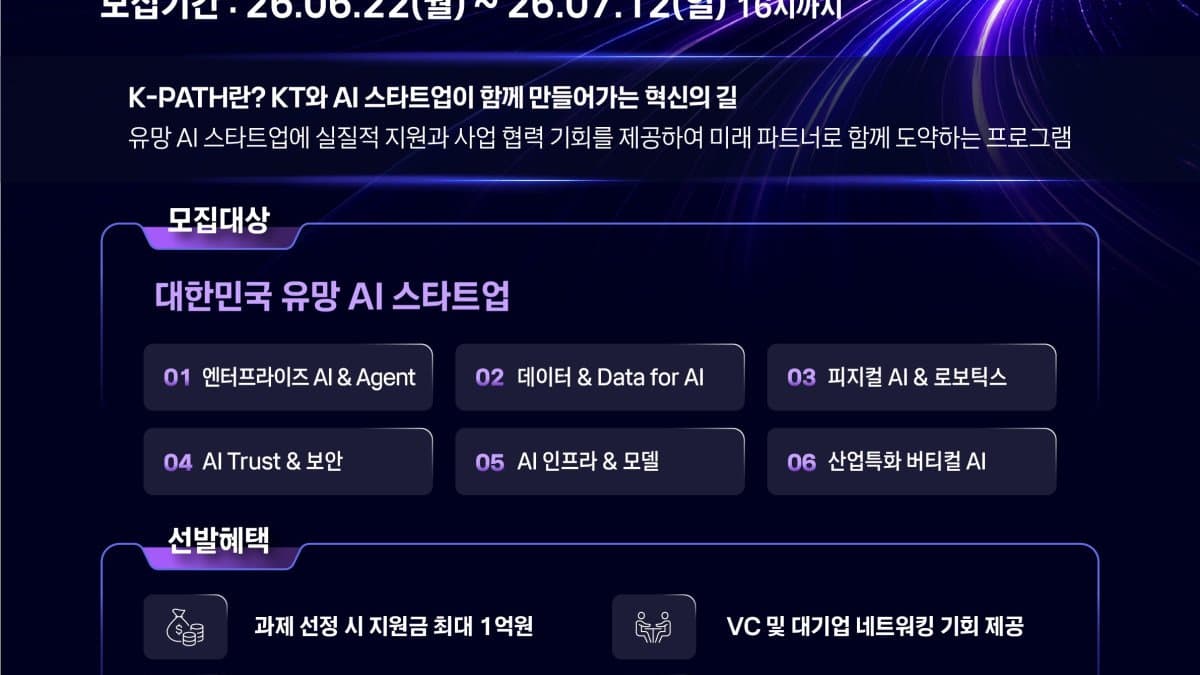
KT opened its open-innovation program "K-PATH 2026," a call to discover AI startups and grow businesses together. The core: pick 20 AI startups, attach KT's resources and customer base, and co-build AX (AI transformation) businesses. The deadline is July 12. It's the classic big-corp-plus-startup alliance — startups with good tech, paired with a large company that can deploy it in the field.
Why is this news? Because it shows a telecom trying to become the hub of the AI ecosystem. Telcos hold massive infrastructure — networks, data centers, nationwide customer reach — but startups build fast-moving AI tech better. KT wants to lay the "table" connecting the two, becoming not just a telecom in the AI era but a "channel for AI business." Let's unpack the structure and who it's an opportunity for.
Who and what — KT, K-PATH, and AX
KT is a large Korean telecom that has, in recent years, branded itself an "AICT (AI+ICT) company," shifting weight toward AI, cloud, and data centers. With telecom revenue growth stalled, AI is both a new engine and a survival strategy. K-PATH is an attempt to accelerate that strategy "with startups" rather than alone.
K-PATH 2026 is the vessel for that collaboration. Not a one-off investment or grant, it's an open-innovation program that connects selected startups to KT's infrastructure, tech, and customer touchpoints, carrying them through to actual commercialization. The scale of 20 companies leans toward "widening the ecosystem" over "elite incubation."
AX (AI transformation) is the destination of it all. AX means changing how companies and industries work using AI. KT's customers span finance, public sector, manufacturing, and retail — and when they want to "change how they work with AI," KT brings startup tech to solve it. For startups it's a bridge to giant customers; for KT, a deck of diverse AI solution cards.
What's in it — the structure of the call
The core is a "discover → connect → commercialize" structure.
| Item | Detail |
|---|---|
| Program | K-PATH 2026 (open-innovation call) |
| Host | KT |
| Selection | 20 AI startups |
| Goal | Co-drive AX (AI transformation) business |
| Deadline | July 12, 2026 |
The key message: KT won't build everything itself. AI tech branches and advances so fast that no single company excels at all of it. Instead, gather 20 strong startups across domains, tie them to KT's business and customers, and KT gains broad AI capability at once while startups gain a big stage instantly. It's "assemble an ecosystem" over "build it all in-house."
Who wins — why this alliance now
KT gains speed and breadth. Internalizing every AI solution costs enormous time and money. Bolting on proven startup tech quickly multiplies the AI cards KT can pitch customers. For trust-sensitive clients like finance and public sector, "a startup KT has vetted and partners with" is reassuring.
Startups gain giant customer access and trust. Even with great AI tech, breaking into large-corporate and public-sector customers directly is brutally hard — the walls of sales, trust, and references are high. Riding KT's vast channel clears those walls at once, and using KT's cloud and data centers eases cost and reliability burdens.
Korea's AI ecosystem gains connection density. Startups with tech but no market, big corps with market but weak tech — the more "tables" connecting them, the faster the whole ecosystem turns. More programs like K-PATH can lift the survival rate and growth speed of Korean AI startups.
Past parallels — wins and losses
Big-corp-led open innovation is a common Korean model with a split record. When it works, a big company's customers and infrastructure meet startup tech and become real revenue and joint products — startups build references toward the next round and customers, big corps get differentiated solutions. A win-win.
But failures abound. The most common trap is a "showcase program": flashy selection, no follow-through to real business or revenue, leaving startups having spent only time. Collaboration also stalls when a big company's slow decisions clash with startup speed. The key is "execution" after "discovery."
Watch too for contract structures unfavorable to startups, or tech lock-in. If partnership constrains a startup's independence and ability to win other customers, a short-term opportunity becomes a long-term shackle. Good open innovation must be "grow together," or only one side benefits.
Competitor counter-play
In the same Korean market, other telecoms like SK Telecom and LG Uplus are building similar AI alliances. All telcos share the "telecom stagnation → AI transformation" homework, and who embraces the startup ecosystem best is the differentiator. K-PATH is KT's move to become "the channel startups most want to work with."
Platform firms like Naver and Kakao, and conglomerates like Samsung and Hyundai, are also expanding startup partnerships and investments. More options is good for startups, but for KT it means fiercer competition to grab the best startups first, on better terms.
Long term, this is a fight over who holds the B2B channel of the AI era. Becoming the first partner a corporate customer thinks of when they say "we want to transform with AI" — telcos, platforms, and conglomerates all want that seat, and whoever weaves the startup ecosystem best gains the edge.
So what actually changes
If you run or are planning an AI startup, programs like K-PATH can be a shortcut to a giant customer base. But beyond selection itself, scrutinize whether it really leads to business and revenue, and whether the contract harms your independence. The deadline is July 12.
If you handle enterprise AX, a growing pool of telco/corporate-vetted startups means more AI solution options. Instead of hunting startups one by one, you can meet validated tech through such programs.
If you watch Korea's AI ecosystem, note telecoms positioning themselves as "AI hubs." The connection density between infrastructure-rich big corps and tech-rich startups shapes Korea's real AI competitiveness. K-PATH is one piece increasing that connection.
🥄 Three Things You're Probably Wondering
— Can my startup apply? If you have AI tech, it's worth a look. With a July 12 deadline, time is tight — having a one-sentence pitch for how your tech fits KT's customers (finance, public, manufacturing, retail) helps.
— Does selection mean funding? By nature this is open innovation weighted toward "business collaboration and infrastructure connection" over "investment." Whether funding is included and on what terms varies by program, so check the official notice. Too early to assume.
— Do these programs actually work? Case by case. If it leads to real revenue and joint products, it's a big springboard; if it's all discovery and weak execution, it can just burn time. The key is how genuinely KT connects you to real business after selection.
Sources
Details and timing are per the official notice and may change.