In an Era Where AI Splits Everyone, Why Do Both Parties Shake Hands on This One?
These days, the moment the word "AI" comes up in Washington, a fight starts almost by reflex. Regulate or not? Open-source models or lock them down? Let each state write its own rules, or have the feds preempt everything? Whichever way it breaks, the two parties land on opposite sides. Sometimes the splits happen inside a single party. So when someone says "AI bill," the default assumption has basically become: "Yeah, that's going nowhere."
And yet, quietly and honestly kind of surprisingly, there's one bill in that mess with Republicans and Democrats standing side by side on it. It's called the CREATE AI Act. Spelled out, that's the "Creating Resources for Every American to Experiment with AI Act." Nice name, right? It's not about clobbering anyone with regulation. It's about building the stage so people can actually do research.
The core idea is exactly one thing. It would take NAIRR — the National AI Research Resource — and permanently, legally establish it inside the National Science Foundation (NSF). Right now NAIRR runs as a temporary pilot. This bill wants to pull it out of that precarious spot, where it can be shaken loose every time an administration changes, and bolt it down in law. That's pretty much the whole bill.
Fortune summed it up in a line that lands perfectly. NAIRR, they wrote, "doesn't pick winners, doesn't burden industry and already has a proven track record." Why do those three things matter so much? Because those are exactly the three spots where AI bills have kept tripping and falling. The criticism that a bill favors specific companies. The pushback that it dumps compliance costs on business. And the doubt of "does this actually work?" This bill sidesteps all three at once.
So in this piece we'll walk through what the bill actually does, who's pushing it, who benefits, how similar government-infrastructure bets have played out historically, and what it means inside the reality of Big Tech's compute dominance. Small spoiler up front: this is less a story about who controls AI, and more a story about who gets to touch it.
The Cast — Bipartisan Lawmakers, the NSF, and University and Nonprofit Researchers
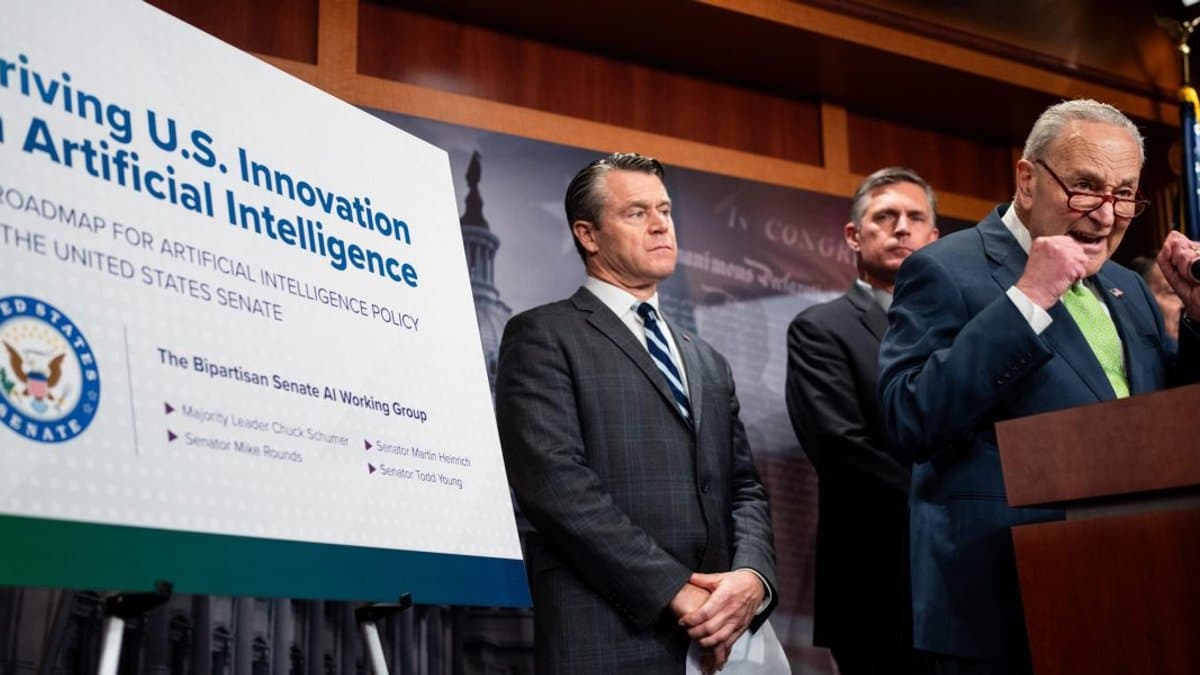
Let's start with the people pushing this. In the Senate, the bill was reintroduced on April 29, 2026, and the four lawmakers leading it are visibly balanced. Democrat Martin Heinrich (New Mexico), Republican Todd Young (Indiana), Republican Mike Rounds (South Dakota), and Democrat Cory Booker (New Jersey). Two Democrats, two Republicans. That's not a coincidence, it's a deliberate lineup. The name arrangement alone sends the message: this isn't a partisan fight.
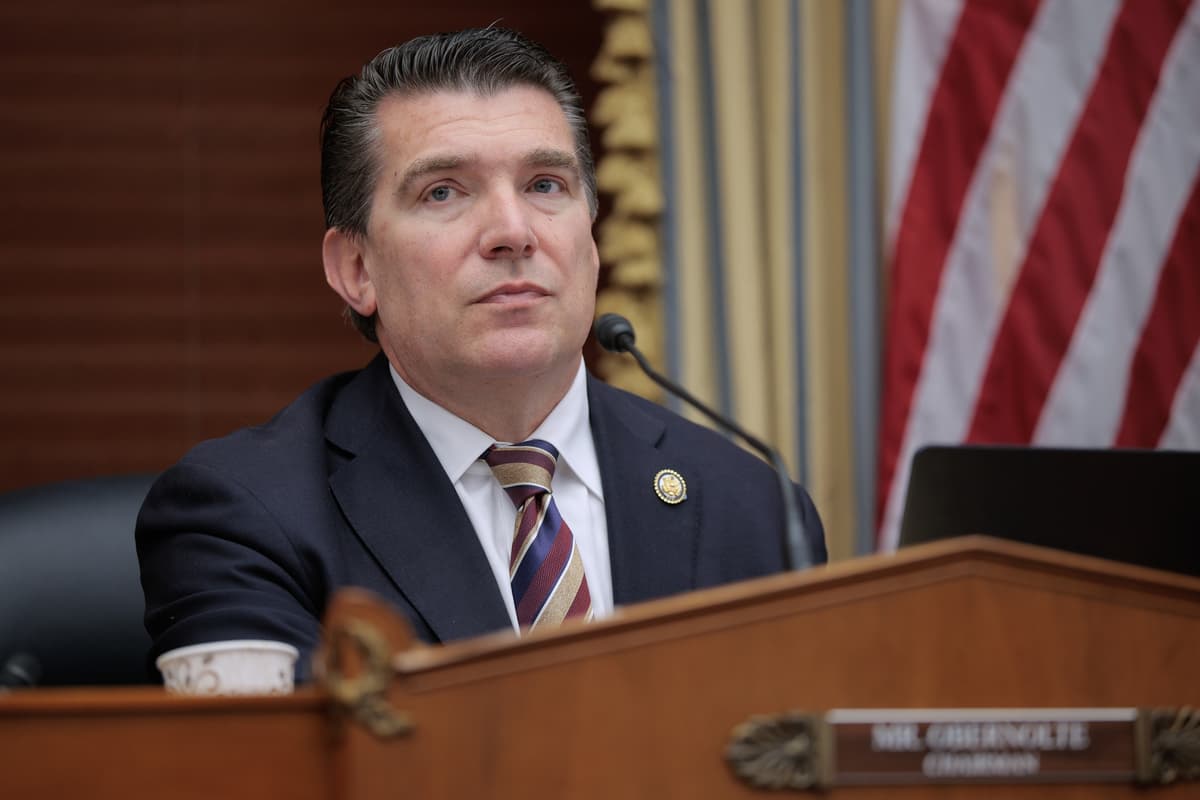
The House side is the same story. The companion bill was already introduced back in 2025 by Republican Jay Obernolte (California) and Democrat Don Beyer (Virginia). Obernolte is well known as one of the few members of the House with a computer science degree, and Beyer has long been engaged in tech policy. So this bill isn't something whipped up by people who don't understand AI and got caught up in the moment. It's the product of lawmakers on both sides who actually know the tech, working in sync.
The next lead character is the NSF, the National Science Foundation. It's the flagship federal agency that funds basic scientific research in the US. From the early infrastructure of the internet to countless university labs, it has long bankrolled the kind of work that "doesn't pay off right away but builds the country's foundational fitness." The CREATE AI Act would establish NAIRR inside this very NSF, specifically under its Office of Advanced Cyberinfrastructure. That's the division that handles computing infrastructure, so the placement fits perfectly.
And the real beneficiaries are somewhere else entirely: graduate students, university researchers, and people at nonprofit research institutions. Plenty of them have the ideas and the skills, but no money to run thousands of GPUs, so they simply can't do frontier AI research. Big Tech labs summon enormous compute with a single click, while a grad student at a rural state university is left staring at the menu. NAIRR is essentially a shared warehouse built to close exactly that gap.
There's one more character worth flagging: NIST, the National Institute of Standards and Technology. Among the resources NAIRR provides is an AI testbed, and it's designed to run as a collaborative project with NIST. In other words, "the place that hands out research resources" gets wired to "the place that builds the standards for evaluating and validating AI." So this isn't just about lending compute — it's a design that keeps the whole ecosystem for safe, trustworthy AI in mind.
What the Bill Actually Does
Okay, let's get concrete about what the bill does. The most important part is that it turns NAIRR from temporary into permanent. Right now NAIRR is running as a pilot that the NSF launched in 2024, based on a Biden-administration executive order. The problem with an executive order is that it appears with one presidential signature and vanishes with another. And in fact, President Trump rescinded that executive order. The pilot itself is thankfully still running, but without a solid legal foundation it can be shaken loose at any time. The CREATE AI Act wants to fix that in statute, making it a fixture that "doesn't disappear when administrations change."
The operating model is interesting too. NAIRR wouldn't be run entirely by the NSF directly. Instead, the bill is designed so that a competitively selected non-governmental entity handles the actual operations. The government sets up the stage and takes care of funding and oversight, while the day-to-day is run by experts on the private and nonprofit side. It blends the stability of government with the flexibility of the private sector.
So you're probably wondering what NAIRR actually hands researchers. It's four bundles. Here it is as a table.
| What NAIRR Provides | What That Means Concretely |
|---|---|
| Computing resources | Open-source software environments + structured API access to AI models |
| Data | Curated datasets of interest + an AI Data Commons (shared data repository) |
| Education & support | Educational tools, technical training, user support |
| AI testbeds | Open testbed catalog + collaborative projects with NIST |
Dig into why these four got bundled this way, and the design turns out to be pretty tight. First, computing resources aren't just "here's some GPU time." They come with open-source software environments already set up. The point is to stop researchers from burning time building environments from scratch and let them jump straight into experiments. On top of that, structured API access to AI models means that even without the horsepower to train frontier models yourself, you can put the latest models to work in your research.
Second, data. In AI research, good data is as precious as compute. Providing curated datasets and an "AI Data Commons" shared repository means researchers spend less time on the grind of scraping and cleaning data from scratch every single time. Third, education and support aren't a "here are the resources, figure it out yourself" deal — they bolt on training and user support to actually grow the pool of people who know how to wield these resources. Fourth, the testbeds connect to that NIST collaboration mentioned earlier, giving researchers a place to validate the AI they build.
And there's been meaningful procedural progress too. The House Science, Space, and Technology Committee advanced a bipartisan AI package that includes this bill. Clearing committee is the gateway to the floor, so it's a signal that this is bipartisan in practice — actually moving through the process — not just in rhetoric.
What's in It for Everyone — Who's Smiling
For a single bill to satisfy both parties like this, each camp has to be able to find something it wants in it. Remarkably, the CREATE AI Act manages that. Look at it from the Republican side. This bill doesn't create new regulation — it lays down research infrastructure. It doesn't burden companies with "don't do this, report that." If anything, it's about building the nation's foundational fitness so the US doesn't fall behind China in the AI race. That fits the "America first" and "spur innovation" frames perfectly. Even regulation skeptics have little grounds to object.
The Democratic side likes it too. Keeping AI research from concentrating in a handful of Big Tech firms and elite private universities, and opening the door to frontier work for underserved regions and smaller institutions, lines up precisely with equity and access concerns. "Don't let the benefits of AI be monopolized by the few" is a message progressives have pushed for a long time. So both sides can back the same bill for different reasons.
The NSF smiles as well. If NAIRR gets locked into law, the NSF firmly cements its role in the AI era. Budget and authority follow, along with the standing of being the central hub of the US AI research ecosystem. From an agency's perspective, it doesn't get better than that. The non-governmental entities that would run it feel the same — the competitive-selection model opens up a major new role for large research consortia and nonprofits.
And the ones truly beaming are the researchers. Especially the people who couldn't act on their ideas for lack of compute and data. The key evidence: the NAIRR pilot already supports more than 600 advanced AI research projects across all 50 states. That means this isn't a "we'll see if it works" experiment — it's a stage that's already running and producing results. Codification is just the act of bolting that stage down so it doesn't collapse.
Big Tech, of course, sits in a more ambiguous spot. On the surface they have no reason to oppose it. If their model APIs get used in public compute, there's a marketing upside and a wider channel for collaboration with academia. But peek under the hood, and the old arrangement — "if you want to do AI research, you come to us" — loosens a little. So it's not pure good news for them. We'll dig into that subtle tension a bit more later.
Past Parallels — Successes and Failures
Does government actually get results by funding research infrastructure? This isn't a new experiment. History already has answers. The most famous success is the internet itself. The roots of the internet we use today are the US Defense Department's ARPANET and, extending it into academia, the NSF's NSFNET. Long before private companies looked at it and thought "there's money here," the government laid the basic infrastructure and connected universities and labs. On top of that, the web was born, search engines were born, and all of today's Big Tech grew up. A textbook success story: government builds the stage, and the private sector blooms on it.
Another is the Human Genome Project. When the US government led the charge in the 1990s to decode the entire human genome, plenty of skeptics asked "what are you even going to do with that money?" But in the end, the data and techniques the project generated became the foundation of the entire biotech and pharma industry. The pattern is identical here. When government builds "a base that isn't commercial today but everyone will use," the private sector creates enormous value on top of it. This picture is exactly what NAIRR is aiming for: government laying down the shared foundation for the AI era.
But we can't forget the counterexamples. There are science-infrastructure projects that collapsed entirely when their funding got cut. A prime one is the Superconducting Super Collider. The US started building a giant particle accelerator in Texas in the late 1980s, but as the budget kept ballooning, Congress killed the funding in 1993. The project was scrapped wholesale after tens of kilometers of tunnel had already been dug. Many argue the result was that the frontier of particle physics passed to Europe (CERN, which later discovered the Higgs boson).
Why does that failure matter here? Because it's exactly what the CREATE AI Act is trying to prevent. If NAIRR keeps running temporarily on the back of an executive order like it does now, then when an administration changes or a budget fight erupts, it could vanish in a moment like the Super Collider. And there's already a precedent — Trump rescinded the underlying executive order. Bolting it into statute is a safety mechanism to escape the fate of "a project that collapses the instant funding is cut."
So the lesson of history is clear. When government lays basic infrastructure, the private sector grows explosively on top of it (the internet, the genome). But when that infrastructure gets jerked around by politics and budgets and cut off midway, you can lose the lead entirely (the Super Collider). Permanently codifying NAIRR is a pretty commonsense bet: repeat the earlier successes while dodging the later failure.
The Competitor Counter-Play
Now it's time to look at the board more coldly. Right now, AI compute is effectively held by a small number of Big Tech firms. Training a frontier model demands tens of thousands of GPUs, staggering amounts of electricity, and the data centers to run it — and the places that can shoulder that are countable on one hand. As a result, the equation "AI research = access to Big Tech's resources" has hardened. No matter how brilliant a university's idea is, to actually experiment they end up paying cloud fees or signing a collaboration deal with Big Tech.
NAIRR is an attempt to crack that arrangement head-on. If the public sector secures compute and data and distributes them to researchers, a path opens to do frontier work without going through Big Tech. Sure, by sheer scale NAIRR can't catch up to Big Tech's compute volume anytime soon. But the important thing is that "one more option exists." In a monopoly, just having one more door open changes bargaining power and research freedom.
Here's the fun paradox. It's hard for Big Tech to openly oppose NAIRR. Publicly saying "don't build public AI research resources" invites the backlash of "so you want to monopolize AI for yourselves?" The smarter counter-play is actually to provide their model APIs to NAIRR while claiming the mantle of "we support public research." So Big Tech is more likely to move toward pulling this bill into its own ecosystem than to block it head-on.
Another thing you can't miss is the relationship with state-level AI regulation. Because the US has no unified federal AI regulation right now, states like California and Colorado are each writing their own AI rules. From a company's perspective, different rules in every state are a headache, so there are loud calls for "the feds to unify this," and, conversely, pushback that "the feds shouldn't preempt all state regulation." This is one of the hottest battlefields in AI politics today.
What's clever about the CREATE AI Act is that it simply doesn't step on that regulatory minefield. This bill is about "what should we support," not "what should we ban," so it doesn't collide head-on with the state-versus-federal regulatory power struggle. The muddier the regulation fight gets, the more attractive this bill's "support, not regulation" position looks by comparison. Dodging the fight is, in effect, this bill's greatest weapon.
So What Actually Changes
Now for the thing you really want to know — "so what changes for me?" — broken down by persona.
If you're a grad student or researcher, this is the most direct. Until now, frontier AI research has effectively been the preserve of "labs with money." If you've ever shelved an idea because you had no GPUs, no data, or the environment setup was overwhelming, NAIRR is a breath of air. You get compute with open-source software environments already set up, curated datasets, plus training and support. The fact that 600+ projects across 50 states are already running this way means you can join frontier research even if your university isn't in the Ivy League.
If you're an AI startup, the shading is a bit different. NAIRR is fundamentally for academic and nonprofit research, not built for you to run commercial services directly on it. But the indirect effects are big. As talent trained through NAIRR pours out, and public datasets and open testbeds accumulate, the ecosystem a startup can draw on gets thicker. The technical base you can build on without relying solely on Big Tech widens.
If you're Big Tech, as noted, it's mixed feelings. In the short term, your model APIs get used in public infrastructure, letting you bank both presence and goodwill. In the long term, the monopolistic position of "if you want to do AI research, come to us" gets diluted bit by bit. Still, opposing it outright is a weak look, so you'll likely end up cooperating on the surface while keeping influence inside the ecosystem.
If you're an ordinary taxpayer, this matters because it's ultimately about how tax money gets spent. The core logic is this: if AI research concentrates in a few companies, so do its benefits. But if the public sector lays down research resources, research erupts across diverse regions and diverse fields (healthcare, climate, agriculture, and more), and the payoff eventually spreads to society as a whole — just as the internet and the genome did. Of course, tax money going in means oversight of "does it really work?" is warranted, but supporters argue that as a project with an existing track record, this isn't money down a hole.
To boil it into one sentence: the CREATE AI Act is a bill that opens the door to "who gets to touch AI," and the wider that door opens, the wider the circle of people who benefit. The catch is that keeping that door open requires the deadbolt of codification — that's the bill's central claim.
Three Things You're Probably Wondering
Bipartisan support is this solid, so is passage basically a done deal?
Sadly, you can't call it that. The US Congress has a ton of bills that both parties like but that just fall asleep, squeezed out by fights over time and priorities. The CREATE AI Act isn't even a first-time introduction — it's a bill that's come back around several times. Clearing committee is clearly big progress, but the gates of a floor vote and House-Senate reconciliation still lie ahead. Bipartisan is a necessary condition for passage, not a sufficient one.
Big Tech runs tens of thousands of GPUs — can frontier research really happen on public compute handouts?
By scale alone, it's true NAIRR can't keep up with Big Tech. Training the latest frontier models from scratch is still Big Tech's domain. But NAIRR's point isn't "let's beat Big Tech," it's "let's make research possible without Big Tech." Accessing existing models via API, fine-tuning them for specific fields, analyzing data — that kind of research runs just fine on this level of resources. And 600+ projects are already producing results exactly that way. Not all research is frontier-model pretraining.
Trump rescinded the underlying executive order — so is this really going to pass under this administration?
This is the key point. The executive order was rescinded, but the pilot itself is still running, and above all, Republican lawmakers are co-sponsors on this bill — that matters. The administration's stance and individual members' judgment are separate things. In particular, because this bill is packaged as "boosting US competitiveness" rather than "regulation," even Republicans have weak grounds to object. That's why the codification effort is alive despite the executive-order rescission. Though, to be honest, we have to admit the final outcome is still open.
Sources
- One rare bipartisan AI bill is moving through Congress — Fortune
- H.R.2385 — CREATE AI Act of 2025 — Congress.gov
- US Senate Reintroduces Bipartisan CREATE AI Act to Codify NAIRR — AIwire
- Heinrich, Young, Rounds, Booker Reintroduce Bipartisan Legislation — Sen. Heinrich
- National Artificial Intelligence Research Resource (NAIRR) Pilot — NSF
- National AI Research Resource — NSF Program Page
Numbers and criteria are as of announcement and may change.