A Cloud Company Suddenly Started Acting Like a Consulting Firm — With $1B on the Line
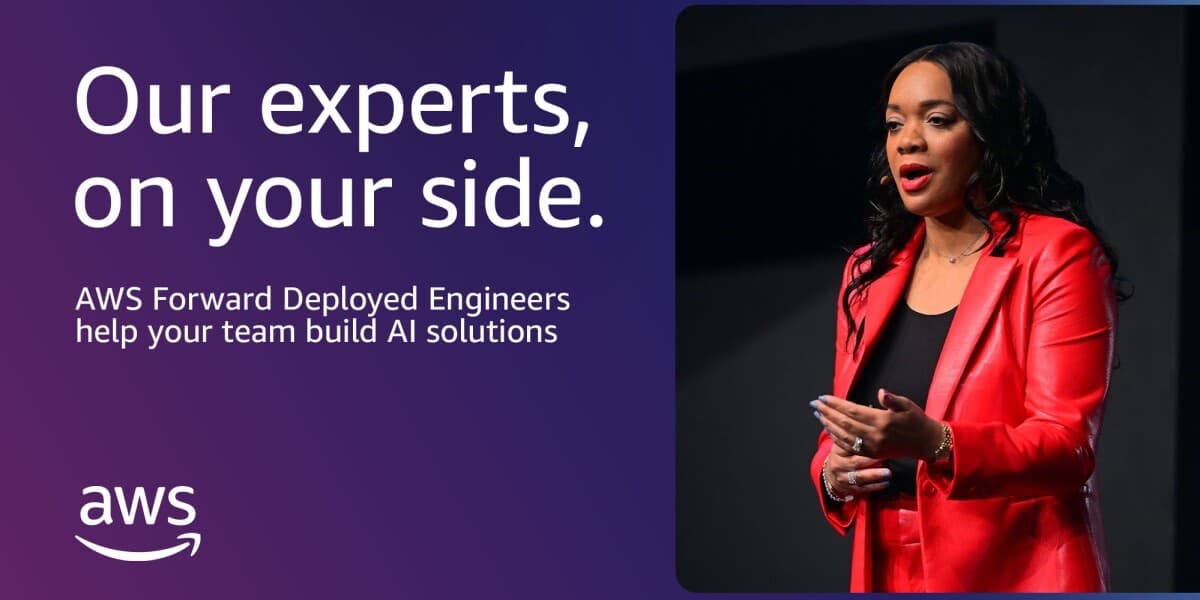
On June 30, 2026, AWS put out a weird announcement. Not a new chip. Not a new model. Not a new data center. What AWS built was an organization made of people. It's called AWS Forward Deployed Engineering (FDE). And Amazon dropped $1 billion straight off its own balance sheet into it — no outside investors, pure company cash.
Why is that weird? Because AWS has always been an infrastructure company. Rent you servers, rent you storage, open up a model API, and the rest is your problem. "Here's the tool, figure out the rest yourself" — that's been the grammar of the cloud business for two decades. This time they went the exact opposite direction. They're pushing engineers inside the customer. Shipping whole teams into client conference rooms and building that company's AI systems alongside them.
Here's the deal: it's all about speed. AWS flat-out said this model shrinks deployment timelines "from months to days." The plan is to punch through that miserable bottleneck — the one where the pilot works great but never crosses into production — using humans. That's the single most painful spot in enterprise AI right now. Everybody builds a flashy demo, and then 90% of them collapse the moment you try to bolt them onto real revenue and real workflows.
But the genuinely interesting part is the timing. Exactly two days after AWS announced this, on July 2, Microsoft dropped a $2.5 billion "Frontier Company" staffed with 6,000 engineers. Before that, OpenAI and Anthropic had each already stood up billion-dollar deployment orgs. So this isn't just an AWS story. The entire AI industry pivoted the same direction inside a few weeks. The "sell the model" era is fading and the "embed the engineer" era is opening up. Let's take the opening shot apart, piece by piece.
The Players on the Board — and the Structure of Each One's Bet
First, the protagonist. AWS FDE is led by Francessca Vasquez, whose title is VP of Frontier AI Engineering and Services — literally the person running Amazon's frontline AI engineering. When she described the org, she hammered one point: leave the customer able to run on their own after the team walks out. When a project ends, you leave behind not just a new solution but new engineering muscle. That's the decisive break from ordinary consulting.
The second player is Anthropic. They moved back in May. Teaming with Goldman Sachs, Blackstone, and Hellman & Friedman, they set up a roughly $1.5 billion joint venture. Look at the structure: Anthropic, Blackstone, and Hellman & Friedman each put in around $300 million, with Goldman Sachs coming in around $150 million as a founding investor, and a consortium including Apollo, General Atlantic, GIC, and Sequoia piling on. The target is telling — mid-sized companies owned by private equity firms. It's a marriage between Anthropic, which holds the engine (Claude), and the PE firms, which hold the customer list (their portfolio companies).
Third is OpenAI. They stood up a separate deployment-only joint venture (the Deployment Company, a.k.a. DeployCo) and pulled in more than $4 billion externally. PE firms like TPG, Bain Capital, Advent, and Brookfield are behind it, and there's talk of a $10 billion valuation target. By sheer scale, it's the most aggressive bet on the board.
And finally, the biggest cannon, fired late: Microsoft. "The Microsoft Frontier Company," announced July 2, runs $2.5 billion and 6,000 engineers — bigger than anyone else here. It's led by Rodrigo Kede Lima, an enterprise sales veteran who was most recently president of Microsoft Asia. They walked out with early partners including the London Stock Exchange Group, Unilever, Land O'Lakes, and Accenture.
Remember just one thing here. The other three are all joint ventures that mix in outside money — only AWS chose "own money, full control." That difference is, honestly, the whole story.
What Actually Happened — What This "FDE" Model Really Is
FDE — forward-deployed engineering — isn't something AWS invented. The originator is Palantir. For years Palantir grew by sending its own engineers directly onto customer sites (government agencies, banks) to sit in the middle of that organization's data hell and solve problems alongside them. Not selling software remotely — planting people on the ground. What AWS just did is transplant that Palantir model wholesale into the context of "AI deployment."
Here's how it works. AWS builds "pods" of about 5–6 engineers and deploys them inside the customer. Each pod runs on roughly 45-day cycles, dragging pilots all the way to production. The 45-day number matters because it's the opposite rhythm from consulting that drags on quarter after quarter. Short, intense, and done only when something ships. AWS explicitly said it will measure by "business outcomes," not billable hours — a clean break from the consulting model where the longer you stick around, the more you make.
So what does a pod actually do in there? Not just wiring up an API. Per AWS, they lay a "semantic layer" over knowledge graphs and governed data. In plain terms, they clean up the customer's scattered data into a form the AI can actually understand and use safely. Then they stack agentic AI solutions on top. That's exactly why they're aiming at regulated industries, financial services, and government — the places where "clean the data + deploy safely" is hardest, and therefore where human hands are most desperately needed.
The early customer list shows how wide this strategy reaches. NFL, NBA, Southwest Airlines, Cox Automotive, the Allen Institute, and Ricoh. Sports, aviation, auto retail, scientific research, office equipment — every industry is different. For the NFL, CIO Gary Brantley described the case himself: "The NFL has millions of fans who want to consume football content throughout the year, including the offseason," and said that together they built fan-facing products like NFL Fantasy AI and NFL IQ. The point is that real products fans use came out of it — not a demo.
Here's the four-camp comparison in one table.
| Camp | Size | Funding structure | Leader | Early targets / customers |
|---|---|---|---|---|
| AWS FDE | $1B | 100% own balance sheet, no outside investors | Francessca Vasquez | NFL, NBA, Southwest, Cox, Allen Institute, Ricoh |
| Anthropic JV | ~$1.5B | Joint venture (Goldman, Blackstone, H&F, etc.) | (unannounced) | PE-owned mid-market firms |
| OpenAI DeployCo | $4B+ raised externally | Joint venture (TPG, Bain, Advent, etc.) | (unannounced) | Broad enterprise, $10B valuation target |
| MS Frontier Company | $2.5B | Internal Microsoft | Rodrigo Kede Lima | LSEG, Unilever, Land O'Lakes, Accenture |
What Each Side Actually Gets
The reason AWS insisted on its own $1 billion is simple — control. A joint venture means someone else funds you, but you share the steering wheel. AWS keeps this org 100% its own, and wires every solution its embedded engineers build straight into AWS and Bedrock consumption. Every time an FDE pod puts an agent into production at a customer, the AWS cloud bill grows. So this $1 billion isn't a "consulting cost" — it's priming the pump for cloud consumption.
What Anthropic and OpenAI get is a different kind of thing. Realistically they can't hire thousands of engineers to tour the country's enterprises themselves. So they borrowed PE's capital and a ready-made customer list in the form of portfolio companies. For Anthropic, dozens of mid-market firms owned by Blackstone or Hellman & Friedman open up overnight as prospects. In exchange, they hand a slice of control and margin to their partners. They traded purity for capital and distribution.
What Microsoft gets is the pressure of scale. Six thousand engineers is bigger than everyone else combined — a flat-out expression of the confidence that "we're already installed across every enterprise, so we just have to add people." Azure, Microsoft 365, and Copilot are already inside these companies, so Frontier Company just needs to stack an execution layer on top. That's also why they put a sales veteran in charge — they see this not as a technical org but as a giant sales-plus-execution machine.
In the end, all four camps are after the same thing. Break the bottleneck where AI dies in the pilot stage, and use that cleared path to pull up consumption of their own product — cloud for AWS, Azure/Copilot for MS, their own models for Anthropic and OpenAI. Only the method differs. The destination is one.
We've Seen This Before — the Bets That Won and the Ones That Broke
This picture isn't new. The closest success story is the Palantir case I just mentioned. Palantir spent years getting mocked: "You're a software company — why are you parking engineers on customer sites?" Bad margins, doesn't scale, are you a consulting firm? And yet that same on-the-ground intimacy let it lock up markets nobody else could crack — government and large enterprise — and FDE is now the standard model the industry copies. It's hard to deny that what AWS, MS, Anthropic, and OpenAI are doing now is, at bottom, "doing a Palantir."
On the flip side, there are bets that broke. The poster child is the Watson business IBM pushed in the 2010s. IBM also flooded customer sites with consultants promising to "bolt AI onto real operations." It made especially loud noise in healthcare, and the result was brutal. The data was filthy, the promised outcomes never showed up, and projects dragged on forever. Why did it fail? Because it carried in the old consulting grammar of charging for time, not outcomes. AWS's pointed insistence on "business outcomes, not billable hours" can fairly be read as a nod to this very Watson ghost.
One more thing to remember: the "Professional Services" arms of the big clouds. AWS, MS, and Google all had consulting arms already. But those were always treated as an appendage to the core cloud business, not a $1B or $2.5B standalone strategic asset. What changed this time is scale and status. It's been promoted from appendage to a company's central bet. That promotion itself proves a painful lesson the industry has learned: AI doesn't sell just by being sold.
The takeaway is clear. The plant-people model has a fundamental weakness — bad margins and hard to scale. Palantir swallowed that and won; IBM designed it wrong and lost. Which of these four camps wins or loses will come down to the same thing: how fast, how repeatably, and how outcome-first they can run these pods.
How the Rivals Counterpunch
The most direct counterattack is already out — Microsoft. AWS bets $1B, MS bets $2.5B. AWS runs pods, MS runs 6,000 people. It's naked scale pressure. MS's weapon is "already installed." Companies already run Microsoft 365 and Azure, so Frontier Company doesn't need to break open a brand-new relationship. Just stack an execution crew on top of existing contracts. AWS can use the same logic as the No. 1 cloud by share, but on the everyday touchpoint of productivity software (Office), MS has the edge.
Anthropic and OpenAI's counter-card is the model itself. AWS and MS are ultimately platforms brokering many models, whereas Anthropic and OpenAI build world-class models in-house. "The people who built the smartest brain also deploy that brain" is a powerful narrative. And by grabbing a closed customer pool like a PE portfolio first, they make it hard for AWS or MS to wedge in. It's a strategy of digging a narrow but deep trench.
And don't forget the dark horse: Palantir. How does the originator see all this? It could be a threat, now that everyone is copying its model — but it's also the best possible marketing that "what we've sold for 20 years was the right answer." Palantir is already dug deep into government, defense, and large enterprise, holding a fortress new entrants can't easily touch. Whether it allies with a model camp or holds out alone is another variable.
Google Cloud's silence is worth watching too. All four camps have moved and only Google is quiet. Two readings are possible — it's preparing a similar org late, or it's making the opposite bet that Gemini's automation lets things "deploy without people." If it's the latter, this could escalate into a doctrinal fight: the "plant humans" camp versus the "automate humans away" camp. Too early to call.
To sum up the front lines: scale (MS) vs. control (AWS) vs. model supremacy (Anthropic, OpenAI) vs. the original trench (Palantir). Four different weapons colliding in one market — enterprise AI deployment.
So What Changes — Broken Down by Who You Are
If you're a regular consumer. Your life doesn't change today. But the back end of the services you use every day quietly shifts. Features like NFL Fantasy AI pop up in the NFL app, airline support gets smoother, and the Cox Automotive data you see when buying a car gets smarter. In other words, without any "new AI feature" label, the apps you use gradually get remodeled into AI-native. Slow to feel, but the direction is certain.
If you're in IT or engineering. Read this as a career signal. The industry is right now pouring $1B and $2.5B into planting engineers on customer sites. Which means the ability to understand a customer's messy data and operations and bolt AI onto real work is becoming as valuable as pure coding chops. The forward-deployed style engineer — who understands a domain and owns deployment on the ground — will command a higher price than the remote code-only role. Conversely, "just wire up the model API" work is at growing risk of being absorbed by these pods.
If you're an enterprise decision-maker. You now have one extra question when picking a vendor — "Will you come inside our company and own it all the way to production?" To dodge the 90% pilot-death trap, a vendor that plants people beats a vendor that just sells a tool. But there's a catch: control. Bring in an AWS pod and you're locked into AWS/Bedrock; bring in an Anthropic pod and you're tied to Claude. The price of convenience is dependence on a specific camp. Coldly weigh "who ends up holding the core of our data and workflows" before you sign.
If you're an investor. (Again, this is not investment advice.) What this trend tells you is that the center of gravity of AI monetization is shifting from "model performance" to "deployment execution." Expect metrics like "our FDE/Frontier org drove X production deployments and Y in added consumption" to show up as a new KPI in earnings calls. AWS and MS, spending their own money, carry margin pressure; Anthropic and OpenAI, spreading risk through JVs, carry control dilution. Which structure lasts longer is the thing to watch.
🥄 Three Things You're Probably Wondering
— So what does this mean for me? Not much right now. But the apps you use (sports, airlines, shopping) will quietly get more "AI-ish." And if you're in tech, it's worth noting the direction: the value of engineers who go on-site and own deployment is going up.
— Is AWS using its own money really that big a deal? Yeah, bigger than it sounds. Own money means 100% control, but you also carry the margin burden alone. Anthropic and OpenAI, who went the JV route, spread the risk but also gave up part of the steering wheel. Which is better, nobody knows yet — it'll take two or three years to answer.
— How is this actually different from a consulting firm? The core difference is what you charge for. Old consulting charged for time (billable hours), so the longer you stuck around, the better. These pods stake themselves on outcomes and a 45-day cycle. If they honor that, it's different; if they don't, it ends up like IBM's old Watson. Too early to call.
References
- AWS commits $1 billion to forward-deployed AI engineers — About Amazon
- Amazon launches new $1 billion FDE org following OpenAI and Anthropic — TechCrunch
- AWS Amazon AI forward-deployed engineers — CNBC
- Anthropic partners with Blackstone, Hellman & Friedman, and Goldman Sachs to launch enterprise AI services firm — Blackstone
- Microsoft launches its own AI deployment company with $2.5 billion commitment — TechCrunch
- Anthropic and OpenAI are both launching joint ventures for enterprise AI services — TechCrunch
Numbers and criteria are as of announcement and may change.