Huawei walks into Nvidia's living room — and the AI-chip map starts to shift
This isn't just another "China made another chip" headline. On July 2, TrendForce reported that Huawei plans to launch its Ascend AI accelerators in South Korea for the first time in the fourth quarter of 2026. That matters because Korea is Nvidia's premium home turf in Asia: it's where Samsung and SK Hynix supply the HBM memory that powers Nvidia's GPUs, and where Naver, Kakao, the three telecom carriers, and the government's large-scale AI infrastructure all run on Nvidia silicon. Huawei is effectively knocking on the door of that living room and walking in.
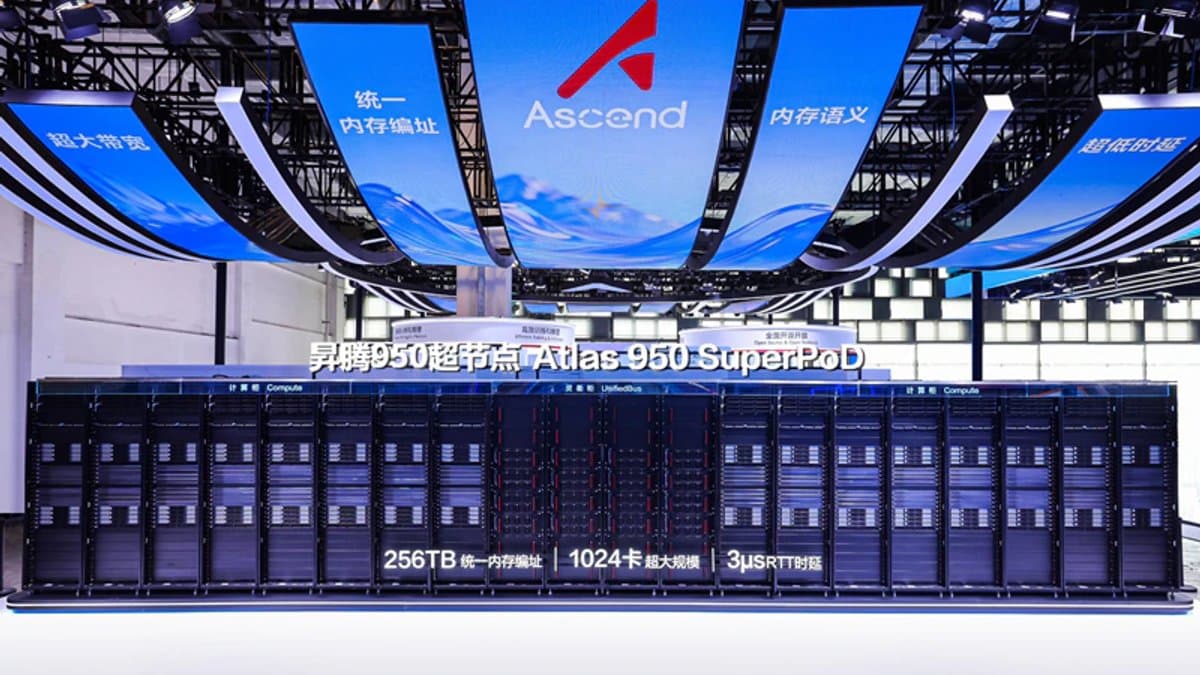
It's carrying two weapons. The first is the Ascend 950 chip family itself — the 950PR tuned for inference, the 950DT tuned for training. The second is the Atlas 950 SuperPod, a system that lashes as many as 8,192 Ascend chips together into a single machine. And the numbers Huawei is throwing out are provocative: it claims the Ascend 950PR delivers roughly 2.87x the inference performance of Nvidia's H20 at about one-quarter the cost. If that held up, the "performance-per-dollar" gap would be more than tenfold.
Stay skeptical, though. This is Huawei's own benchmark, hedged with a "for specific inference workloads" asterisk. The H20 is itself a deliberately hobbled part — Nvidia cut its performance to comply with US export controls on China — so it's an unfair yardstick to begin with. Huawei even concedes the 950PR trails Nvidia's real flagship, the H200. So "2.87x faster than H20" is the marketing headline; the real thing to watch is whether a price-and-volume assault actually lands in Korea.
And the timing is loaded. Korea's market is starved for GPUs right now. Nvidia's queues are long and its prices are whatever it wants to charge. Huawei is threading exactly that gap: "the performance may be a notch lower, but I'll give it to you right now, in bulk, at a quarter of the price." That's the real tension in this story.
Meet the fighters — Huawei, Nvidia, and the Korean distributors
The protagonist is obviously Huawei. This is the same company whose smartphone business was cut in half by US sanctions — and it's now betting its comeback on AI silicon. It hardened its domestic base with the Ascend 910C last year, and the new 950PR already went into mass production in April 2026. There's even word that DeepSeek, China's marquee AI startup, has adopted the Ascend 950PR for deployments of its next model, "V4." Build references at home, then push abroad — it's the classic Chinese expansion playbook.
In the other corner: Nvidia, the de facto global standard for AI computing and one of the most valuable companies in human history by market cap. Nvidia's real weapon isn't the chip — it's CUDA, its software ecosystem. For 15 years the world's AI developers have written their code on top of CUDA, so switching to a different chip means rewriting code, re-fitting libraries, and re-hunting bugs. That switching cost is the moat that actually protects Nvidia.
Then there are the quiet co-stars of this story: the Korean distribution partners. Per TrendForce, Huawei keeps SK Shieldus as its existing partner and has picked one additional local distributor chosen for its distribution experience and technical chops — reports point to Hansol PNS. The key detail is that Huawei won't be selling directly; it's fronting the deal with Korean company names. That's a calculated move to soften the "made in China" reflex, and Huawei is reportedly preparing a Korea-specific brand name and tailored pricing and marketing to go with it.
Once you see this triangle, the picture sharpens. Huawei brings price and volume; Nvidia brings ecosystem and trust; the distributors are the buffer that scrubs off the "Chinese-made" label. Fights where each side's weapon is this different don't come along often.
Breaking down the substance — Ascend 950 vs Nvidia, by the numbers
Now for the guts of it. The Ascend 950PR is built for inference — running an already-trained AI model to produce answers. The 950DT, by contrast, is optimized for training, teaching a model from scratch. On raw single-chip performance, Huawei admits it can't match Nvidia's top-end H200. So its strategy is to win on quantity: take a weaker chip, wire up to 8,192 of them together over a very fast network into one giant SuperPod, and argue that in aggregate the whole thing can go toe-to-toe with an Nvidia system.
That giant is the Atlas 950 SuperPod. The crucial framing is that Huawei is selling a system, not a chip. Nvidia does the same with rack-scale products like the GB200 NVL72, but Huawei is scaling the count far higher to make its bet. On the CUDA-compatibility problem, Huawei says it will route around it with proprietary networking technology and its own software stack — and that's the least-proven part of the whole pitch.
| Item | Ascend 950PR (Huawei) | Nvidia H20 | Note |
|---|---|---|---|
| Primary use | AI inference | AI inference (export-restricted part) | 950DT is a separate training chip |
| Inference perf | ~2.87x H20 (Huawei's claim) | Baseline (1.0x) | For specific workloads |
| Price | ~1/4 of H20 | Baseline | Huawei's claim |
| Vs. flagship | Trails the H200 | — | Huawei concedes this |
| System scaling | Atlas 950 SuperPod, up to 8,192 chips | GB200 NVL72, etc. | Closing the gap with scale |
| Software | Proprietary stack (not CUDA-compatible) | CUDA ecosystem | Switching cost is the crux |
| Mass production | Began April 2026 | In production | DeepSeek V4 adoption cited |
| Korea launch | Q4 2026 (planned) | Already shipping | Via SK Shieldus, Hansol PNS |
The table lays Huawei's math bare. It isn't trying to win a single-chip duel; it's trying to win on total score via "price x volume x system scale." The problem sits in the bottom two rows — software and trust. Those two can quietly neutralize every shiny number above them.
Power consumption is the sharpest example. Because Huawei papers over lower per-chip efficiency by adding more chips, matching a given performance level means far higher power draw and heat. For a data-center operator, the electricity bill and cooling cost over three to five years often exceed the price of the chips themselves. Whether "a quarter of the chip price" also means a quarter of the total cost of ownership is a completely different question.
What each side actually gains
What Huawei gains is clear. First, symbolism: breaking into Korea, right in the middle of America's alliance network. In the very market where Samsung and SK feed HBM to Nvidia, homegrown Chinese silicon starting to sell there becomes a showcase for technological self-reliance. Second, economies of scale. Domestic Chinese demand for Ascend is already explosive, but overseas references drive down mass-production costs and grow the software ecosystem. Korea is the first foreign beachhead.
What Korean customers gain is choice and leverage. Until now, building AI infrastructure meant lining up in front of Nvidia and paying whatever it asked. With Huawei as an alternative, buyers suddenly have a bargaining chip. Even customers who never actually buy a Huawei chip can change the negotiating table just by saying, "cut me a deal or I'll go to Huawei." For mid-tier clouds and AI startups squeezed by GPU shortages, a quarter of the price can be genuinely tempting.
Paradoxically, Nvidia gains something too: vigilance. This news is a warning shot that says, "don't take the Korean market for granted." If Nvidia reacts by releasing more supply, adjusting prices, or deepening its Korean partnerships, Korean customers benefit either way. Competition makes even a monopolist move.
To be fair, look at what can be lost, too. A Korean company that buys Huawei chips takes on the risk of fresh US sanctions or export controls. If the US-China tech conflict escalates, a chip bought cheaply today could become a stranded asset tomorrow — cut off from parts supply or software updates. That geopolitical exposure is the true flip side of the quarter-price sticker.
Past fights like this one — the wins and the collapses
We've seen this "discount challenger invades the incumbent's living room" move many times in chip history. Start with the wins. AMD is the classic case. During Intel's 20-year lock on the CPU market, AMD pushed Ryzen with "similar performance, dramatically lower price" and eventually clawed data-center server-CPU share up to a meaningful level. The key was that it fought on the same ecosystem, x86 — no need to rewrite software. So once the price was right, switching was easy.
Another win is Huawei's own history. In telecom equipment, Huawei once bulldozed into a market held by Western giants like Ericsson and Nokia with "half the price, comparable performance," and became the world's number-one telecom-gear maker. What it's attempting in AI chips is a near-exact rerun of that script. Huawei is a company that's comfortable with the long game: open the market on price, grow the ecosystem on volume, close the gap over time.
But the failures are more instructive. Look at Intel's Gaudi AI accelerators, its bid to break into the GPU market. The performance and price figures weren't bad — but it still couldn't scale the wall of the CUDA ecosystem. Developers refused to move, reasoning that "even if the chip is cheaper, the time and risk of porting the software is greater." Intel proved, at an expensive tuition, that you can't beat Nvidia on a hardware spec sheet alone.
The most painful cases are the ones that collapsed on regulatory risk. Chinese firms have repeatedly tried to establish themselves in Korean and US markets with telecom gear or surveillance cameras, only to be shut out of government procurement over security concerns or shunned in the private sector. Neither the technology nor the price was the problem — "which country's company is this" tripped them up. That's the most realistic wall Huawei's Ascend will hit in Korea, which is exactly why Huawei is fronting Korean distributor names and even building a Korea-only brand.
Nvidia's counter-play — it won't sit still
There's no chance Nvidia watches this passively. Its first card is supply and price. Nvidia is currently sorting out how to allocate next-gen Blackwell-class volume across Asia, Korea included, and a Huawei pitch at a quarter of the price gives Nvidia a reason to rethink supply priority and pricing terms for major Korean accounts. When a monopoly shows cracks, even the monopolist gets flexible.
Its second card is fortifying the CUDA ecosystem. Nvidia's real strength isn't the hardware but the software, libraries, and community that keep developers locked to CUDA. Expect Nvidia to layer on inference-optimization software (the TensorRT family), white-glove support for large customers, and denser local partner and training programs in Korea — all reinforcing the sense that "leaving us costs you." Continually raising the switching cost is the surest defense.
The third card is geopolitics. Nvidia won't say it out loud, but the US-sanction and security baggage that trails Huawei chips is a free reinforcement in Nvidia's favor. The bigger the Korean conglomerate, the more entangled it is with US markets and partners, and the more cautious it has to be about adopting Huawei silicon at scale. Nvidia knows this risk works for it without it having to say a word.
That said, Nvidia has a weakness too: GPUs are so scarce and expensive that the pricing itself has been piling up customer resentment. That resentment is precisely the crack Huawei is prying at. If Nvidia doesn't loosen supply and price, real customers will start saying "fine, Huawei then." How fast and how sincerely Nvidia counters will set the tempo of this whole contest.
So what actually changes — sorted by who you are
If you're a developer or engineer. Not much changes right away. Porting CUDA-based code to Ascend is still cumbersome and risky. But if your employer starts weighing Ascend adoption under cost-cutting pressure, it's now worth peeking at Huawei's CANN software stack and its Ascend migration tooling ahead of time. This is a phase where engineers who can handle heterogeneous compute environments see their market value climb.
If you run industry or data-center procurement. This means you have one more card to play. Regardless of whether you actually deploy it, you now have a lever to pressure Nvidia at the negotiating table. Just be sure to compute in TCO — total cost of ownership. A chip that's a quarter of the price can see its advantage shrink fast once you add power, cooling, and software-porting costs, and you have to layer in the invisible cost of geopolitical risk on top.
If you're an investor. This news hints at a possible crack in Nvidia's monopoly premium — but it's still only a possibility. What to watch is how much Ascend translates into actual Korean contracts, and how the US reacts. In the near term, the more interesting names may be HBM and memory makers like Samsung and SK Hynix. Whether Huawei or Nvidia wins, more AI chips sold means more HBM demand — the "sell picks and shovels regardless of who strikes gold" dynamic.
If you're a general reader. No change you'll feel tomorrow. But in the big picture it matters. If real competition enters a structure that's been over-concentrated on a single company, the cost of AI computing falls over the long run — and that eventually shows up in the price and quality of the chatbots, translation, and image-generation tools you use. This news is the starting gun for that competition.
🥄 Three Things You're Probably Wondering
— So what does this mean for me? You'll never buy a chip yourself, but when AI-infrastructure competition heats up, the cost of AI services has room to fall over the long run. That can filter into the price and performance of the AI tools we all use over a few years, so it's hard to call it irrelevant.
— Are Huawei's chips actually better than Nvidia's? No — too early to say. The "2.87x vs H20" figure is Huawei's own benchmark, and the H20 is itself a performance-cut, export-restricted part, so it's not a fair comparison. Huawei even admits it trails the real flagship H200. The point isn't performance — it's value for volume.
— Will Korean companies actually buy them? Right now it's a coin flip. A quarter of the price is attractive in a world of scarce, expensive GPUs, but the security wariness of Chinese tech, the CUDA switching cost, and US-sanction risk are all serious. Expect volume-hungry mid-tier operators, rather than the big conglomerates, to be the first to weigh it — cautiously.
References
- TrendForce — Huawei Reportedly Plans 4Q26 Korea Launch of Ascend AI Chips and Atlas 950 SuperPod as Nvidia Alternative (2026-07-02)
- DIGITIMES — Huawei Ascend chips eye Nvidia's Korea market (2026-07-02)
- Huawei — Ascend Computing product & Atlas 950 SuperPod overview
- NVIDIA — CUDA Toolkit documentation (developer ecosystem reference)
Numbers and criteria are as of announcement and may change. Investment calls are yours to make!