A "next month" promise that is now two months overdue
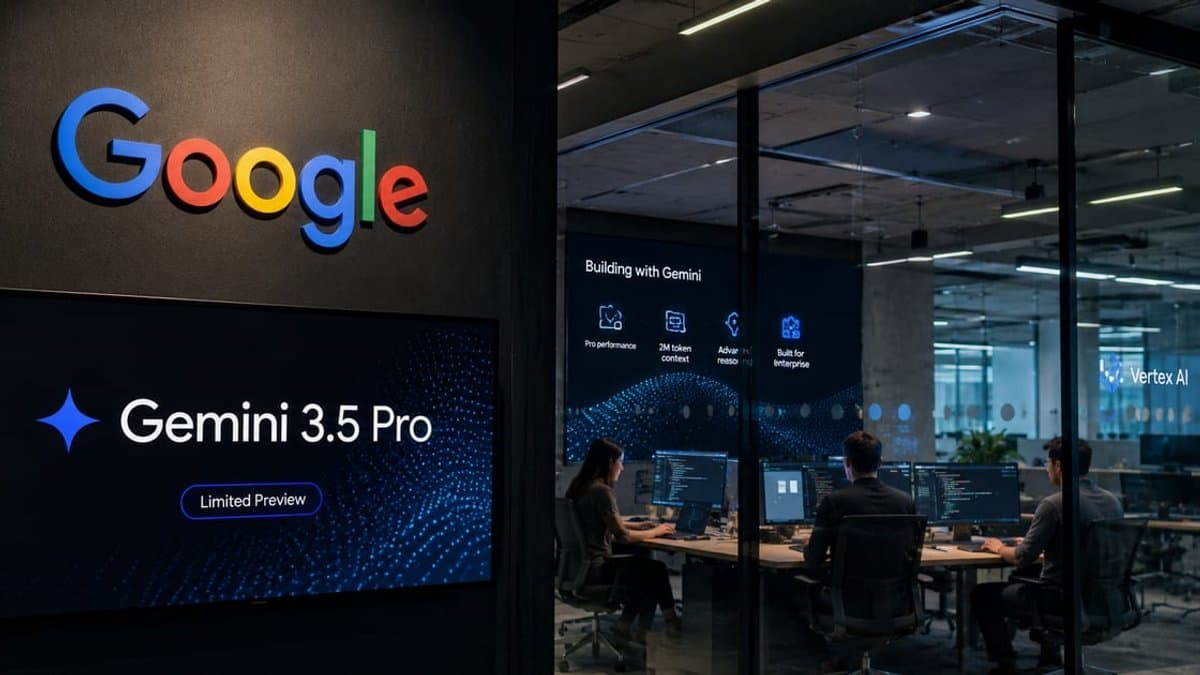
Here is the deal: the Gemini 3.5 Pro that Sundar Pichai personally said would land "next month" on the I/O stage back on May 19 is, entering the second week of July, still not generally available. Google did not just quietly miss its June GA target. The model is sitting inside a limited Vertex AI enterprise preview with no confirmed benchmark scores and no final price sheet. Only a small set of approved enterprise customers, testers on Google's internal Antigravity platform, and the benchmarking community site LMArena can actually touch it.
Why is that news? Because the delay itself matters less than what the delay reveals. In a frontier-model race that plays out quarter by quarter, the richest and most infrastructure-heavy company on the planet blowing its own publicly stated date by two months is basically an admission: the quality bar we set for ourselves is not met yet. And the reasons leaked out with surprising specificity. Token efficiency, coding performance, and long-horizon multi-step reasoning — those three things reportedly are not yet at flagship standard, according to early enterprise testers.
A Google spokesperson declined to comment on the delayed timeline. Instead the company keeps repeating the boilerplate line that it is "collecting input from early testers and making adjustments." And per an Investing.com report dated June 24, Google (GOOGL) was actually up +1.82% at the time of writing. In other words, the market did not read this delay as a disaster. Still, the industry is watching closely, because this single model launch is one of the few events that could tilt the balance of the AI landscape in the back half of 2026.
The players — Google, DeepMind, and a 2-million-token weapon
The protagonist is Google, or more precisely Google DeepMind. Coming through Gemini 3, then 3.1, and now 3.5, DeepMind has a narrative to protect: that it sits in the front row of the frontier. And Gemini 3.5 Pro is not some minor point release — Google positioned it as the flagship aimed squarely at the enterprise market.
The model's biggest weapon is a 2-million-token context window. That is roughly double the leading rivals. If Anthropic's Claude Opus 4.8 offers something like a 1-million-token context, Gemini 3.5 Pro can swallow twice that in a single pass. It is currently reported to be the largest context of any production frontier model. Two million tokens means you can drop in multiple thick books, an entire large codebase, or a stack of hundreds of pages of contracts and ask questions across all of it at once.
The second weapon is Deep Think reasoning mode. This is Google's answer to OpenAI's extended thinking — a feature that makes the model reason at length before answering hard scientific, mathematical, and coding problems. A prior Deep Think tier reportedly scored 84.6% on ARC-AGI-2 and hit gold-medal-level performance on international-olympiad-grade problems, so it is a capability Google clearly wants to show off. That said, the 3.5 Pro version of Deep Think is expected to be gated to the top Ultra subscription tier.
The catch is that no matter how flashy those two weapons are, the model has not passed the real-world tests that actually matter: how cheaply, quickly, and reliably it handles everyday work. When enterprise customers pick a model, what they truly watch is cost per token, latency, and consistency across long tasks — not benchmark bragging. And that is exactly where early feedback flashed red.
Supporting cast: the competitors. Anthropic has a strong presence in coding and agentic work with Claude Opus 4.8, and OpenAI is reportedly keeping its next model (whispered about under names like GPT-5.6) locked. In this three-way fight, Google chose to show its hand first — and that card slipped out of its grip.
What actually went wrong — three reasons behind the slip
The core of the delay is three intertwined problems. First, token efficiency. Being able to accept 2 million tokens and processing those 2 million tokens without waste are entirely different problems. A big context means compute and cost explode, and early testers reportedly flagged that outputs were verbose and burned more tokens than necessary. That is a number that lands directly on the customer's invoice, which is exactly what enterprises are most sensitive about.
Second, coding performance. These days the battleground for frontier models is basically coding. Real-world software-engineering benchmarks like SWE-bench Verified make or break a model's value. Some reports cited internal data suggesting 10-to-15-point SWE-bench Verified gains over the 3.1 generation — but that figure is unverified and not officially confirmed by Google. The problem is that even those gains apparently did not clear the "flagship" bar Google set at I/O.
Third, long-horizon multi-step reasoning. That is the ability for an agent to push through a long, multi-stage task without losing the thread halfway, and feedback suggested it still wobbles here. In the agent era this is a fatal weakness. A model can nail one or two rounds of Q&A but still be useless for real automation if it cannot reliably run a ten-step workflow.
Here is the picture in one table.
| Item | Status | Note |
|---|---|---|
| Unveiled | 2026-05-19 (Google I/O) | Pichai said "next month" |
| Original GA target | June 2026 | Missed |
| Current status (2nd week of July) | Vertex AI enterprise preview | Approved customers, Antigravity, LMArena only |
| Context window | 2 million tokens | ~2x rival models |
| Deep Think reasoning | Included (expected) | Reportedly Ultra tier only |
| Official benchmarks | Not published | 10-15pt SWE-bench gain is unverified |
| Official pricing | Not published | $15 in / $60 out per M tokens, 10x premium is speculative |
The key thing to note is that the bottom three rows are all "not published" or "speculative." Google has not officially released benchmarks or pricing. So the numbers floating around — "$15 per million input tokens, $60 for output, a 10x premium for Deep Think" — are all extrapolated from prior generations. Nothing about them is confirmed.
What each party gains — a delay is not pure loss
For Google, the delay stings, but it is also a calculated choice. Google has been badly burned before (more on that below). The judgment underneath is that shipping something half-baked and ruining first impressions is worse, long term, than shipping late and still earning a "yep, that's Gemini" verdict. The enterprise market especially is a place where lost trust is hard to win back, so betting on polish can be rational.
For the enterprise customers — the teams that were evaluating the model — it is an awkward spot. On the bright side, the preview stage buys them time to find the weak points early and check whether it fits their workflows. On the downside, they have to plan adoption around a model with no confirmed price and no benchmarks, which leaves decisions in limbo. That is why the practical advice going around is: do not go all-in on Gemini 3.5 Pro right now — set a baseline with the current 3.1 or a rival model and wait.
The competitors purely bought time from this delay. Had Google planted its flag first, Anthropic and OpenAI would have been on the back foot; instead that pressure eased for a moment. Claude Opus 4.8, strong in coding and agent work, can keep pushing the message: "We're available and stable, right now."
And the surprise beneficiaries are the developers and startups who were watching from the sidelines. A frontier model slipping by two months means products built on existing models can keep running for a while without the "about to be obsolete" anxiety. The pressure to rip everything up the moment a new model drops is briefly deferred.
Past parallels — the cost of haste and the reward of patience
To understand this story, start with Google's trauma. In February 2023, chased by ChatGPT, Google rushed out Bard and its demo produced a factual error about the James Webb Space Telescope. That single stumble wiped roughly $100 billion off Alphabet's market cap in a day. It is the textbook case of what it costs when a hastily shipped AI trips on first impressions. There is clearly a memory of this behind Google's refusal to force out an unfinished Gemini 3.5 Pro now.
Conversely, Google has its own case where patience paid off. When it announced Gemini 1.0 in late 2023, it did not immediately release the top-tier Ultra model — it rolled it out months later as Gemini Advanced. It may have lost a bit in the immediate headline race, but it succeeded in landing the model in the market steadily. It showed that "ship it late but finished" is not necessarily a losing strategy.
Zoom out to the whole industry and the pattern repeats. OpenAI, moving from GPT-4 to the next generation, delayed timelines and slotted in interim versions multiple times to tune quality. Frontier models are a domain where the time and cost to squeeze out the final few percent of quality grow exponentially, so a widening gap between announcement and actual release has become almost normal in this business.
The lesson is clear. A delay itself is not failure. The real failure is shipping something unready and losing trust. That said, if delays repeat and stretch, you start losing the narrative war over whether Google is really ahead at all — and Google is standing right on that line now.
Competitor counter-play — what Anthropic and OpenAI do
Anthropic is best positioned to make the most of this gap. Claude Opus 4.8 already earns strong marks on coding and agentic workloads, and even if it loses the raw context numbers game (2 million vs 1 million), the message that "this runs reliably in production right now" is far more persuasive. Some reports even claimed a few of Google's senior researchers moved over to Anthropic — but that talent-movement story is unconfirmed, so take it with a grain of salt.
OpenAI is running a different calculation. Its next model is reportedly still locked and unrevealed, which is likely a timing play: watch Google trip over itself, then come out swinging with something clearly ahead. When your rival stumbles over their own feet, there is little reason to rush.
Here is the interesting part: that 2-million-token context advantage may not be as decisive a weapon as it looks. A big context does not mean the model uses everything inside it well. The "lost in the middle" problem — where models drop information buried in the middle of a long context — is an industry-wide challenge, and above all, cost and latency climb as context grows. So competitors can pull out the counter card: "our context may be a bit smaller, but it is far more efficient and cheaper within it." Ironically, the exact spot where Google is stuck right now is token efficiency.
One more thing: this race is not purely about model performance. Google holds the Vertex AI enterprise distribution pipeline plus Search and Workspace as delivery channels. Even a late model has plenty of room to make up ground later thanks to that distribution muscle. For Anthropic and OpenAI, the question is how fast they can lock their current time advantage into actual contracts and deployments. They bought time — but time that cannot be cashed in means nothing.
So what actually changes — sorted by who you are
If you are an enterprise adoption lead, do not finalize a roadmap that assumes Gemini 3.5 Pro right now. If you have preview access, measure token efficiency and long-task consistency against your own real workloads — but push the production decision to after GA, once benchmarks and pricing are public. Until then, set a baseline with the current 3.1 or a rival model and stack up comparison data.
If you are a developer or a startup, you can actually breathe easier. You get about two months of relief from worrying that the model you use will suddenly go stale. That said, once the 2-million-token context and Deep Think open up officially, product designs that need long-document processing or complex reasoning could shift — so it is worth sketching out now how your product would change if those features were available.
From a general-user or investor angle, there is no need to conclude that Google has fallen behind based on this one delay. The market reacted with a slight gain at the June announcement, and Google's distribution and infrastructure are still overwhelming. What is true is that its image as a "company that keeps its promises" took a small crack, so the real test is how convincing its next punch — the quality of the actual launch — turns out to be.
To sum up: this is not a "Google is doomed" story. It is a "Google chose caution, and the price of that caution was briefly lending the narrative initiative to its rivals" story. How forcefully it reclaims that borrowed initiative at launch is the thing to watch in the second half.
🥄 Three Things You are Probably Wondering
— So what does this mean for me? If you are an individual user, almost no direct impact. But if your company is evaluating AI models, planning around Gemini 3.5 Pro right now is premature — it is a model with no benchmarks and no pricing yet.
— Is this a sign Google is falling behind? Too early to say. Delays are common and the market did not flinch much. But missing its promise for two months is clearly a minus for the "we're ahead" narrative, so the pressure to make up for it with launch quality just went up.
— Does a 2M-token context clearly put it ahead of rivals? By the raw number, roughly 2x ahead. But a bigger context does not mean it uses everything well, and it actually raises cost and latency. Ironically, token efficiency is exactly where Google is stuck — so size alone does not make it a clear win.
References
- MarketScale — Gemini 3.5 Pro is still in preview entering the second week of July
- Investing.com — Google delays Gemini 3.5 Pro model release to July
- Google DeepMind — Gemini models
- Google Blog — Gemini 3.1 Pro announcement
- TechTimes — Gemini 3.5 Pro cleared for July launch
- Bind AI — Gemini 3.5 Pro slips to July: what developers should know
Numbers and criteria are as of announcement and may change.