A 6-trillion-parameter monster is still baking
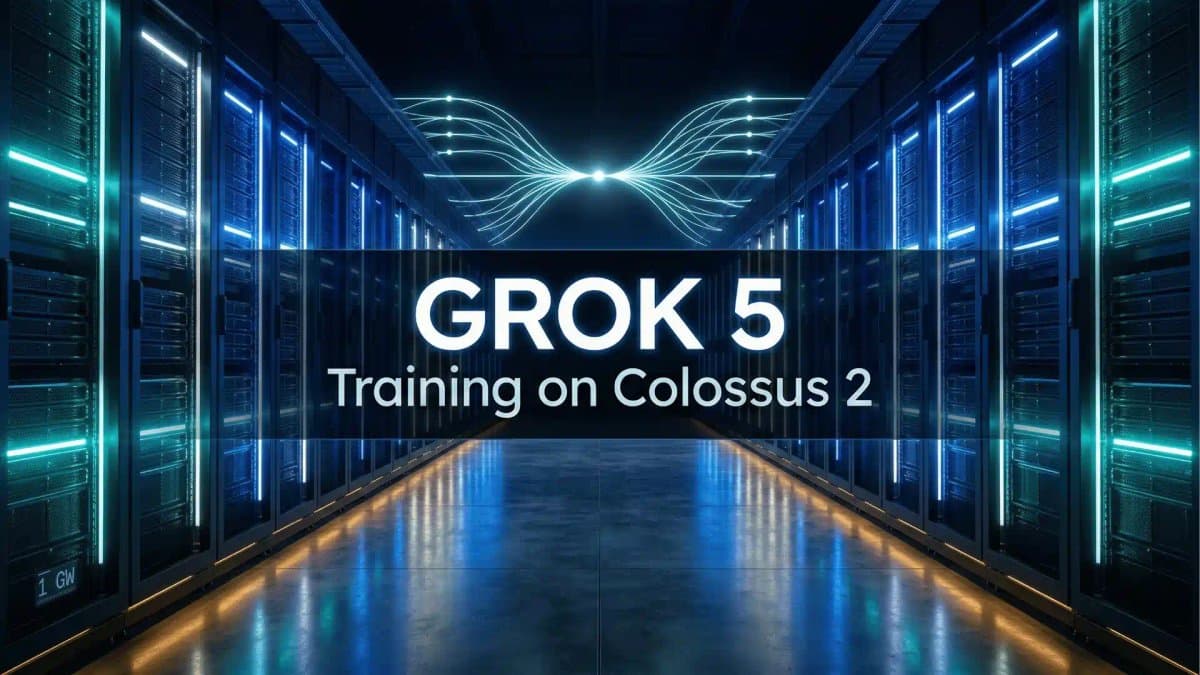
Here is the deal: Elon Musk's xAI has slipped Grok 5 again. The next-gen flagship was originally supposed to land in late 2025. Then it moved to Q1 2026. Then Q2. And now the industry read is that "full API access is a Q3 (July–September) story at best." Today is July 7, so we are technically already at the start of Q3 — and this 6-trillion-parameter model is still just grinding away inside Colossus 2, the 1-gigawatt supercluster in Memphis.
The key thing to understand: Grok 5 was never un-announced. It just hasn't shipped. Musk has laid out the specs multiple times, and even went as far as saying Grok 5 "will be indistinguishable from AGI." But the actual product keeps not arriving. This isn't just a marketing slip — it's a live case study in how long, and how expensive, the "bake one giant model in a single monster run" strategy really is right now.
While competitors ship incremental updates to GPT-5-class models, Gemini, and Claude every few weeks, xAI is pouring electricity into the biggest single pile of GPUs on Earth, betting on one model that flips the board in a single move. That bet is now being tested against the clock.
The players — xAI, Musk, and 555,000 GPUs
Start with xAI. Musk founded it in 2023, and it runs the Grok chatbot bolted onto X (formerly Twitter). Through Grok 3 and Grok 4, it clawed its way up the benchmarks, chasing OpenAI, Google, and Anthropic. Now the goal with Grok 5 is to leapfrog the front of the pack entirely. Back in November 2025, at Baron Capital's investment conference, Musk sat down with investor Ron Baron and pinned it down: Grok 5 would be a 6-trillion-parameter model, arriving in 2026. For reference, Grok 4 is estimated at around 3 trillion parameters — so this is roughly doubling the size.
The second character is Colossus 2, and honestly it's the heart of this whole story. It's xAI's own data center in Memphis, Tennessee, and when it came fully online in January 2026 it became "the world's first gigawatt-scale AI training cluster." The numbers attached to it are absurd: around 555,000 NVIDIA GPUs, roughly $18 billion in hardware. Musk said he'd push capacity to 1.5 gigawatts by April, and eventually double it toward 2 gigawatts — and he's been buying up additional buildings to make that happen. AI training ultimately comes down to how much power and how many chips you can amass, how fast. On that raw physical scale race, xAI is currently the most aggressive player on the board.
Third: Colossus 2 isn't baking Grok 5 alone. According to reporting, it's training seven models at once. That's Imagine V2 (a video model), two variants at 1 trillion parameters, two at 1.5 trillion, one at 6 trillion, and one at 10 trillion. Those last two — the 6T and the 10T — are the two Grok 5 variants. So under the single name "Grok 5," xAI is running a 6-trillion-parameter workhorse aimed at real deployment alongside a larger, more experimental 10-trillion version.
Put it together: an ambitious founder, at the largest-power-draw data center in the world, is baking the biggest publicly announced model in history — and seven of them at once. And the oven door has stayed shut a lot longer than anyone expected.
The substance — why is this taking so long?
Training a giant model isn't "hit start and wait." There are roughly three stages. Pre-training crunches through a massive pile of data. Then post-training and alignment shape it to answer the way humans actually want. Finally, deployment infrastructure gets bolted on so it can be served through an API. When you scale parameters to 6 or 10 trillion, every one of those stages stretches proportionally — and if training blows up mid-run (a loss spike) or you hit a data-quality problem, you can lose days or weeks rewinding.
The reported roadmap says the 10-trillion variant alone takes something like two months just for pre-training. Add post-training, alignment, safety evals, and the serving infrastructure needed to actually run a 6T or 10T model in production, and the punchline is clear: "training done" is nowhere near "shipped." When Musk said Q1, the public heard "coming soon." But to an engineer, finishing pre-training still leaves a long road ahead.
One more thing. xAI hasn't been sitting on its hands while Grok 5 cooks. It's been cranking out intermediate models the whole time: a ~500-billion-parameter Grok 4.3 beta, a 1-trillion Grok 4.4, a 1.5-trillion Grok 4.5, plus a coding-specialized model. That's exactly what those "seven models training at once" actually are. So while Grok 5 slips, users have kept getting fresh capabilities through the Grok 4.x line — which, ironically, reduces xAI's urgency to rush Grok 5 out the door.
| Item | Detail |
|---|---|
| Model | Grok 5 — 6T-parameter workhorse + 10T-parameter variant |
| Architecture | Mixture-of-Experts (MoE), natively multimodal (text, image, video, audio) |
| Training infra | Colossus 2, Memphis, 1GW→1.5GW→2GW, ~555,000 GPUs, ~$18B |
| Models in training | 7 (Imagine V2, 1T×2, 1.5T×2, 6T×1, 10T×1) |
| Release history | Late 2025 (missed) → Q1 2026 (missed) → Q2 (missed) → Q3 watch |
| Prediction markets | Grok 5 release contracts listed on Polymarket & Kalshi; early-release odds priced low |
| Comparison | Grok 4 ~3T params → Grok 5 is 2x+ the size |
Quick correction on one number: some early summaries floating around listed a Grok 5 variant at "100 trillion parameters." The original reporting says 10 trillion, not 100. Even so, that's still among the largest publicly disclosed models anywhere — and given that OpenAI and Google rarely reveal exact parameter counts, it fits Musk's habit of loudly flexing raw scale as a strategy.
What each party gets out of it
For xAI, this delay is painful but calculated. The upside is obvious: if 6T and 10T parameters actually translate into performance, xAI gets to own the "we beat the field on sheer scale" narrative. The moment Musk's "indistinguishable from AGI" line gets proven on benchmarks, the AI axis linking X's ecosystem, Tesla, and xAI into Musk's empire gets a lot stronger. The downside is time and trust. Having broken three release windows, "they delayed it again" fatigue is building among users and investors.
Competitors get a windfall from the delay. While xAI preps its one big punch, OpenAI, Google, and Anthropic keep shipping incremental improvements and locking in real-world usage. They know that steady updates hold onto actual users better than a "perfect single release." The longer Grok 5 slips, the more time rivals get to close (or widen) the gap.
The chip and power supply chain — think NVIDIA — wins no matter what. Colossus 2 vacuuming up 555,000 GPUs and expanding toward 2 gigawatts is a signal that data-center GPU demand is still exploding. As long as the model race stays a "who builds the bigger oven" contest, whoever sells the oven ingredients keeps printing money.
Finally, prediction-market participants. Polymarket and Kalshi both list contracts with real money riding on when Grok 5 goes public. As of late June, early-release odds were priced low — meaning the market is betting on "delayed again." Amusingly, that prediction market has itself become a live scorecard grading xAI's release credibility in real time.
Past parallels — the wins and the flops
Start with a win. OpenAI's GPT-4 in 2023 was exactly this pattern: train at enormous scale, quietly, for a long time; don't disclose the specs; then drop it all at once and flip the board. "Bake big, launch big" paid off spectacularly. What xAI is chasing is precisely this — a GPT-4 moment via Grok 5. If the scale bet gets rewarded with performance, the delays get forgotten fast.
The other win column is xAI itself. Building Colossus 1 in 122 days and rapidly catching up through Grok 2, 3, and 4 was a genuinely impressive execution record. There's a track record of "when Musk says it, it's late but it eventually ships," which makes it hard to fully dismiss the Q3 read as noise. Whether it's rockets or EVs, the timelines always slipped — but the product eventually landed.
Now the cautionary tales. Meta's Llama 4 "Behemoth" is the obvious one. Ambitiously teased as a giant model, its training kept slipping, and when it did surface it reportedly underdelivered relative to the hype. It showed that bigger doesn't automatically mean better — and the same risk applies to Grok 5's 10-trillion variant. A huge parameter count is not a guarantee of intelligence.
Google's Gemini Ultra is also worth noting. It was teased as a top-tier model, but the gap between announcement and actual public access stretched out, and Google lost ground in the competitive narrative during that window. The trap with giant models is the gap between "announced" and "actually usable" — and Grok 5 has now been widening that gap for three straight quarters, so this failure pattern is the one to watch most carefully.
How competitors counter-play
OpenAI answers with speed. Instead of one giant monolithic model, it ships frequent updates, doubles down on reasoning (the o-series), and locks in usage through an agent-and-tool ecosystem. However big Grok 5 turns out to be, "just bigger" isn't enough to make people rip out a ChatGPT/API workflow already embedded in their stack. OpenAI is buying time with the "we're already here, and we keep getting better" card.
Google counters with infrastructure and distribution. It crushes training cost with its own TPUs and pushes Gemini straight into Search, Android, and Workspace. While xAI spends $18 billion on 555,000 GPUs, Google can run comparable scale on its own silicon for less. It's beating the scale race not on money but on unit cost.
Anthropic differentiates on safety and trust. Rather than chasing the biggest model, it leads with alignment, safety, and enterprise trust to dig into regulation-sensitive markets. That's the exact opposite pose from Musk selling "indistinguishable from AGI." Even if Grok 5 is big and powerful, enterprise buyers with weak safety validation may still pick Anthropic.
And the Chinese camp (DeepSeek and others) shakes the board on efficiency. As approaches that squeeze solid performance out of far fewer chips keep appearing, they raise the fundamental question: is dumping $18 billion into 6T and 10T parameters actually efficient? If small, efficient models get close to Grok 5's performance for far less, xAI's giant bet could lose its justification. That's the real risk that grows the longer the delay drags on.
So what actually changes
If you're a regular user? Not much, for now. Grok 4.x keeps getting updates while Grok 5 cooks, so the Grok you use on X is already improving little by little. If you were weighing "should I switch off ChatGPT/Gemini when Grok 5 lands," you'll need to wait until at least Q3 — and even that isn't locked in.
If you're a developer, this is more concrete. "Full API access in Q3" means designing a service that depends on the Grok 5 API right now is premature. The pricing, speed, and context limits for the 6T model aren't out yet, so don't hard-code your roadmap to Grok 5 — keep a fallback on Grok 4.x or a competitor model.
If you're an investor or industry watcher? This delay is data for reading the cost curve of the AI scale race. The fact that an $18-billion facility baking seven models at once still can't ship after three quarters is proof that the time-and-cost risk of giant models is real. At the same time, xAI absorbing that cost and pushing anyway is evidence of its capital and ambition. Either way, the day Grok 5's real performance goes public will be the grading day for this bet.
If you're in a rival camp, this is a window to buy time — more room to lock in usage share and wall off ecosystems while Grok 5 slips. But don't get complacent: Musk's track record is "late, but eventually delivers something big," so a genuine GPT-4-scale shock in Q3 can't be ruled out.
🥄 Three Things You are Probably Wondering
— So what does this mean for me? Almost no direct impact right now. But if you were waiting on the Grok 5 launch to switch chatbots, you'll have to wait until at least Q3, and even that's not confirmed. The Grok 4.x you use today keeps improving, so it's fine to ride that in the meantime.
— Why is this news right now? Because the late-2025, Q1, and Q2 targets all got missed, the "is Q3 finally real?" read set in, and late-June prediction-market contracts settling put it back in the spotlight. It's less a fresh event than the state itself — "still not out" — being the news.
— Is xAI ahead of rivals or behind? Too early to call. On raw scale (6T/10T), it looks ahead — among the largest disclosed models anywhere. But real performance only shows once it's public. Until then, "biggest on paper, hasn't shown its hand yet" is the accurate read.
Sources
- AdwaitX — Grok 5 Is Still Being Trained on Colossus 2
- SemiAnalysis — xAI's Colossus 2: First Gigawatt Datacenter In The World
- Benzinga — Musk Tells Ron Baron: Grok 5 Set For 2026 With 6 Trillion Parameters
- Interesting Engineering — xAI launches world-first gigawatt-scale AI training cluster
- Introl — xAI Colossus Hits 2 GW: 555,000 GPUs, $18B
- xAI Official — Colossus
- Polymarket — Grok 5 released by...?
Numbers and criteria are as of announcement and may change.