America Leads on Performance — So Why Are US Companies Running Chinese Models?
Here's a paradox nobody quite predicted. The US is supposed to be winning the AI performance race. GPT-5.5, Claude Opus 4.8, Gemini — the top of most frontier benchmarks is still owned by American labs. And yet, when you look at the API tokens US companies actually burn in production, nearly half of them are flowing to Chinese-built models. That's the number CNBC put on the table on July 7, 2026.
Start with the headline figure. OpenRouter is a routing platform that lets developers pick among hundreds of AI models. Its usage data shows that the share of API tokens from US companies going to Chinese models has topped 30% every single week for months, peaking as high as 46%. A year earlier, in the first half of 2025, that average was 4.5%. That's a tenfold jump.
And here's the part that actually matters: this is not a temporary spike. Since February 8, 2026, that share has not dipped below 30% in any single week. Holding steady in the 30s week after week means developers aren't just poking at Chinese models out of curiosity — they've wired them into real production services. This is a structural shift, not a fad.
And the cause of all of it is almost embarrassingly simple. One thing: price.
OpenRouter, DeepSeek, and the Weapon Called "Open-Weight"
Let's meet the cast. The stage for this story is OpenRouter — an API broker that lets a developer swap between hundreds of AI models without touching a line of code. Using OpenAI and want to try DeepSeek instead? Just change the model name. That's it. Which makes OpenRouter's traffic data a pretty honest thermometer for what US companies are actually spending money on right now. That's exactly why CNBC leaned on it.
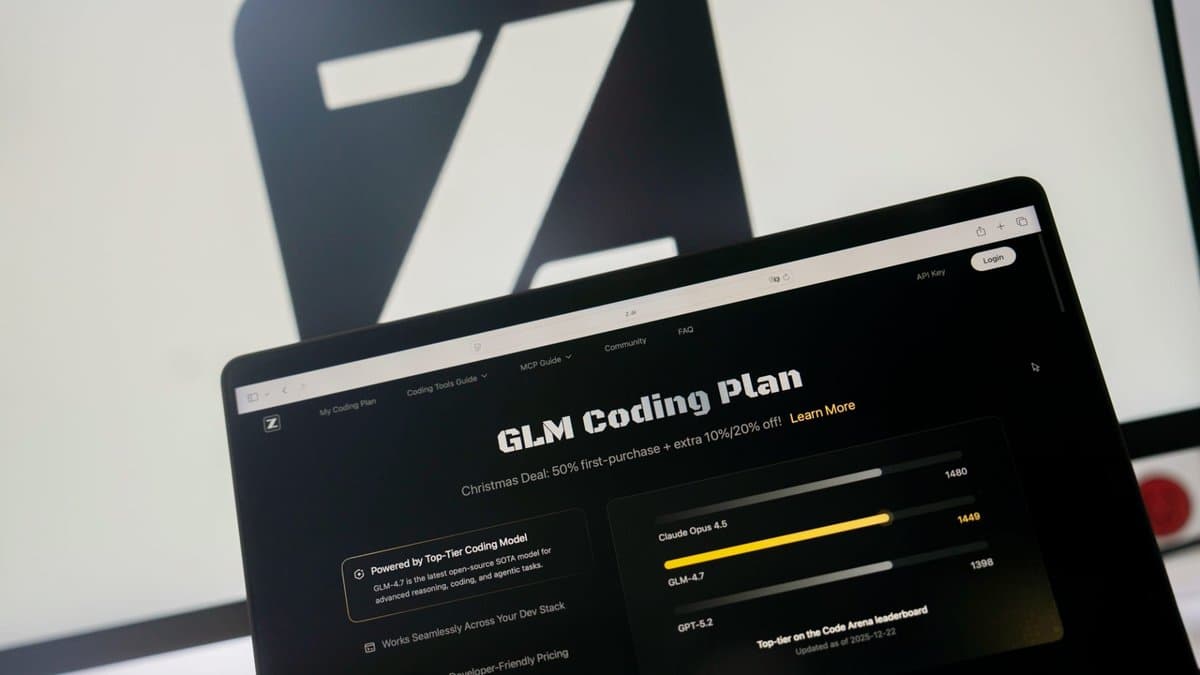
The protagonist is DeepSeek. Born out of a Hangzhou hedge fund, the company shocked the world with R1 in early 2025 and has been rewriting the rules ever since through the V4 series. Its core weapon is "open-weight" — it dumps its model weights onto the internet so anyone can download and run them on their own servers. And it's not just DeepSeek. Chinese open-weight models like GLM 5.2 (Zhipu) and Kimi K2.7 (Moonshot) are all charging in together.
Why does "open-weight" matter so much? Because it basically neutralizes US control. Once the weights are already public, there's no clean way for a government to say "don't use them." A US company can load those weights onto Amazon or any domestic infrastructure provider, run them on American soil, and no data ever crosses into China. Lindy did exactly this — it hosts DeepSeek on Atlas Cloud, a US-based inference provider, running on American servers.
And the performance gap is no longer a punchline. Per CNBC's reporting and the associated benchmarks, the latest Chinese open-weight models have closed to within about a percentage point of frontier US models on agentic tasks. GLM 5.2, for instance, lands within one percentage point of Anthropic's Opus 4.8 on a leading agentic benchmark — at roughly one-fifth the cost. We've moved past "a bit weaker but way cheaper" into "basically as good but way cheaper." That second sentence is a very different thing to defend against.
What 60-90% Cheaper Actually Looks Like
Put it in numbers and the migration explains itself. DeepSeek V4 Flash runs about $0.14 per million input tokens on its official API. OpenAI's GPT-5.5 runs $5.00 per million input tokens. Processing the same amount of text costs more than 35 times as much on the US model. Output tokens tell the same story — GPT-5.5 is $30 per million output tokens; DeepSeek Flash is $0.28.
Here it is as a table.
| Model | Input (per 1M tokens) | Output (per 1M tokens) | Type |
|---|---|---|---|
| DeepSeek V4 Flash | $0.14 | $0.28 | Chinese open-weight |
| OpenAI GPT-5.5 | $5.00 | $30.00 | US proprietary |
| Rough multiple | ~36x | ~107x | — |
Enterprise API usage is dominated by input tokens. Summarizing long documents, analyzing a whole codebase, replaying conversation history over and over — all of it is input-heavy. Which is why the real-world savings companies report land around 60-90%. For a company burning tens of millions of dollars a month on AI, that isn't "let's trim costs." That's a different income statement.
Here's the genuinely scary part underneath it all: AI usage is still exploding. Everyone's bolting on agents, automating workflows, letting models grind away in the background. The old era rewarded "just use the best model." But once usage gets this big, unit price stops being a footnote and becomes the variable that decides your margins. If performance is comparable, the reason to eat a 35x price difference keeps evaporating.
Coinbase and Lindy — Two Companies That Actually Switched
Enough abstract statistics. Let's talk about companies that actually pulled the trigger. The most symbolic one is Coinbase.
Coinbase, the largest US crypto exchange, runs roughly 1,200 AI agents internally. These agents handle code writing, review, and operational automation — and Coinbase switched its engineers' default models to Chinese open-weight models: GLM 5.2 and Kimi K2.7 Code. The result? Its AI spend dropped by nearly half. And that's with token usage actually going up. In other words, it used more and paid less. The trick was standing up a multi-model infrastructure that automatically routes each job to the right model.
The second protagonist is the AI agent startup Lindy, and Lindy went further. It didn't just shift a slice of traffic — it moved essentially 100% of its managed agents' primary model from Claude to DeepSeek V4. Lindy's CEO Flo Crivello told CNBC the switch saves the company millions, and reported that inference costs on the migrated routes fell by roughly 90%. It was a decision made once AI costs grew larger than personnel costs.
But there's a crucial detail in the Lindy story: they did not switch blind. Offline evals, then provider testing, then prompt optimization, then internal rollout, then online evals, then retention checks, then a full ramp. They ran the whole gauntlet. And interestingly, they kept Sonnet around for specific tasks that need higher intelligence. So it wasn't "cheapest, always" — it was "cheapest that does the job." Crivello even said he'd switch back if Anthropic cut prices. That's not loyalty. That's pure economics.
What makes these two cases so alarming for the US labs is that they're production decisions, not experiments. Nobody was kicking tires — these are live services earning real revenue with Chinese models wired into the core.
Déjà Vu — We've Seen This "Value Invasion" Before
Doesn't this picture feel familiar? A cheaper alternative that's a touch weaker on performance eats the market from the bottom up, then keeps climbing until it swallows the middle and top. That's Clayton Christensen's disruptive innovation, textbook edition.
Take the success cases first. Android did exactly this. Early Android phones were clunkier than the iPhone, but they were cheap and open, so they took emerging markets first — and today Android owns the overwhelming majority of global smartphone OS share. Being open source, so anyone could grab it and run with it, was decisive. That's an eerie match for the "open-weight" strategy DeepSeek, GLM, and Kimi are running right now. Linux is the same tale — dismissed as a "toy OS" once, now the backbone of the world's server infrastructure.
But there's a counter-case that ended in failure: Huawei's telecom gear. On price and performance it made serious inroads into Western markets — then hit a wall of national security concerns and got pushed out of core US and European markets. Geopolitics, not technology, decided that fight. Chinese AI models are standing at exactly that fork now. On pure economics the penetration keeps going; how much the security variable intervenes will decide the ending.
So the whole thing narrows to one question to watch. Does "value disruption" (the Android route) win, or does "security lockout" (the Huawei route) win? And judging by the numbers so far, the market has already started walking toward value.
How Will OpenAI and Anthropic Fight Back?
The ones cornered here are the US labs. So how do they counterpunch? A few cards are visible.
Card one is cutting prices. The most direct response. OpenAI has already opened batch and flex processing modes that halve GPT-5.5's rate to $2.50/$15. Given that Lindy's CEO said he'd come back if Anthropic dropped prices, aggressive price cuts could win back some of the departed traffic. The catch: this eats into their own margins, and they'd have to explain to investors that they're trading profitability for growth.
Card two is differentiating on performance. If you can't win on price, you push the line that "our model is just smarter, so it's actually cheaper in the end." Keep a clear lead on complex reasoning, long context, and reliable tool use, and the high-intelligence top of the market stays with US models. Lindy keeping Sonnet for its high-intelligence tasks is exactly that proof. The problem is that the gap has now closed to a single percentage point.
Card three is the policy and security card. This isn't one the labs play directly, but it could work in their favor. On July 8, 2026, CNBC reported that the House Committee on Homeland Security and the House Select Committee on China are jointly investigating US companies' adoption of Chinese AI models. Homeland Security chairman Andrew Garbarino said recent reporting that a Chinese open-weight model can match leading US models on certain vulnerability-discovery and cybersecurity tasks is "highly alarming." Names like Cursor and Airbnb came up as subjects of scrutiny.
But there's a dilemma baked in. Open-weight models already have their weights public on the internet, which makes a full ban essentially impossible. Even if the government says "don't use them," a company can just download them and run them on US servers. CNBC's read is that while the Trump administration is "clearly worried" about the risk, finding a way to actually regulate it is hard.
So What Actually Changes for You
Let's break down what this means for each of you.
If you're a developer or engineer, this is honestly good news. More model choices and lower unit prices mean you can now ship features that cost used to kill. Run more agents, throw more background jobs at the wall, experiment more boldly. The flip side: handling "multi-model infrastructure" becomes a new must-have skill. Routing models by task, the way Coinbase does, is about to become standard design. And if your company is in a regulated industry (finance, healthcare, government contracting), which model runs where becomes a compliance question, so factor that in too.
If you're an investor, this is a signal that a crack has opened in the US labs' margin story. The logic "we monopolize frontier performance, so we can charge premium prices" starts wobbling the moment the performance gap shrinks to a percentage point and Chinese models arrive at one-fifth the cost. The very top of the intelligence market will likely stay American, but price pressure on the high-volume mid-and-low tier of token demand won't let up. This is reading market structure, not investment advice, so don't take it as the latter.
If you're a regular user, there's not much to feel day to day. You probably don't know which model runs behind the app you use, and that's fine. But two things are worth knowing. One is that AI-powered services now have room to get cheaper or offer more free features (because costs are falling). The other is that the debate over which model processes your data is about to get loud — and if a service handles sensitive information, that's a question worth asking.
🥄 Three Things You're Probably Wondering
— If it runs on US servers, is there really no data-leak risk? The "data crossing into China" problem is largely solved by hosting on US infrastructure — that's exactly why Lindy uses Atlas Cloud. But worries like "what if there's a backdoor or bias baked into the model itself?" are separate from where the server sits, and that's precisely where the lawmakers are digging. It's too early to fully relax.
— So are US models done for? No. The top of the market — hardest tasks, complex reasoning, reliable tool use — still belongs to US models. Even Lindy kept Sonnet for its high-intelligence work. The real shift is that the era of "always use the priciest best model" is over, and weighing cost-per-job on every task is now the default.
— This 46% number — will it keep climbing? On pure economics there are plenty of reasons for it to rise: performance has caught up and the price is one-fifth. But the wild card is geopolitics. If the congressional probe turns into regulation, or the US labs slash prices hard, the trend could bend — just like Huawei got blocked by security, not technology. So this is a story where you have to watch political news alongside market data to forecast it.
Further Reading
- CNBC — Chinese AI models are gaining ground with U.S. companies as OpenAI, Anthropic costs surge
- CNBC — Lawmakers probe growing use of Chinese AI models in U.S. companies
- The New Stack — Coinbase runs 1,200 agents and just slashed its AI bill in half
- Lindy — Migrating from Claude to DeepSeek
- The New Stack — This AI agent startup ditched Anthropic for DeepSeek
- DeepSeek API Docs — Models & Pricing
- OpenRouter — DeepSeek V4 Flash API Pricing & Benchmarks
Figures are as of announcement and may change.