The robots aren't making real money yet, but the IPOs have already started
On July 14, a Shenzhen humanoid robot startup called LimX Dynamics (逐际动力) announced it had closed a pre-IPO round of nearly $200 million. If "pre-IPO" isn't in your vocabulary, it means exactly what it sounds like: the last private money a company takes before it goes public. Closing one is a statement — the listing clock is already running. The post-money valuation came in at RMB 15 billion, which works out to roughly $2.2 billion. The Next Web pegged it more precisely at $2.21 billion, though the dollar figure drifts by a hundred million or so depending on which outlet's exchange rate you use, so "about $2.2 billion" is the safe way to hold it.
On its own, that reads like another entry in the endless "Chinese robotics company raises big pile of cash" genre. Here's the deal: the weight of this news isn't in the number. It's in one sentence from the founder. Ahead of the announcement, founder and CEO Will Zhang (Zhang Wei) told reporters, "Listing is a must." Not exploring. Not considering. Must. And the company confirmed it's already in the confidential filing phase, with Hong Kong the likely venue.
That's the part worth watching, because LimX is not alone. As CNBC laid out in a July 13 piece, Chinese humanoid companies have entered a full-on collective IPO rush. Unitree has already secured approval for its Shanghai listing. EngineAI filed confidentially in Hong Kong, per Bloomberg. CNBC also reports DeepRobot and Leju lining up behind them. China has well over 100 humanoid robot companies, and a meaningful slice of the leaders are knocking on the public-market door at almost the same moment.
So the real question today isn't "how much did LimX raise." It's why is everyone trying to list right now, all at once? And is that a signal that humanoid revenue has become real — or a timing play to cash in before the narrative cools? Let's take it apart.
The players — a tenured Ohio State professor who set up shop in Shenzhen
LimX Dynamics was founded in 2022 in Shenzhen. The résumé of founder and CEO Will Zhang explains a lot about the company's character. Zhang was a tenured professor at Ohio State University. Tenure in American academia is, functionally, the end of the career ladder — a job you hold for life if you want it. Walking away from that to move back to China and start a robot company in Shenzhen is the kind of move a person makes when they've decided a window is open and won't stay open long.
The Shenzhen part isn't incidental either. Shenzhen is arguably the fastest place on earth to turn a hardware idea into a working prototype. Motors, gearboxes, sensors, batteries, injection-molded parts — the entire supply chain for building a robot sits within a few dozen kilometers. You can recruit software talent from Silicon Valley, but you cannot replicate that component density anywhere else. And for something like a humanoid, where you have to run the design-build-test-revise loop hundreds of times, iteration speed is the competitive advantage.
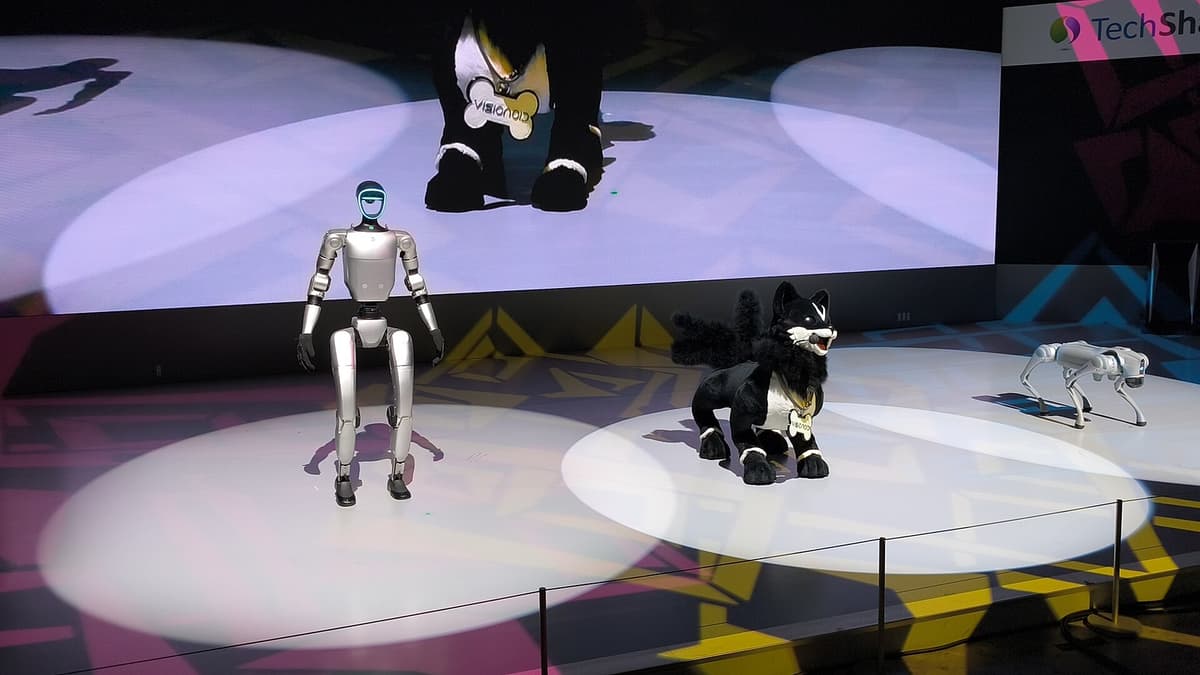
The product lineup tells you what they're aiming at. The flagship is Luna, a 160cm full-size interactive humanoid with 27 degrees of freedom — that is, 27 independent directions in which its joints can move. More degrees of freedom means more complex, more human-looking motion. Luna launched in May 2026, and batch deliveries began within a month of launch, including to customers in South Korea. Alongside it are TRON 2, a modular multi-form robot aimed at developers, its predecessor TRON 1, and Oli.
The technical stack is organized in an unusual layered way. System 0 is a full-body motion foundation model — essentially, a base model that has learned how to move a body. System 1 builds actual humanoid capabilities on top of that. System 2 is an embodied agent OS, the layer where the robot reasons and plans its own actions. On top of all that, the company open-sourced the FluxVLA Engine. VLA stands for Vision-Language-Action, a model architecture that fuses seeing, understanding, and moving into one system. It's the frontier grammar of robotics AI right now, and very few companies have shipped a working implementation into the open.
What actually happened — $400M in six months, and 70% of it foreign
Let's go through the numbers one at a time. The size is nearly $200 million — outlets are consistent that it's "nearly," not exactly $200 million, which is a small precision point worth respecting. And this is LimX's second mega-round of the year. The company raised a roughly $200 million Series B in February 2026. That means it has pulled in about $400 million in six months. That's secondary-offering pace for a company that isn't public yet.
The investor list is where this deal gets genuinely interesting. The leads: IDG Capital, one of China's top-tier VCs; Lens Technology (藍思科技), best known as an Apple device supplier; Stone Venture out of Abu Dhabi; Italy's GGG Group; and Germany's Redstone VC. Joining them were NIO Capital, WestSummit Capital, Hefei Binhu Industry Development Group and Hua Capital, with existing holders Vitalbridge, CoStone Capital, Nanshan SEI and Shangqi Capital adding on. Worth noting: this detailed investor breakdown comes from 36Kr, Gasgoo and Caixin reporting rather than the company's own press release, which stays light on names.
Two things jump off that list. First, Lens Technology. When the company that makes iPhone cover glass takes a strategic position in a humanoid startup, that's a signal the consumer-electronics supply chain has started treating robots as the next mass-manufactured product category. When a component maker writes a check, it usually isn't a pure financial bet — it tends to lead to production partnership. Second, Abu Dhabi, Italy, Germany. Middle Eastern and European capital leading a Chinese robotics round is not a common picture. And indeed, roughly 70% of this round came from overseas institutions.
That 70% figure matters more than it looks. US-China tensions have made it dramatically harder for Chinese deep-tech companies to take Western money. LimX went the other way and sourced the bulk of its capital abroad. That says two things simultaneously: humanoids are attractive enough as a sector that investors will eat geopolitical risk to get in, and LimX positioned itself as a globally oriented company from the start. The company says it has booked thousands of orders, more than half of them from overseas, and has a multi-year plan to ship thousands of humanoids to the Middle East.
The IPO preparation is concrete, too. LimX completed its share reform in March 2026 — the conversion from a limited liability company to a joint-stock company, a mandatory precursor to a Chinese IPO. Now it's in confidential review. But draw the line clearly here: the venue and timing are not settled. "Hong Kong is likely" is the honest ceiling of what can be said today.
| Item | Detail |
|---|---|
| Company | LimX Dynamics (逐际动力), founded 2022 in Shenzhen |
| Founder | Will Zhang (Zhang Wei) — former tenured Ohio State professor |
| Round | Pre-IPO (announced July 14, 2026) |
| Size | Nearly $200 million |
| Valuation | RMB 15 billion (about $2.2 billion, post-money) |
| Lead investors | IDG Capital · Lens Technology · Stone Venture (UAE) · GGG Group (Italy) · Redstone VC (Germany) |
| Key participants | NIO Capital · WestSummit · Hefei Binhu Industry Development Group · Hua Capital · Vitalbridge · CoStone · Nanshan SEI · Shangqi Capital |
| Overseas capital share | About 70% |
| Raised in six months | About $400 million (incl. ~$200M Series B in February) |
| Flagship product | Luna — 160cm, 27 degrees of freedom, launched May 2026 |
| Other products | TRON 2 · TRON 1 · Oli |
| Tech stack | System 0 (whole-body motion model) / System 1 (humanoid capabilities) / System 2 (agent OS) + open-source FluxVLA Engine |
| Orders | Thousands, more than half overseas / multi-year Middle East supply plan |
| IPO status | Confidential filing phase, Hong Kong likely (not confirmed) · share reform completed March 2026 |
What each side gets — and why they're all running at once
For LimX, this round is both ammunition and a warm-up lap. Humanoids, unlike software, are a business where money turns into physical objects. You buy motors, stand up production lines, carry inventory, build a service organization. Actually delivering thousands of units demands an enormous amount of working capital. On top of that, a pre-IPO round functions as a de facto floor for the offering price. LimX is walking into its listing with a $2.2 billion price tag already stamped on it by the market.
The investors each want something different. Financial backers like IDG are playing for listing upside — a pre-IPO round is typically the last discounted entry point before a company goes public, taken on the assumption that the listing is close. A strategic investor like Lens Technology is running a different math. As the smartphone market matures, precision component makers are desperately hunting for the next mass-production category. If humanoids turn out to be it, planting equity now is a way of pre-booking future manufacturing orders.
Middle Eastern and European capital has an even more explicit angle. For Abu Dhabi's Stone Venture, robotics is a piece of the post-oil portfolio and, simultaneously, a channel for actually getting robots into the country. The fact that LimX has a multi-year plan to ship thousands of units to the Middle East and that this investor set showed up is not a coincidence — capital and demand walked in together. Europe's GGG Group and Redstone are doing something similar: securing a pipeline for putting robots onto their own manufacturing floors.
And the Chinese robotics sector as a whole benefits. When one leader gets a $2.2 billion price tag, the valuation baseline for everyone behind it rises with it. That's visible in the aggregate: Q2 2026 investment into the Chinese humanoid sector hit RMB 47.09 billion (about $6.95 billion), more than double Q1. The pot in this market doubled in a single quarter.
Now the cold part. There's a plausible reading in which everyone is racing to list because right now is the best price they will ever get. Humanoids are not a category with proven large-scale commercial revenue. Thousands of orders is impressive, but nobody outside these companies knows whether that's durable industrial demand with repeat purchases or a wave of first-generation pilot buys. Going public when the narrative is at its hottest is a rational move. It's also, unavoidably, a signal of anxiety — a read that if you don't go now, you might be too late.
Precedents — what worked and what didn't
The closest comparison is Unitree. Same country, same category, and the front-runner of this entire rush. Unitree cleared review by the Shanghai Stock Exchange on June 1, 2026, and secured final CSRC registration approval on July 3, 2026 for a STAR Market listing targeting roughly RMB 4.2 billion (about $610–620 million). In other words, Unitree isn't "preparing" — it has the approval in hand. Part of the reason Zhang can say "listing is a must" with a straight face is that he has watched a peer walk all the way through the door.
EngineAI is a different path. Bloomberg reported on June 12, 2026, citing unnamed sources, that it filed confidentially in Hong Kong. That's a confidential filing based on anonymous sourcing, not a publicly confirmed process, and it deserves that qualifier. The DeepRobot and Leju preparations come from CNBC's reporting and haven't been independently corroborated elsewhere. So the accurate scoreboard is: Unitree approved, EngineAI reportedly filed, LimX in confidential review, others said to be preparing. Same "rush," wildly different stages — worth keeping straight.
Historically, this kind of synchronized sector listing has broken two ways. The good version happens when an industry is genuinely crossing an inflection point. China's EV trio — NIO, XPeng, Li Auto — hitting US markets in roughly the same window around 2020 is the canonical case. At the time, plenty of people asked how you justify those valuations on so few cars sold. Over the following years, actual delivery volumes caught up and the narrative converted into results. It's fitting, then, that NIO Capital is in this LimX round: capital that lived through that exact cycle in EVs is now looking at the same shape in robots.
The bad version is just as clear. Autonomous trucking and lidar both saw a stampede into public markets while the technology narrative was hot, followed by valuations collapsing when revenue failed to track the projected curve. The common pattern is a simple one worth memorizing: backlog, delivery, and repeat purchase are three completely different metrics. LimX's "thousands of orders, more than half overseas" is a genuinely good number, but how many units have actually been delivered, and how many customers came back for a second order, is not public information. Once the company lists, it will have to publish those figures every quarter. That's the real reason this IPO rush is interesting: public markets force narrative to convert into numbers.
How rivals counter
Unitree's counter is speed and brand. With CSRC approval already secured, it gets the offering proceeds in hand first. And the title of "first listed humanoid company" is a marketing asset in its own right. The initial pool of institutional money allocated to this sector is likely to flow toward Unitree, which in turn lowers its cost of subsequent capital. LimX stamping a $2.2 billion price tag on itself in a pre-IPO round reads as an attempt to blunt exactly that first-mover effect.
EngineAI and the other Hong Kong hopefuls play a different card. Hong Kong offers far better access for overseas investors than Shanghai does. For a company like LimX — 70% of its capital from abroad, more than half its orders from abroad — Hong Kong is the far more natural stage. Shanghai skews toward domestic capital and policy support; Hong Kong skews toward global capital and an export-revenue story. Within the same industry, the choice of listing venue is itself a strategic declaration.
The other hundred-plus companies have a far more desperate counter to run. China has well over 100 humanoid firms. RMB 47.09 billion flowed into the sector in Q2, but it did not spread evenly across 100 companies. In phases like this, capital concentrates violently at the top. The companies that list use the proceeds to lock in manufacturing capacity and unit-cost advantage, and everyone behind them immediately finds themselves paying more for the same components. The scary thing about an IPO rush isn't who lists first — it's the consolidation and shakeout that starts right after.
And the competitors outside China aren't sitting still. Humanoid camps in the US, Europe, Korea and Japan see Chinese firms using public-market money to drive down prices and push outward as the top threat. LimX having already shipped Luna to South Korea and holding a multi-year Middle East supply plan is proof this competition has already crossed borders. How non-tariff barriers — supply-chain security reviews, data regulation — end up shaping that fight is still an open question.
So what actually changes
If you're a developer — the most immediately usable thing here is that LimX open-sourced the FluxVLA Engine. Vision-Language-Action models are the hottest architecture in robotics AI right now, and very few companies have released a working implementation. TRON 2 was designed from the start as a modular robot for developers. If you've wanted to get your hands on humanoid software, the barrier is dropping. Just note that the full System 0–2 stack isn't all open, so check for yourself exactly where the line sits before building on it.
If you're an investor — two signals matter here. First, 70% of the capital came from overseas, which means global money is willing to lead a Chinese robotics round even amid US-China tension. Sector heat has, for now, overwhelmed geopolitics. Second, Q2 sector investment of RMB 47.09 billion, more than double Q1. But stay cold about the other side: no revenue figure supporting a $2.2 billion valuation has been disclosed. What's confirmed is "thousands of orders" and "more than half overseas," full stop. If the listing actually happens, those numbers get published by mandate. Whether today's valuation was justified gets settled then, not now.
If you're a regular person — nobody is putting a humanoid in your living room this year. The units shipping now go overwhelmingly to research institutions, developers, and industrial sites. But the direction is unmistakable. Luna entering batch delivery within a month of launch, with South Korean customers in the first wave, means humanoids are moving from trade-show demo to a thing you can order and receive. And once listed companies deploy public-market capital into mass production, unit prices have to come down. How fast that price curve falls is the next thing worth watching in this industry.
🥄 Three Things You're Probably Wondering
— So what does this mean for me? Not much directly, today. But LimX's Luna has already started shipping to customers in South Korea, which means seeing a Chinese-built humanoid in a lab or on a factory floor near you is closer than you'd assume. Once IPO money funds mass production, the price should follow it down.
— Are these companies actually making money? Too early to say with confidence. What's public is "thousands of orders, more than half overseas" and "Luna entered batch delivery within a month of launch." No revenue or profit figures have been disclosed. Ironically, that's what makes the IPO rush welcome — once these firms are public, they have to report quarterly, and that's when we finally learn whether humanoid revenue is substance or story.
— When and where is LimX actually listing? Nothing is locked in. The company has said only that it's in the confidential filing phase, and Hong Kong is considered the likely venue. It completed its share reform in March 2026, so the process is genuinely underway — but naming an exchange or a date right now would be getting ahead of the facts.
Sources
- CNBC — 'Listing is a must': Chinese humanoid startups are rushing to launch IPOs
- Caixin Global — Chinese Robotics Startup Raises $200 Million
- LimX Dynamics newsroom — Closes US$200 Million Pre-IPO Round
- 36Kr — LimX Dynamics $200M Pre-IPO Financing | 15B Yuan Post-Money Valuation
- The Next Web — LimX Dynamics hits a $2.2bn humanoid valuation
- The Information — Chinese Humanoid Startup LimX Dynamics Closes Pre-IPO Funding at $2.2 Billion Valuation
- Gasgoo — LimX Dynamics Raises Nearly $200 Million in Pre-IPO Funding
Numbers and criteria are as of announcement and may change. Investment calls are yours to make!