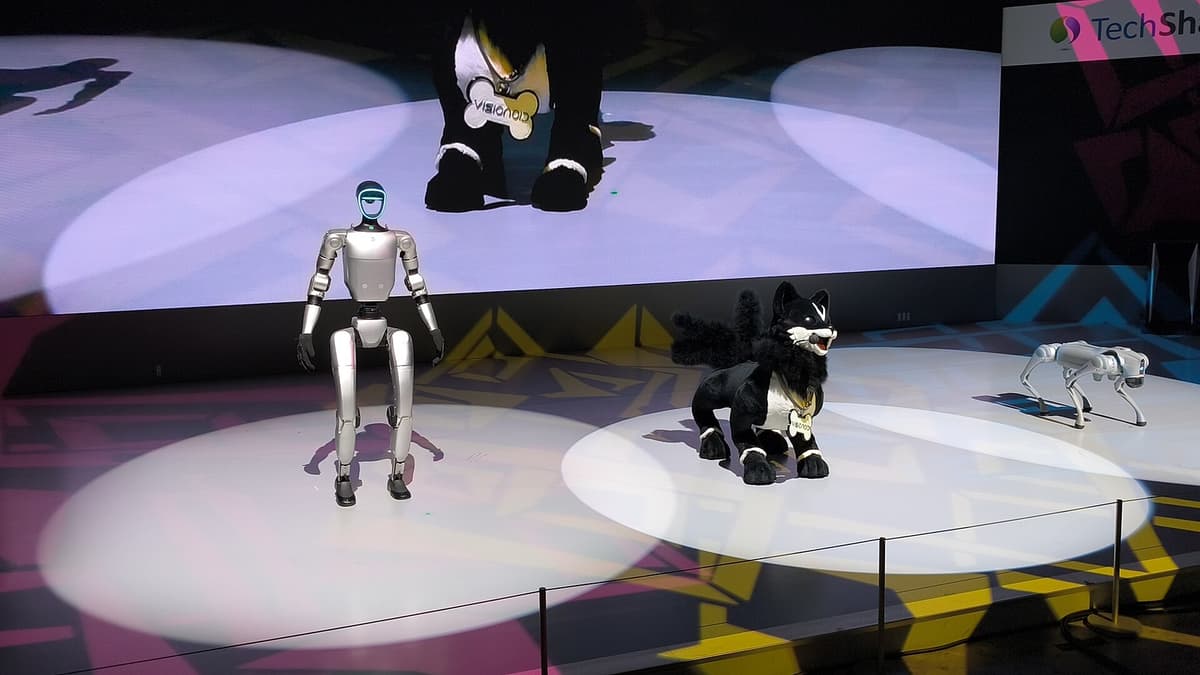
The Robots Are Walking Onto the Stock Market, One by One
For the past few years, humanoid robots have lived in the "demo video" era. Clips of them dancing, doing backflips, and moving boxes flooded everyone's feeds. But in the spring of 2026, those videos suddenly started turning into a different kind of paperwork: stock exchange listing filings.
On June 1, the Shanghai Stock Exchange's STAR Market listing committee approved Unitree's IPO — on a fast track, no less. It came with a title attached: the first "embodied AI" listing in China's A-share market, full stop. And almost simultaneously, Bloomberg reported on June 12 that EngineAI, a young Shenzhen startup, had filed confidentially for a Hong Kong IPO.
This isn't one or two companies happening to list around the same time. Robot-hand maker Linkerbot is chasing a roughly $6 billion raise, and other Chinese robotics firms are lining up their own filings. This isn't just IPO news — it's the signal of a full capital cycle kicking into gear. The demo era is ending, and the money era is beginning.
In this piece, we'll walk through who's listing where and for how much, why it's happening right now, and who laughs and who cries when the rush is over.
The Cast — EngineAI, Unitree, and China's Robotics Ecosystem
Let me introduce the two leads. They're completely different characters.
Unitree is the proven heavyweight. It's the world's top humanoid robot seller, and it's also famous for its quadruped robots (robot dogs). The most impressive thing, though, is the accounting. It's posted a profit every single year since 2020. For a robotics startup to be profitable every year is unicorn-among-unicorns rare. In the first nine months of 2025, it logged 1.2 billion yuan in revenue and 105 million yuan in net income. And here's the key part: humanoids jumped from 1.9% of revenue in 2023 to 51.5% by late 2025. Unitree is going public at the exact moment its identity is flipping from "robot-dog company" to "humanoid company." Its overall gross margin sits around 59.5% — absurdly high for a hardware company.
EngineAI is the opposite. Founded in Shenzhen in 2023, it's barely three years old. But its pace is insane. In April 2026 it raised a $200M Series B at roughly a $1.5B valuation, led by Henan Investment Group and Luxshare (yes, the Apple-supply-chain Luxshare). Then on June 1 it opened a 12,000-square-meter factory that reportedly builds its T800 humanoid once every 15 minutes, targeting 10,000 units a year.
EngineAI's robots aren't for demos. They're aimed at real jobs: traffic management, security patrols, retail-floor service, and industrial factory tasks. The phrase "embodied AI" fits its positioning perfectly — take smart software, put it in an actual body, and send it into the field.
Behind these two sits a huge ecosystem. Robot-hand specialist Linkerbot is pushing for a roughly $6 billion raise, and countless other Chinese robotics firms are drafting filings at the same time. Two forces make this possible. One is China's national robotics policy — this is a sector the government is openly backing. The other is exploding demand — real, paying appetite for embodied AI in logistics and manufacturing. Policy + demand + capital all met at one point, and that point is spring 2026.
The Core — Who's Listing Where, and For How Much
It's a lot, so let me lay it out in a table. You'll see at a glance how different a game these two are playing.
| Item | EngineAI | Unitree |
|---|---|---|
| Exchange | Hong Kong (HKEX), confidential filing | Shanghai STAR Market |
| Valuation | ~$1.5B (per Series B) | ~42 billion yuan (~$6.2B) target |
| Raise size | IPO size undisclosed (confidential stage) | ~4.2 billion yuan (~$608M) target |
| Status | Confidential filing reported June 12 | STAR review passed June 1 (fast-tracked) |
| Key trait | Founded 2023, 1 unit per 15 min, 10K/yr goal | Profitable since 2020, humanoids 51.5% of revenue |
| Underwriters | CICC, CITIC Securities | — |
The table reveals a fascinating contrast. Unitree is "an already-profitable company bringing its track record to debut on the mainland (A-share) market," while EngineAI is "a young company knocking on international capital's door (Hong Kong) with an explosive growth story." Both are humanoids, but the stories they're selling investors are completely different.
Another thing worth noting about Unitree's IPO is the timing. It filed its STAR Market application on March 20, and by June 1 it had already cleared review — about two and a half months. By STAR Market standards, that's a clear fast track. How quickly the Chinese authorities want to get this company — or more precisely, this industry — onto the capital markets is written all over that speed. Unitree also unveiled its new GD01 Mecha humanoid alongside the listing push. The message: "We've got plenty more product where that came from."
EngineAI's side is still at the confidential stage, so there's no concrete IPO size or valuation yet. But given it was at $1.5B at its April Series B, it'll be aiming higher by the time it lists in Hong Kong. The fact that two top-tier Chinese investment banks, CICC and CITIC Securities, are on board as underwriters is itself a signal that this is for real.
What Each Side Gains
What Unitree gains: deep liquidity in the mainland capital market, plus the symbolic weight of being "China's first embodied-AI listed company." That's branding beyond mere fundraising. Going forward, when people in China say "humanoid," Unitree becomes the reference point. With 4.2 billion yuan in hand, it gets the ammunition to pour into mass-production lines and R&D.
What EngineAI gains: a Hong Kong listing is a gateway to international investors. Foreign capital flows in more easily than on the mainland (A-share) market, and global recognition rises along with it. A three-year-old company is handing out its business card on the international stage with a story about a factory that builds one robot every 15 minutes. If it succeeds, it secures the funding to push production capacity to 10,000 units a year and stake out the position of "Chinese humanoids = cheap, fast, mass-produced."
What the banks and early investors gain: underwriters like CICC and CITIC pocket fees, but the bigger picture is opening a new revenue stream — a "humanoid IPO pipeline." Series B investors like Henan Investment Group and Luxshare secure an exit path through the listing. For Luxshare, this is more than a financial bet; there's supply-chain synergy to chase, too.
What the Chinese government gains: visible proof of its national robotics policy. It's evidence that "the industry we backed is actually being valued in the capital markets." The fast-track approval itself is an expression of policy intent.
Past Parallels — Successes and Failures
This kind of "new tech + simultaneous IPO rush" isn't a first. Let's look at what history teaches.
On the success side: think back to China's electric-vehicle (EV) boom in the 2010s. Policy + demand + capital converged, and countless EV startups went public all at once. Most vanished, but the real winners like BYD climbed all the way to global No. 1. Humanoids look structurally similar today — dozens are taking a shot, and one or two will become the next BYD. The fact that Unitree is profitable is a signal it's closer to being one of those "one or two."
On the failure side: by contrast, look at the dot-com bubble of the early 2000s, or more recently the once-hot drone and VR hardware booms. The demos were dazzling and the IPOs lined up, but companies whose actual revenue and margins couldn't keep up saw their stocks collapse brutally after listing. Hardware is especially merciless — unit costs, yield rates, after-sales service, and inventory all trip you up. "One unit every 15 minutes" sounds cool, but the real question is who's going to buy those 10,000 units.
So the key fork in this rush is whether the numbers catch up to the story. You can't judge a company that already has revenue and profit (Unitree) by the same yardstick as one where production capacity and growth story run ahead of the financials (EngineAI). Bubbles always pop in the "all story, no results" zone.
Competitors' Counter-Play
China isn't the only one playing this game. Let's look at the global board.
U.S. — Figure, Tesla Optimus: the American camp is trying to differentiate on "premium + software edge." Tesla's Optimus aims to graft the AI stack it built in self-driving onto robots, while Figure is chasing a general-purpose humanoid on the back of massive funding. But the U.S. side risks losing to China on unit cost and speed. If China charges ahead with "one unit per 15 minutes, 10,000 a year," the U.S. counters with "yeah, but our brain (AI) is smarter."
Korea: Korea holds a powerful card in Hyundai Motor Group (which owns Boston Dynamics). That said, Korea's strength lies less in a mass-production startup ecosystem and more in conglomerate-led, high-reliability industrial robots. Rather than going head-to-head on Chinese-style price competition, the realistic play is defending a premium in areas where precision and safety matter (car factories, logistics automation).
The heart of the counter-play: China's weapons are "speed + unit cost + government capital." The West's weapons are "AI software + brand trust + capital-market depth." This IPO rush is the moment China declares, "We've now got the capital, too." For the Western camp, it creates pressure: sit still and you might fall behind even on the speed of raising money. So expect IPO or mega-funding news from Figure and other U.S. players to arrive as a response to this rush.
So What Actually Changes — By Who You Are
If you're an investor: humanoids have finally become "an asset you can buy as a stock." Until now, unless you got into a private funding round, access was basically impossible. Now, through the Shanghai and Hong Kong exchanges, even retail investors have a way in. But remember — in the early innings of a rush, the wheat and the chaff aren't sorted yet. A company with real results (Unitree) gets valued in the same basket as one that's all story. Watching the "real numbers" — profitability, the shift in revenue mix, gross margin — matters more than ever.
If you're a manufacturing or logistics company: it's time to seriously consider deploying humanoids. As these companies secure ammunition through listings, unit costs will fall fast, and the "robots instead of people" math will actually start to pencil out in more areas. The traffic management, security patrols, retail service, and factory tasks EngineAI is targeting are exactly those first targets. Drag your feet, and if a competitor automates first, catching up gets hard.
If you're a casual observer: file this away as "the inflection point where robots crossed from sci-fi into industry." Demo videos turning into listing filings means this technology is no longer a spectacle but an industry where money flows. The day you bump into a patrol robot on the street or a greeter robot in a store may come sooner than you think.
🥄 Three Things You're Probably Wondering
— If EngineAI's factory really builds one unit every 15 minutes, can it actually sell all 10,000? This is the real core question. Production capacity and actual demand are two different things. It's true the factory opened June 1 targets 10,000 units a year, but there's no guarantee yet that translates into real sales. Whether demand from traffic, security, and retail can keep up with that pace will show up in quarterly results after the listing.
— Unitree is profitable, but did that profit come from humanoids or from the legacy robot dogs? An important distinction. It's true that the humanoid share of revenue surged from 1.9% in 2023 to 51.5% by late 2025, but a big chunk of the cumulative profit (since 2020) was likely laid down by the legacy quadruped business. Whether humanoids alone deliver the same margin needs a bit more watching.
— If a bunch of other companies list too, won't the bubble pop? Honestly, there's that risk. Like the past EV and drone booms, if "all story, no results" companies pile on, a correction is almost inevitable. The difference this time is that an actually-profitable company (Unitree) sits at the front, which sets it apart from a pure bubble. In the end, the numbers sort the wheat from the chaff.
References
- Humanoid robot maker EngineAI files for a Hong Kong IPO — The Next Web
- Unitree fast-tracks Shanghai IPO with target valuation of $6.2 billion — Caixin Global
- Unitree gets STAR Market green light in China's hard-tech IPO wave — CGTN
- A Complete Guide To Unitree Robotics' 2026 IPO — KraneShares
- Bloomberg: EngineAI confidential Hong Kong IPO filing (reported 2026-06-12)
Numbers and criteria are as of announcement and may change. Investment calls are yours to make!