A $54 billion markup in about five months, and not a share has changed hands yet
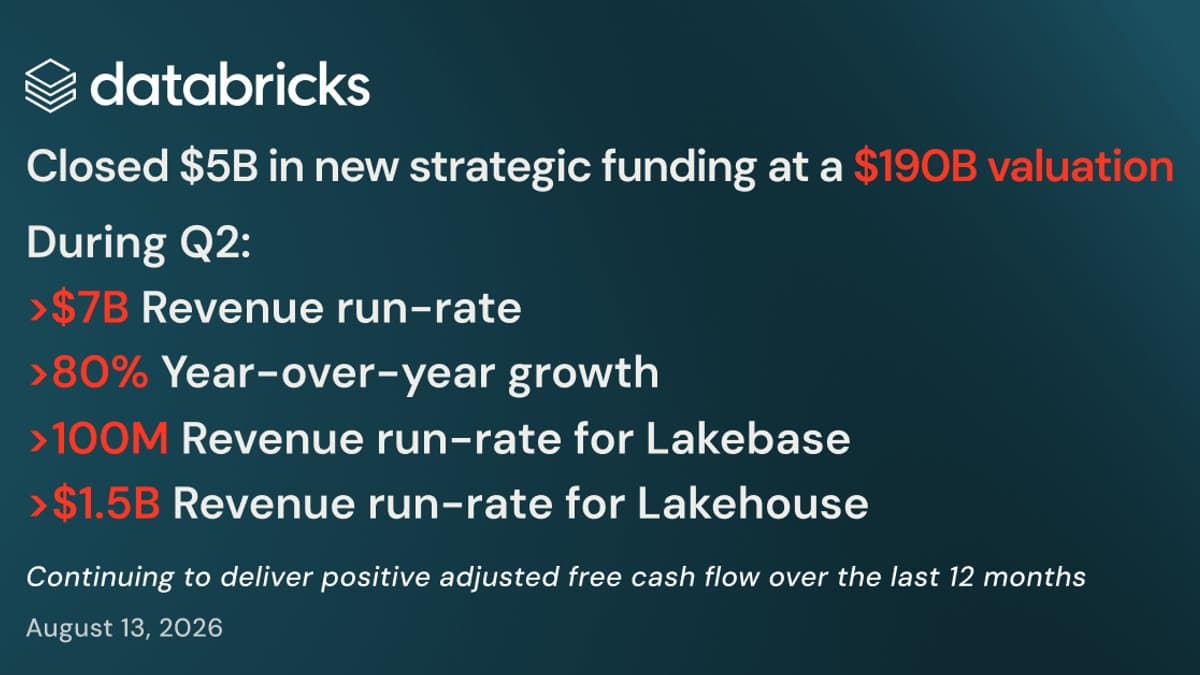
On July 16, 2026, Databricks put up a newsroom post with a title that does a lot of work: "Databricks is Raising a Strategic Round of Funding at a $188 Billion Valuation." Read the verb tense. Is raising. Not raised. Not closed. The company says it has signed a term sheet, that the round is led by existing investor Coatue alongside additional new and existing investors, and that it expects the thing to close later this summer.
Here's the deal: the last time anyone put a number on Databricks, it was $134 billion — announced December 16, 2025 and completed February 9, 2026. So in roughly five months, the private mark on this company jumped about 40%, or $54 billion in raw dollars. That is more incremental value than the entire market cap of most enterprise software companies you can name off the top of your head, created in the time it takes to run two quarterly board meetings.
Now the part that got flattened in most coverage: Databricks did not disclose the size of the round. The "around $3 billion" number you're seeing everywhere originated with a Wall Street Journal report on July 16 citing people familiar with the matter, got picked up by Reuters the same evening, and was carried by Bloomberg on July 17. Databricks' own release discloses exactly two things — the valuation and Coatue's lead. Treat the $3 billion as reported, not confirmed. Same goes for the investor roster: the release says "additional new and existing investors" and names none of them. And no specific Coatue partner has been publicly identified as running the deal, so don't let anyone tell you which Laffont brother signed it.
There's a bigger question sitting under the number, and it's the one worth your attention. Databricks is now the most expensive private company in enterprise software, it is generating serious revenue, it is free-cash-flow positive, and it keeps choosing not to go public. Every round like this is, functionally, an IPO deferral with a price tag. So let's work through what's actually being bought here — and what the last company to hold this exact position, Snowflake, did to the people who bought in at the top.
The players — the company that lost the "AI winner" bet and won anyway
Databricks was founded by the Berkeley AMPLab crew behind Apache Spark, and for the first decade of its life it sold something deeply unglamorous: a better place to run large-scale data processing. The "lakehouse" pitch — merge the cheap, messy data lake with the structured, governed data warehouse into one thing — was an architecture argument, not an AI story. That's important context, because it means Databricks did not show up in 2023 as an AI startup. It showed up as the company that already had the enterprise's data, at the exact moment enterprises figured out that data was the only durable moat in AI.
Ali Ghodsi, co-founder and CEO, has spent the last three years converting that position into an AI product line, and his framing of this round is the sharpest thing in the release: "Enterprises are moving from tokenmaxxing to valuemaxxing. They don't want to burn expensive tokens on the smartest model for every task — they want the best outcome per dollar." That sentence is the entire thesis. Databricks is not trying to beat OpenAI or Anthropic on model quality. It is positioning as the neutral governance, routing, and cost-control layer sitting above all of them — the place where a Fortune 500 company decides which model handles which task, at what price, under which policy.
Coatue leading is its own signal. Coatue is a crossover fund — it plays in both private and public markets — and it was already on the Databricks cap table. When an existing investor leads a 40% markup rather than a new marginal buyer setting the price, the bull read is conviction: the people with the most information are doubling down. The bear read is that insider-led rounds are the easiest way to print a valuation without genuinely testing outside demand. Both readings are legitimate and neither can be resolved from the outside, because private marks are negotiated, not discovered.
Worth naming the crowd already in this cap table, because it explains why the number can go where it goes. The $134 billion Series L was led by Insight Partners, Fidelity and J.P. Morgan Asset Management, with participation from BlackRock, Blackstone, Andreessen Horowitz, T. Rowe Price, Tiger Global, Thrive Capital and Robinhood Ventures. The February completion pulled in J.P. Morgan Chase's Strategic Investment Group, Glade Brook Capital, Growth Equity at Goldman Sachs Alternatives, Microsoft, Morgan Stanley, Neuberger funds, the Qatar Investment Authority and UBS-affiliated funds. Credit facilities were led by JPMorgan Chase Bank, Barclays, Citi, Goldman Sachs and Morgan Stanley. That is not a venture cap table. That is a pre-IPO shareholder register, complete with sovereign wealth and every bank that would want the listing mandate.
And note the delicious awkwardness: Microsoft is an investor and a competitor. Fabric is aimed squarely at the lakehouse. That's the shape of this market — everybody is invested in everybody, and everybody is trying to eat everybody.
What actually happened — the ladder, the math, and where the money goes
The valuation ladder is worth laying out end to end, because the slope is the story. Databricks went from $43 billion (Series I, September 2023) to $62 billion on a then-record $10 billion Series J (December 2024) to $100 billion on roughly $1 billion (September 2025) to $134 billion (announced December 2025, completed February 2026) to $188 billion now. That is roughly 3x in about 19 months.
One caveat on the "second raise of 2026" framing you'll see in headlines. It's defensible but sloppy. The prior round was announced December 16, 2025 as a ">$4 billion Series L at $134 billion" and completed February 9, 2026 at roughly $5 billion of equity plus about $2 billion of debt capacity — over $7 billion of total investment. It straddles both years. TechCrunch's shorthand of "February 2026: $5 billion Series L at $134 billion" is describing the close, not the announcement.
Then the revenue side. On February 9, 2026, Databricks said it had surpassed a $5.4 billion annualized revenue run-rate, growing more than 65% year over year, with $1.4 billion of that from AI products, net revenue retention above 140%, positive free cash flow over the trailing twelve months, 800+ customers above $1 million of annual run-rate and 70+ above $10 million. Then CNBC reported on June 16, 2026 that growth had accelerated past 80% year over year to a $6.9 billion annualized run-rate. Flag that clearly: the $6.9 billion figure is from that June report and is not restated in the July release, so the exact revenue base underlying the $188 billion mark is inferred, not company-confirmed.
| Item | Detail |
|---|---|
| Announcement | Term sheet signed for a strategic round; announced July 16, 2026 |
| Valuation | $188 billion (company-disclosed) |
| Round size | Reportedly ~$3 billion (WSJ, via Reuters/Bloomberg — not company-disclosed) |
| Lead | Coatue, an existing investor (no individual partner publicly named) |
| Other investors | "Additional new and existing investors" — identities undisclosed |
| Status | Not closed; expected to close "later this summer" |
| Prior mark | $134 billion — announced Dec 16, 2025, completed Feb 9, 2026 |
| Step-up | ~40.3% in roughly five months |
| Valuation ladder | $43B (Sep '23) → $62B (Dec '24, $10B Series J) → $100B (Sep '25) → $134B → $188B |
| Revenue (Feb 9, 2026) | >$5.4B annualized run-rate, >65% YoY, $1.4B from AI products, NRR >140% |
| Revenue (CNBC, Jun 16, 2026) | ~$6.9B annualized run-rate, >80% YoY growth |
| Implied multiple | ~27x run-rate at $6.9B (vs ~25x at $134B/$5.4B) — inferred, not confirmed |
| Customers | 20,000+ organizations; ~70% of the Fortune 500 (up from "60%+" in February) |
| Named customers | Adidas · AT&T · Bayer · Block · Mastercard · Rivian · Unilever |
| Use of proceeds | Unity AI Gateway, Genie, Lakebase; future AI acquisitions; AI research |
Do the multiple honestly, because this is where bulls and bears actually diverge. Against a $6.9 billion run-rate, $188 billion is roughly 27x revenue. Against the February print, $134 billion on $5.4 billion was roughly 25x. So the multiple expanded slightly — the valuation went up ~40% while the run-rate went up ~28% over the same window. The bull rebuttal is that at 80%+ growth the multiple compresses violently on its own: hold that rate and the run-rate approaches $12 billion within a year, which drops the same $188 billion to roughly 16x without a single thing improving. The bear rebuttal is that 80%+ growth at $6.9 billion of scale has essentially no precedent in enterprise software, and the entire valuation is a bet that it persists.
On use of proceeds, Databricks names three products. Unity AI Gateway — multi-model governance that applies security guardrails, blocks harmful prompt responses, and surfaces cost-reduction opportunities across models. Genie — the "AI coworker" that turns business data into answers and actions, recently extended with Genie One (natural-language querying across Databricks and external platforms) and Genie Ontology (automatic business-record organization). Lakebase — serverless Postgres built for AI agents, built on the Neon acquisition (~$1 billion, May 2025). SiliconANGLE adds Mooncake Labs, acquired for tech that cuts data-movement cost; TechCrunch references Omnigent, an agent-management platform, and Databricks' push toward open-weight models for cost control — the company argues that "Open models, and GLM 5.2 in particular, are now able to handle even the highest level of task difficulty" in coding, at lower cost than proprietary alternatives.
And the explicit fourth use: future AI acquisitions. Databricks just told the entire market it is shopping.
What each side gets
Databricks gets time, and a war chest for M&A. The capital matters less than the option it buys. A company that is free-cash-flow positive doesn't strictly need $3 billion to operate — it needs it to buy things fast in a market where the interesting acquisition targets in agent tooling, Postgres, feature stores and observability are all being bid on simultaneously. Cash on the balance sheet at a $188 billion currency means Databricks can pay in stock that everyone believes in, or in cash when the seller doesn't.
Coatue gets a defended position at a price it helped set. Crossover funds that entered earlier are now marking up their own book, which is genuinely useful for their LP reporting and genuinely uncomfortable as a governance matter. The honest way to read it: Coatue is buying more of something it already knows intimately, at a price it believes will look cheap against a 2027 listing. If the IPO prints above $188 billion, this is a great trade. If it prints below, insiders led a round into their own mark.
Employees get liquidity, and that's underrated. Databricks has run structured secondaries alongside recent rounds, and at eleven-plus years old with a large staff, unexercised options and expiring windows are a real retention problem. A round at a higher mark lets long-tenured engineers take money off the table without the company going public — which is precisely the mechanism that lets Ghodsi keep saying no to the listing.
The existing shareholders get an IPO deferral without a liquidity crisis, which is the whole trick. Ghodsi told CNBC in December 2025 that he "wouldn't rule out a 2026 IPO," then reversed on June 4, 2026, telling Bloomberg Television: "We will be a public company. I just think this is a terrible year to go public." Note what he did and didn't say — he committed to the destination and refused the date. A 2027 listing is the consensus analyst expectation, not company guidance. This round is what makes waiting affordable.
What nobody gets is a price discovered by an open market. $188 billion is a number two sophisticated parties agreed on in a negotiation. It is not a clearing price with millions of participants and daily marks. That distinction is the entire subject of the next section.
Precedents — MosaicML worked, Snowflake's IPO buyers did not
Start with the case for Databricks' M&A ambitions, because there's a strong one. In June 2023, Databricks bought MosaicML for $1.3 billion and got widely mocked for it — a nine-figure-revenue-at-best training-infrastructure startup at a billion-plus price looked like frothy nonsense. It became Mosaic AI, the foundation of the AI product line that was doing a $1.4 billion run-rate by February 2026. Put plainly: within three years the acquisition was generating annual revenue roughly equal to its purchase price. Tabular (>$1 billion, 2024) did something similar on a different axis, locking in Apache Iceberg leadership and neutralizing the open-table-format fight. That track record is why "funds future AI acquisitions" should be read as a real capability rather than a press-release throwaway.
Now the cautionary case, and it is uncomfortably exact. Snowflake IPO'd in September 2020 at $120 a share, opened near $245, and briefly carried roughly a $120 billion market cap on about $600 million of revenue — call it a 200x multiple. Growth was triple-digit and everyone extrapolated. Then growth decelerated the way growth always does at scale, and the stock fell roughly 70% from its peak by 2023–24. The company was fine. The business kept compounding. The buyers at the top were destroyed, because they paid for a multiple that mathematically could not survive normalization. Same sector, same architecture fight, same "obviously the winner" consensus.
The difference is real and worth stating fairly: Databricks at ~27x run-rate is nowhere near Snowflake's ~200x, and Databricks is growing faster in absolute dollars at seven times the revenue base. That's a materially better setup. But the structural lesson survives: a data-platform company's multiple can run far ahead of its growth curve, and the correction lands on whoever bought last. In a private round, the people who bought last are the ones writing checks right now.
The extreme version of the failure mode is WeWork — marked at $47 billion by SoftBank in January 2019, IPO withdrawn eight months later, bankrupt by 2023. Nobody sane thinks Databricks is WeWork; Databricks has real revenue, real retention above 140%, and positive free cash flow, which WeWork never had. But WeWork remains the canonical demonstration that a private mark is an opinion until a public market ratifies it. The longer a company stays private at an escalating mark, the more of that unratified opinion accumulates on somebody's balance sheet.
How rivals counter
Snowflake's counter is the boring one, and it's effective: we're audited. Q1 FY2027, the quarter ended April 30, 2026, put up $1.33 billion of product revenue, up 34% year over year, total revenue of $1.39 billion, up 33%, with FY2027 product revenue guidance raised to $5.84 billion (~31% growth) and a non-GAAP operating margin target of 13.5%. Snowflake will lean hard on the framing that its numbers are verified by auditors and priced by a liquid market every single day, while Databricks' $188 billion is a negotiation between people who own the asset. Note the fairness caveat: comparing the two on price-to-sales requires Snowflake's current market cap, which isn't verified here — so take that comparison qualitatively, not as a computed ratio.
Snowflake also isn't ceding the product ground. It signed a reported $6 billion AWS commitment, is pushing Cortex AI, and has a Crunchy Data-based Postgres offering that is a near-mirror of Lakebase. When two companies ship the same product category within months of each other, that's not coincidence — it's both of them reading the same customer requirement: agents need transactional Postgres sitting next to the analytical data, not across a network boundary.
Microsoft's counter is structural and slightly awkward. It is a Databricks investor and it ships Fabric, which bundles the lakehouse into the Microsoft estate where the enterprise agreement, the identity layer, and the procurement relationship already live. Microsoft rarely wins these fights on product quality. It wins them on the fact that the customer already signed the contract. Google (BigQuery), AWS (SageMaker Lakehouse), and Palantir on the operational-decisioning flank fill out the field.
The most interesting counter isn't a company — it's the model labs moving down the stack. Databricks' whole positioning depends on being the neutral layer above the frontier labs, taking a cut for governance, routing and cost optimization. That layer is valuable exactly as long as the labs don't build it themselves. Every lab shipping better native enterprise connectors, permissions, and cost dashboards compresses the space Unity AI Gateway occupies. Ghodsi's "valuemaxxing" line is a bet that enterprises will insist on a vendor-neutral control plane rather than accept one from a lab that's also selling them tokens. That bet is reasonable. It is not guaranteed.
Expect the near-term response across all of them to be the same two moves: accelerated agent-governance features, and defensive M&A in the Postgres, feature-store and agent-observability layers. Databricks just announced it's shopping with billions of fresh capital. Nobody wants to be outbid for the same targets.
So what actually changes
If you're a developer — the practical signal is where the money is pointed. Unity AI Gateway, Genie, Lakebase. Two of those three are about the same underlying shift: agents need governed, transactional access to enterprise data, not a vector index bolted onto a warehouse. Lakebase in particular — serverless Postgres, built on Neon, positioned for agent workloads — is Databricks saying the agent's working memory belongs next to the analytical data. If you're architecting agent systems on enterprise data in 2026, that convergence is worth planning around regardless of which vendor you pick, because all of them are converging on it. The open-weight angle matters too: Databricks publicly arguing that open models now handle top-difficulty coding tasks at lower cost is a procurement argument you can reuse internally.
If you're an investor — separate the confirmed from the reported before you do anything. Confirmed: $188 billion, Coatue leading, term sheet signed, not closed, expected to close later this summer. Reported but not company-disclosed: the ~$3 billion size. Undisclosed entirely: every other participant. Inferred, not confirmed: the ~27x multiple, because the $6.9 billion run-rate comes from a June CNBC report rather than the July release. Expectation rather than guidance: a 2027 IPO — Ghodsi has committed only to "we will be a public company," with no date. The bull case is genuinely strong: 80%+ growth at nearly $7 billion of scale, NRR above 140%, positive free cash flow, 70% of the Fortune 500 as customers. The bear case is Snowflake 2020 — a great company whose multiple ran ahead of its curve, where the loss landed on the last buyer. And if you're accessing this through a secondary vehicle or a fund marking Databricks at $188 billion, understand that you are buying a negotiated mark, not a market price, with an unknown holding period until liquidity.
If you're a regular user — none of this touches you directly this week, but the direction does. The reason Databricks can charge $188 billion worth of expectation is that large companies are now spending enormously to make AI actually useful on their own data, under their own rules. The airline that knows your booking history, the bank that flags your transaction, the retailer that predicts a stockout — the plumbing behind all of that is what this round funds. Ghodsi's "best outcome per dollar" line is the tell: the industry is past the phase of running the most expensive model on everything, and into the phase of routing cheap models to easy work. That's the shift that eventually decides whether AI features in the products you use get cheaper and more common, or stay expensive and rationed.
🥄 Three Things You're Probably Wondering
— So what does this mean for me? Directly, nothing this week. Indirectly, this is a bet on where enterprise AI spending goes next — from "buy the smartest model" to "govern and route many models cheaply." If that bet is right, AI features inside the apps and services you already use get cheaper and more widespread over the next couple of years, because the companies building them stop overpaying for every single query.
— Is Databricks actually worth $188 billion? Nobody knows, and that's the honest answer. It's roughly 27x an inferred ~$6.9 billion annualized run-rate that's growing over 80% a year — expensive, but not insane if that growth holds even partway. The catch is that $188 billion is a price two parties negotiated privately, not one a public market discovered. Snowflake's 2020 IPO buyers learned exactly how far apart those two things can be.
— If they have this much money and momentum, why not just IPO? Ghodsi answered it himself on Bloomberg TV in June: "We will be a public company. I just think this is a terrible year to go public." Rounds like this are what make waiting cheap — employees get liquidity through secondaries, the company gets acquisition capital, and nobody has to accept a public market's opinion of the price. A 2027 listing is what analysts expect, not what the company has promised.
Sources
- Databricks is Raising a Strategic Round of Funding at a $188 Billion Valuation — Databricks Newsroom (Jul 16, 2026)
- Databricks hits $188B valuation, extending its run as AI's favorite second act — TechCrunch
- Coatue Leads Databricks Funding Round at $188 Billion Valuation — Bloomberg
- Databricks raising new funding at $188B valuation — SiliconANGLE
- Databricks Grows >65% YoY, Surpasses $5.4 Billion Revenue Run-Rate, Doubles Down on Lakebase and Genie — Databricks (Feb 9, 2026)
- Databricks raises $4B at $134B valuation as its AI business heats up — TechCrunch (Dec 16, 2025)
- Databricks revenue growth tops 80% to $6.9 billion annualized — CNBC (Jun 16, 2026)
- Databricks is buying database startup Neon for about $1 billion — CNBC (May 14, 2025)
- Snowflake Reports Financial Results for the First Quarter of Fiscal 2027 — Business Wire (May 27, 2026)
Numbers and criteria are as of announcement and may change. Investment calls are yours to make!