Same $5 billion, $56 billion more company
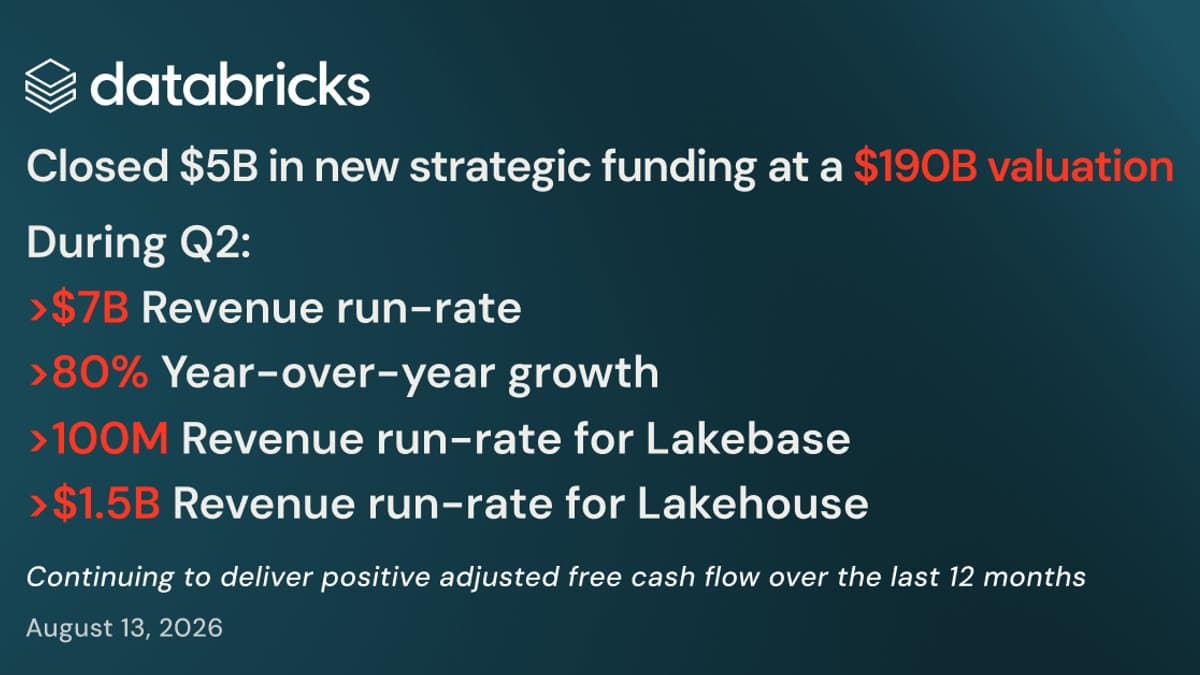
Here's the deal: on August 13, Databricks closed a $5 billion funding round at a $190 billion valuation. Coatue Management led. Blackstone, the UAE sovereign fund MGX, and accounts advised by T. Rowe Price participated, with Sixth Street Growth, BOND, Clearlake Capital, Point72, Premji Invest, and TPG coming in as new investors.
The interesting part is that the company raised the same amount roughly six months ago — at a $134 billion valuation. Half a year later, $56 billion has been added. Identical check size, company worth 42% more.
What justified that $56 billion is the substance of this announcement, and the answer the company gave is revenue. It crossed a $7 billion annualized run rate in Q2 2026, growing more than 80% year over year. It also reported positive adjusted free cash flow over the trailing twelve months.
That last line matters. Most large AI-adjacent raises right now assume deepening losses. $7 billion in revenue, 80%-plus growth, and positive cash flow is an uncommon combination in this market.
What Databricks has become
Databricks was founded in 2013 by the people who built Apache Spark at UC Berkeley. It started by selling a large-scale data processing engine as a service, then pushed the "lakehouse" concept — merging the data lake and the data warehouse into one structure — into becoming a major player in data infrastructure.
There's a specific reason the AI boom has been kind to this company. Training models and running agents ultimately requires data, and enterprise data mostly sits on platforms like this one. However good a model company's model is, connecting an enterprise customer's data to it means going through the data layer. Databricks stands in that hallway.
The customer metrics show that position. More than 20,000 organizations use the platform, including 70% of the Fortune 500. Over 1,000 of those customers run at a $1 million-plus revenue run rate, and more than 100 at $10 million-plus. That last figure is the meaningful one: a $10 million annual contract isn't a department budget, it's a company-wide infrastructure decision.
CEO Ali Ghodsi described the use of funds this way: "That requires real-time operational data with Lakebase, context from across the business with Genie, and multi-AI cost controls with Unity AI Gateway." Three product names in one sentence — that's the actual content of this round.
On listing, he's noncommittal. Ghodsi says a public offering remains part of the plan while downplaying any urgency: "We're not just a company that wants to stay in the private, but right now I just think there would be too much distraction in the public market." That's a striking contrast with Anthropic preparing an October IPO.
What the three products are aiming at
Here are the numbers from the announcement.
| Item | Figure |
|---|---|
| Raised | $5 billion |
| Valuation | $190 billion |
| Prior round (~6 months earlier) | $5 billion at $134 billion |
| Total revenue run rate | $7 billion+ |
| YoY growth | 80%+ |
| Lakehouse revenue run rate | $1.5 billion+ (100%+ YoY growth) |
| Lakebase revenue run rate | $100 million+ |
| Customers at $1M+ run rate | 1,000+ |
| Customers at $10M+ run rate | 100+ |
| Organizations on platform | 20,000+ (70% of Fortune 500) |
| Adjusted free cash flow | Positive over trailing 12 months |
| Lead investor | Coatue Management |
Go through the three products and the strategy comes into focus.
Lakebase is a serverless Postgres database built for AI agents. The reason it needs to exist: agents need operational data, not analytical data. Traditional data warehouses were designed to answer "what was revenue last quarter." Agents ask "what's this customer's current order status and can I change it right now." Latency and transaction semantics are entirely different. It launched recently and is already past a $100 million run rate.
Genie is an AI coworker for business intelligence. Classic BI built dashboards for humans to read; Genie takes a natural-language question and goes to find the answer in the data. This space is crowded — every BI vendor is building the same thing. Databricks' differentiator is simply that the data already lives on its platform, which happens to be the biggest differentiator available.
Unity AI Gateway is the most timely of the three. It provides governance and cost controls for organizations running multiple AI models. This is a real, current problem: one team uses Claude, another GPT, another Gemini, and nobody knows who's spending what. Nor can anyone trace which data goes to which model. A whole new market layer is opening up around solving that.
Coatue co-founder Thomas Laffont explained the investment thesis simply: "They've compressed R&D timelines that used to take years into months." Shipping speed offered as the valuation argument.
The revenue mix is worth a look too. Of the $7 billion total, Lakehouse accounts for $1.5 billion-plus, growing more than 100% year over year — faster than the 80% overall rate. The center of gravity is shifting toward newer products.
Who gains from this round
Databricks gains two things: cash, and freedom from listing pressure. If you can raise $5 billion in the private market twice in a row, there's no reason to rush an IPO. Ghodsi's "too much distraction in the public market" is what that comfort sounds like.
Coatue and the new investors boarded on what may be the last stop before a listing. A company with $7 billion in revenue, 80% growth, and positive cash flow is a rare private-market profile. If you believe the listing valuation will exceed today's, this is a rational entry.
Enterprise customers get stability. Data infrastructure is a multi-year decision once made. A vendor with ample capital and positive cash flow scores real points in procurement review.
AI model companies face something subtler. Once a layer like Unity AI Gateway settles in, enterprise customers can swap models like components — which weakens model vendors' pricing leverage. Gateway layers structurally accelerate the commoditization of models.
Competing data platforms feel the pressure. $7 billion at 80% growth suggests the gap in this market is widening. And 100-plus customers at $10 million-plus specifically signals first-mover advantage taking hold in large contracts.
We've seen infrastructure companies compound like this — the results split
A company holding the infrastructure layer growing explosively during a platform transition is a repeating pattern.
The success case people cite is the infrastructure cohort of the cloud transition. As applications moved to cloud, the companies providing the layer beneath multiplied several times over in a few years. The logic that worked is clear: the application layer follows fashion, the infrastructure layer is needed no matter which application wins. Databricks sits there now. Whichever model company wins, enterprise data still has to be stored and governed somewhere.
The failure pattern exists too: the infrastructure winner of one transition getting displaced in the next. The cause is usually the same — the architecture built during the growth phase doesn't match next-generation requirements, and existing customers make it impossible to abandon. Building Lakebase as a separate product looks like a move made in awareness of that trap: rather than forcing operational workloads through an analytical architecture, they built a new thing.
A third reference point is the valuation itself. $190 billion against $7 billion in revenue is roughly 27x. That's a high multiple even accounting for 80% growth, and if growth settles into the 50s, it won't hold. Assuming a valuation that rose 42% in six months rises at that rate for the next six is not a safe assumption.
How the rivals counter
The big three clouds are the most direct competition. AWS, Azure, and Google Cloud all have their own data platforms and AI gateway capabilities, and can bundle them into existing cloud agreements. Since Databricks runs on top of them, the partner-and-competitor dynamic persists.
Snowflake and the data warehouse camp compete head-on in the same market. They're attaching AI capabilities quickly too, and enterprise buyers routinely evaluate both platforms side by side.
Frontier labs apply pressure from above. OpenAI and Anthropic are both building tools to connect enterprise data to models. But handling the physical location and governance of that data is a separate problem, so the likelier outcome is layer specialization rather than displacement.
Open source applies its usual downward pressure. As open table formats like Iceberg standardize, data stops being locked to a specific vendor. That erodes Databricks' lock-in long-term — though the company has itself moved toward supporting open formats.
So what actually changes
If you own enterprise data, the practical takeaway is the emergence of the gateway layer. If multiple AI models are being used across your org with no controls, getting that spend and those data flows visible in one place is the next task. That's not an argument to buy this specific product — it's an argument that the layer needs to exist.
If you build AI agents, Lakebase is telling you something. For an agent to do real work, it needs operational data, not analytical data. If your prototype runs beautifully and stalls in production, the data layer is a likely culprit.
From an investment view, positive adjusted free cash flow is the standout line. When most large AI raises presume widening losses, a company generating cash gets evaluated in a different category. Worth noting that "adjusted" is doing work there, and what got adjusted wasn't disclosed.
If you're a founder, there's a market-structure signal here. The model layer is consolidating into a few companies, but the layers above and below — data, governance, cost control, evaluation — are still open. That's also where the big money is currently moving.
For the industry, this round signals that the center of AI spending is shifting. In 2024–2025 the money went to models themselves. Now it's flowing into the layer that connects those models to enterprise data and controls them, because that's where revenue actually gets generated.
🥄 Three Things You're Probably Wondering
— A 42% valuation increase in six months — is that backed by anything? The case is $7 billion in revenue, 80% growth, and positive cash flow. At 27x revenue, growth makes it explainable. But the defining feature of names like this is that when growth decelerates, the multiple breaks before anything else does.
— When does it go public? Unknown. Ghodsi says it will happen eventually but that public markets would bring "too much distraction" right now. If you can raise $5 billion privately twice running, there's no urgency. That's a different calculation from Anthropic heading toward an October listing.
— Does my company need this? Depends on scale. If multiple teams use different AI models and nobody can total the spend, you're at the point where a gateway layer earns its keep. If it's one team on one model, it's early — a spreadsheet still covers it.
References
- Databricks Grows >80% YoY, Surpasses $7B Revenue Run-Rate (Databricks newsroom, 2026-08-13) — the primary source: the $5B at $190B, the full investor list, $1.5B Lakehouse and $100M Lakebase run rates, the 1,000 and 100 customer tiers, and the Ghodsi and Laffont quotes.
- Databricks wraps $5 billion funding round at $190 billion valuation (CNBC, 2026-08-13) — the comparison to the $134 billion round six months earlier, and the source of Ghodsi's comments on listing.
- Databricks Raises $5 Billion at a $190 Billion Valuation (Bloomberg, 2026-08-13) — independent confirmation of deal structure and investor composition.
- Databricks hits $190B valuation (Axios Pro, 2026-08-13) — where this round sits in the enterprise software deal landscape.
- Databricks in talks to raise $5 billion at a $134 billion valuation (Benzinga) — reporting from when the prior round was being negotiated; the $134 billion baseline.
Numbers and criteria are as of announcement and may change. Investment calls are yours to make!