The biggest defence-tech round Europe has ever seen, and the factory that came 24 hours later
Monday, July 13, 2026. Helsing, a defence-AI company headquartered in Munich, announced it had closed a US$1.8 billion Series E at an $18 billion post-money valuation. That is the largest funding round ever raised by a European defence-technology startup — and one of the largest rounds ever raised by any European startup, of any kind, in any sector. The announcement went up on Helsing's own newsroom and was covered same-day by CNBC, Bloomberg, Defense News and Sifted.
Sit with the trajectory for a second, because it's genuinely absurd. Helsing was founded in 2021. In June 2025 it raised €600 million at roughly a €12 billion valuation (about $13.7 billion), in a round led by Spotify co-founder Daniel Ek's investment vehicle Prima Materia. Thirteen months later the number is $18 billion. That's roughly 1.3x in about a year, and it means a company that did not exist six years ago is now worth more than a long list of publicly traded European industrial firms with actual factories and actual order books.
Here's the deal: the round is not the most interesting thing that happened this week. One day later, on July 14, Helsing announced it had selected West Virginia for its first US "Resilience Factory" — a plant intended to build its HX-2 strike drones, with a stated design capacity of more than 2,000 units per month once fully operational. Read that again. A company whose entire public identity has been built on the argument that Europe must control its own defence technology is now pouring concrete in the United States, in the backyard of Anduril, the American company it is most often compared to.
So this story has two halves that have to be read together. Half one is a capital event: European defence tech has hit escape velocity, and American institutional money is now buying it. Half two is a strategic event: the European sovereignty champion is going global, and that complicates its own pitch. Let's take both apart.
The players — two co-CEOs, a Spotify founder, and the banks that used to say no
Helsing was founded in 2021 by three people. Torsten Reil is co-CEO; before this he founded NaturalMotion, a games-AI company — his background is in machine learning for animating bodies, which turns out to be a stranger and more relevant lineage than it sounds. Gundbert Scherf is the other co-CEO and comes from the opposite direction: he's a former German defence ministry official, which in a business where procurement is the entire game is not a decorative credential. Niklas Köhler is CTO. The company has offices in Germany, the UK, France and the Baltics, and headcount is roughly 800 to 900 — tracker data logged 761 as of May 31, 2026, while TNW reports around 900, so treat that band as the honest range rather than picking a number.
The board is where the story's ambition becomes visible. Co-chairs are Daniel Ek, the Spotify co-founder, and Tom Enders, the former CEO of Airbus. Board members include Jeannette zu Fürstenberg (La Famiglia/General Catalyst) and General Denis Mercier, former NATO Supreme Allied Commander Transformation. That's a deliberately assembled bridge: consumer-tech capital on one side, European aerospace and NATO command on the other. Jennifer McArdle runs the US operation as general manager, and she is the voice on the West Virginia announcement.
Now the money, and this is where the crawl summaries floating around got it wrong. The round was not led by JPMorgan. Reporting from Sifted and TNW identifies Dragoneer Investment Group as lead and Lightspeed Venture Partners as co-lead. The full disclosed participant list is: Dragoneer, Lightspeed, Disruptive, Iconiq, Growth Equity at Goldman Sachs Alternatives, JPMorganChase, Canada Pension Plan Investment Board (CPP Investments), General Catalyst, Plural and StepStone, alongside returning backers Prima Materia (Ek), Accel and Greenoaks. JPMorgan, Goldman's growth arm and CPP Investments were participants writing large new institutional checks — not leads.
That distinction matters more than a pedantic correction usually would. A Goldman growth vehicle, a JPMorgan check and a Canadian public pension fund buying into a European weapons-adjacent company is a genuine break with how this asset class was treated five years ago, when ESG mandates made "defence" a word that got you screened out of institutional portfolios. Helsing's own line on the round was blunt: "Investor demand significantly exceeded the available allocation." Secondary reporting goes further and says the round grew from an initially planned ~$1.2 billion to $1.8 billion at an unchanged $18 billion valuation — worth flagging that this upsizing detail comes from press reporting, not from Helsing itself.
There's a counterweight to note honestly. Reporting in the Bloomberg/Sifted orbit has described internal staff unease about Helsing shifting employee compensation toward VSOPs — virtual stock options — rather than real equity. That is reported, not company-confirmed, and you should hold it loosely. But at an $18 billion valuation, how employees participate in the upside stops being an HR footnote and starts being a retention question in a market where every rival is hiring.
What actually happened — the numbers, and the ones nobody will confirm
Start with what's solid. $1.8 billion raised. $18 billion post-money. Largest European defence-tech round on record. Helsing's stated use of proceeds: "This latest investment will accelerate Helsing's mission to develop and integrate entirely new AI platforms into the defense capabilities of its growing number of partner nations."
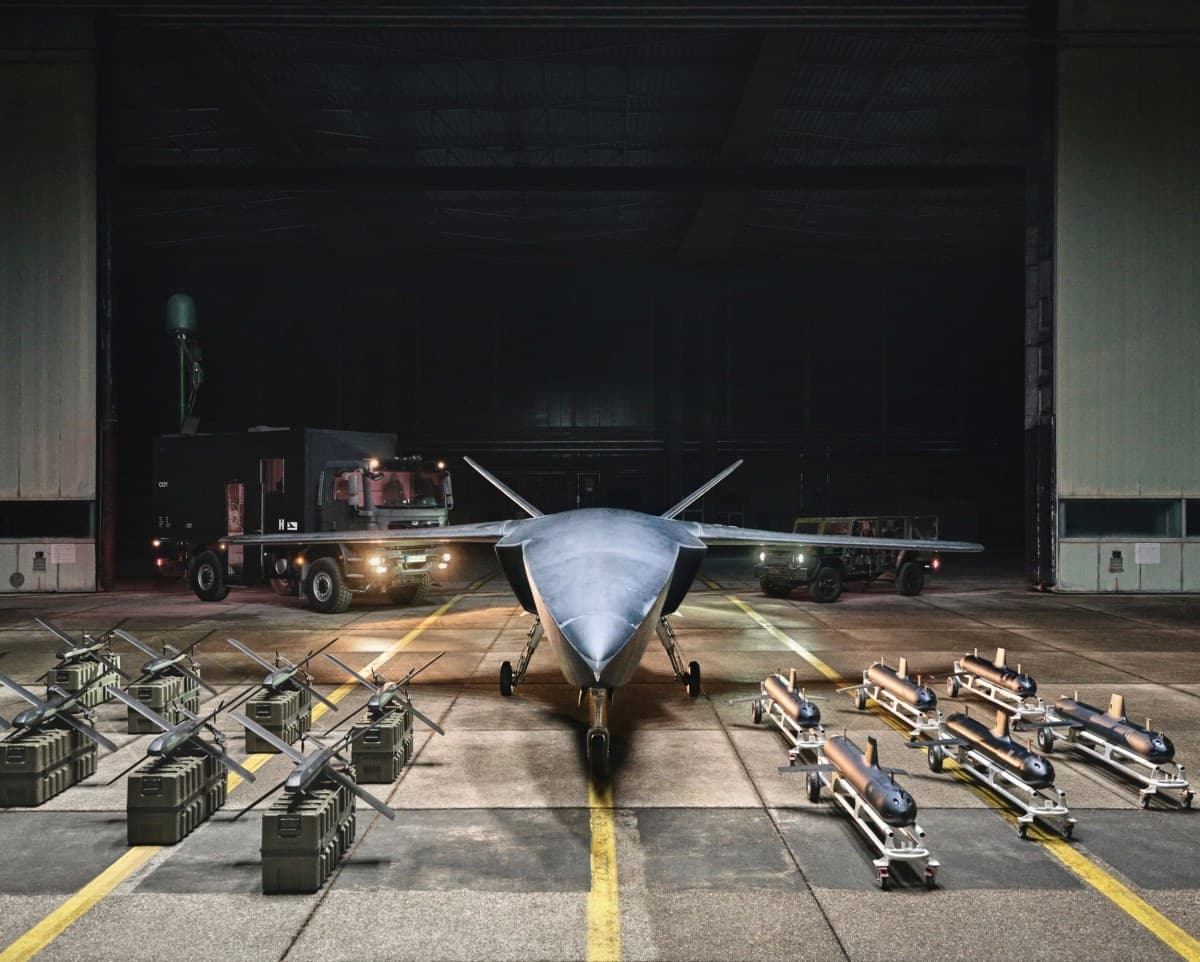
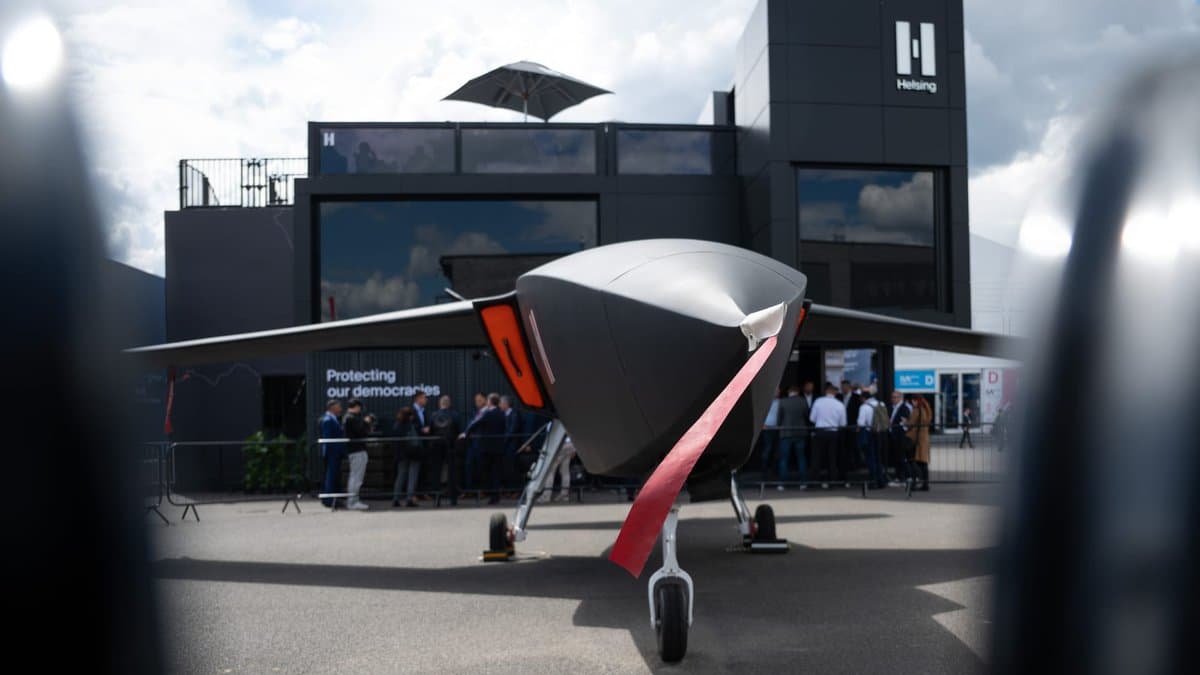
The product line explains where the money goes. Altra is the original product — AI-enabled battlefield-operations and strike software, the thing Helsing was before it touched hardware. HX-2 is an AI-enabled loitering strike drone, already deployed in Ukraine and tested by US Army forces during the Flytrap exercise in Lithuania. CA-1 Europa is a proposed autonomous combat aircraft. And underwater, Helsing runs AI-powered SG-1 Fathom surveillance gliders. It partners with Rheinmetall, Kongsberg and Saab, counts Germany, Estonia, the UK and Ukraine among government customers, has pledged thousands of drones to Ukraine, and committed £350 million to a Plymouth, UK manufacturing site for those gliders. Scherf has framed the software-to-hardware pivot as customer-driven: demand from customers "wanting AI capabilities deployed more quickly in the field."
Now the honest gap. Disclosed revenue is thin to the point of being unhelpful. The last well-sourced figure is €9.6 million (about $10.4 million) in 2023, up 721% from €1.2 million the year before. Any current revenue number you see circulating for 2025 or 2026 is an estimate, not a company disclosure. So the valuation math has to be stated plainly: $18 billion is priced off European rearmament and a forward order pipeline, not off demonstrated sales.
| Item | Detail |
|---|---|
| Round | Series E, US$1.8bn, announced July 13, 2026 |
| Valuation | $18bn post-money — largest European defence-tech round ever |
| Prior round | €600m, June 2025, ~€12bn (~$13.7bn), led by Prima Materia |
| Valuation move | Roughly 1.3x in about 13 months |
| Lead / co-lead | Dragoneer (lead), Lightspeed (co-lead) — per Sifted/TNW reporting |
| Notable new institutions | Goldman Sachs Alternatives growth arm · JPMorganChase · CPP Investments |
| Other participants | Disruptive · Iconiq · General Catalyst · Plural · StepStone |
| Returning backers | Prima Materia (Daniel Ek) · Accel · Greenoaks |
| Founded | 2021 · Munich HQ · offices in Germany, UK, France, Baltics |
| Headcount | Roughly 800–900 (761 per tracker data as of May 31, 2026; ~900 per TNW) |
| Last disclosed revenue | €9.6m FY2023, +721% YoY — current revenue undisclosed |
| Products | Altra (software) · HX-2 strike drone · CA-1 Europa aircraft · SG-1 Fathom gliders |
| Customers cited | Germany · Estonia · UK · Ukraine |
| Next-day news | West Virginia "Resilience Factory," 2,000+ HX-2/month design capacity |
A few more things need explicit hedging, so let's do it in one place. The West Virginia plant has no announced opening date, and the 2,000-drones-per-month figure is a stated design capacity "once fully operational" — not current output, not a shipping number. Whether Helsing holds or is pursuing US government contracts is contested: Sifted reported it has no US government contracts, while building a US drone factory rather strongly implies it intends to win some. Do not read the West Virginia news as evidence of American contract wins. And on ownership, Helsing says it "remains predominantly European-owned"; Reil's more specific "roughly 80% European-owned" figure was given in May 2026, before this round, so the post-round split is genuinely unstated.
What each side gets — sovereignty capital, institutional cover, and a hedge
Helsing gets two things. The obvious one is manufacturing capital. The pivot from software into drones, gliders and a proposed combat aircraft is enormously capital-hungry in a way that selling battlefield software never was — factories, supply chains, testing, certification. £350 million for one UK site tells you the unit cost of this strategy. The less obvious one is balance-sheet credibility in front of defence ministries. Governments hate single-supplier risk from startups that might not exist in five years. Eighteen billion dollars of paper and a Goldman/JPMorgan/CPP cap table is, functionally, a procurement argument.
The investors get exposure to the clearest macro trend in Europe. European defence budgets are rising under NATO pressure and the war in Ukraine, and the incumbent primes — Rheinmetall, Airbus, Thales, Leonardo, Saab — are already re-rated. Helsing is the venture-shaped way to buy the same thesis with a much steeper payoff curve. For Goldman's growth arm and CPP Investments in particular, there's a second prize: being early into an asset class that institutional capital spent a decade avoiding. If defence tech normalizes as a category, the funds that showed up in 2026 will have written the reference deals.
European governments get a champion, and a headache. The champion part is straightforward: Germany, Estonia, the UK and Ukraine all now have a domestic-ish supplier of AI battlefield software and strike drones that isn't dependent on American export licences. The headache is concentration risk. When one company absorbs $1.8 billion and becomes the default answer to "who does our autonomy," you've created a national-champion dependency — the exact problem European sovereignty rhetoric was meant to solve, just relocated from Washington to Munich.
West Virginia gets jobs. Governor Patrick Morrisey framed the plant as high-skilled employment that strengthens America's defence industrial base. McArdle's stated reasoning: "Industrial capacity is a critical strategic advantage," with West Virginia chosen for its "commitment to innovation, skilled local workforce and competitive infrastructure." Which is the polite version. The impolite version is that the US defence budget is the largest single addressable market on earth, and you cannot meaningfully sell into it from Bavaria. Building on American soil is the price of admission — and it's a hedge, too, against the possibility that European rearmament spending arrives slower than the $18 billion valuation requires.
Precedents — the Anduril script, and the graveyard nobody puts on a slide
The success case is sitting right there, and Helsing has clearly read it. Anduril Industries, founded 2017, ran exactly this playbook: software-first autonomy (Lattice), then hardware, then owned factories (Arsenal-1 in Ohio). On May 13, 2026 it raised $5 billion at a $61 billion valuation, led by Thrive Capital and Andreessen Horowitz, after doubling 2025 revenue to $2.2 billion. That last number is the important one — Anduril proved a venture-funded newcomer can take real programme-of-record money away from entrenched primes, which for decades was considered structurally impossible. SpaceX is the older version of the same proof: private capital displacing government-contractor incumbents by shipping faster.
But here's the comparison that should make you cautious. Helsing is valued at roughly 30% of Anduril on a small fraction of the disclosed revenue. Anduril has $2.2 billion of demonstrated sales behind its $61 billion. Helsing's last well-sourced revenue figure is €9.6 million from 2023. Even assuming — reasonably — that the real current number is dramatically higher, the multiple gap is enormous. You are not buying a revenue story. You are buying a bet that European rearmament converts into multi-billion recurring programme wins that Helsing has not yet publicly demonstrated.
The failure side of the ledger is instructive because it's rarely about technology. Boston Dynamics built decades of world-leading robotics on DARPA money and never converted it into a durable defence business — it passed through Google and SoftBank to Hyundai without one. Wing Aviation and a cohort of drone ventures hit regulatory and procurement walls despite genuine technical leadership. And the broader 2000s wave of defence-adjacent startups raised on procurement optimism and then died in the gap between funding rounds and budget cycles.
The lesson across all of them is the same, and it's the central risk here: defence procurement moves on a far slower clock than venture capital. A programme of record can take five to ten years from concept to sustained funding. Venture money wants an exit inside that window. Helsing's answer — get deployed in Ukraine now, where the procurement clock is compressed by necessity, and use that as the proof point for peacetime buyers — is the smartest available answer. It is not a guaranteed one, and it carries its own dependency on a conflict continuing.
How rivals counter — and why Anduril will take West Virginia personally
Anduril is the direct collision. A European company building strike drones in West Virginia is an incursion into its home market, and Anduril can outspend Helsing on US lobbying, US manufacturing and US political relationships by a wide margin — it has the revenue, the valuation and a decade of Washington relationships Helsing doesn't. Expect the counter to be symmetric: an accelerated Anduril push into Europe, building on footprints it already has in the UK and Australia. The likely shape of 2027 is both companies fighting on each other's continents rather than staying in their lanes.
The German rivals will use this round as a comp. Quantum Systems (Munich) raised $1.2 billion at around $8 billion on July 2, 2026, co-led by Blackstone, Noteus, Airbus and Advent. Stark Defence (Berlin, founded 2024 by Florian Seibel and Johannes Schaback) raised €500 million led by Sequoia and Founders Fund above a €3.5 billion valuation. Both compete for the same Bundeswehr and Ukraine drone budgets, and both now have a fresh $18 billion data point to wave at investors for their next raise. Elsewhere in Europe: ICEYE (Finland) raised €450 million, Harmattan AI (France) $200 million at €1.4 billion, and Kraken Technology (UK) $175 million at $1 billion. This is not a Helsing anomaly — it's a sector repricing.
The scale of that repricing is worth one number: per Dealroom, defence-tech startups raised a record $17.4 billion globally in the first half of 2026, against $11.2 billion for all of 2025. The first six months of this year beat the entire prior year by more than 50%.
The legacy primes will mostly not fight head-on. Rheinmetall, Airbus, Thales, Leonardo and Saab have watched this movie and their revealed preference is partner-and-invest: Airbus co-led the Quantum Systems round, and Rheinmetall, Kongsberg and Saab already partner with Helsing. Their structural advantage is that they own certification pathways, long-cycle programme relationships and the systems integration work that startups find hardest to replicate. Buying optionality in the fast movers while keeping the integration layer is the rational play.
The fourth counter is political rather than corporate. European governments will face growing pressure over concentration risk. When one venture-backed company becomes the default autonomy supplier across multiple NATO members, procurement officials start asking uncomfortable questions about pricing power, second sources and what happens if the cap table drifts non-European. Helsing's insistence that it "remains predominantly European-owned" is not PR filler — it's pre-emptive defence against exactly that line of attack, which is precisely why the unstated post-round ownership split is worth watching.
So what actually changes
If you're a developer or engineer — defence tech has become a legitimate destination for AI talent in Europe in a way it emphatically wasn't five years ago, and $1.8 billion buys a lot of hiring across Munich, London, Paris and the Baltics. The work is genuinely hard and unglamorously physical: real-time perception under jamming and degraded comms, autonomy that has to work when the network doesn't, edge inference on power and thermal budgets that make a data centre look like a playground. Go in with your eyes open on two fronts, though. One is ethical, and it is not abstract — you would be building systems that select and strike targets. The other is compensation: the reported staff friction over VSOPs instead of real equity is unconfirmed, but if you're evaluating an offer, understanding exactly what instrument you're being granted at an $18 billion valuation is basic due diligence.
If you're an investor — the structural signal is bigger than the company. $17.4 billion in H1 2026 versus $11.2 billion for all of 2025, with Goldman, JPMorgan and a Canadian public pension in the same round, means defence tech has completed the journey from ESG-excluded to institutionally normal. That repricing is the trade, and it lifts the whole cohort — Quantum Systems, Stark, ICEYE, Harmattan, Kraken. But price the risks honestly: current revenue is undisclosed, the only well-sourced figure is €9.6 million from 2023, the valuation implies programme wins that haven't been publicly demonstrated, the West Virginia factory has no announced opening date, and Sifted's reporting that Helsing holds no US government contracts sits awkwardly next to a US factory. This is a multi-year bet on European rearmament budgets actually converting into signed contracts, and the exit path for an $18 billion private defence company is not obvious.
If you're a regular reader — the thing to take away is that the European defence industry is being rebuilt by venture capital rather than by governments, and quickly. For decades, weapons came from a handful of state-entangled primes on twenty-year timelines. Now a five-year-old startup is worth $18 billion and shipping AI strike drones into an active war. That brings real capability faster — and it also means decisions about how much autonomy a weapon should have are increasingly being made inside private companies. Reil's own standing argument is worth quoting in full, because it's the honest version of the tension: "We should develop homegrown systems that we control, both in terms of actually controlling the whole technology, but also the ethics side of it… what degree of autonomy are we prepared to accept is something that we need to be able to control." That's the right question. Notice that a company, not a parliament, is the one asking it.
🥄 Three Things You're Probably Wondering
— So what does this mean for me? Nothing you'll feel this week. But European defence budgets are your tax money, and an increasing share is flowing to venture-backed AI companies rather than legacy state contractors. That means faster capability and more competition — and also that decisions about autonomous weapons are being made inside private firms on venture timelines.
— Is Helsing actually worth $18 billion? On disclosed financials, nobody can say — the last well-sourced revenue figure is €9.6 million from 2023 and the company hasn't published a current number. The valuation is a bet on European rearmament converting into large recurring programmes. For scale: Anduril is worth $61 billion on $2.2 billion of 2025 revenue, so Helsing is priced at roughly 30% of Anduril on a tiny fraction of the demonstrated sales.
— Wait, isn't a US factory the opposite of European sovereignty? That's the sharpest tension in the story, yes. Helsing says it "remains predominantly European-owned," but the specific ~80% figure Reil gave was from May 2026 and predates this round, so the post-round split is unstated. The West Virginia plant has no announced opening date, and reporting says Helsing currently holds no US government contracts — so read it as intent to enter the US market, not as contracts won.
Sources
- Helsing raises US$1.8bn in Series E — Helsing Newsroom
- Helsing Expands U.S. Market, Selecting West Virginia For Its First U.S. Resilience Factory — Helsing Newsroom
- Europe's Anduril rival Helsing raises $1.8 billion at $18 billion valuation — CNBC
- Helsing raises $1.8bn backed by Goldman and Lightspeed — Sifted
- Helsing raises $1.8 billion in Europe's biggest defense-startup round — Defense News
- Goldman Backs Drone Startup Helsing at $18 Billion Valuation — Bloomberg
- Helsing raises $1.8bn at an $18bn valuation — TNW
- Anduril raises $5B, doubles valuation to $61B — TechCrunch
- Autonomous drone startup Quantum Systems raises $1.2 billion as investors pile into defense — CNBC
Numbers and criteria are as of announcement and may change. Investment calls are yours to make!