A $179 Recorder the Size of a Credit Card, and $100M for Korea
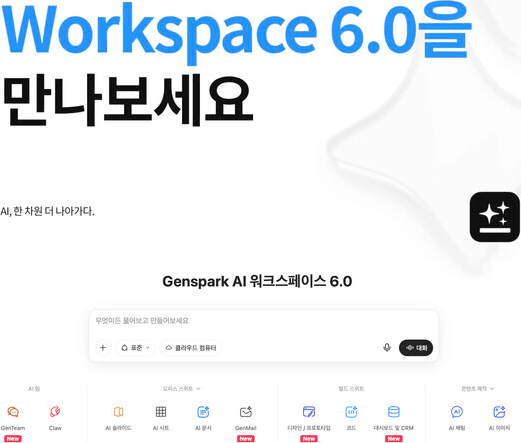
On July 21, 2026, Genspark shipped AI Workspace 6.0 and, for the first time in the company's history, a piece of hardware. It's called SecondBrain Note. Credit-card sized, 16 grams, designed to stick to the back of your phone and record meetings, calls, hallway conversations, and the things you mutter to yourself — then turn all of it into searchable, structured memory. List price is $199, with an early promo at $179.
Why does an AI software company suddenly build a recorder? The answer is sitting in the press release headline: AI's next breakthrough isn't models, it's context. That's the bet, stated plainly.
Three days later, on July 24, the entire Genspark founding team showed up in Gwangjin-gu, Seoul. CEO Eric Jing, CTO Kay Zhu, and COO Wen Sang all attended a media day where the company announced its official entry into the Korean market plus a plan to invest $100 million over the next three years. It was the third such event after New York and Tokyo. The COO's line: Korea matters enough that the entire California-based leadership team flies to Seoul for the moments that count.
Read the two announcements separately and you get a product update and a regional launch. Put them side by side and the picture changes. Genspark is rearranging the whole company around one premise — that raw model performance no longer differentiates anything — and it's executing that premise on three fronts at once: a memory layer that permanently stores a user's work context, dedicated hardware that captures that context directly, and concentrated investment in the regional market where the combination should land hardest.
Korea being that market isn't random. Per Newsway's reporting, Korea sat at number five in Genspark's global market rankings and just moved into the top three. And if you remember that LG Technology Ventures was already an investor in the November 2025 Series B, this launch doesn't look sudden at all. The board was set eight months ago.
Who Genspark Is, and Why It's Standing Here
Genspark was founded in December 2023 in Palo Alto. Three founders. Eric Jing, the CEO, came out of Microsoft. Wen Sang, the COO, holds an MIT PhD and previously founded Smarking, a Y Combinator-backed parking data startup. Kay Zhu is the CTO. All three were in Seoul. AI startup CEOs drop into Korea all the time; the entire founding trio showing up together is rarer.
The company started life as a search product. Then in April 2025 it pivoted hard toward work agents, and that's when the numbers started moving. Per Forbes, Genspark hit $50 million in annualized revenue within five months of launching its work AI tools, and rode that momentum into a $275 million Series B in November 2025 at a $1.25 billion post-money valuation. Emergence Capital led. SBI Investment, LG Technology Ventures, Temasek-affiliated Pavilion Capital, and Uphonest Capital participated. The name "AI Workspace" first appeared then, too.
Eight months later, the numbers the company is quoting are much bigger. By Genspark's own accounting: $250 million in annual recurring revenue twelve months after launch, more than 7,000 enterprise customers, $645 million raised to date, and a $2.6 billion valuation. Piecing together Korean press coverage, the ARR path went $100 million at the nine-month mark and then jumped to $250 million three months later — and the company says a meaningful chunk of that growth came from Korea.
Worth flagging, though: every one of those figures is self-reported and none of it comes from audited financials. ARR is a metric that bends depending on how you define it — annualized contract value versus last month's revenue times twelve produce very different headlines from the same business.
There's also something telling in the comparison Forbes reached for when describing Genspark: Microsoft 365 Copilot and Google Gemini. This company doesn't position itself as a chatbot alternative. It positions itself as a replacement for work software. Frame it that way and the competitor isn't OpenAI, it's the office suite. And in that fight, the decisive asset isn't the model — it's who holds the organization's working data.
Which is exactly where SecondBrain comes from. Jing's line in the release was that AI Workspace 6.0 gives knowledge workers a second brain that never forgets. In a Digital Today interview he drew a sharper line: this isn't memory that personalizes answers, it's memory an AI system can actually use to do the work. Remembering your preferred tone and remembering last quarter's negotiated terms are not the same problem.
What's Actually in 6.0 — Memory, Hardware, and a Team Layer
SecondBrain is the center of AI Workspace 6.0. It pulls work context scattered across email, calendar, chat logs, documents, meeting notes, and CRM into a single continuous memory layer, and it connects to the usual suspects — HubSpot, Notion, Google Workspace. The core claim is that previous work becomes input to the next piece of work. You write this week's proposal with the system already holding the assumptions behind last week's proposal and the reason it got rejected.
One design choice matters more than it sounds. Ownership and control of accumulated memory stays with the user. You can open up what the system remembered, edit it, export the whole thing, or delete it. Data is encrypted, and the company is leading with SOC 2 Type II and ISO 27001 certifications. A company selling memory knows that trust is the first thing it has to defend.
SecondBrain Note is the input device that pushes everything happening off-screen into that memory. Card sized, 16 grams, roughly 35 hours of battery per Money Today's reporting. An indicator light comes on when recording starts, and every recording syncs into SecondBrain as user-owned memory. The rest of 6.0 rounds out with GenMail (an email agent), AI Design (visual output), GenTeam (a collaboration surface where humans and AI agents work on shared memory), and AgentBase (custom software without writing code). IT Daily reported that 6.0 stitches together 40-plus frontier models, 150-plus office tools, and 20-plus datasets, with a three-tier cost optimization scheme that routes everyday tasks to lightweight and fine-tuned models.
| Item | Detail |
|---|---|
| AI Workspace 6.0 unveiled | July 21, 2026 (BusinessWire release) |
| Korea launch announced | July 24, 2026, Seoul media day (after New York and Tokyo) |
| Korea investment | $100M over three years (team, partnerships, expansion) |
| SecondBrain Note price | $199 list / $179 early promo |
| Hardware specs | Credit-card size, 16g, ~35-hour battery, recording indicator light |
| Security certifications | SOC 2 Type II, ISO 27001 |
| ARR (company-reported) | $100M at 9 months → $250M at 12 months |
| Enterprise customers (company-reported) | 7,000+ |
| Total raised / valuation | $645M / $2.6B |
| Series B | November 2025, $275M, $1.25B post-money |
| Hiring plan | 100+ globally (sales, technical consulting, customer success; some in Korea) |
| Korea partners | LG Uplus, Mirae Asset Capital (per Korean press) |
The Korea-specific figures — the 7,000 enterprise customers and the LG Uplus and Mirae Asset partnerships — come from Korean outlets including Money Today, Newsway, and IT Daily. Contract sizes and structures weren't disclosed. Genspark also said it maintains working relationships with frontier labs including Microsoft, Anthropic, and OpenAI. Translation: the models belong to somebody else, and the moat is supposed to live in memory and orchestration.
What Each Side Gets — and Where This Breaks
What Genspark gets is switching cost. Once a user has six months of meeting transcripts and email context sitting in SecondBrain, moving to another tool stops being an account migration and becomes throwing away a memory. Model performance gets matched in six months. Accumulated context doesn't. Building the hardware follows the same logic: on-screen data like mail and documents is already reachable by several companies, but nobody owns what got said in the conference room. Own that input channel and you own data nobody else has.
The Korean partners get something too. For LG Uplus, licensing a proven agent stack onto an existing distribution channel is cheaper than entering the foundation-model race, and Genspark borrows a large enterprise's sales network and credibility. This is old grammar in the Korean SaaS market. Korean enterprises are conservative about buying unproven foreign SaaS directly, but drop a telco or a chaebol affiliate in as a reseller and the purchase approval sails through procurement. Given LG Technology Ventures was already on the Series B cap table, the investment, the partnership, and the market entry all sit on one line.
Korean users get early access. The COO said Genspark has given Korean users early access to each new AI model, testing alongside them and collecting feedback. Getting new products first is genuinely nice. Flip it around and it also means Korea is being used as a pre-global-launch testbed. The concrete upside is that some of those 100 new hires land locally, which means actual technical support and consulting bodies on the ground.
Now the sharp edge, and it's sharpest in Korea specifically: the legal status of always-on recording hardware. Korea's Protection of Communications Secrets Act bans recording "conversations between others" by someone who isn't a party to the conversation, and the penalty is heavy — one to ten years imprisonment. Conversely, recording a conversation you are a party to is not a violation, whether or not you tell the other person. The problem is that real-world usage of a device like SecondBrain Note crosses that line constantly. Leave the device on the conference table and step out, and from that moment it can be recording a conversation between others. An indicator light does not shield you from criminal liability.
The second layer is the Personal Information Protection Act. Even if you never trip the communications statute, collecting, processing, and transferring abroad the third-party personal information embedded in recorded audio is separately regulated. If SecondBrain lives in the cloud and the operator is a US company, cross-border data transfer notice and consent obligations attach. For enterprise customers, add trade-secret leakage risk and internal audit exposure on top. Genspark leading with SOC 2, ISO 27001, and user deletion rights is a deliberate defense of this exact flank — but certification proves security controls, it does not make the act of recording lawful. In Korea, the real test for this product isn't performance benchmarks. It's the in-house legal team.
Precedents — What Worked and What Didn't
The clearest case study in how AI hardware dies is Humane's AI Pin. It got hammered in nearly every review right after its 2024 launch, with overheating, battery life, and response latency coming up over and over. The ending arrived in February 2025. HP acquired Humane's assets for $116 million, and the AI Pin servers went dark at 3 p.m. Eastern on February 28, 2025. After that moment, the devices could no longer place calls, send messages, run AI queries, or reach the cloud at all. A company once discussed at a $1 billion valuation exited as a nine-figure asset sale. What HP bought wasn't the product — it was 300-plus patents and an engineering team, folded into a group called HP IQ. Rabbit's R1 followed a similar arc: despite the "large action model" marketing, reviews at launch reported that the thing could barely do anything.
The common thread in both failures is that they tried to sell hardware as a new primary device replacing the phone. To make someone abandon what they already carry, you have to be overwhelmingly better. Neither was.
On the other side sits Plaud. That company ran the opposite playbook. It didn't replace the phone — it stuck to the back of one. Do one thing, recording, well, then convert that recording into a subscription that summarizes and searches it. Forbes profiled Plaud in September 2025 as one of the few profitable AI startups, and Bloomberg reported in June 2026 that the company had crossed $250 million in recurring revenue without venture funding and was targeting $500 million in 2026 revenue. The hardware-to-subscription flywheel produced 10x growth two years running. Meanwhile Limitless, a competing pendant, was acquired by Meta in December 2025 and pulled from standalone sale — a signal that this category has already become big tech hunting ground.
By form factor, SecondBrain Note is unmistakably in the Plaud lineage. Card shaped, phone mounted, recording as the single function. What's interesting is that Genspark's announced $250 million ARR and Plaud's $250 million recurring revenue are the same number arrived at from opposite directions. Plaud sold hardware and climbed into software subscriptions. Genspark already had the software subscription and bolted hardware on. The advantage of the latter: if the hardware flops, the core business survives. The disadvantage: manufacturing, logistics, and after-sales support are entirely different muscles, and Genspark has to build them from scratch in a hurry. That's precisely where Humane came apart.
How Rivals Counter
OpenAI is already moving the same direction. ChatGPT's memory feature and Projects both exist to carry context across sessions, and the connector work to attach external business tools keeps expanding. OpenAI's overwhelming advantage is user count. When Genspark talks about 7,000 enterprise customers, OpenAI is operating at a different order of magnitude — and if memory ships as a free baseline feature, "AI that remembers" stops being a differentiator and becomes table stakes.
Anthropic's counter has a different texture. Claude Cowork arrived as a desktop research preview in January 2026, and per TechCrunch it expanded to web and mobile on July 8, opening to Max subscribers first. The usage statistics Anthropic published are the part worth staring at: across 1.2 million sessions and 600,000 organizations, business process optimization was the largest category at 33.4%, content creation at 16.4%, and software development at just 8.7%. A tool that started as a coding agent is mostly being used for general office work — which overlaps exactly with the market Genspark is targeting. Anthropic's approach substitutes file read/write permissions on designated folders for a vendor-hosted memory layer, and enterprise legal teams may well prefer that, since nothing accumulates in a vendor cloud.
Microsoft 365 Copilot is the most structural threat, and it's the one Forbes named. The reasoning is simple: most Korean enterprise work context already lives inside Outlook, Teams, and SharePoint, and Microsoft doesn't have to collect any of it. Teams meeting recording and transcription are standard features already, which squeezes the space available for a separate $179 device pitching "AI that remembers your meetings." Notion AI is threatening on the same logic — if the documents and the wiki are already in Notion, the race for context starts from a different line.
Inside Korea, Naver and Kakao are the wildcards. Naver formally launched an AI tab built on HyperCLOVA X and passed 3 million cumulative users within a month of beta. Neither company is going head-to-head with Genspark in enterprise work agents yet, and analysts generally see Kakao's AI monetization ramping only gradually from 2027. But two cards stay strong: data residency inside Korea, and Korean-language work context. In public sector, finance, and healthcare — anywhere data export is tightly controlled — those conditions become the deciding variable well before performance differences do.
So What Actually Changes
For developers, the thing to study is AgentBase and the integration architecture. The fact that 6.0 wires together 40-plus models and 150-plus tools, then routes everyday tasks to lightweight models in a three-tier cost structure, tells you this company isn't making margin on models — it's making margin on routing. If you're assembling a similar agent stack internally, that design is worth borrowing. And if your reaction is "we could build this," look at the other half too: the part you can't build is the accumulated memory, not the code.
If you're the person evaluating this at a company, flip your order of operations. Don't start adoption review with a performance proof-of-concept. Start with legal and security. The moment an always-on recorder enters a conference room, you're simultaneously dealing with third-party conversation recording under the communications statute, cross-border personal data transfer notice and consent, and your own trade-secret handling policy. Then, at contract time, write the memory portability terms down explicitly: export format, proof of deletion, and what happens to stored memory at termination. Genspark emphasizing user ownership and deletion rights is exactly the leverage you use to demand those clauses.
From an investor angle there's one central question: of that company-reported $250 million ARR, how much is real enterprise contracts? Genspark's revenue mixes individual subscriptions with enterprise deals, and consumer-heavy subscription revenue churns hard the moment a free alternative lands. The $2.6 billion valuation is roughly 10x ARR, a multiple that only holds if the growth rate holds. Layer hardware on top and gross margin dilution becomes a real question. The counterweight is capital efficiency — two and a half years old, $645 million raised, and that revenue trajectory means the burn rate isn't the problem here.
For regular users it's simpler. Whether to buy a $179 recorder comes down to one question: how many meetings do you have a day, and do you actually go back and look up what was said in them? This category has an unusually high rate of ending up in a drawer. And if you're using it in Korea, remember one thing — recording a conversation you're part of is fine, but the legal character changes the moment you leave the device behind and walk away. That's set by statute, not by the user manual.
🥄 Three Things You're Probably Wondering
— So what does this mean for me? Not much directly, today. But when the collaboration tool your company uses starts advertising that it remembers last week's meeting, you'll want to know where that memory is stored and who can delete it. In Korea that question stops being a convenience issue and turns into a legal one fast.
— Can I trust the $250 million ARR number? Too early to take at face value. It's self-reported, not audited, and ARR swings widely depending on how it's calculated. That said, Emergence Capital and a Temasek affiliate did diligence before writing Series B checks, which counts as at least some cross-validation.
— Is this recorder going to flop like Humane? Lower odds, because the shape is different. Humane tried to replace the phone and failed; Genspark is doing the Plaud thing and sticking to the back of one. And if the hardware doesn't sell, the subscription business underneath it survives. But this is still a company doing manufacturing, logistics, and after-sales support for the first time, so it's too early to call.
References
- BusinessWire — Genspark Unveils AI Workspace 6.0: Betting AI's Next Breakthrough Isn't Models, It's Context (2026.07.21)
- Digital Today — Genspark unveils persistent memory-based AI Workspace 6.0, launches first hardware (2026.07.22)
- Money Today — US startup Genspark plants its flag in Korea: betting on AI that remembers (2026.07.25)
- Newsway — Genspark launches AI Workspace 6.0, signals $100M investment in Korea (2026.07.24)
- IT Daily — Genspark officially enters the Korean market and announces AI Workspace 6.0 (2026.07.24)
- Forbes — Genspark Joins The Unicorn Club With Latest Funding Round (2025.11.20)
- BusinessWire — Genspark Raises $275M Series B, Launches AI Workspace to Put Busywork on Autopilot (2025.11.20)
- Genspark Blog — Introducing Genspark AI Workspace 6.0 (2026.07.21)
- TechCrunch — Claude Cowork expands to mobile and web (2026.07.07)
- Bloomberg — Plaud Plans New Wearable as AI Note-Taking Startup Eyes $500 Million in Sales (2026.06.16)
- Forbes — How An AI Notetaker Became One Of The Few Profitable AI Startups (2025.09.02)
- Fortune — HP-Humane deal: AI Pin shutting down (2025.02.19)
Numbers and criteria are as of announcement and may change. Investment calls are yours to make!