A deputy prime minister stood up and said his country would export tokens
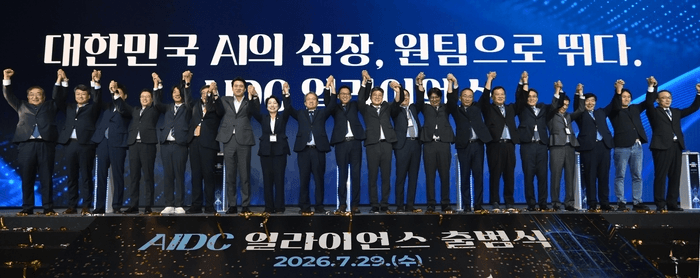
Here's the line that got everyone's attention. On the afternoon of July 29, at the Lotte Hotel Seoul in Jung-gu, Deputy Prime Minister and Science Minister Bae Kyung-hoon told a room of several hundred executives that "an AI data center is a token factory." Then he went further: Korea, he said, would establish itself as a nation that exports AI tokens to the entire world.
That sentence deserves unpacking. A "token" is the chunk of text a language model actually processes — ask a chatbot one question and hundreds or thousands of tokens move through a GPU cluster somewhere. So what the minister is really proposing is a shift in what Korea sells. This is a country that got rich exporting wafers, memory chips and ships. The pitch now is that it should export the computation itself — the finished inference, not the silicon it ran on. Think of a steel exporter announcing it wants to sell cars instead.
And this wasn't a throwaway line at a ribbon-cutting. The Ministry of Science and ICT (MSIT) convened the event jointly with the Ministry of Trade, Industry and Energy, the Financial Services Commission and the Ministry of Land, Infrastructure and Transport to launch the AI Data Center (AIDC) Alliance. Roughly 400 companies and institutions from industry, academia and research took part. Bae serves as the government co-chair; Jung Jae-heon, chairman of the Korea Association for ICT Promotion and CEO of SK Telecom, is the first private co-chair.
Four ministries on one masthead is the real tell. Power belongs to the industry ministry, land and permitting to the land ministry, financing to the financial regulator. By building the alliance that way, Seoul is formally conceding something the industry has known for two years: a data center program is not an IT project. It's an energy, land and capital project that happens to have servers in it.
And there's a number attached — 18.4 gigawatts. That's the end-state target from the "AI Data Center National Strategic Industrialization" strategy the government announced in June, and this alliance is the machinery meant to deliver it. We'll get to how big 18.4GW really is. Fair warning: that's the uncomfortable part of this story.
Four hundred names showed up, but the list that matters is the twelve in the front row
Four hundred sounds impressive. The group that will actually steer things is the 12-company steering council: Naver Cloud, Samsung SDS, SK Telecom, NHN Cloud, LS Electric, LG Uplus, LG Electronics, GS, Kakao, KT, KTNF and Furiosa AI. Read that list once and the government's intended value chain falls right out of it.
Cloud and telecom take up half the seats. Naver Cloud, NHN Cloud and Samsung SDS build and operate facilities and sell the capacity as a service. All three mobile carriers — SK Telecom, KT and LG Uplus — are in. Carriers belong here because a large share of Korea's commercial data center floor space is carrier-owned and the national backbone is theirs. AI clusters move brutal volumes of east-west traffic between GPUs, so at this scale networking is performance. Getting all three carriers to sit down together is itself a signal that Seoul considers this a national program rather than a subsidy line item.
Equipment and power are represented by LG Electronics and LS Electric. LG Electronics has been pushing hard into data center cooling — chillers, liquid and immersion systems. LS Electric does switchgear, transformers and power distribution. GS is the interesting one: it's named as the developer behind an AIDC build in the Donghae area on the east coast. Watch that carefully, because it's an energy conglomerate re-identifying itself as a data center developer.
Domestic hardware gets two seats: KTNF, a Korean server manufacturer, and Furiosa AI, a fabless company building inference NPUs. Their presence is not decorative. The government's stated ambition is explicitly not "warehouses full of imported GPUs." Bae said investment in AIDC should not stop at "putting up buildings and filling them with servers" but should build competitiveness across design, construction, operation and the whole cloud technology stack. Furiosa and KTNF are what that sentence looks like as an org chart.
Kakao leading the foundation division is worth a beat too. That division handles law, regulation, workforce and ecosystem, and draws in trade associations, universities and law firms. Kakao is the company whose national-scale services went dark during the October 2022 Pangyo data center fire, and it has since built its own facility in Ansan. On redundancy, safety and regulation it has scar tissue and opinions. Day-to-day secretariat work sits with NIPA, IITP and KAIT, one per division.
Jung Jae-heon, the private co-chair, framed the whole thing in a single sentence: "If the data center of the past was a warehouse that stored information, an AIDC is an export factory that produces intelligence and supplies it to the global market." He added that in the AI era, "competition is between nations, not individual companies." The minister's "token factory" and the CEO's "export factory" are the same metaphor twice — this launch had a very disciplined message.
Here's exactly what was announced
The alliance runs as three divisions plus one task force. The demand division (Naver Cloud) validates domestic solutions in real deployments and stands up large-scale testbeds. The supply division (LG Electronics) handles core technology localization and technical standardization. The foundation division (Kakao) owns law, regulation and talent. Separately there's an export industrialization task force, and that's the genuinely new piece here.
The export plan splits in two. For the training market, the customer is global big tech — rent Korean soil and Korean power to train someone else's frontier model. For the inference market, the plan is to bundle design, construction and operation into an exportable package. The country the government has named out loud as a target is the UAE, plus other demand nations. Translation: places with capital but without the engineering bench to run this stuff.
There's a calendar too. Division-level roadmaps land in Q3 of this year. Q4 brings the first steering council meeting and a draft AIDC special act. Q1 2027 brings an AI data center program office and the designation of cluster special zones. The special act is expected to cover fast-track permitting, deemed-approval clauses when agencies blow past deadlines, and eased power-related assessment procedures. One caveat worth stating plainly: the special act is still a draft. Nothing in it is real until the National Assembly passes it.
Here are the announced facts in one place.
| Item | Detail |
|---|---|
| Launch event | July 29, 2026, Lotte Hotel Seoul |
| Convening ministries | MSIT, Trade/Industry/Energy, Financial Services Commission, Land/Infrastructure/Transport |
| Participation | ~400 companies and institutions |
| Government co-chair | Deputy PM and Science Minister Bae Kyung-hoon |
| Private co-chair | Jung Jae-heon, KAIT chairman and SK Telecom CEO |
| Steering council | 12 companies |
| Divisions | Demand (Naver Cloud), Supply (LG Electronics), Foundation (Kakao) |
| Separate body | Export industrialization task force |
| Secretariat | NIPA, IITP, KAIT |
| Headline target | 18.4GW of AIDC by 2035 |
| Phase one | 8.4GW |
| Private investment | KRW 550 trillion (SK, GS, Naver and others) |
| Underlying strategy | June 2026 "AI Data Center National Strategic Industrialization" |
| National AI Computing Center | Solaseado, Haenam; 15,000 GPUs by 2028 |
One honest caveat on those numbers: the phasing and dates for 18.4GW are reported inconsistently. Some outlets have 8.4GW by 2029 and 18.4GW by 2035. Others put phase one's 8.4GW at 2035 with a second SK-led phase after that. The site-level figures floating around — roughly 5GW for SK including Ulsan, 2.4GW for GS at Donghae, 1GW for Naver at Sejong — don't cleanly sum to 8.4GW either. Given that the government says the confirmed roadmap arrives in Q3, the safest read is that these numbers aren't settled internally yet.
Everyone at the table gets something. Nobody said who pays the 18.4GW electricity bill
SK Group is the clearest winner. It's building the country's largest AIDC in Ulsan, SK Hynix sells the HBM that goes into every GPU server on earth, and now SK Telecom's CEO holds the private co-chair. No other group sits at both ends of this value chain. The flip side: concentration cuts both ways. If demand undershoots, SK eats the depreciation.
The cloud operators — Naver, Kakao, Samsung SDS — are playing a different game. Their prize is public sector and financial sector AI demand landing on Korean clouds rather than foreign ones. Naver Cloud chairing the demand division effectively means "we run the validation." For domestic hardware vendors, getting onto that validated list is close to existential.
The supply side — LG Electronics, LS Electric, KTNF, Furiosa AI — gets something even more valuable than revenue: a credible anchor customer. Korean NPUs have been stuck behind the same wall for years, which is that the performance is defensible but nobody will commit to a large deployment. Real testbeds lower that wall. Worth keeping in perspective, though: Korea's NVIDIA arrangement covers more than 260,000 GPUs — roughly 50,000 for the public sector including the National AI Computing Center, and over 200,000 for private firms including Samsung, SK, Hyundai Motor Group and Naver. Against that backdrop, the realistic beachhead for domestic silicon is inference, not training.
Now the uncomfortable question. Is there electricity for 18.4GW? This isn't a couple of contrarians grumbling — it's arithmetic. 18.4GW is around 20% of Korea's current peak power demand, and matching it with Korean APR1400 reactors (1.4GW each) would take roughly 13 units running flat out simultaneously. One Korean business paper's editorial put the generation capex alone at a minimum of KRW 65–78 trillion. That's a single outlet's estimate rather than an official figure, but it's useful for order-of-magnitude calibration.
Generation isn't even the hard part — transmission is. Power made at east coast plants or Honam-region renewables has to reach data centers clustered near Seoul and Chungcheong. A single 765kV ultra-high-voltage line carries on the order of 4GW, so you'd need four or five more corridors. In Korea, transmission tower projects routinely slip 10 years or more on local opposition and compensation disputes. And because resistive loss scales with the square of current (I²R), pushing too much through existing lines burns hundreds of megawatts as heat over long distances. That's the basis for the blunt line circulating among energy specialists: supplying the promised 18.4GW is physically impossible with the grid as it exists today. When Bae pledged the government would "fully support everything including securing power and water," he was acknowledging the bottleneck. A cross-ministerial support task force covering sites, power, water and financing exists for the same reason. But "we will support this" and "we will build a ten-year transmission line in five" are very different sentences.
There's a second weakness, and it's structural. Demand validation is missing entirely. 18.4GW is a supply target; no contracts have been published showing who buys that much compute. Korea's domestic market cannot absorb it. That's precisely why an export task force exists and why the minister reached for the word "exporter." But notice the logic is inverted — normally you land the customer and then build the plant. Here the plant comes first and the customer is a plan. Korean semiconductors actually grew that way, so it's not impossible. It's just that data centers depreciate faster than fabs and GPU generations turn over every couple of years. An empty rack loses value every single day.
Korea has run this movie twice — Barakah worked, 28GHz didn't
Start with the success. In December 2009, a KEPCO-led consortium won the contract to build four APR1400 reactors at Barakah in Abu Dhabi — roughly $20.4 billion, covering design, construction and operations support, with Hyundai, Samsung, Doosan and others in the consortium. Unit 1 started up in 2020. Government opens the door, chaebols form a consortium, infrastructure gets exported as a package. That is structurally almost identical to what the AIDC export task force is describing, and the named target country is even the same. Whatever else you think of the plan, this precedent proves Korea has done the hard version of it before.
Now the failure. In 2018, all three carriers bought 800MHz of 5G spectrum each in the 28GHz band. The condition attached was 15,000 base stations within three years. None of them came close. In December 2022 the government cancelled KT's and LG Uplus's 28GHz allocations, and in May 2023 it cancelled SK Telecom's. Korea kept its "world's first 5G" headline, and the 28GHz ecosystem went back to a blank page.
So what actually separated the two? Barakah had a customer first. There was a buyer issuing a tender and paying invoices. 28GHz had a customer as an assumption — build fast millimeter-wave coverage and the applications will show up. The applications didn't, so the carriers slow-walked capex, and the government responded by revoking licenses. Which side the AIDC Alliance lands on comes down to one thing: do buyers of Korean tokens ever appear on a signed contract? So far what exists is a target number and an organizational chart. Contracts are not visible yet.
One overseas precedent is worth reading too. Dublin won the data center race and then discovered its grid couldn't take the win. New grid connections in the Greater Dublin area have been effectively frozen since 2021; grid operator EirGrid signalled in 2022 that new connections were unlikely before 2028. Regulator CRU finally replaced the blanket moratorium with a new connection framework applying to applications filed after December 12, 2025 — and the core of the new rules ties new data center demand directly to added renewable and dispatchable capacity. A country already attracted the investment, then had to stall it for years because it couldn't deliver electrons. Anyone saying "18.4GW" out loud should read that file.
The competition is already writing different answers
The United States competes with capital. The Stargate project announced in early 2025 put $500 billion over four years behind data centers, and combined hyperscaler capex alone laps Korea's KRW 550 trillion plan in a handful of years. America's weak point is the same as Korea's: power. There are completed U.S. facilities sitting dark waiting on interconnection. Which reframes the whole race — the grid constraint is not a Korean problem, it's the global bottleneck, and whoever unblocks transmission first wins.
China solved it with geography. The "East Data, West Computing" program puts computing hubs where power is cheap and abundant in the west and ships the workloads out from the populous east, with the state designating eight hub clusters. That's conceptually the same as Korea's "decentralize away from the capital region, build regional clusters" idea — except China started four years earlier and can push land and transmission decisions far faster. Korea's edge can't be scale; it has to be speed and build quality. Which is exactly why Jung Jae-heon keeps saying AIDC is a race against the clock.
The UAE is simultaneously Korea's target customer and its competitor. Abu Dhabi unveiled a 5GW AI campus concept in 2025 and, through G42, deals directly with American hyperscalers and NVIDIA. So here's the cold question: when the UAE already has a pipeline wired straight into U.S. silicon, what exactly differentiates the Korean package? The honest answers are probably cheaper, proven engineering-procurement-construction and operations, plus a track record of actually finishing reactors and plants on foreign soil. It won't be chip access.
Japan and Europe play other cards. Japan subsidizes domestic data center and GPU investment with sovereignty as the explicit goal. Europe is slowed by regulation and industrial power prices. Which narrows the field of countries able to sell "sovereign AI infrastructure" in Asia to roughly Korea, Japan and China. And Korea holds one card nobody can route around: HBM and memory. Samsung and SK Hynix are non-optional inputs to every GPU server built anywhere. How that leverage gets woven into a data center export package may matter more than any of the gigawatt targets.
There's one more competitor the alliance may be underweighting, and it isn't a government. The hyperscalers themselves already run Korean regions and can fund bigger local facilities out of pocket whenever they choose. Whether a state-sponsored domestic stack or AWS/Azure/Google is the cheaper, easier choice for a Korean enterprise is a question the market decides. If the alliance leans on "buy Korean" as its main argument, it risks being confined to public-sector demand forever. That's the demand division's actual job — producing validation results that win on price and performance rather than on patriotism.
So what actually changes for you
If you're a developer, the thing you'll feel first is the price and availability of domestic inference capacity. The National AI Computing Center is going into Solaseado in Haenam, South Jeolla, with roughly 15,000 GPUs targeted by 2028 and expansion to 50,000 by 2030, and part of that capacity is designed to open up to industry, academia and research. The Samsung SDS-led consortium is breaking ground in Q3 of this year, so the schedule is at least real enough to have a shovel attached to it. If you've been eating latency and FX charges on an overseas region, that's one more option on the table. It's also 2028 — between now and then, it's still a knife fight for GPUs.
If you're an investor, follow where money physically flows rather than the headline gigawatts. On announcement day the market interest wasn't in model companies, it was in switchgear, transformers, cabling and cooling. Even half of 18.4GW moves an enormous amount of electrical equipment. The risk lives in the same place: if the special act stalls in the Assembly or transmission plans slip, that's the first line item to get rescheduled. Watching for disclosed contracts and actual groundbreaking dates is far more informative than counting target numbers.
If you're an enterprise operator, put Q1 2027 on the calendar — cluster special zone designation, plus whatever survives into the final AIDC special act. If fast-track permitting and eased power assessment become actual statutory text, the math on site selection, power purchase agreements and tax treatment all changes at once. If your product could plausibly land on a domestic validation testbed, find the demand division channel now. If you work with municipalities near candidate sites, start tracking the special zone shortlist.
If you're a regular user, two things. First, service quality: large local AIDC capacity means lower latency for Korean-language services and faster AI adoption in public, healthcare and financial services where data residency rules bite. Second, and less fun, electricity bills and local disputes. There's active discussion of a data-center-specific tariff, and if that tariff lands below cost, somebody else absorbs the difference. Where the new transmission lines and substations go is about to become local news. The AI story quietly turning into a utility-bill story is not hypothetical — it already happened in the U.S. and Ireland.
One last thing. The word the government kept repeating at this launch was "golden time." Bae said the next three to five years are the golden window in the AI infrastructure race. That's both an ambition and a self-imposed deadline. If grid capacity, permitting and customers don't all arrive inside that window, 18.4GW stops being a target and starts being unfinished concrete.
🥄 Three Things You're Probably Wondering
— So what does this mean for me? Not much immediately. But if large AI data centers actually come online in Korea, response times and pricing for Korean-language AI services could shift. You may also feel it from the other direction, through electricity tariffs and transmission siting fights.
— Is 18.4GW actually achievable? Too early to call. The generation equivalent is roughly 13 nuclear units and the grid math implies four or five additional transmission corridors, which is why grid specialists say the current network can't carry it. The government clearly agrees power and water are the binding constraint — that's what the cross-ministerial task force is for.
— Is "exporting tokens" a real business or a slogan? No contract has confirmed it yet. The stated approach is bundling design, build and operations into a package for demand nations like the UAE, while treating the training market as a global big tech play. The target and the org chart exist; the first won deal is what would make this judgeable.
References
- AI Data Center Alliance goes into full operation for national strategic industrialization — MSIT press release, full text
- Demand, supply and foundation divisions — public-private AIDC Alliance launches — ETNews
- Opening the 18.4GW AI data center era — public-private 'one team' launches — Digital Daily
- AIDC Alliance launches — 'AI data centers must become export factories' — Money Today
- Deputy PM Bae Kyung-hoon: Korea will become a nation exporting AI tokens worldwide — ZDNet Korea
- AI data center national strategic industrialization kicks off — ZDNet Korea
- Editorial — the 18.4GW power monster and the hidden bill in Korea's AI data center blueprint — SKE News
- Government, NVIDIA, and Leading Korean Companies Join Forces to Strengthen Capabilities in the AI Ecosystem — MSIT
- National AI Computing Center Establishment Plan — MSIT
- Haenam National AI Computing Center breaks ground in Q3 — 15,000 GPUs by 2028, 50,000 by 2030 — Seoul Economic Daily
- LG Uplus and KT halt 5G 28GHz service as spectrum allocations are cancelled — Korea Policy Briefing
- CRU Publishes its Decision on New Electricity Connection Policy for Data Centres — Commission for Regulation of Utilities, Ireland
- EirGrid says no new applications for data centers in Dublin until 2028 — Data Center Dynamics
- Nuclear Power in the United Arab Emirates (Barakah contract overview) — World Nuclear Association
Numbers are as of announcement and may change.