A Training Log With No Nvidia In It
On July 31, Huawei quietly flipped a repository to public. It lives on GitCode, inside a community called Ascend Tribe, under the name openPangu-2.0-Pro. Inside: the full model weights, the inference code, and a PDF technical report sitting right next to them. That combination matters more than it sounds. Plenty of "open source" model announcements out of China amount to a demo link and a blog post. This one shipped the actual artifacts.
Here's the deal on the numbers. Total parameters: 505 billion. Parameters actually firing on any given token: about 18 billion, because it's a Mixture-of-Experts model. Context window: 512K tokens. Pretraining corpus: roughly 34 trillion tokens. In the summer of 2026, none of those figures is shocking on its own. Half-trillion-parameter MoE models have become a genre.
The line that made people stop scrolling was elsewhere. Huawei says the entire pretraining run happened on its own Ascend NPUs. No A100s. No H100s. Not even one of the neutered H20 cards that used to be China's legal Nvidia option. Reporting puts the training silicon at the Ascend 910B generation; Huawei's own announcement is vaguer, saying only "Ascend NPU" without pinning a generation. That gap between what Huawei stated and what got reported is worth holding onto, because it comes back later.
Why is that a story? Because until now, essentially no frontier-scale open-weight model could honestly claim it never touched Nvidia hardware. DeepSeek's lineage went through Nvidia clusters. So did the GLM family. So did Qwen. Chinese AI companies have been saying "domestic accelerators are ready" since roughly 2022, but nobody had published a completed half-trillion-parameter pretraining run done end-to-end on non-Nvidia silicon. openPangu-2.0-Pro is aimed squarely at that hole in the record.
And then, less than a day later, the counterargument landed. TechTimes ran a piece headlined around the idea that the supply chain tells a different story. The short version: the Ascend 910B chips in that training cluster were themselves built with TSMC-fabricated compute dies and foreign-sourced Samsung HBM. So "trained without Nvidia" can be true while "trained on a fully domestic hardware stack" is not. What the run proves is that Huawei's software and architecture layer can survive frontier-scale training. What it does not prove is that SMIC-fabricated dies paired with CXMT HBM could have done the same job.
The People Standing Around This Thing
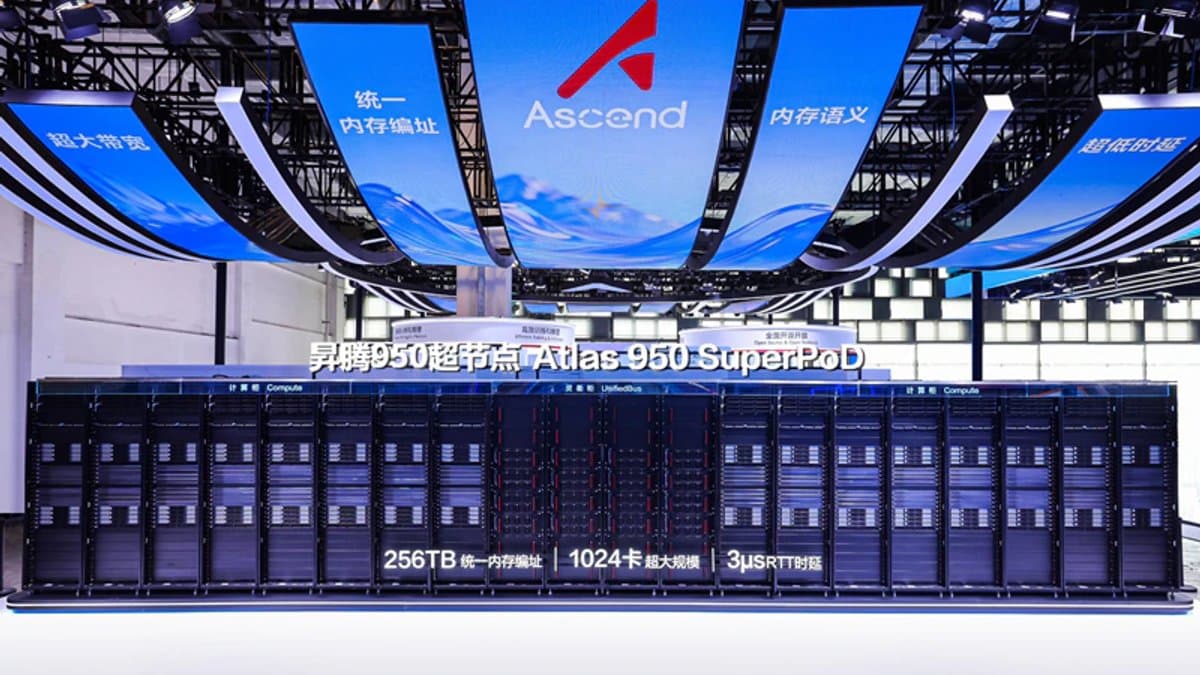
Start with Huawei itself. Since landing on the US Entity List in 2019, this company's entire operating pattern has been "whatever Washington cuts off, build a replacement." Android got cut, so HarmonyOS happened. Advanced mobile silicon got cut, so Kirin came back from the dead. Nvidia access got cut, so Ascend became the priority. Ascend started in 2019 with the original 910, which most Western observers dismissed as a TPU knockoff. The 910B and 910C generations are now the only domestic accelerator actually shipping in volume into Chinese AI data centers. Their limiting factor has never really been peak FLOPs on a slide. It's been units produced and high-bandwidth memory secured.
Then there's Yu Chengdong, Huawei's executive vice president and the public face of its consumer business. At HDC 2026 in June, previewing openPangu 2.0, he said something unusually candid for a launch keynote. AI compute is extremely expensive, he explained, and most of Huawei's capacity goes to supporting other Chinese enterprises — which leaves Huawei itself with limited headroom. So rather than chasing raw parameter count, the company would optimize latency and throughput. That single quote explains a lot about why this model is 505B and not a trillion. Huawei is fundamentally a chip vendor here. Every card it burns on its own model is a card it can't sell to someone else.
Third player: Ascend Tribe, the Huawei-led open source community hosted on GitCode (AtomGit). That's the primary distribution channel for this release, and the choice is interesting. The smaller sibling model, openPangu-2.0-Flash at 92B total and 6B active, is up on Hugging Face too. The 505B Pro's first-party distribution is China-platform-centric. That creates a real friction point for international researchers, and it also means the mirroring question — who rehosts these weights, in what format, under what terms — becomes part of the story. Reporting indicates community efforts to convert the weights to standard formats and run them on Nvidia GPUs are already underway.
The fourth party didn't plan to be in this article at all. On the exact same day, July 31, LG AI Research published K-EXAONE 2.0 to Hugging Face: 750 billion total parameters, 37 billion active per token, 256 experts with 8 selected per token, a 262,144-token context window, and — this is the part that matters — an Apache 2.0 license. It's the second model delivered under South Korea's Independent AI Foundation Model Project, overseen by the Ministry of Science and ICT. Lim Woo-hyung, co-head of LG AI Research, emphasized that Korean researchers completed the entire development process independently. Two frontier-scale open-weight releases, two national strategies, roughly forty-eight hours apart.
What's Actually Inside
Let's go architecture first. openPangu-2.0-Pro is a Mixture-of-Experts model that keeps MLA (multi-head latent attention) for inference efficiency and then layers two different attention regimes on top of it: DSA for sparse global context and SWA for sliding-window local modeling, stacked at a 1:2 ratio. The SWA layers handle nearby tokens cheaply; the DSA layers reach across the full window sparsely. The whole point is to make a 512K context window economically survivable — cutting compute, memory footprint, and, critically, memory bandwidth pressure during long-context inference.
On top of that sit two more pieces. There's a 4-stream mHC residual connection scheme, and a 3-head MTP (multi-token prediction) self-speculative module. MTP is the interesting one for practical latency: the model proposes several tokens ahead and verifies them, which is speculative decoding without needing a separate draft model. Training used the Muon optimizer, which the technical report credits with faster convergence. Read the whole design together and the intent is obvious — every architectural choice bends toward maximizing tokens per card per second on Ascend hardware, not toward winning a parameter-count contest.
The post-training pipeline is denser than most Chinese releases bother to describe. Huawei says it ran supervised fine-tuning that fuses fast and slow thinking modes, then stacked multiple specialized reinforcement learning stages on top, then used online distillation (which they abbreviate OPD) to fuse the resulting capabilities back into one model. The shipped artifact splits into Thinking and Non-Thinking variants. The model card's Thinking-mode numbers include AIME 2026 at 95.4 (avg@16), GPQA-Diamond at 87.9 (avg@4), LiveCodeBench V6 at 85.7 (avg@3), and IMO-AnswerBench at 84.3 accuracy.
Treat those scores as vendor-reported for now. Every one of them is Huawei's own measurement, published by Huawei, on benchmarks Huawei selected. There is no independent reproduction yet, and there won't be quickly — verifying a 505B model requires either an Ascend cluster or a serious pile of GPUs plus a working format conversion. That's not an accusation, just calibration. The weights being public means verification is at least possible, which is more than can be said for most frontier claims.
Now the claim with the most marketing DNA in it: Huawei says openPangu 2.0 delivers roughly twice the per-card inference throughput of mainstream open-source models on Ascend compute. This line has been repeated consistently since the June HDC keynote. Read the comparison conditions carefully. It is not "openPangu is 2x faster than DeepSeek." It's closer to "on Ascend silicon, a model co-designed for Ascend gets about double the per-card throughput of a general-purpose open model ported onto the same Ascend silicon." There is no head-to-head against an H100 or B200 in that framing. Which makes sense, because Huawei is not selling a model. It's selling an accelerator platform, and this benchmark is a platform argument dressed as a model argument.
Deployment has its own wrinkle. Inference runs through the omni-infer framework, with setup instructions living in a separate repository called openPangu-2.0-Infer. That repo describes itself as a large-model inference deployment project based on Ascend 910C, and it ships separate documentation for INT8/W8A8 quantization. So the shape of the story is: trained on 910B, optimally served on 910C. Two different silicon generations doing two different jobs.
Then there's licensing, which is where this diverges hardest from its Korean counterpart. openPangu-2.0-Pro is not Apache 2.0. It ships under Huawei's own "OPENPANGU MODEL LICENSE AGREEMENT VERSION 2.0," the same license attached to the Flash model card on Hugging Face. What that permits and restricts around commercial use, redistribution, and derivative models is something you have to read in the LICENSE file yourself — and if you're building a product, you probably want counsel reading it, not a blog post summarizing it.
| Spec | openPangu-2.0-Pro | openPangu-2.0-Flash | K-EXAONE 2.0 (LG) |
|---|---|---|---|
| Release date | 2026-07-31 | 2026-06-30 (released first) | 2026-07-31 |
| Total parameters | 505B | 92B | 750B |
| Active per token | 18B | 6B | 37B |
| Expert routing | MoE (config undisclosed) | MoE (config undisclosed) | 8 of 256 experts |
| Context window | 512K | 512K | 262,144 |
| Training tokens | ~34T | ~34T | Not disclosed |
| Training hardware | Ascend NPU (910B per reporting) | Ascend NPU | Not disclosed |
| License | OPENPANGU MODEL LICENSE 2.0 | OPENPANGU MODEL LICENSE 2.0 | Apache 2.0 |
| Primary distribution | GitCode Ascend Tribe / Huawei Cloud MaaS | GitCode + Hugging Face | Hugging Face |
| Released artifacts | Weights + inference code + tech report | Weights + inference code + training operators | Weights |
One more thing before we move on, because it's been polluting coverage all week. Several English-language outlets reported this model as having "50.5 billion parameters." That's off by a factor of ten, and the cause is a Chinese-language transcription error. 505B renders as 5050亿 in Chinese. Some outlets wrote 505亿 instead, which is 50.5 billion, and the mistake propagated straight through translation. ZOL's writeup, for instance, published "Pro版总参数量为505亿,实际激活参数量18亿" — which shrinks not just the total but also the active parameter count, turning 18B into 1.8B. The correct figures are 505B total and 18B active, and both Huawei's official announcement and the GitCode model card agree on them. Get the decimal wrong and this goes from a geopolitically loaded frontier release to a routine mid-size model launch.
Who Gets Paid Here
Huawei's payoff isn't licensing revenue. It's a reference implementation. The single biggest objection any Chinese enterprise raises when evaluating Ascend is not "can it do inference" — inference is a solved-enough problem. It's "can my team actually train a large model on this without CUDA." Training is where the pain lives: optimizer numerical stability at scale, collective communication libraries, kernel maturity, checkpoint and failure recovery across thousands of cards running for weeks. None of that shows up on a TFLOPs comparison chart, and all of it decides whether a procurement decision becomes a career-ending mistake. "505B parameters, 34 trillion tokens, run completed" is Huawei's answer to that objection, and shipping the weights plus the technical report is how it makes the answer checkable.
Chinese AI startups get something concrete too. Compute is the binding constraint in that market right now — Nvidia procurement is legally blocked, and Ascend supply is tight. Against that backdrop, an Ascend-optimized 505B open-weight model means you don't have to pretrain from scratch to have a frontier-class base. Fine-tuning and domain adaptation get you most of the way for a fraction of the compute. The 512K context is immediately monetizable in legal, medical, and codebase-scale applications where document length is the whole problem. The license is the friction point, and it's a real one.
The HarmonyOS ecosystem is the third beneficiary, and arguably the strategic one. Huawei claims openPangu 2.0 is deeply integrated with HarmonyOS and delivers faster, more accurate, lower-resource performance on agent tasks. Read that as the final piece of a vertical stack: chip, operating system, model, agent layer, all under one roof. Structurally it's Apple's playbook — own the silicon, own the OS, own the model. The difference is that Huawei is releasing the model layer as open weights, using openness to expand a closed ecosystem rather than to escape one.
So who loses? In the short term, mostly Nvidia's narrative — though which direction it cuts is genuinely unclear. Nvidia has argued to Washington for years that restricting its China sales just hands the market to Huawei. openPangu-2.0-Pro strengthens both sides of that debate simultaneously. Yes, Huawei pulled off a frontier training run, which supports Nvidia's "they'll fill the vacuum" case. But it also supports the opposite reading: that export controls accelerated exactly the self-sufficiency they were meant to prevent. Meanwhile, analyses like the Council on Foreign Relations' assessment argue Huawei still can't catch Nvidia on AI silicon by a wide margin. Washington's conclusion is not settled, and anyone telling you it is has a position to sell.
This Has Happened Before — The Wins and the Faceplants
The obvious precedent on the win side is DeepSeek in early 2025. Working under hardware constraints, DeepSeek produced frontier-class results and generated a narrative that constraint breeds efficiency innovation. The cost figures got argued about for months, and some of those arguments were fair. But the net effect was a durable credibility upgrade for the entire Chinese open-weight camp. openPangu-2.0-Pro is the hardware-layer sequel to that story. Where DeepSeek's pitch was "you don't need that much money," Huawei's is "you don't need American chips."
The faceplant precedent is closer to home. Huawei's Pangu line took real reputational damage in 2025 when one of its open models drew accusations that its parameter distribution resembled another open model's a little too closely. What the community demanded at the time is, almost item for item, what Huawei shipped this week: weights, a technical report, and enough reproducible detail to check the work. The unusually transparent posture of this release reads like a direct response to that episode. Once trust breaks, you pay it back in documentation.
There's a third pattern worth naming: the long history of "we trained it on domestic silicon" claims that shrink under inspection. This isn't only a Chinese phenomenon — several countries have announced sovereign-hardware model training. Read the fine print and you usually find one of three things. The model was small, in the single-digit or low-double-digit billions. Or only fine-tuning ran on domestic accelerators while pretraining used imported hardware. Or the cluster was mixed, and the press release said "trained on" without saying "exclusively." openPangu-2.0-Pro is being treated differently because it asserts both frontier scale and a complete pretraining run. That assertion has not been independently audited. But the technical report is public, so academics will have opinions within weeks, not years.
And the supply chain critique has its own well-worn track record. Teardown analysis of the Ascend 910C previously found TSMC-manufactured CPU dies dating to 2020 still inside the package. SemiAnalysis has documented Huawei's TSMC die bank and repeatedly identified HBM as the actual production bottleneck, not logic fabrication. So when TechTimes points out that the training silicon depended on TSMC dies and Samsung memory, it's not a novel gotcha — it's the same structural fact resurfacing at a moment when the headline invites people to forget it. "We didn't use Nvidia" and "we didn't use foreign supply chains" are completely different sentences that headlines love to blur together, and this is the distinction Huawei has the hardest time answering.
How Everyone Else Punches Back
The most direct counter arrived the same day from Seoul. K-EXAONE 2.0 is bigger (750B versus 505B), more permissively licensed (Apache 2.0 versus Huawei's own agreement), and distributed somewhere the global research community already lives (Hugging Face). LG reported an average of 70.1 across 24 benchmarks spanning nine categories, up from 63.3 for the first generation, with about a 30 percent improvement on coding and agentic tasks. On the OpenAI-MRCR long-context retrieval benchmark it posted 94.4, ahead of Qwen 3.5 at 93.0 and DeepSeek V4 Pro Max at 92.9. On Korean long-context comprehension (Ko-LongBench) it scored 89.6.
But LG left two gaps of its own. It published no direct comparison against GPT, Claude, or Gemini — a point coverage flagged explicitly, and one that makes the frontier-parity question unanswerable from the announcement alone. And it did not disclose training hardware at all. Notice how neatly the two launches invert each other. Huawei's headline asset is what it trained on and its weak spot is licensing. LG's headline assets are who built it (Korean researchers, end to end) and how freely you can use it, while the hardware question goes unaddressed. Each company led with the axis where it's strong.
Inside China, the competitive math runs differently. DeepSeek, Alibaba's Qwen line, and Zhipu's GLM family all still benefit operationally from Nvidia-based clusters and the mature tooling around them. The harder Huawei pushes "Ascend-native" as a brand, the more incentive those teams have to counter-position on portability: our model runs anywhere, on any stack, day one. And in the open-weight market, adoption is often decided less by benchmark scores than by whether vLLM and SGLang support the architecture out of the box. A model whose reference path is omni-infer on Ascend has a real onboarding tax outside China until the community closes that gap.
Nvidia's response will likely be political rather than technical. The company has been telling Washington that if it exits China, Huawei becomes the default standard — and openPangu-2.0-Pro is close to ideal evidence for that argument. The restriction hawks will counter with the TechTimes framing: strip away TSMC dies and Samsung HBM and this run doesn't happen, so controls are working and should tighten. The same event, cited by both camps, supporting opposite policy conclusions. That's normally a sign that the underlying facts are genuinely ambiguous rather than that one side is lying.
The American open-weight camp is the wildcard. What Meta, Mistral, and OpenAI's open model line do next — at what scale and under what license — determines whether the current "open weights means Asia" framing holds. As of August 2026, the frequency of 500B-plus open-weight releases clearly favors Asian labs, but that reflects strategy more than capability. If your revenue comes from API access to closed models, giving away frontier weights is self-harm. If your goal is making your hardware or your national stack the default substrate, it's the cheapest marketing there is.
Finally, the verification community is its own counterplay. Public weights mean anyone can probe them. Expect benchmark contamination checks, weight-similarity analyses against other open models, and empirical tests of whether that 512K context actually retains information across the full window rather than degrading past some fraction of it. For Huawei this is both exposure and opportunity. Pass the scrutiny and this release becomes the symbol of Chinese AI self-sufficiency. Fail it and 2025 repeats with a bigger audience.
So What Actually Changes
For developers, honestly, not much this week. If you don't have Ascend cards, 505B of weights is a very large file and not much else. At FP16 you're looking at roughly a terabyte of storage before you even think about the memory needed to serve it, and the reference inference path assumes hardware most of the world doesn't own. That changes if and when the community lands solid format conversion and GPU backend support, which is reportedly in progress. Until then the practical entry point is openPangu-2.0-Flash: 92B total, 6B active, already on Hugging Face, same 512K context. If you're building a long-document pipeline and want to see what the DSA/SWA hybrid actually does to long-context retention, Flash is the cheap experiment.
For investors, there are two threads worth tracking, and neither resolves this quarter. The first is how the Nvidia-China narrative settles, because this release feeds ammunition to both the loosen-controls and tighten-controls camps, and the resulting policy adjustments matter more to revenue than any single model launch. The second is HBM. Multiple independent analyses converge on the same conclusion: Huawei's real ceiling isn't logic die fabrication, it's high-bandwidth memory supply. That makes policy decisions touching Samsung, SK Hynix, and Micron more consequential for the Ascend ramp than anything happening in model architecture. Treat all of that as structural observation, not a trade thesis — there are far too many moving pieces to convert it into a position.
For enterprises, the decision starts and ends with the license, and it splits cleanly by geography. K-EXAONE 2.0 under Apache 2.0 gives you commercial use, modification, and redistribution with essentially no strings. openPangu ships under Huawei's own agreement, which means someone has to actually read the terms, and on top of the license text you're layering geopolitical exposure. If you sell into the US market, putting a Huawei-licensed model into production is not a decision to make without legal review — not because the license is necessarily restrictive, but because the vendor is an Entity List company and procurement, compliance, and customer questions all follow from that. Flip the geography and the calculus inverts: if you're targeting China's domestic market, Ascend plus openPangu plus HarmonyOS may be the lowest-regulatory-risk stack available to you.
For ordinary users, there's no immediate effect. This model isn't landing in an app you use tomorrow. The medium-term effect is real, though. Every additional frontier-class open-weight release puts downward pressure on API pricing and expands the set of workloads that can run on-premise or on-device instead of through someone else's cloud. If you're in Korea specifically, K-EXAONE 2.0 is the release that will touch you sooner — an Apache-licensed model posting 89.6 on Korean long-context comprehension is going to show up inside domestic products fairly quickly.
For researchers, the most valuable artifact here isn't the weights at all. It's the technical report. A detailed account of what breaks when you train a 505B MoE on 34 trillion tokens using non-Nvidia accelerators — communication patterns, the Muon optimizer choice, stability interventions, failure recovery at cluster scale — transfers directly to any other sovereign-accelerator program. Teams building domestic AI hardware in India, Europe, and the Gulf can read this as a field manual rather than a press release. That Huawei published it at all tells you where it thinks the money is: selling the platform beats monetizing the model, and it isn't close.
🥄 Three Things You're Probably Wondering
— So what does this mean for me? Practically nothing today, unless you own Ascend hardware. A 505B model isn't something you run on a workstation. What it changes over the next year is pricing pressure on AI APIs and a wider menu of models you can host yourself. If you're in Korea, the same-day K-EXAONE 2.0 release will probably reach you faster.
— Is the "trained without Nvidia" claim actually true? Huawei and multiple outlets agree there were no Nvidia chips in the training cluster, and that part looks solid. The catch is that the Ascend silicon itself reportedly used TSMC-fabricated dies and Samsung HBM. So "without Nvidia" holds while "without American, Taiwanese, and Korean supply chains" does not. Whether a fully domestic stack could repeat this run is still unproven.
— Can I just use it commercially? Not without reading the fine print. This is not Apache 2.0 — it ships under the OPENPANGU MODEL LICENSE AGREEMENT VERSION 2.0, and the terms around redistribution, derivatives, and permitted uses live in the LICENSE file in the repo. Add the Entity List dimension and it's too early to call this a drop-in replacement for a permissively licensed model in a Western production system.
References
- Huawei Newsroom — openPangu-2.0-Pro model and technical report officially open-sourced (July 31, 2026)
- Ascend Tribe / GitCode — openPangu-2.0-Pro model card and technical report
- Ascend Tribe / GitCode — openPangu-2.0-Infer deployment repository
- IT之家 — Huawei's openPangu-2.0-Pro model and technical report go open source
- IT之家 — Huawei unveils openPangu 2.0 at HDC 2026: up to 505B parameters
- Hugging Face — openpangu/openPangu-2.0-Flash model card
- TechTimes — Huawei Pangu Pro Trains 505 Billion Parameters Without Nvidia: Supply Chain Tells Different Story
- TechTimes — Open-Source 700B Models Released Two Days Apart as Korea Nears Sovereign AI Elimination Round
- The Korea Times — LG unveils 750 bil.-parameter frontier AI model K-EXAONE 2.0
- TheElec — LG AI Research Unveils 750-Billion-Parameter K-EXAONE 2.0
- GitHub — LG-AI-EXAONE/K-EXAONE official repository
- Council on Foreign Relations — China's AI Chip Deficit: Why Huawei Can't Catch Nvidia
- SemiAnalysis — Huawei Ascend Production Ramp: Die Banks, TSMC Continued Production, HBM is The Bottleneck
- ZOL — Huawei releases open-source openPangu 2.0 (example of the parameter-count typo)
Numbers and criteria are as of announcement and may change. Investment calls are yours to make!