The Second of Silence That Kills Every AI Phone Call
Anyone who has called a support line knows the moment. You finish your question, and then nothing happens. A second goes by. Maybe a second and a quarter. A human would fill that gap with an "uh-huh" or a "let me check on that for you," because humans hate dead air on a phone line. An AI voice agent just sits there, thinking. And you, on the other end, read that silence as "it didn't hear me," so you start talking again. Now the model thinks you interrupted, discards its plan, and starts over. That's how AI phone calls die — not from a wrong answer, but from a badly timed pause.
On July 29, 2026, xAI said it cut that pause roughly in half. Its new speech-to-speech model, Grok Voice Think Fast 2.0, drops time to first audio from 1.25 seconds to 0.70 seconds. On paper that's 0.55 seconds. In conversation it's much bigger than that, because human turn-taking isn't linear. Research on conversational timing across ten languages found a unimodal peak of responses within roughly 200 milliseconds of the end of a question, with cross-language variation staying inside a 250ms band. Push past about a second and listeners start registering something as off. 1.25 seconds sat outside that line. 0.70 sits inside it. Crossing a perceptual threshold doesn't feel like a 44% improvement — it feels like the machine suddenly started paying attention.
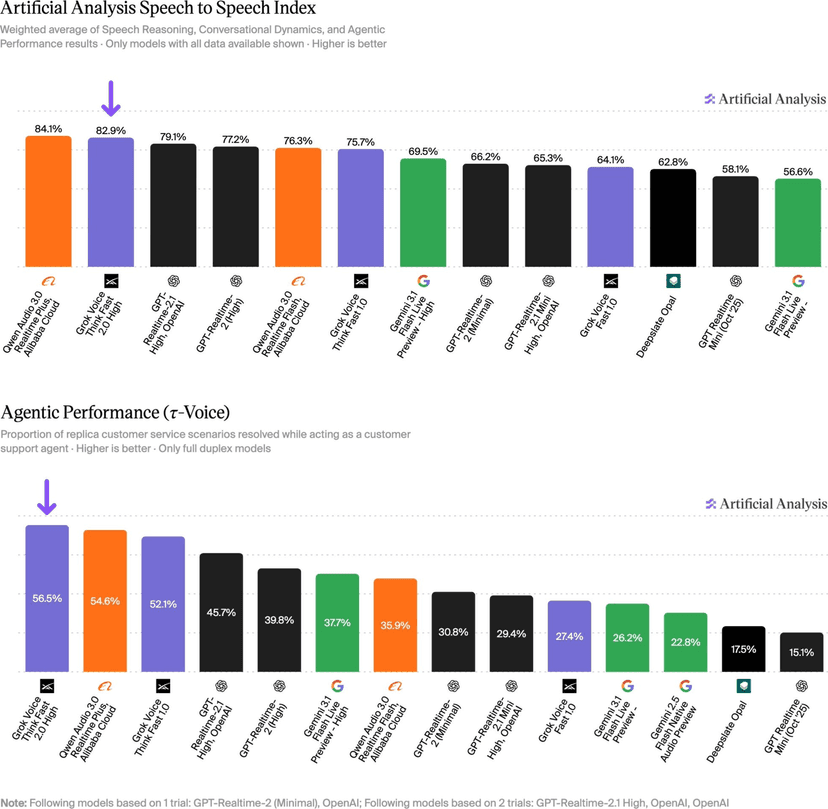
The same day, the independent benchmark shop Artificial Analysis published its scorecard. Grok Voice Think Fast 2.0 High debuted at 82.9% on the Speech to Speech Index, up from 75.7% for Think Fast 1.0, ahead of OpenAI's GPT-Realtime-2.1 High at 79.1% and Google's Gemini 3.1 Flash Live at 69.5%. On τ-Voice, the agentic slice of the index, it took outright first place at 56.5%. But it did not take the overall crown. Alibaba's Qwen Audio 3.0 Realtime Plus had claimed that a few days earlier at 84.1%. Grok debuted at number two — and that gap between "number two overall" and "number one where it counts" is the most interesting thing about this launch.
So here's what this piece is going to work through. Why 0.70 seconds is a category change rather than a spec bump. What "think while speaking" actually means at the architecture level. Why the model that scores highest on the leaderboard may be the one you absolutely cannot ship. Why xAI raised the price 60% in an industry where every generation gets cheaper. What $0.08 a minute does to a contact center's cost model. And who's going to punch back, from Mountain View to Hangzhou.
Who's Actually in This Fight
Start with xAI, except calling it just xAI is now imprecise. Per CNBC's February 3, 2026 report, SpaceX absorbed xAI in an all-stock deal valuing the combined entity at $1.25 trillion — $1 trillion for SpaceX, $250 billion for xAI — the largest private merger on record. Grok, the X platform, and xAI's model business all landed under the SpaceX roof, and the combined company listed on Nasdaq in June. Which is why x.ai's own newsroom and the Artificial Analysis leaderboard now show the provider as "SpaceXAI." We'll keep saying xAI for readability, but hold onto the structural fact: this is a division of a public company now. Voice API revenue is something an investor relations team has to explain on a call.
Then there's Artificial Analysis, which has quietly become the scoring authority for this industry. Their Speech to Speech Index, launched in 2026, exists because native audio models needed a single comparable number the way text models have one. It blends three benchmarks at equal 33.3% weight: Big Bench Audio for speech reasoning (1,000 questions drawn from four Big Bench Hard categories, synthesized with 23 different TTS voices), Full Duplex Bench for conversational dynamics (pause handling, turn-taking, interruption handling, backchannels), and τ-Voice for agentic performance. A model has to score on all three to appear at all.
τ-Voice deserves its own paragraph, because it's the number that matters most and the one people understand least. It comes from a 2026 arXiv paper by Soham Ray, Keshav Dhandhania, Victor Barres and Karthik Narasimhan (arXiv:2603.13686) that extends the text-only τ²-bench into the voice modality. It runs 50 airline scenarios, 114 retail, and 114 telecom, and scores pass@1 task completion — did the agent actually resolve the customer's problem. The clever part is the simulated user: an LLM drives the customer's decisions, and the audio layer adds diverse accents, background noise, and packet loss modeled on real network conditions. It's full duplex, so the simulated customer can interrupt, yield, or wait. Artificial Analysis has been blunt that agentic performance is "the hardest dimension by a wide margin," which tells you where the real ceiling is.
The opposing corner has four distinct camps. OpenAI's GPT-Realtime line has been the default choice for voice agent builders, with 2.1 High sitting at 79.1%. Google fields Gemini 3.1 Flash Live at 69.5% but competes on distribution rather than score, folding Gemini Live into products people already use. Alibaba shipped Qwen Audio 3.0 Realtime in July in Plus and Flash variants, and Plus leads all three component benchmarks — 99.2% on Big Bench Audio, 98.4% on Full Duplex Bench, 54.6% on τ-Voice. And then there are the specialists: Deepgram with Nova-3 on the transcription side, ElevenLabs with Scribe v2 and its Agents platform. xAI named those last two explicitly in its announcement, which is not an accident. Most voice agents today are assembled — Deepgram or ElevenLabs to listen, a frontier LLM to think, a TTS engine to speak, LiveKit or similar to glue it together. Naming the specialists is a declaration that the assembly job should go away.
What Actually Shipped: "Think While Speaking," Explained
The pitch is in the name. Think Fast. Per the announcement, the structural move is running reasoning and speech generation in parallel rather than in sequence. The conventional voice agent pipeline is strictly serial: detect end of user speech, transcribe, run the LLM, generate response text, synthesize audio, stream it out. Every stage's latency stacks. Reason harder and you get more accurate but slower; reason less and you get faster but wrong. That trade-off is why building good voice agents has been miserable, and the leaderboard shows it in one line: Qwen Audio 3.0 Realtime Plus, the overall index leader at 84.1%, averages 4.02 seconds to first audio. Highest score in the world, and you cannot put it on a live phone call.
Think Fast 2.0's claim is that it sidesteps the trade-off rather than optimizing along it. The model starts talking while it's still reasoning, and it fires tool calls before the sentence it's speaking is finished. Coverage summarizing xAI's post describes tool calls typically executing "before the agent completes its first sentence." Translate that to a contact center: while the agent is saying "sure, let me pull that up for you," the lookup query is already in flight to the backend. That's exactly how a competent human rep works. Previous AI agents finished the sentence, then started the lookup — which is why "let me pull that up" was always followed by another dead second.
The second axis is efficiency, and it's more interesting than it looks. Median reasoning token usage dropped to 0.4× the previous generation, about a 60% reduction, while scores went up. In a voice context, reasoning tokens are literally time, so cutting them is a latency lever as much as a cost lever. But you don't get "fewer tokens and better scores" by making the model smarter in the abstract. Per the announcement summaries, reinforcement learning was used to shape conversational strategy toward shorter answers and handling one issue at a time. That's not a modeling insight so much as a customer service insight — it's what quality coaches teach human reps, because customers can't absorb three things at once over a phone line. The model got less chatty, not just smarter.
The third axis is listening. xAI reports that across thousands of short utterances in 24 languages, Think Fast 2.0's transcription accuracy improved 1.5–2.0× relative to Deepgram Nova-3 and ElevenLabs Scribe v2, and 1.4× relative to its own 1.0. Under significant background noise, the company says the gap widens to roughly 10×. Worth flagging clearly: those are xAI's own evaluations on xAI's own set, and no independent replication has been published. For context on the comparison targets, Deepgram's Nova-3 announcement cites a median WER of 6.84% on real-time streams, while ElevenLabs says Scribe v2 Realtime hits 93.5% accuracy across 30 languages at under 150ms latency. Different datasets, different definitions of accuracy. Read "1.5 to 2.0×" as true within xAI's chosen conditions, not as a settled fact.
| Item | Detail | Basis |
|---|---|---|
| Announced | July 29, 2026 | xAI newsroom; Artificial Analysis published same day |
| Time to first audio | 1.25s → 0.70s | Artificial Analysis TTFA measurement |
| Speech to Speech Index | 82.9% (1.0 scored 75.7%) | Artificial Analysis Speech to Speech Index |
| Overall rank | #2 — Qwen Audio 3.0 Realtime Plus leads at 84.1% | Artificial Analysis leaderboard |
| Agentic (τ-Voice) | 56.5%, #1 overall (1.0 scored 52.1%) | Artificial Analysis / τ-Voice benchmark |
| Rival scores | GPT-Realtime-2.1 High 79.1%; Gemini 3.1 Flash Live 69.5% | Artificial Analysis leaderboard |
| Speed standout | Only top-five index model with sub-1-second average TTFA | Artificial Analysis post |
| Reasoning tokens | Median 0.4× prior generation (~60% reduction) | xAI announcement summaries |
| Transcription | 1.5–2.0× vs Nova-3 and Scribe v2 across 24 languages | xAI internal eval, no independent replication |
| Price | $0.08/audio minute ($4.80/hr); 1.0 was $0.05/min | xAI developer docs |
| Alias cutover | grok-voice-latest flips to 2.0 on August 5, 2026 |
xAI notice; 1.0 requires explicit pinning |
That price row is the one that should stop you. Five cents a minute to eight cents a minute is a 60% increase. The industry convention over the last two years has been that each generation delivers more for less, so going the other way is a statement. Either the parallel-reasoning architecture genuinely costs more to serve, or xAI decided its performance lead was worth capturing as margin. For calibration, GPT-Realtime-2.1 bills per token — roughly $32 per million audio input tokens and $64 per million audio output tokens — and measurement-based analyses put typical agent workloads somewhere around $0.06 to $0.11 per minute depending on how much the bot talks and how well you cache. So $0.08 isn't gouging; it lands near the middle of the market. Just remember xAI's docs also note server-side tools bill separately, so your effective rate sits above the headline.
And then there's August 5. That's when grok-voice-latest stops pointing at 1.0 and starts pointing at 2.0. If you want the old model you have to explicitly pin grok-voice-think-fast-1.0. For anyone running production traffic behind that alias, this is a forced upgrade with a 60% price increase attached, plus a change in response style and latency profile that your turn-detection logic may or may not like. Today is August 3. You have two days.
Who Wins, Who Eats the Loss
The clearest winners are the teams building voice agents. The standard architecture in this space has been a chain of specialists, and every link adds latency and its own failure mode. A native speech-to-speech model that also transcribes well collapses that chain. The τ-Voice number is what makes this credible rather than just fast: 56.5% means it leads the field at actually calling tools correctly and driving a customer issue to resolution, which is a very different claim from "sounds natural in a demo." For a team trying to automate real work rather than build a voice toy, that's the line item that justifies a migration.
Contact center operators now have arithmetic to do. Fully-loaded onshore outsourced agent rates in the US run roughly $25–$45 per hour in 2026, and per-minute inbound pricing generally lands between $0.50 and $1.75 of talk time. Grok Voice 2.0 costs $4.80 an hour. On raw rate that's one-fifth to one-ninth of a US agent, and six to twenty-plus times cheaper on a per-minute basis. Now, this is apples to oranges and you should say so out loud in any meeting where the comparison comes up: the human rate bundles supervision, QA, training, and after-call work, while the AI rate excludes tool-call billing, orchestration infrastructure, escalation-to-human costs, and — in regulated industries — audit logging and compliance overhead. But an order-of-magnitude difference survives a lot of adjustment. And when the gap is an order of magnitude, the conclusion isn't "pilot a bit," it's "redesign the operation."
On the losing side, standalone speech vendors feel this most directly. xAI naming Deepgram and ElevenLabs as the transcription baseline was a targeting decision. If the speech-to-speech model hears well enough, the separate STT line item gets questioned at renewal. Both companies clearly saw this coming. ElevenLabs wired Scribe v2 Realtime into its Agents product and sells a platform rather than a model, with SOC 2, ISO 27001, PCI DSS L1, HIPAA and GDPR coverage plus EU and India data residency and a zero-retention mode — a moat made of procurement paperwork, which benchmark scores don't cross. Deepgram holds ground on ultra-low-latency streaming and on-prem deployment. Neither is dead. Both are now defending rather than expanding.
The second group taking a hit is xAI's own existing customers. The August 5 alias flip is effectively a mandatory upgrade with a 60% price increase riding along. Three cents a minute sounds trivial until you run the volume: an operation doing 10,000 minutes a day is looking at roughly $9,000 a month in new spend. For workloads where 1.0 was already good enough — order status lookups, appointment confirmations, simple routing — the extra capability buys nothing and the invoice just went up. Those customers will pin 1.0, or start shopping.
And then the human agents, where the honest answer is messier than the headlines suggest. Latency and word error rate were never the real blocker for contact center automation; exception handling was. The angry customer, the case that isn't in the playbook, the two backend systems that disagree about what the customer paid. Flip the τ-Voice number around: 56.5% completion means 43.5% of scenarios still fail, and by contact center standards that's not a passing grade. The realistic near-term outcome is a higher share of tier-one calls handled without a human, and human reps left with a queue composed entirely of the hard ones. That's a real change to the job, and not obviously a pleasant one.
We've Seen This Movie Before — Twice Each Way
Take the wins first. The clearest case of speech technology genuinely reshaping an industry is Nuance in medical dictation. The Dragon product line got physicians documenting encounters by voice, embedded itself inside clinical workflow, and became structurally hard to remove — which is why Microsoft paid $19.7 billion for it in 2021. The lesson isn't about recognition accuracy. Nuance didn't win a benchmark; it won a position inside the electronic health record, where switching cost is measured in retraining thousands of clinicians. Model quality got it in the door. Workflow integration kept it there.
The second win is more recent and closer to xAI's playbook: ElevenLabs converting text-to-speech quality leadership into actual market share between 2023 and 2025. It proved naturalness in demos, opened an API so developers could build on it, then wrapped the whole thing in an agent platform so the model became a dependency rather than a commodity. That's the exact arc xAI is attempting — win attention with benchmark numbers, capture developers with Agent Builder, where 2.0 was reportedly made available at launch, and end up owning the infrastructure layer rather than a spec sheet line.
Now the failures. Google Duplex is the canonical one. At I/O 2018, an AI called a hair salon, dropped in a perfectly-timed "mm-hmm," and booked an appointment while the audience applauded. Then reality arrived: a meaningful share of live calls needed human operators behind the scenes, the ethics of an AI passing as human on the phone became a public argument, and the ambition quietly shrank until most of it was retired. The lesson is that a stage demo and a wild call are different sports. The wild has regional accents, a toddler in the background, and questions nobody wrote a playbook for. That is precisely why τ-Voice bothers to simulate accents, noise, and packet loss instead of running clean audio.
The second failure is Humane's AI Pin in 2024, and it maps directly onto this story's core argument. A voice-first wearable, reviewed brutally, and the complaint reviewers kept returning to was latency — you asked, and you waited, and waiting felt awful. The product evaporated. In a voice interface, latency isn't a spec, it's the product's identity. 0.70 seconds and 2.5 seconds aren't two settings of the same thing; they're two different products, and only one of them is a phone call. Which is exactly why Qwen can hold the number one score at 84.1% and still be irrelevant to live telephony at 4.02 seconds TTFA, while Grok at 82.9% and 0.70 seconds is the more shippable object. Read the leaderboard as a single column and you'll get this backwards.
How the Competition Punches Back
OpenAI's most likely counter is price and tiering. GPT-Realtime bills per token, which gives it more room to maneuver than a flat per-minute rate, and a mini tier lets it defend the low-complexity workloads where 82.9% versus 79.1% simply doesn't matter. Measured analyses that put typical sessions at $0.06–$0.11 per minute also note that number drops when prompt caching is working properly, which is a lever xAI's flat rate doesn't have. OpenAI also has something xAI doesn't: an enterprise sales motion with the compliance paperwork already filed. Contact center replacements don't get decided by benchmark deltas; they get decided by procurement. Expect the next GPT-Realtime release to market time to first audio explicitly, too — OpenAI hasn't leaned on that metric before, and it just lost the only sub-one-second slot in the top five.
Google is playing a different game entirely. Gemini 3.1 Flash Live's 69.5% is a real gap to the frontier, but Google's weapon has never been the leaderboard. It's Android, Search, Workspace, and carrier relationships. If voice AI arrives bundled inside products a company already licenses, a dozen index points stop being the deciding factor. And the Flash line is built around price-performance, which lets Google pose an uncomfortable question to enterprise buyers: do you want 82.9% at eight cents a minute, or 69.5% at something close to free inside a contract you've already signed? Given how much call volume is genuinely simple, that question lands harder than it should.
Alibaba has already counterpunched — it just did it first. Qwen Audio 3.0 Realtime Plus took the index lead at 84.1% days before Grok 2.0 shipped, sweeping all three component benchmarks. The obvious next move is a latency-optimized variant, and Alibaba already runs a two-tier Plus/Flash structure where Flash is the speed-oriented line. If a future release pairs low-eighties quality with sub-second TTFA, Grok's differentiator evaporates in a single announcement. There's price pressure too: on the leaderboard's cost-per-hour-of-input-audio view, Qwen's realtime models sit far below Grok's rate, which is leverage in any high-volume negotiation even before you account for regional availability differences.
ElevenLabs and Deepgram will argue they sell systems, not models. ElevenLabs has already fused Scribe v2 Realtime into Agents and stacked certifications, residency options, and zero-retention mode to hold financial and healthcare accounts. That trench is hard to cross with accuracy claims, because a regulated buyer asks "do you have HIPAA coverage" before "how many times more accurate." Deepgram can defend on on-prem deployment and adjacent markets like call recording analytics, where a speech-to-speech model isn't the right tool anyway.
Finally, there's the neutral infrastructure camp — LiveKit, Twilio, Vapi and friends — and they win no matter who tops the index. In fact, every forced migration like the August 5 alias flip makes their pitch stronger, because developers who just got surprised by a model swap start wanting an abstraction layer between their product and any single vendor. xAI wants lock-in. Events like this push the market toward portability instead. That tension is worth watching over the next few quarters.
What Actually Changes for You
If you're a developer, you have a two-day task. Anything pointed at grok-voice-latest changes model on August 5. Faster is welcome, but the response style shifted toward shorter, one-issue-at-a-time answers, which can fight with prompts you tuned to make 1.0 explain things thoroughly, and your end-of-turn detection thresholds were probably calibrated against a 1.25-second profile. Also tell whoever owns the budget that the rate goes up 60%. The safe sequence is boring and correct: pin 1.0 now, A/B 2.0 in staging against your real call recordings, then cut over deliberately rather than getting cut over automatically at midnight.
For investors, two threads are worth pulling. First, this is now a business unit of a public company after the SpaceX merger, which means voice API revenue becomes something management has to narrate. Shipping a better model and raising the price 60% is a data point against the assumption that inference costs only fall — it suggests either that parallel reasoning is genuinely expensive to serve, or that xAI believes it has enough of a lead to charge for it. Second, watch how the standalone speech vendors hold up. The ones with compliance moats and platform surface area look structurally different from the ones competing purely on model quality, and the next few quarters should separate them visibly.
For everyday users, this arrives invisibly. One day you call an airline or a carrier and the thing on the other end is oddly quick, doesn't make you say "representative" four times, and actually solves your problem. The upside is fewer eight-layer phone menus. The downside is the Duplex problem, recycled: as synthesized speech gets faster and cleaner, telling AI from human by ear gets harder, and disclosure rules become the only protection left. That's not an abstract worry for this company in particular — xAI has been in the news lately over a UK deepfake lawsuit and a Minnesota state suit, so the scrutiny on how its voice and synthesis tech gets used isn't hypothetical.
If you're evaluating this for an enterprise, the main advice is: do not copy benchmark numbers into your KPI deck. τ-Voice covers airline, retail, and telecom scenarios, and your call mix matches none of them exactly. The 0.70-second TTFA is an average measured over Big Bench Audio questions, and your real calls carry longer context and heavier tool payloads. Three things actually matter in a pilot. One, transcription failure rate in noise — your customers call from cars and train platforms, not recording booths. Two, escalation quality: does it hand off to a human quickly when it's out of depth, or does it confidently make something up? Three, true end-to-end cost including tool billing, orchestration, and after-call processing, because $0.08 a minute is the model line only.
And for anyone working on policy: better transcription plus lower latency means the audible difference between a human call and an AI call is closing fast. Disclosure requirements, recording consent, and synthetic-voice labeling all assume a gap that is shrinking. Existing transparency rules — the EU AI Act's disclosure provisions, various US state AI disclosure requirements — are about to get stress-tested by a system that answers in seven-tenths of a second and sounds like it's paying attention.
🥄 Three Things You're Probably Wondering
— So what does this mean for me? Not much this week. But if a support line suddenly feels fast and human over the next few months, this class of model is a likely reason, and you still get to ask whether you're talking to a person. If you build voice agents, August 5 is a real deadline, not a suggestion.
— Is Grok the best voice model now? Half yes. Alibaba's Qwen Audio 3.0 Realtime Plus leads the overall index at 84.1% versus Grok's 82.9%. But Grok is first on agentic performance at 56.5% and it's the only top-five model averaging under one second to first audio, while Qwen averages 4.02 seconds. For live phone calls specifically, Grok looks like the more practical pick right now — though these rankings flip every few weeks, so calling it settled would be premature.
— Why did the price go up if it got better? It did: $0.05 to $0.08 per audio minute, a 60% increase. xAI hasn't spelled out why, so this is inference — either parallel reasoning genuinely costs more to serve, or the company decided to monetize a performance lead. If you run high call volume, the rational move is to pin 1.0 and measure whether the quality difference actually earns the extra three cents on your traffic.
Sources
- Artificial Analysis — Announcing the Speech to Speech Index
- Artificial Analysis — Speech to Speech benchmarking methodology
- Artificial Analysis — Speech to Speech model leaderboard
- Artificial Analysis post — Grok Voice Think Fast 2.0 index debut
- τ-Voice: Benchmarking Full-Duplex Voice Agents on Real-World Domains (arXiv:2603.13686)
- xAI developer docs — model list and per-audio-minute pricing
- xAI — Introducing Grok Voice Think Fast 2.0
- Stivers et al. — Universals and cultural variation in turn-taking in conversation (PNAS, 2009)
- ElevenLabs — Introducing Scribe v2 Realtime
- Deepgram — Introducing Nova-3
- CNBC — Musk's xAI and SpaceX combine in the biggest merger ever
Numbers are as of announcement and may change.