It said no to $800 million in 2025. In 2026 it raised ₩850 billion without giving up control.
Here's the deal: when FuriosaAI reportedly declined Meta's acquisition offer in March 2025, opinion split down the middle. The figure was $800 million — the largest offer a Korean AI chip startup had received — and the reported reason for refusing wasn't price. It was disagreement over post-acquisition restructuring and strategic direction.
Eighteen months later, this is the follow-up. FuriosaAI has begun receiving a pre-IPO round of up to ₩850 billion. Smaller than what it turned down, but categorically different money: this doesn't hand over the company.
The mechanics: two board resolutions, on April 29 and May 11, authorized new share issuances of roughly ₩232 billion and ₩637 billion respectively, with an initial tranche of about ₩8.3 billion disbursed first. The remainder flows in as each investor's committee process completes.
The round values the company at ₩3 trillion, near the top of Korea's AI chip sector. With the full amount in, the valuation is expected to rise proportionally.
FuriosaAI: eight years to build a chip company
FuriosaAI was founded in 2017 as a fabless AI semiconductor company. CEO June Paik came out of AMD and Samsung, and the company committed early to building for inference rather than training.
That was a contrarian call at the time. AI chip discourse from 2017 to 2020 centered on training performance, and a queue of startups lined up to challenge Nvidia there. Furiosa went the other way, on the thesis that running trained models in production would eventually be the far larger market by volume. From here, that call looks right.
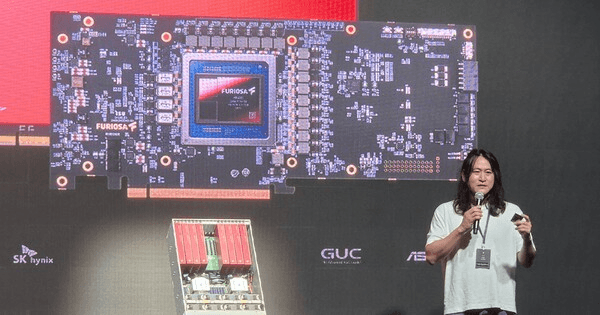
The first-generation chip was Warboy. The second is RNGD — pronounced "Renegade." The headline claim is power efficiency: three times the performance per watt versus Nvidia's H100, which carries a 350W TDP. It's a pitch aimed squarely at inference workloads, where electricity is a large share of total cost of ownership.
The turning point came in July 2025. After a seven-month evaluation, LG AI Research approved RNGD as the inference chip for its EXAONE 4.0 platform, targeting enterprise deployment across electronics, finance, telecom, and biotech. Landing that four months after refusing Meta carried obvious symbolic weight.
Current status, per the company: a target of 16,000 additional Renegade units during 2026, and a 0.75MW data center operating in Seoul's Gangnam district. The third-generation chip is in development with mass production targeted for 2028. A listing is planned for 2027–2028.
Where the ₩850 billion comes from — half of it is policy capital
Break down this round and you get a picture of current Korean AI semiconductor policy.
| Component | Size | Nature |
|---|---|---|
| Existing investors | ~₩150B | follow-on |
| New private investors | ₩250–300B | new capital |
| Policy funds (National Growth Fund, KDB, etc.) | ₩400–450B | policy matching |
| Total | up to ₩850B | at ₩3T valuation |
The key line is that policy money accounts for roughly half. The National Growth Fund and Korea Development Bank participate, with private capital matched against them. The Financial Services Commission reportedly approved a ₩370 billion direct investment through its advanced strategic industries fund.
The reason this structure exists is straightforward. Semiconductor startups require enormous capital with long payback periods, and conventional venture funding rarely carries a company to volume production. For AI chips built on leading-edge foundry nodes, mask sets alone run into the tens of millions of dollars.
The structure is also contested. When policy capital dominates a round, critics argue that allocation decisions reflect policy judgment rather than market validation. FuriosaAI and Rebellions being designated as "K-Nvidia" candidates for state support drew exactly that criticism. The counterargument is equally strong: with the US and China deploying national capital into semiconductors, market logic alone doesn't produce competitors.
Who gets what
FuriosaAI buys time. AI chip generations turn over quickly, and missing one is very hard to recover from. ₩850 billion funds second-generation volume production and third-generation development simultaneously. Targeting 2028 for the third chip specifically implies the development budget through that window is now secured.
The pressure rises too. A ₩3 trillion valuation demands growth to match, and with a listing targeted for 2027–2028, visible revenue and customer traction have to arrive on that schedule.
The government and policy lenders get an execution case. Domesticating AI chip production has been a stated goal across multiple administrations with few examples reaching volume. That Furiosa generated commercial revenue through the LG contract is the evidence base for continued public investment.
Domestic customers like LG AI Research get supply optionality. AI inference infrastructure is overwhelmingly Nvidia-dependent, and simply obtaining GPUs has become a competitive factor. A domestic alternative that actually works creates procurement leverage. The practical barrier is software migration cost.
Korea's chip ecosystem sees knock-on effects. One fabless company reaching volume creates demand for design IP, packaging, and software stack vendors around it. That ecosystem has to exist before a second and third company can follow.
The scorecard for AI chip startups is mixed
The history here supports both optimism and pessimism.
The success case usually cited is Habana Labs, the Israeli startup Intel acquired for $2 billion in 2019, which became the basis for Intel's Gaudi line. That was a successful company outcome, not a successful product outcome — Gaudi has continued to struggle for market share.
The other side has more entries. Graphcore was once heralded as the credible Nvidia challenger at a multi-billion-dollar valuation, then struggled as revenue failed to follow, and was acquired by SoftBank in 2024 at a price reported to be far below its peak mark. Wave Computing went bankrupt. Several AI chip startups disappeared quietly.
Two failure modes recur. The first is software: however good the silicon, customers don't migrate without a stack that can substitute for CUDA. The second is generational cadence — falling behind Nvidia's annual release rhythm means launching a product that's already behind.
The successes share a pattern too: concentrate on a specific workload, and land one large customer as a reference. Google's TPU scaled from internal workloads, and the Furiosa–LG relationship has the same shape.
How competitors respond
Nvidia is defending inference actively, strengthening inference-oriented product lines while software lock-in continues to do the heavy lifting. Even when a challenger claims a performance edge, porting cost tends to offset it.
Rebellions is the direct domestic rival. It merged with Sapeon to gain scale and sits in the same policy-support cohort. Two companies competing for the same domestic customers and the same public resources makes differentiation urgent.
Hyperscaler in-house silicon competes from another direction. Google TPU, AWS Inferentia, and Microsoft Maia all target inference and already absorb large volumes within their own clouds. Competing means going after on-premise deployments outside those clouds — a smaller market.
Chinese vendors form a separate axis. US export controls restricting Nvidia access accelerated domestic Chinese AI chip development, and if price competitiveness follows, they'll meet Korean chips in Asian markets.
Inference service providers are the natural customers. For companies serving models via API, inference cost is margin. If the 3x efficiency claim holds in practice, the math works for them. That market is also deeply optimized around GPUs already, which makes switching costs high.
One current constraint deserves mention. As covered elsewhere in today's briefing, 2027 DRAM and HBM capacity is fully booked across all three major memory makers. Building an AI chip means securing HBM, and in an allocation queue a young fabless company ranks behind the largest buyers — Nvidia itself has already trimmed a product spec over HBM availability. Capital raised doesn't help if components can't be sourced, which makes supply chain access as much a gating factor as silicon design.
The power-efficiency positioning also lands well right now. Data center expansion has been capped by electricity rather than land or capital for a while. Processing more inference within the same power envelope isn't just a cost saving — it raises the ceiling on how much work a facility can do at all. Turning that argument into purchase orders requires measurements from real deployments, though, and little independent verification has been published so far.
So what actually changes
If you procure AI infrastructure, a domestic inference chip is approaching the point of being a real evaluation candidate. Watch two things: whether reference customers beyond LG appear, and how cleanly the software stack runs actual production models. In practice, porting difficulty matters more than benchmark numbers.
If you work in semiconductors, this is a case study in a domestic fabless company crossing into volume production — including how heavily the funding structure leans on policy capital, and how directly a large customer win feeds valuation.
If you're an investor, the ₩3 trillion valuation is the thing to interrogate. Revenue isn't disclosed and the listing is 2027–2028, so results have to materialize in that window. The first checkpoint is simple: does the stated 16,000-unit Renegade target actually ship, and to how many customers?
If you follow industrial policy, this is a large, concentrated public bet on a single company. Success makes it a model; failure makes it a cautionary example of picking winners. The verdict is years away.
If you're a general reader, read it as the sequel to the company that said no to $800 million. That looked reckless to some at the time. It has since secured comparable capital while staying independent — though how the story ends is still unwritten.
🥄 Three Things You're Probably Wondering
— Has the full ₩850 billion arrived? No. Board resolutions authorized the share issuance and an initial tranche of roughly ₩8.3 billion was disbursed. The rest flows in as each investor's review committee signs off, and the final total is still being adjusted.
— Can it actually beat Nvidia? Not in training — that's not realistic. Furiosa targets inference, and specifically the segment where power efficiency dominates cost. Even there, the real barrier is the software ecosystem rather than silicon performance. That's precisely what sank companies like Graphcore despite competent hardware.
— Should I buy at IPO? That's a 2027–2028 question with insufficient basis today. What matters is how much revenue materializes by then and which customers join LG. Single-customer dependence is the structural risk in AI chips, so the count of reference deployments is the number to track.
Sources
- 퓨리오사AI, 프리 IPO 투자금 납입 시작 (THE ELEC, 2026-08) — the primary source: board resolution dates and sizes, the initial tranche, Renegade production targets, and data center status.
- 퓨리오사AI, '프리 IPO' 8500억으로 확대 (THE ELEC) — how the round grew from ₩750 billion to ₩850 billion, with the investor breakdown.
- 퓨리오사AI, 국민성장펀드 최종 발탁 (THE ELEC) — confirmation of the policy fund allocation.
- '국민성장 3700억 발판' 퓨리오사AI, 프리IPO 1조로 커지나 (TheBell) — the ₩370 billion direct investment approval and outlook for round expansion.
- AI chip startup FuriosaAI reportedly turns down $800M acquisition offer from Meta (TechCrunch, 2025-03-24) — the declined acquisition, with reporting that strategy and structure, not price, drove the decision.
- FuriosaAI partners with LG AI Research for deployment of RNGD inferencing chips (DataCenterDynamics) — the seven-month evaluation and EXAONE platform adoption.
Numbers and criteria are as of announcement and may change. Investment calls are yours to make!