Microsoft replaced its own coding model after 100 days
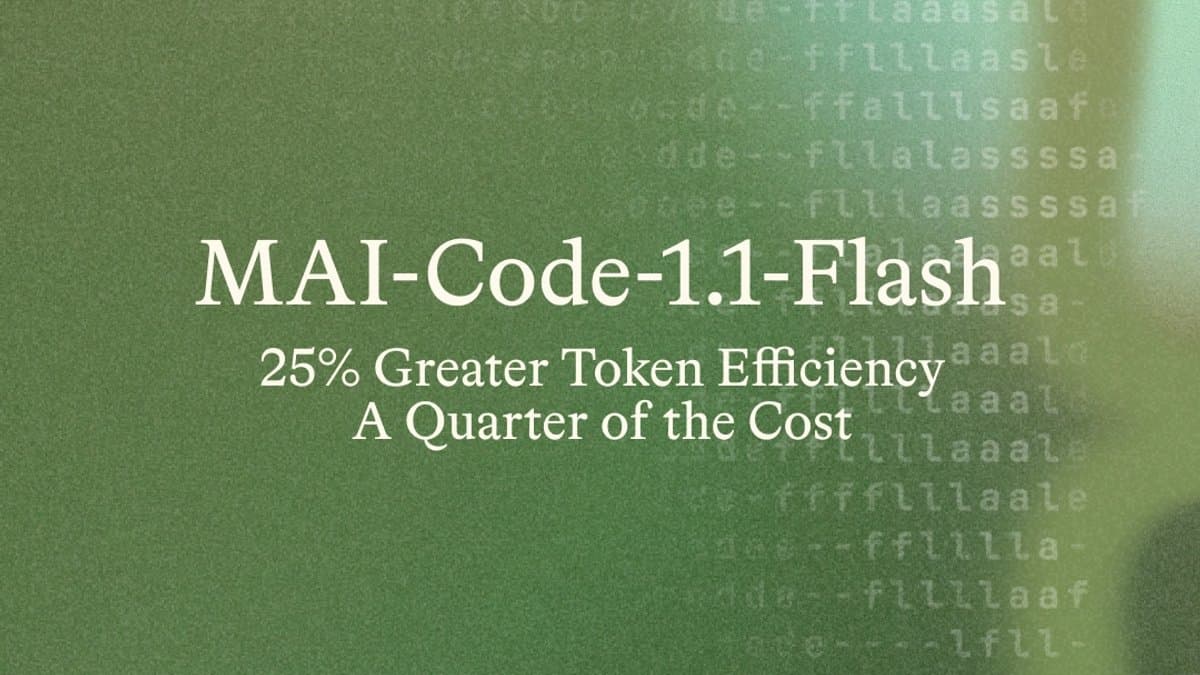
Here's the deal: on August 11, Microsoft shipped MAI-Code-1.1-Flash. The decimal in the name tells you it isn't a new generation — it's a point release on top of MAI-Code-1-Flash, which came out on June 2. But the numbers attached to this minor version bump are not minor. Token list prices came down 73%. The Terminal Bench 2.1 score went from 51.7 to 62.9.
The same day, GitHub posted a second notice alongside the launch: MAI-Code-1-Flash will be deprecated across all GitHub Copilot experiences on September 10. Ship on June 2, kill on September 10. That's a 100-day lifespan. Microsoft handed its own model a death sentence three months after shipping it.
That's the most revealing part of this release. Model vendors usually keep old versions alive for a long time, because enterprise customers tune prompts and pipelines against a specific model and get loud when it disappears. Microsoft went the other way — announced the successor and gave the incumbent 30 days. It's treating models as swappable parts rather than assets.
And the substance of the announcement is price, not capability. As the table below shows, the pure coding metric — SWE-Bench Verified — moved from 71.6 to 72.6. That's a single point. The price went to a quarter. The message Microsoft is sending is closer to "this got cheaper" than "this got smarter." In the AI coding market right now, cheaper is the scarier weapon.
Who built this, and how they got here
MAI-Code comes out of Microsoft AI's Superintelligence team, formed in November 2025 and run directly by Mustafa Suleyman. He co-founded DeepMind, then founded Inflection AI, then joined Microsoft as CEO of Microsoft AI in 2024 when the company absorbed most of Inflection's staff.
The team exists for one reason. For three years, Microsoft was a company that shipped OpenAI's GPT inside Word, Excel, Teams, and GitHub. The distribution belonged to Microsoft; the model belonged to somebody else. Suleyman has said in interviews that renegotiating the OpenAI agreement was the single pivotal moment that let Microsoft chart its own AI course — after that, Microsoft could train frontier models at scale on its own IP.
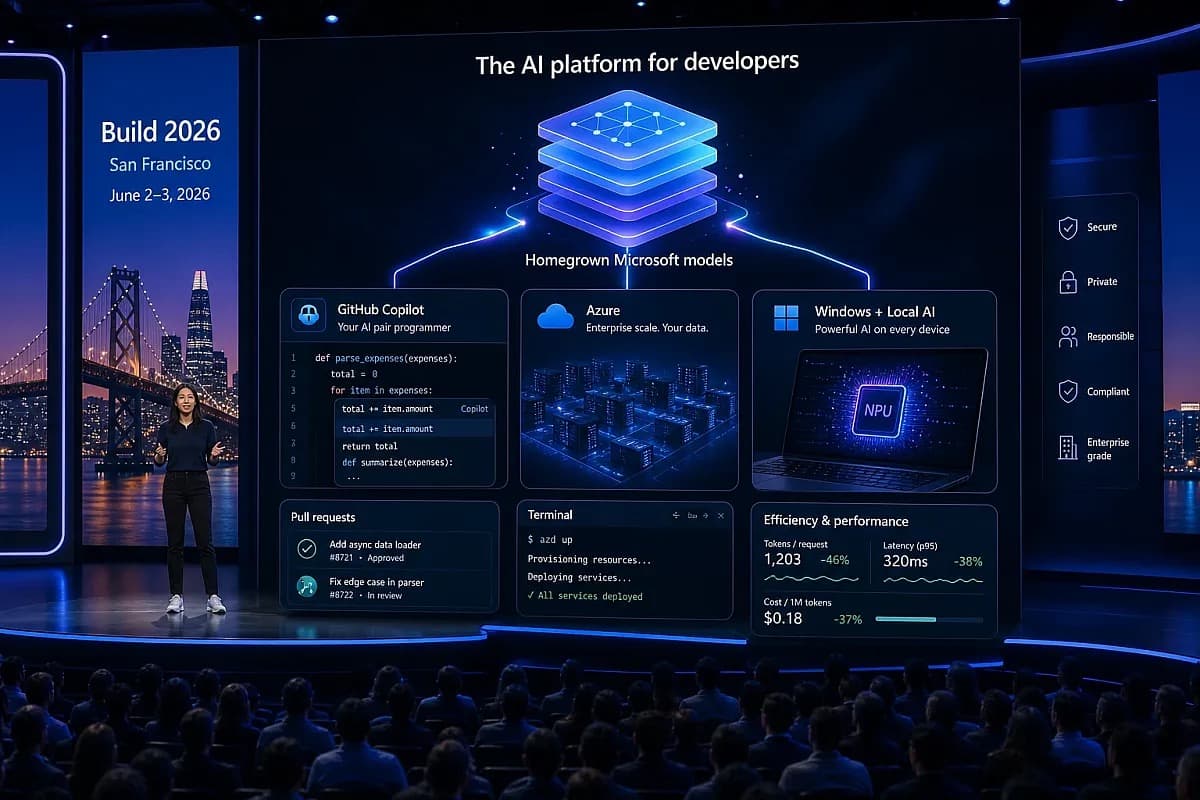
The payoff landed on June 2, 2026, at Build. Microsoft announced seven in-house models in a single day: the reasoning model MAI-Thinking-1, the coding model MAI-Code-1-Flash, image generation with MAI-Image-2.5 and its Flash variant, transcription with MAI-Transcribe-1.5, and speech synthesis with MAI-Voice-2 and MAI-Voice-2-Flash. Image, voice, transcription, reasoning, code — an entire lineup at once. The announcement was explicit about method: "We don't distill from other labs and we don't rely on opaque data. Our datasets are clean, traceable, and enterprise-grade." That sentence is aimed squarely at enterprise legal departments.
MAI-Code-1-Flash rolled out that day, expanded to more Copilot surfaces on June 18, and reached Copilot Business and Enterprise on June 26. So Microsoft spent June pushing its own model into every corner of Copilot — and two months later, it's swapping that model out.
The hardware line in the June post is the one to remember. Microsoft said co-design with its own Maia 200 silicon delivered a 1.4x efficiency boost, and that a next-generation GB200 cluster was live at MAI. That's where a 73% price cut comes from. A company that builds the model, builds the chip the model runs on, owns the datacenter the chip sits in, and owns the product the model is sold through doesn't have to pay a margin to anyone.
What actually improved, straight from the model card
Specs first. Per the model card, MAI-Code-1.1-Flash is a transformer using sparse Mixture-of-Experts layers, with 138B total parameters and 5B active. Context length is 256K tokens. It takes text and image input and produces text. Training ran March through August 2026, with a pretraining cutoff of December 2025.
The lineage is interesting. The model started from MAI-Thinking-1's compressed 5B-active-parameter mid-training checkpoint. Microsoft took its large reasoning model, compressed it, added a light supervised fine-tuning pass for instruction and format following, ran a second mid-training phase on roughly 2 million synthetic agentic tasks, then finished with large-scale reinforcement learning across more than 150,000 environments. It distilled from its own big model rather than someone else's — which is consistent with the "we don't distill from other labs" claim.
Here's the benchmark table as published, with average tokens per completed task alongside each pass rate. Microsoft's argument is that when pass rates are close, the model that burns fewer tokens is the better one.
| Benchmark | MAI-Code-1.1-Flash | MAI-Code-1-Flash | Claude Haiku 4.5 | GPT-5.4 mini |
|---|---|---|---|---|
| SWE-Bench Verified (pass rate) | 72.6 | 71.6 | 69.8 | 69.2 |
| ↳ token usage | 8.6K | 10.8K | 20.9K | 9.4K |
| Terminal Bench 2.1 (pass rate) | 62.9 | 51.7 | 49.4 | 60.7 |
| ↳ token usage | 17.0K | 14.2K | 25.5K | 21.9K |
| Text2WebApp (internal) | 74.1 | — | 11.5 | 58.3 |
| ScreenShot2WebApp (internal) | 42.1 | — | 10.0 | 39.3 |
| Vision2Web Level3 | 11.5 | — | 13.7 | 10.1 |
And the pricing, per 1M tokens:
| Item | MAI-Code-1.1-Flash | MAI-Code-1-Flash | Claude Haiku 4.5 |
|---|---|---|---|
| Input | $0.20 | $0.75 | $1.00 |
| Cached input | $0.02 | $0.075 | — |
| Output | $1.20 | $4.50 | $5.00 |
| Copilot premium request multiplier | 0.25× | — | — |
Input and output both fell exactly 73%, which lines up precisely with GitHub's stated "73% lower list price than MAI-Code-1-Flash." Annual Copilot subscribers get a 0.25× premium request multiplier, meaning one request counts as a quarter — effectively four times the throughput on the same allowance.
Microsoft also published real-usage deltas. Tokens stream 25% faster, the model uses 25% fewer tokens for the same task, Terminal-Bench 2.1 improved 22% inside GitHub Copilot CLI, and .NET tasks improved 15%. Two more numbers are worth flagging because they come from telemetry rather than benchmarks: 4% more generated code survives through to commit, and return visits are up 9%.
Now read the table skeptically, because three things stand out.
First, the pure coding gain is smaller than the headline suggests. SWE-Bench Verified moved 1.0 point, from 71.6 to 72.6. The big jump is Terminal Bench 2.1, from 51.7 to 62.9 — but that measures an agent stringing together shell commands to finish a task, which is a different skill from writing good code. So "better" here mostly means better agentic operation and better token economy. The model didn't get dramatically better at writing code.
Second, the comparison isn't neutral, and the model card says so. Every evaluation ran in "the same VS Code-based harness used to evaluate production GitHub Copilot workflows," with all compared models on identical settings. That's an honest disclosure, but it also means these are Copilot-harness scores, not absolute capability scores — and MAI-Code was trained directly against that harness. The giveaway is Claude Haiku 4.5 scoring 11.5 on Text2WebApp and 10.0 on ScreenShot2WebApp. Haiku 4.5 is not a model that fails to build web apps nine times out of ten. Put a model in a harness it wasn't shaped for and the score collapses. Anything labeled "internal" in that table deserves extra caution.
Third, the new vision capability is still thin. On Vision2Web Level3, MAI-Code-1.1-Flash scored 11.5 against Haiku 4.5's 13.7. That's the only row where Microsoft's model loses — in Microsoft's own harness, on Microsoft's own evaluation. It handles the easy screenshot-to-app case at 42.1, but the harder visual reasoning task isn't there yet.
A few more constraints practitioners should log. Supported languages: English only. Pretraining cutoff is December 2025, so anything shipped in frameworks or APIs since then is outside its knowledge. The model card's pricing field literally reads "To be finalized" even though GitHub's billing is already live — meaning list prices still have room to move. And the model card says GitHub Copilot CLI support is "planned for a later rollout" while the announcement touts CLI improvements and the changelog lists CLI as supported. The documents don't fully agree with each other.
Rollout conditions matter too. Copilot Free and Student users get it through automatic model selection. Pro, Pro+, Max, Business, and Enterprise can pick it manually or automatically — but for Business and Enterprise the default is off, so an administrator has to enable it in model policies. Supported clients are VS Code, Visual Studio, JetBrains IDEs, Eclipse, Xcode, Copilot CLI, the cloud agent, GitHub Mobile, and Copilot Chat on GitHub.
Who gets what out of this
Microsoft gets a different cost structure, full stop. Until now, Copilot was a business where growth in usage meant growth in token payments to Anthropic and OpenAI. Microsoft owned distribution while a meaningful slice of the margin walked out the door to model suppliers. Every point of traffic that shifts to an in-house model closes that leak — and if it's served on Maia silicon, the Nvidia share shrinks too. Replacing a model after 100 days reads as urgency about finishing that transition fast.
GitHub gets a better product story. One knock on Copilot was that it's ultimately a wrapper reselling someone else's models. That changes when the in-house model is cheaper than Haiku 4.5, performs better in the harness that actually serves users, and ships by default to Free and Student tiers. Cheaper unit economics on the free tier means you can afford to keep free users engaged longer, and that's the top of the paid conversion funnel.
Paying Copilot users get real headroom. A 0.25× premium request multiplier means four times the requests on the same monthly allowance. Push routine refactors, test generation, and repository Q&A here and save the top-tier model budget for work that needs it.
Enterprise administrators get a negotiating card. When you're talking seat prices with Anthropic or OpenAI, "we can route a large share of our traffic to MAI-Code by policy" is now a real option rather than a bluff. The flip side is two decisions land on your desk: whether to flip the default-off switch, and whether a model with a demonstrated 100-day lifespan belongs in your internal standard.
Anthropic and OpenAI are on the losing end. Haiku 4.5 and GPT-5.4 mini were built for exactly this slot, and they've just met a competitor with a structural cost advantage inside the largest distribution channel in the category. Both remain in Copilot's model picker, but losing the default and the free tier to a house model compounds over time.
Application-layer companies like Cursor and Cognition get a mixed outcome. Cheap, competent small coding models help their cost of goods. But the model card scopes MAI-Code to commercial use within GitHub Copilot and its supported clients — this isn't a model outsiders can license and build on. The net effect is that the company that already owns the distribution channel now also owns the cost advantage, which is not a friendly development for anyone renting both.
Nvidia is the name nobody says out loud in this announcement. When Microsoft credits Maia 200 co-design with a 1.4x efficiency boost, that's a statement about serving the same workload with fewer GPUs. The volume isn't decisive yet. The direction is unambiguous.
Precedents — where vertical integration worked, and where house models died
Platform companies pushing their own models over their suppliers' is not a new move. The results have split hard.
The cautionary tale is Amazon's Titan. Amazon owned Bedrock, a model marketplace, and put its own foundation models on it. Every structural argument said the channel owner should win. In practice, most Bedrock customers picked Anthropic's Claude and Meta's Llama anyway, and Amazon ended up investing $8 billion in Anthropic instead. The lesson is blunt: owning the shelf does not make customers pick your product off it. Developers choose the model that makes their code work.
The second cautionary tale is Microsoft's own Phi series. Phi posted impressive benchmark numbers for its size and generated real research attention, but production adoption never matched the scorecard. Small models optimized against benchmarks kept falling apart when they met messy real-world context. There are signs Microsoft learned from this. The model card goes out of its way to explain that pass rates are "measured end to end, with repository context, tool calls, and verification included, rather than in a stripped-down benchmark environment" — and the headline metrics Microsoft chose to promote include commit survival rate and return visits, which are telemetry, not leaderboard entries.
On the success side, two examples. Amazon's Graviton is the cleanest one: build your own ARM server chip, lower EC2 costs, pass the savings to customers, take share. Intel and AMD couldn't answer because Amazon controlled chip, cloud, and customer simultaneously. Maia 200 plus Copilot is the same drawing.
The second is Google's Gemini Flash. Google used TPUs to price small models aggressively and reset the floor for the entire budget tier. Competitors followed the price down, industry margins compressed, and the only companies that could absorb it were the ones with their own silicon. A 73% cut on MAI-Code is the same species of move — and notably, GitHub's changelog shows Gemini 3.7 Flash arriving in Copilot on August 13, two days later. Two companies are fighting for the same low-cost slot.
How competitors answer
Anthropic is the direct target. Haiku 4.5 lists at $1 input and $5 output per million tokens; MAI-Code-1.1-Flash lists at $0.20 and $1.20. That's roughly a 5x gap, playing out inside a channel Anthropic doesn't control. Anthropic has three plays: cut Haiku-tier pricing, grow its own distribution through Claude Code and direct enterprise relationships, or lean on quality differentiation at the Sonnet and Opus tiers to make "cheap is cheap for a reason" stick. It has been weighting the third option most heavily for several quarters.
OpenAI is in the more awkward position. GPT-5.4 mini didn't do badly in the table — 60.7 on Terminal Bench 2.1 against MAI-Code's 62.9, and 69.2 on SWE-Bench Verified. The problem is price: at roughly $0.75 input and $4.50 output per million tokens, it's several times more expensive. And OpenAI is simultaneously Microsoft's partner and a competitor inside Microsoft's own model picker. That tension has been widening since the agreement was renegotiated.
Google is the peer competitor here. It designs TPUs, runs them in its own datacenters, and has already won a price war in the budget tier with Gemini Flash. It's the one rival with a comparable cost structure, which means if Microsoft pushes on price, Google can push back rather than retreat. Gemini 3.7 Flash landing in Copilot on August 13 captures the strangeness of the moment — Microsoft is reselling Google's model inside its own product while competing with Google on price.
Chinese open-weight models set the floor. Qwen Coder variants, GLM, DeepSeek, and MiniMax coding models cost nothing in license fees if you run them on your own infrastructure. Microsoft arriving at $0.20 isn't unrelated to that pressure. List prices in the small-coding-model tier are going to keep grinding down, and margins in this slot are structurally thin.
Amazon will likely take the other road. If Titan taught anything, it's that forcing a house model is harder than serving other people's models cheaply — which is what Trainium plus Bedrock plus the Anthropic relationship is built to do. Same vertical integration instinct, different stopping point: Microsoft integrates through the model, Amazon stops at the chip.
Agent companies like Cursor and Cognition answer at the workflow layer, not the model layer. When model prices keep falling, the model stops being a differentiator and the fight moves up to repository comprehension, multi-agent orchestration, and review integration. It's an uncomfortable fight, though, against a competitor that owns the IDE, the repository, and the CI system in one company.
What actually changes for you
If you're a developer, there's something concrete today. If you're on Copilot, MAI-Code-1.1-Flash should be in your model picker, and at a 0.25× multiplier your allowance effectively stretches four times further. Don't move everything, though. Routine refactors, test scaffolding, and repository questions fit this model well; work that requires design judgment still belongs on a top-tier model. And keep the constraints in mind — English only, and a December 2025 knowledge cutoff.
If you're an engineering leader, two decisions just landed. One is whether to enable this model in Business or Enterprise policy, because the default is off and inaction means your org can't use it. The other is September 10 — if any pipeline or automation calls MAI-Code-1-Flash, you have a month to migrate. The broader lesson matters more: Microsoft just demonstrated it will rotate house models on a 100-day cycle. If you have automation hardcoded to a model name, this is the week to put an abstraction layer in front of it.
If you're in enterprise procurement, this is negotiating material. A 73% list-price cut in the budget tier is leverage in any conversation about coding-tool seat pricing. But check your contract for model deprecation notice periods. Models vanishing on 30 days' notice is now a thing that actually happens.
If you're an investor, read this as a margin story. AI coding tool economics have been "seat revenue minus model API cost," with the second term outside the vendor's control. Microsoft is internalizing that term. Two things to watch: how fast the share of Copilot requests served by in-house models climbs, and how much of the serving volume moves onto Maia-family silicon. If both rise, Microsoft's AI margin structure changes fundamentally.
If you're a general reader, the direct impact is small, but the trend is worth knowing. Model prices are falling several-fold per year, and the fall is coming from cost engineering more than from capability gains. That's why AI features keep showing up bundled into products at no extra charge — the marginal cost of including them keeps dropping.
If you're a junior developer, there's a signal buried in Microsoft's own metrics. One of the numbers it chose to promote was that 4% more generated code survives to commit. Flip that around: a substantial share of AI-written code still gets thrown away before it reaches a commit. What the model is good at is producing a fast draft. Deciding whether a draft is worth keeping is still a human job, and that judgment is what the market is currently pricing.
🥄 Three Things You're Probably Wondering
— So is it actually better than Haiku or GPT? Inside Copilot, probably yes. But every number in that table came from Microsoft's Copilot harness, and MAI-Code was trained directly against that harness. Haiku 4.5 scoring 11.5 on Text2WebApp is the tell that this comparison reflects harness fit at least as much as raw capability. Assuming the same ranking holds elsewhere would be jumping ahead of the evidence.
— What happens if I don't switch? If you're on MAI-Code-1-Flash, it disappears on September 10. GitHub advised migrating workflows and integrations before then, and Enterprise administrators may need to enable access to a replacement model in Copilot policy settings. No cleanup action is required once the old model is gone.
— Is this Microsoft breaking up with OpenAI? Too early to read it that way. OpenAI models are still in Copilot, and Microsoft's house models are so far confined to the small, cheap tier. But the direction is clear enough. Suleyman named the contract renegotiation as the turning point, and six months later there are seven in-house models, custom silicon, and a 100-day replacement cycle. Dependence is being reduced. How far it goes gets answered when a top-tier MAI model shows up.
Further Reading
- MAI-Code-1.1-Flash: Better, faster, at a quarter of the cost (Microsoft AI, 2026-08-11) — the official announcement, with the 25% faster streaming, 25% fewer tokens, 22% Terminal-Bench gain, 15% .NET gain, 4% commit survival and 9% return-visit figures.
- MAI-Code-1.1-Flash available in GitHub Copilot (GitHub Changelog, 2026-08-11) — 73% lower list price, 0.25× premium request multiplier, tier-by-tier availability, default-off for Business and Enterprise, full client list.
- MAI-Code-1.1-Flash model card PDF (Microsoft AI) — 138B total / 5B active parameters, 256K context, the raw benchmark tables including Vision2Web, plus the training pipeline and evaluation methodology.
- Upcoming deprecation of MAI-Code-1-Flash (GitHub Changelog, 2026-08-11) — the September 10 retirement notice, migration guidance, and what Enterprise admins need to do.
- microsoft/MAI-Code (official GitHub repository) — where Microsoft publishes MAI-Code releases and takes developer feedback; summarizes the 1.1 improvements.
- Building a hill-climbing machine: Launching seven new MAI models (Microsoft AI, 2026-06-02) — the Build 2026 lineup, the "we don't distill from other labs" position, Maia 200 co-design at 1.4x efficiency, and the GB200 cluster.
- Introducing MAI-Code-1-Flash (Microsoft AI, 2026-06-02) — the predecessor announcement, with the original Haiku 4.5 comparisons including SWE-Bench Pro at 51.2 vs 35.2, and the adaptive solution length explanation.
- MAI-Code-1-Flash is now available for GitHub Copilot (GitHub Changelog, 2026-06-02) — the June 2 rollout notice, day one of the 100-day clock.
- Claude Haiku 4.5 (Anthropic) — official pricing for the comparison model: $1 per million input tokens, $5 per million output tokens.
Numbers are as of announcement and may change.