Two Thousand Driverless Cars, and None of the Tech Is Western
Here's the deal: on August 14, Uber and Pony.ai announced an expanded partnership to deploy more than 2,000 robotaxis across Europe. It landed simultaneously as an Uber investor release and a Pony AI SEC Form 6-K.
The number is large, but the combination is what makes it notable. An American platform is putting Chinese autonomous driving technology on European roads. In the US, Chinese autonomy stacks are effectively blocked from public roads by regulation. So Uber went where they aren't, and Pony.ai got the only route it had to scale outside its home market.
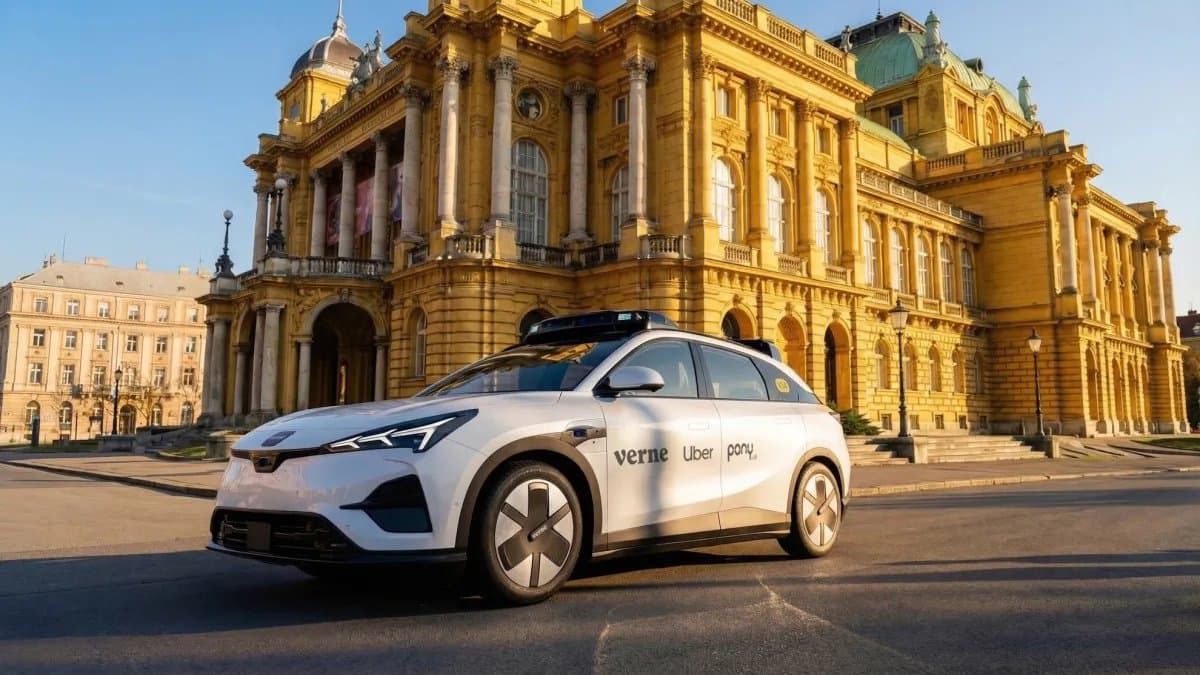
There's already a starting point. In March of this year, Europe's first commercial robotaxi service launched in Zagreb, Croatia — Verne, the Croatian mobility company founded out of the Rimac Group, handled local operations; Pony.ai supplied the autonomy; Uber supplied the demand. This announcement extends that template into four more European cities. Which cities, and on what timeline, hasn't been disclosed.
The Three Legs of the Deal
Uber decided years ago not to build autonomy itself. It ran an in-house unit, ATG, and handed it to Aurora in 2020. Since then the strategy has been partnerships — over thirty AV companies now — putting their vehicles into the Uber app. Own the demand, skip the R&D risk.
That strategy is struggling at home. Waymo dispatches passengers through its own app, and every ride that doesn't route through Uber chips away at Uber's position as the final gatekeeper of ride demand. Lose that seat and Uber's business model wobbles.
Pony.ai is a Guangzhou-based autonomy company, Nasdaq-listed, running robotaxis in four Chinese cities. It has Level 4 technology and a growth ceiling: the domestic market is crowded with Baidu Apollo Go and WeRide, and the US is closed to it. Europe is effectively the only large open market left.
The local operator is the third leg, and it matters more than it sounds. Autonomous cars still need cleaning, charging, maintenance and parking — none of which is software. Verne does it in Zagreb, and other cities will get local partners. Vehicle ownership varies by market, per the announcement. This is the most underestimated cost in the business: keeping one car running for a day requires chargers, wash bays, overnight parking and someone who can physically go retrieve it when it breaks. Building that yourself means founding a company in every city, and that burden is part of why Cruise buckled during expansion.
The Middle East is in the announcement too. Pony.ai has worked with transport authorities in Qatar and elsewhere, and the Uber relationship dates back to May 2025.
Why Europe
The choice of Europe explains the deal's character. The US robotaxi market belongs to Waymo, which serves riders through its own app and appears in Uber's only in select cities.
Europe is still open ground. Waymo is at trial stage in London and Tokyo; Tesla remains tangled in certification. European autonomy approval is stricter than the US and varies country by country, so American-style expansion speed simply isn't available. During that lag, Uber can lock up local partners, permits and operating depots — so that when Waymo does arrive, going through Uber is still the path of least resistance.
For Pony.ai, Europe isn't a choice either. The US is closed by connected-vehicle software restrictions, and the Chinese domestic market is crowded. A Nasdaq-listed company needs a growth story, and European road data has genuine technical value on top — narrow old-town streets, roundabouts and heavy cycling traffic look nothing like Chinese conditions.
In short, this is a deal between two parties who are each blocked or losing on their home turf. That's why it's big and why it was announced fast. Companies with comfortable positions don't move like this.
The Structure, Summarized
| Role | Who | Notes |
|---|---|---|
| Autonomy stack | Pony.ai | Level 4, operating in 4 Chinese cities |
| Demand & dispatch | Uber | 30+ AV partnerships |
| Fleet ops & maintenance | Local partner | Verne in Zagreb |
| Vehicle ownership | Varies by market | Stated in the release |
| Scale | 2,000+ vehicles | Europe |
| Cities | Zagreb + 4 | Names and timing undisclosed |
Look at what each party lacks and the three-way split makes sense. Pony.ai has no European brand and no ground staff. Uber has no autonomy. The local company has neither technology nor demand. Bolt the three together and you get a business — and revenue split three ways.
Zagreb was a deliberate first city, too. Croatia is in the EU so it sits inside European certification frameworks, but the market is small enough that failure costs little, and Rimac provides a serious local industrial partner. Good conditions for a regulatory pilot.
What Each Side Gets
Uber buys time. The goal is to claim the market before Waymo or Tesla arrive in force. In robotaxis, being early matters because permits, depot real estate and local partnerships are all first-come. 2,000 vehicles is the size needed to hold those positions.
Pony.ai buys foreign revenue and data. With the US closed, Europe is what keeps the growth narrative alive, and European driving data has independent technical value.
Local partners buy a new business line. Supply the operational infrastructure, share the revenue, skip the R&D entirely. For European cities with automotive industrial bases, that's an appealing proposition.
Riders get an open question. Whether robotaxi fares undercut taxis depends on region and density; early deployments usually price at parity or slightly above. The real gain shows up at night and on the outskirts, where drivers are scarce.
City authorities get both a benefit and a bill. The benefit is late-night mobility and inbound investment. The bill is sorting out liability structures for crashes, managing conflict with incumbent taxi operators, and supervising where road data goes. Zagreb went first, so the next cities will negotiate harder using that precedent.
What the Robotaxi Record Looks Like
Waymo is the success case. Driverless commercial service began in Phoenix in 2020 and expanded to San Francisco, Los Angeles and Austin. The method mattered: spend years in one city accumulating maps and edge-case handling before moving on. Slow, but dense in each market. That's also why this is a city-by-city business rather than a national one — road rules, signal conventions, pedestrian behavior and incident procedures all differ.
Cruise is the opposite case. GM's subsidiary chased Waymo fast, then lost its permits after a 2023 pedestrian incident in San Francisco was mishandled. GM shut the robotaxi business down. What decided it wasn't autonomy quality — it was incident response and regulator trust.
Uber's own history is relevant. Its test vehicle killed a pedestrian in Arizona in 2018, and that event led to winding down the internal autonomy program. Today's platform-only posture rests on that experience.
Chinese companies operating abroad is the part nobody can call yet. Autonomous vehicles are also cameras and mapping rigs, so whose company scans whose roads is permanently sensitive. Whether Europe diverges from the US or eventually converges on similar rules is the single biggest variable here.
There's a useful adjacent precedent: Chinese EVs in Europe. They gained share quickly on price, then the EU imposed countervailing duties in 2024 and the trend broke. Welcome while small, regulated once European incumbents felt threatened. Robotaxis could follow the same arc — 2,000 vehicles is comfortably below that threshold, which is part of why it passes now.
The Competitive Board
Waymo has begun testing in London and Tokyo. Its US safety record is a strong asset, but re-certifying across European jurisdictions is slow. This deal is aimed squarely at that lag.
Tesla runs its own robotaxi service in some US cities and has promised European expansion, though Europe's certification regime keeps pushing the timeline.
Baidu Apollo Go is also going abroad, focused on the Middle East and Southeast Asia while looking for European partners. A Chinese-versus-Chinese fight in Europe is plausible.
European operators are thin. Verne is the most advanced, but as an operations partner rather than an autonomy developer. Europe has Volvo, Mercedes and BMW working on autonomy, but focused on driver assistance in privately owned cars rather than fleet services. American platforms and Chinese stacks are filling that vacuum together — which becomes politically interesting the moment Europe starts worrying about technological dependence.
Incumbent taxi operators are a live variable. European cities fought Uber hard on entry, and driverless vehicles will not soften that. Spain and parts of Italy still restrict Uber sharply, which likely rules them out of the four-city list and points toward Central, Eastern or Northern Europe.
So What Actually Changes
For European city residents, this becomes visible within a few years — but with no cities named, waiting is the only option. Zagreb suggests the pattern: small geofenced zones first, with a year or two before the service area meaningfully widens.
For the autonomy industry, a business model is hardening. Technology provider plus demand platform plus local operator keeps recurring, largely because companies that tried to do all three struggled. Waymo is the exception, and it took Google's balance sheet and patience.
For investors, one caveat. 2,000 is a plan, with no cities and no dates attached. AV announcements have a long history of gaps between plan and deployment. Pony.ai is Nasdaq-listed, so quarterly fleet counts and regional revenue are the honest progress metric.
For everyone else, no immediate change — but the question shifting from "when will autonomy work" to "which cities and how many cars" is itself meaningful. When the argument moves from capability to deployment, an industry has usually turned a corner.
🥄 Three Things You're Probably Wondering
— Which cities? Not announced. Both companies said only "four European cities" and declined to give names or timing, promising a phased reveal. Given Zagreb went first, expect places with flexible regulation and an available local partner.
— Is it OK to run Chinese autonomous vehicles in Europe? It's proceeding without obstruction today. But cross-border transfer of road and location data collected by AVs has been raised in Europe repeatedly, and the US has already restricted Chinese connected-vehicle software. Whether Europe follows is this deal's biggest risk.
— Is 2,000 vehicles a lot? Split across cities it's roughly 400 each — comparable to or slightly below Waymo's presence in major US markets. What's unprecedented is that any commercial robotaxi deployment at this scale is happening in Europe at all. And density matters more than headcount: 400 cars in one city brings wait times down to taxi levels, which is where a service becomes genuinely usable.
References
- Pony.ai and Uber Expand Partnership to Deploy Over 2,000 Robotaxis in Europe (Uber Investor Relations, 2026-08-14) — The official release: 2,000+ vehicles, expansion from Zagreb into four cities, Middle East plans, and the local-operator structure.
- Pony AI Inc. SEC Form 6-K exhibit — The filing Pony.ai submitted to the SEC, with the exact language a listed company was willing to commit to.
- Uber and Pony.ai plan to bring 2,000 robotaxis to Europe (TechCrunch, 2026-08-14) — Confirms cities and timing are undisclosed, covers the Verne partnership in Zagreb, and notes ownership varies by market.
- Uber's autonomous vehicle deal tracker (TechCrunch, 2026-08-01) — The full list of Uber's 30+ AV partnerships, useful for placing this deal in strategy context.
- Uber turns to Chinese companies to snap up robotaxi market share in Europe, Middle East (TechCrunch, 2025-05-06) — Where the May 2025 partnership began and why Uber chose Chinese suppliers.
- Uber partners with China's Pony.ai for 2,000 robotaxis in Europe (CNBC, 2026-08-14) — Capital-markets read on the deal and Pony.ai's share reaction.
Numbers and criteria are as of announcement and may change. Investment calls are yours to make!