By the Numbers, the Best Half-Year Ever
Here's the deal: on August 19, Korea's Ministry of SMEs and Startups published H1 2026 venture investment and fund formation figures.
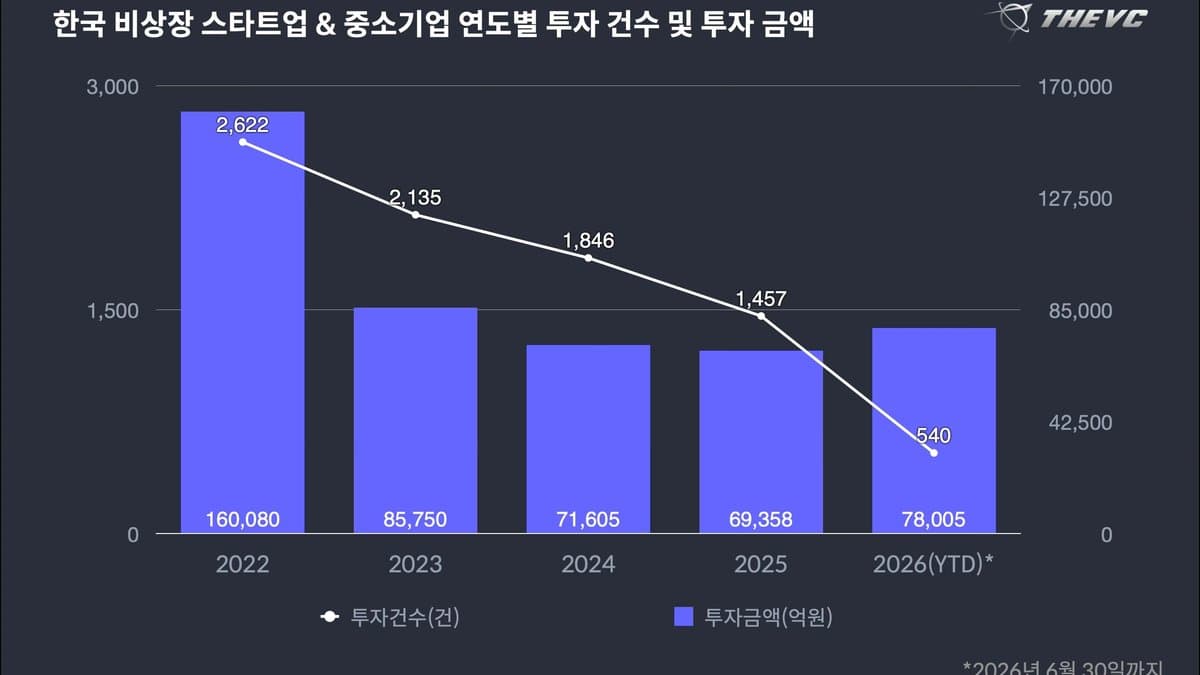
New venture investment: ₩8.8676 trillion. Up 54.3% year over year, and an all-time record — past the previous peak of ₩7.6442 trillion in H1 2022. Anyone who remembers 2022 understands the weight of that. It was the zero-rate liquidity boom, and for three years afterward the industry treated that number as unrepeatable.
Fund formation reached ₩8.4366 trillion, up 33.0% — the second-highest first half on record.
And yet the headlines that day split. One set read "record high." The other read "exits blocked, redemption failure feared within three years." Two opposite tones off one press release. This piece looks at both faces.
The Cast: The Ministry, Financial Institutions, and AI
The Ministry of SMEs and Startups (MSS) both publishes these statistics and designs the policy. Government contribution to the increase isn't small: policy finance commitments rose 58.3% to ₩1.6274 trillion.
But the real shift is private. Private commitments rose 28.1% to ₩6.8092 trillion, and within that, financial institution commitments jumped 54.9% to ₩2.6061 trillion. Private money accounts for over 80% of the total. Government funds primed the pump; returning private capital is what actually drove the record.
Why financial institutions came back is the most operationally important part of this release. The answer is regulation. The risk weight (RW) on policy-purpose venture funds dropped from 400% to 100%. That quarters the capital banks and insurers must hold against a venture fund commitment — meaning the same capital now supports four times the commitment. That single change explains a large share of the 54.9%.
AI and deep tech are where the money went. But precision matters here: the ministry's sector taxonomy has no line item called "AI." What it shows instead is this.
Where the Money Went
| Sector | Amount | Share | Growth |
|---|---|---|---|
| ICT services | ₩1.86T | 21.0% | 62.2% |
| Electrical/machinery/equipment | ₩1.5359T | 17.3% | 90.4% |
| Bio/medical | ₩1.5041T | 17.0% | — |
| ICT manufacturing | — | — | 143.3% |
| Gaming | — | — | only sector to decline |
ICT manufacturing leading growth at 143.3% tells you the character of this cycle. ICT manufacturing means semiconductors, components, and equipment. Hardware, not software. Electrical/machinery/equipment at 90.4% points the same way. We call it AI investment, but a substantial share of the money went into semiconductors and equipment.
That marks a shift from recent years. The 2021-2022 boom was pulled by platforms, commerce, and fintech — software companies with relatively low capital intensity. Now it's the inverse: fabless chips, equipment, materials, robotics. Capital-hungry sectors with long paths to exit.
Gaming being the only decline deserves attention. Gaming has long been a flagship Korean venture sector. That seat emptying is a signal that money moved rather than merely grew.
Early stage did well too. Investment into companies under three years old rose 56.4% to ₩1.8282 trillion, and the number of companies funded rose 28.9%, from 499 to 643. Not just larger deep tech deals — a genuinely wider base.
Non-capital-region investment rose 104.7% to ₩1.0647 trillion, more than double the capital region's 49.9% growth. In absolute terms it's still about 12% of the total, so read that growth rate as a low-base effect rather than a closed gap.
And the concentration. Sixteen companies raised ₩10 billion or more, totaling ₩421.8 billion. Of those, nine companies raising ₩315.3 billion were AI and robotics — 75% of large-deal value on one axis.
What a 400%→100% risk weight actually means
Since this one rule explains much of the data, it's worth unpacking.
Banks and insurers must hold capital in proportion to an asset's assessed risk. Government bonds carry a risk weight near zero; riskier assets carry more. A 400% risk weight means committing ₩10 billion to a venture fund counts as holding ₩40 billion in risk assets. The capital requirement makes it unattractive no matter how good the returns look.
Cut it to 100% and the same capital supports four times the commitment. Returns unchanged, capital efficiency quadrupled. Financial institution commitments rose 54.9% not because venture suddenly looked attractive, but because the arithmetic changed.
One caution. A risk weight is a regulatory number, not a measurement of actual risk. The real loss probability and illiquidity of a venture fund are identical at 100% and at 400%. The regulation changed; the asset didn't.
Who Gets What
Deep tech founders are the clear winners. In semiconductors, AI infrastructure, or robotics, the funding environment is the best in years. Financial institution money enlarged funds enough to absorb larger rounds.
Venture capital firms grew AUM and thickened their management fee base. That's not unambiguously good. Funds raised now must run eight to ten years, and nobody can vouch for the exit environment across that window.
Financial institutions opened a new asset class through deregulation. With capital charges quartered, return on capital improved substantially. But venture funds are illiquid, and a lower risk weight didn't make them less risky.
Gaming, platform, and commerce founders are on the wrong side. Total investment grew 54% while their sector shrank — a sharp relative demotion in the capital market. The same deck that got meetings two years ago doesn't now.
Accelerators and seed investors benefited from the widening base. Companies under three years old receiving funding rose from 499 to 643, meaning a thicker market to absorb follow-on rounds. A seed investor's worst outcome is a portfolio company that can't raise its next round, and that risk is currently reduced.
The government got a performance metric. A specific policy — the risk weight cut — connected to a specific number, which becomes ammunition for the next round of reform.
The Problem Is That the Exit Door Is Narrow
Now the shadow side.
Venture investment only works when money going in pairs with money coming out. Funds typically carry eight-year terms, within which portfolio companies must list or sell so capital returns to limited partners. That's the exit — and in Korea right now, that door is narrow.
The most concrete number: 74% of KOSDAQ-listed companies trade below their IPO price. Listing increasingly fails to return principal. As an exit route, the public market is losing its function.
Hence industry warnings that venture funds could face redemption failure in three to four years. The logic is simple. Funds being raised now must liquidate in eight to ten years. If the exit route stays blocked when the term arrives, LPs don't get cash back. And LPs who experience that don't come back for the next fund.
Expert assessments split accordingly. Yoon Gun-soo, CEO of DSC Investment, called the rise in early-stage investment meaningful, crediting policy support converging with AI-driven industrial change. Kim Dae-hyun, CEO of Kiwoom Investment, flagged capital concentrating into specific deep tech companies and excessive valuations forming.
These aren't in conflict. The base widened and the top concentrated, simultaneously — that's the accurate description. The 75% of large-deal value going to AI and robotics supports it.
MSS proposed expanding M&A, secondary funds, and specialized funds in response. The direction is right; the pace is the question. A functioning secondary market needs a deep buyer base, and active M&A needs large corporates acquiring startups. Neither yields to policy alone within a few years.
Precedents: What Followed Previous Records
Korea's own 2021-2022 boom is the nearest case. After the ₩7.6442 trillion H1 2022 record, rising rates froze the market. 2023 investment fell to roughly half, and funds raised in that window now face exit pressure. A record doesn't itself forecast the next phase — but the conditions that produced it deserve scrutiny.
This record rests on two conditions: the AI industry cycle and deregulation. The first is exogenous and outside Korea's control. The second is already priced in, so incremental effect is limited.
The post-2000 US dot-com period is also instructive. When venture investment peaked and collapsed, the worst-hit funds were those raised just before the peak — entering at high valuations and exiting into a lower market. It can't be ruled out that funds forming now occupy that position.
Israel offers the counterexample: a different exit structure produces different outcomes. Israeli startups exit primarily through M&A into US companies rather than domestic listing, which is why the ecosystem works despite a small home exchange. Korea's plan to grow secondaries and M&A moves toward that model, constrained by the fact that Korean corporate startup-acquisition culture hasn't developed to that level.
Competitor Counterplay: Capital Crosses Borders
Foreign VCs are looking at Korean deep tech differently. As Korean technical competitiveness gets recognized in semiconductors and AI infrastructure, cross-border investment is rising. More options for founders; more competition for good deals among domestic VCs.
Japan has significantly increased government startup funding and is restructuring the Tokyo Stock Exchange Growth market. It faces the same problems Korea does — weak post-listing performance, thin exit routes — with similar prescriptions, making it a useful comparison in a few years.
US big tech acquiring Korean AI startups is theoretically an exit route. But strategic sectors like semiconductors and AI infrastructure trigger review processes and talent/technology outflow controversy. Too much policy variance to rely on.
China demonstrated the opposite. Unitree rising 629% on its Shanghai STAR Market debut proved that in state-designated strategic sectors, the exit route is decisively open. Set against 74% of KOSDAQ listings trading below offer price, the contrast is stark. Whether a 629% day-one pop constitutes healthy price discovery is a separate question — but on the existence of an exit route, the comparison is unflattering.
Korean conglomerates hold the actual key. For M&A to work as an exit, Samsung, SK, Hyundai, Naver, and Kakao need to buy startups. Strategic investment in AI and semiconductors is rising; outright acquisitions remain rare.
What Actually Changes for You
If you're an AI or deep tech founder: this is the fundraising window. Financial institution money enlarged funds, and 75% of large-deal value went to AI and robotics. But the valuation-concentration critique means you'll have to defend that mark in the next round. Taking the highest price now isn't always the right answer.
If you're a gaming, platform, or commerce founder: you need a strategy revision. Your sector shrinking while the total market grew 54% is a structural signal. Two responses: reposition into a deep tech narrative by embedding AI, or build a business that runs on revenue rather than VC. The second is less glamorous and probably safer in this phase.
If you work at a startup: recalculate what your options are worth. With 74% of KOSDAQ listings below offer price, listing is not the same as cashing out. When your company discusses going public, "through what route" is a more useful question than "when."
If you're an LP: funds forming now mature in 2034-2036. Nobody knows that exit environment, and today's strength doesn't guarantee it. Increasing secondary allocation is a practical hedge.
If you follow policy: the lesson is how much one rule can move. A 400%→100% risk weight change lifted financial institution commitments 54.9%. Inverted, that suggests equally effective regulatory levers may exist on the exit side. Whether the current prescription — expanding M&A and secondaries — carries comparable specificity hasn't been demonstrated.
If you're just reading the news: money came in at record levels, went to AI and semiconductors, left gaming, and the exit door is still narrow. The first three are settled facts. The last is the variable for the next few years.
🥄 Three Things You're Probably Wondering
— I read AI was 45% of the total. Is that right? The ministry's sector taxonomy has no separate "AI" line, so that figure can't be verified directly from the release. What is verifiable: ICT manufacturing up 143.3%, electrical/machinery/equipment up 90.4%, and nine of sixteen companies raising ₩10 billion or more being AI or robotics (₩315.3 billion). The tilt toward AI is real; stating a specific percentage is less accurate than citing these.
— If it's a record, why call it a crisis? Because inflows and the exit door are mismatched. Investment rose 54% while 74% of KOSDAQ listings trade below offer price. Funds have terms; without exits, LPs don't get their money back. Today's strength returning as a problem in three to four years is the industry's concern.
— Will this continue? It depends on two things. One is the AI industry cycle, exogenous and outside Korea's control. The other is the deregulation effect, which is already reflected — limited headroom remains. If the exit market doesn't open, the next cycle is likely to be shallower than this one.
References
- Financial News — AI lifted venture investment, H1 record ₩8.9T (2026-08-19)
- Electronic Times — Financial institution venture commitments up 55%, money into AI/deep tech, gaming alone in reverse
- Asia Today — Record ₩8.8T venture investment, exits blocked, redemption failure feared in three years
- Korea Economic Daily — ₩8.9T into AI and semiconductors, record H1 venture investment (2026-08-19)
- Herald Business — H1 venture investment ₩8.9T record, AI and semiconductor investment active
- Ministry of SMEs and Startups — 2026 changes to the venture investment regime
Numbers and criteria are as of announcement and may change. Investment calls are yours to make!