Corporate open innovation always fails at the same point
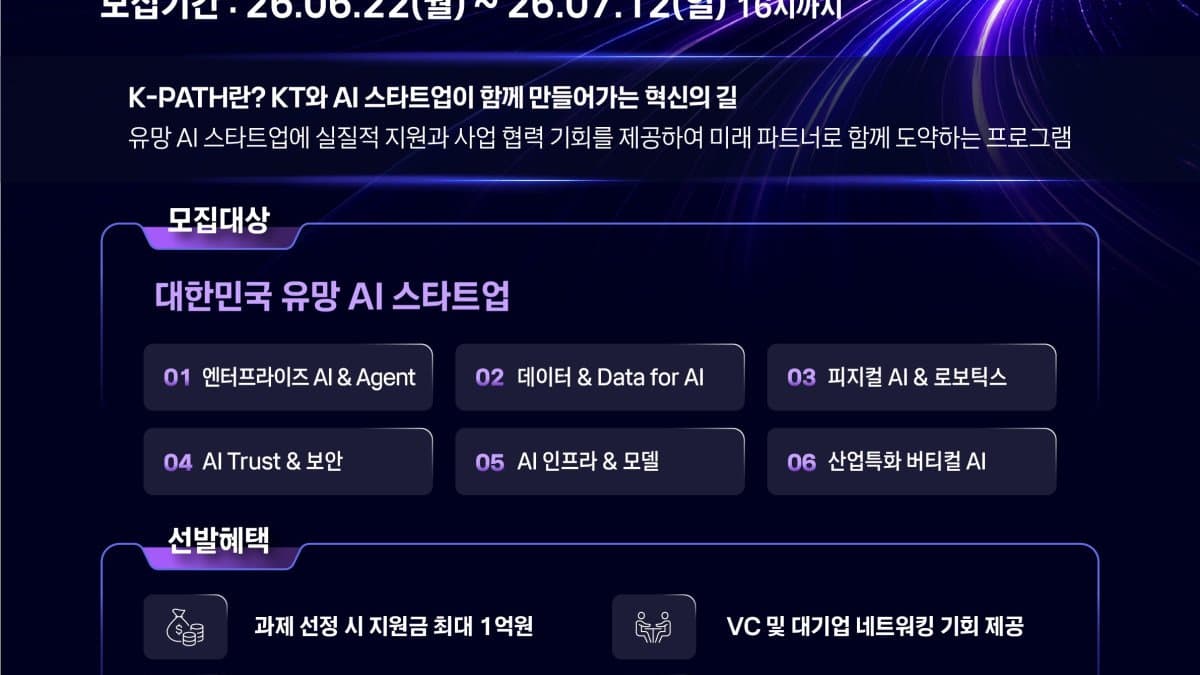
Here's the deal: on August 20, KT announced the final 16 companies selected for its open innovation program K-PATH 2026. Recruiting opened in June and drew 193 applicants — roughly 12-to-1 odds.
On the numbers alone this is an ordinary corporate startup program announcement. Most large Korean companies run one, and these releases land every year. But there's one line worth stopping on: the program aims to move past technical verification to actual business results.
That line matters because it names exactly where corporate open innovation collapses. Select startups, give them space and mentoring, run a proof of concept for a few months, present at a demo day — and stop. The startup gets a reference line that says "ran a PoC with a major corporate." The corporate gets a press release about contributing to the innovation ecosystem. The share that converts into revenue is small.
KT changed one thing in the design: quick-win projects begin in September — tasks chosen because they produce measurable results in a short window — and the K-PATH 2026 event on October 20 will show collaboration results and commercialization cases with KT's own business units. Rather than extending the PoC period, it compresses it and pushes through to customer proposals.
Who's involved — KT, AX, and the 16
KT is a telecom operator that has spent several years rewriting its identity around AX (AI Transformation) — selling AI-driven workflow change to enterprise customers. The complication is that the stack this requires isn't what a telco already owns. Agent frameworks, synthetic data, GPU scheduling, model security — all faster to source than to build. K-PATH looks less like an R&D program and more like a procurement pipeline.
A word on AX itself. It's the term telecom and IT vendors are pushing as the successor to digital transformation, and operationally it means "attaching AI to existing business processes to replace or augment human work." Telcos are chasing it for an obvious reason: core connectivity growth stalled long ago and enterprise IT services are the remaining growth axis. But in that market, the network and infrastructure assets a telco already owns don't automatically translate into advantage. Software capability has to come from somewhere, and programs like this are one of the intake channels.
Seven categories were selected for: enterprise AI and agents, physical AI and robotics, Data for AI, AI trust and security, AI infrastructure and models, industry-specific vertical AI, and AI ESG.
The list itself reveals where KT believes its gaps are. AI trust and security and AI infrastructure and models are the interesting inclusions, because those are the two axes where enterprise AI deals most often stall: "where does our data go" and "can we run this in our environment."
Among the disclosed selections, the picture sharpens further: CyonicAI in enterprise generative AI, AlgorithmLabs in industrial AI agents, SkyIntelligence in synthetic data for robotics, PrivateAI in privacy technology, TEN in GPU resource management, and C-Platform AI in multilingual chatbot solutions.
A GPU resource management company on that list is a notably practical choice. The largest hidden cost in Korean enterprise AI adoption right now is idle GPU — bought and underused, or poorly scheduled. Improving utilization proves itself in numbers far faster than building a new model does. That fits the quick-win framing precisely.
The AI ESG category deserves a note too. It's the most different of the seven, and it tracks Korea's phased expansion of corporate ESG disclosure obligations. Emissions accounting, supply chain data collection and report automation are repetitive, data-intensive tasks that suit AI well — and regulation manufactures the demand, so revenue conversion tends to be fast. This item shows the category list was drawn from where money is likely to appear, not from a purely technical view.
How it runs — the calendar
| Date | Stage |
|---|---|
| 2026-06 | Applications open |
| June–August | Document review + presentation evaluation. 193 → 16 (roughly 12:1) |
| 2026-08-20 | Final selection announced |
| From 2026-09 | Quick-win projects launch with business units, targeting short-term measurable results |
| 2026-10-20 | K-PATH 2026 event discloses collaboration results and commercialization cases |
| 2027 | Second-phase collaboration including R&D projects; expanded joint commercialization |
Four evaluation criteria applied: technological competitiveness, real-world applicability, commercialization potential, and collaboration synergy with KT.
The last two are the real filter. Strong technology without a natural attachment point to an existing KT business unit is unlikely to get through. Read generously, that's selection for feasibility. Read coldly, KT chose companies that complement what it can already sell. This is closer to sourcing complements than to backing disruption.
The calendar applies serious pressure, too. Start in September, show results on October 20 — under two months. What fits in that window isn't large-scale systems integration; it's replacing or improving one slice of an existing process. Hence "quick-win."
What each side gets
KT gets speed and optionality. Running small projects with 16 companies at once produces data in two months about which combinations actually work. Only the ones that do move into second-phase collaboration in 2027. In effect, KT bought a cheap portfolio of options. Building the same capabilities internally would have meant standing up a team per domain and spending a year or two.
Startups get two things. A reference — in Korea's B2B AI market, one large-enterprise logo is decisive in subsequent sales. And distribution — a route onto KT's enterprise customer base, which matters most in high-barrier segments like public sector and finance where going in alone is slow.
The asymmetry is real, though. Sixteen companies spending two months building to a KT business unit's requirements produce work that's substantially specific to KT's processes. If you don't make the second-phase cut, that engineering effort is hard to recover. It's a bet with time as the stake, and how IP ownership and exclusivity clauses are settled in the contract is where the actual outcome is decided.
KT's business unit staff carry part of this load too. They have two months to bolt an external solution onto their process and produce results while the day job keeps running. One of the most common reasons open innovation programs stall is simply that business units have no capacity — however good the companies the program team brings in, nothing progresses if nobody has time to integrate them. A fixed October 20 date is partly a device to force that capacity into existence.
KT's enterprise customers get more options. Until now, adopting AI in Korea meant buying a global vendor product directly or integrating through a systems integrator. Domestic startup solutions arriving pre-validated and packaged by a telco shorten the procurement path.
For Korea's AI ecosystem, 193 applications is itself a signal — there are at least that many AI startups with a plausible attachment point to KT's AX business. Read the other way, it also means those 193 are converging on program applications rather than breaking into enterprise accounts on their own.
That raises a concern. If clearing 12-to-1 odds becomes the standard route to a large enterprise customer, startup product roadmaps start following corporate requirements. That path hardens into something closer to subcontracting than to building an independent market — a pattern repeatedly criticized in Korea's B2B software sector. Whether this program reinforces that path or gives companies a reference to build independent customer bases from depends on each firm's negotiating position.
Precedents — what makes open innovation work
Google's Launchpad Accelerator and Microsoft's ScaleUp sit on the successful side. What they share is that a product integration path existed after the program ended — listing on a cloud marketplace, entry into a partner program. The program wasn't the destination; it was the front of a pipeline.
Korean corporate accelerator and internal venture programs have produced mixed results. Many generated publicity without converting to procurement, and the cause is usually structural: when the team running the program (strategy, CSR, open innovation) is separate from the team that spends money (business units), even excellent selections never reach a purchasing decision-maker.
KT foregrounding results with business units suggests awareness of exactly this. But the announcement alone doesn't settle it. October 20 is the checkpoint: whether what gets shown is PoC output or actual contracts determines what this program really is.
SK Telecom's and Naver's comparable programs are the domestic comparison. Telcos and platform companies all run AI startup collaboration tracks, and the pool of promising Korean AI startups is narrower than it looks — the same company appearing in multiple programs is not unusual. For the corporates, the competitive variable becomes how fast selection converts into a contract.
Deutsche Telekom's hubraum is the useful international case. It's among the longer-lived telco-run accelerators, and the success factor most often cited is focus on products that only work in combination with telecom infrastructure — network, edge, security — rather than general-purpose software. Of K-PATH's seven categories, AI infrastructure and trust/security fit that description most closely.
How competitors respond
SK Telecom and LG Uplus are pushing their own AI transitions, which makes them de facto competitors for the same startup pool. The competition isn't exclusive, though — startups benefit from working with multiple carriers, and carriers rarely pay enough to enforce exclusivity.
Korean systems integrators face a subtle threat. If KT packages startup solutions and sells them directly to enterprise customers, some of the integration margin SIs used to capture moves. Large-scale enterprise system integration remains SI territory, so the immediate overlap is limited.
Global AI vendors sit in a mixed position. KT's AX business runs substantially on global models. Layering Korean startups' agent, security and data tiers on top is complementary; substituting domestic models is competitive. Including "AI infrastructure and models" among the seven categories suggests the second option is being kept open.
Government policy interlocks here as well. Corporate-startup collaboration is a recurring emphasis in Korea's AI industry policy, and if public procurement continues to award preference points to domestic AI solutions, telco-validated Korean startup products gain a structural advantage in that market.
What actually changes for you
If you run an AI startup, read the selection as a map of where KT is prepared to spend. The seven categories are that map, and priority sits with areas that can show numbers within two months — GPU resource management, privacy, industrial agents. If you're targeting the next cycle, prepare a sentence about which of a business unit's metrics you improve and by how much, not a technology pitch.
If you evaluate enterprise AI, the October 20 event is a genuinely useful information source. A collection of AI projects that actually worked in a Korean environment is harder to find than it should be. Just account for the fact that only successes get presented.
If you follow KT as an investor or watch the telecom sector, the metric is 2027. This program's success isn't the selection count; it's the share that advances to second-phase collaboration and whether those projects book revenue. How many of the 16 survive tells you whether this was a procurement pipeline or a communications exercise.
If you're a developer, the category mix in these 16 companies is a demand map for Korea's B2B AI market. Enterprise agents, data pipelines, model security, GPU operations — that's where Korean companies are currently spending.
If you're job hunting, this list is a hiring signal. Startups that win a large-corporate collaboration typically expand engineering right after; a two-month quick-win needs people immediately, and second-phase work turns that into permanent headcount. For anyone tracking Korean AI startup jobs, selection lists like this lead the job postings.
If you watch policy, programs like this are proliferating because early revenue is the binding constraint for Korean AI startups — under-resourced for global competition, and facing high barriers in domestic enterprise procurement. Corporate programs are filling that gap. Whether that's a healthy structure or one that deepens dependence on large companies is a question the next few years will answer.
🥄 Three Things You're Probably Wondering
— Does money actually go to the 16 companies? Nothing disclosed specifies investment or grant amounts. What was announced is joint projects with business units and commercialization collaboration. It reads as a partnership program rather than a funding program, and the practical value to a startup is reference and distribution rather than cash.
— Can anything real happen in two months? The name answers that. What fits in two months is improving one slice of an existing process, not building a new system. So what matters is the kind of result shown on October 20. Metric improvements with numbers attached mean something real; case introductions without them mean it's still at PoC stage.
— Are programs like this actually worth it? It depends on the startup. If your product needs enterprise distribution, it's a shortcut. If you need to build your own product and channel, spending two months building to someone else's requirements can distort your roadmap. Selection matters less than how IP ownership and exclusivity got settled in the contract.
Sources
- Newsspace — KT to find future AX business with 16 AI startups (2026-08-20)
- eNewsToday — KT to develop future AX business with 16 AI startups (2026-08-20)
- WorkToday — KT selects 16 AI startups as AX business partners (2026-08-20)
- Kookjeilbo — KT selects 16 startups for K-PATH 2026 (2026-08-20)
- Fintech Times — KT to find future AX business with 16 AI startups (2026-08-20)
- Korea NGO News — KT begins full AX business collaboration with 16 AI startups (2026-08-20)
Figures are as of announcement and may change.