The point isn't the money. It's that this isn't a fab.
At a glance, what Micron announced on August 20 reads like every other American semiconductor investment headline. A facility called Micron Research Labs in Boise, Idaho. $10 billion over the next decade. Ground breaking in 2027. Room for hundreds of researchers.
Miss one word and you miss the story. It's not a fab. Nearly every US chip investment announcement of the past several years has been about production — build the fab, install the tools, push out wafers. This one is shaped differently. It isn't a place that makes product. It's a place that researches things that aren't on any roadmap yet.
Micron called it the first dedicated memory research institution of its kind in the US. The scope listed is four things: critical memory technologies, advanced memory and compute architectures, packaging, and future semiconductor manufacturing. Tom's Hardware summarized it more bluntly — post-DRAM and post-NAND, plus packaging.
In other words, not the next generation of the DRAM and NAND Micron sells today. The next thing after the categories themselves.
Who's who — Micron, and the era when memory became the bottleneck
Micron is the last large memory manufacturer left in the United States. It makes DRAM and NAND and, along with Samsung and SK Hynix, splits the world memory market three ways. Its headquarters are in Boise, and the new lab lands in that same home base.
The company's position has changed dramatically in a few short years. Pre-AI memory was a textbook cyclical business: boom and bust every few years, an essentially commoditized product, prices set by whether supply had overshot. The AI accelerator era inverted that. HBM — high-bandwidth memory — became the practical bottleneck on GPU performance.
The reason is simple. Compute units kept getting faster while the speed of getting data to them didn't keep pace. Bolt on the fastest arithmetic you like; if you can't pull weights out of memory fast enough, it idles. So a large share of AI chip design turned into the question of how to put memory physically closer to compute and widen the pipe between them. Memory got promoted from component to strategic asset.
Which left the three memory makers holding a chokepoint on the AI supply chain. That position is as dangerous as it is lucrative, because today's advantage is tied to one specific technology generation, and nobody knows how long that generation lasts.
What was actually announced
| Item | Detail |
|---|---|
| Name | Micron Research Labs |
| Location | Boise, Idaho, USA |
| Investment | $10 billion |
| Period | Over the next decade |
| Ground breaking | Calendar 2027 |
| Staffing | Sized for hundreds of researchers |
| Research scope | Critical memory tech, memory/compute architectures, packaging, future semiconductor manufacturing |
| Partners | Universities, government, startups, other semiconductor companies |
The first number worth staring at is the duration. Spending $10 billion across ten years is roughly a billion a year. By semiconductor standards, that's less than the cost of one fab. So reading this as "Micron is pouring in staggering sums" gets the scale wrong.
The real signal isn't the amount. It's the character of the commitment. A company in a cyclical business publicly promised a ten-year research budget. The memory industry is famous for cutting R&D first when a downturn hits. A company with that habit just put a number on a stretch of time guaranteed to contain several downcycles. This is less a financial event than a recruiting pitch and a political signal.
Read the 2027 ground breaking the same way. Nothing that emerges from this facility before 2036 will touch the current product roadmap. This investment is aimed at the next architectural generation, not the next quarter.
The quote list gives away what kind of announcement this is
The names attached to the press release tell you a lot.
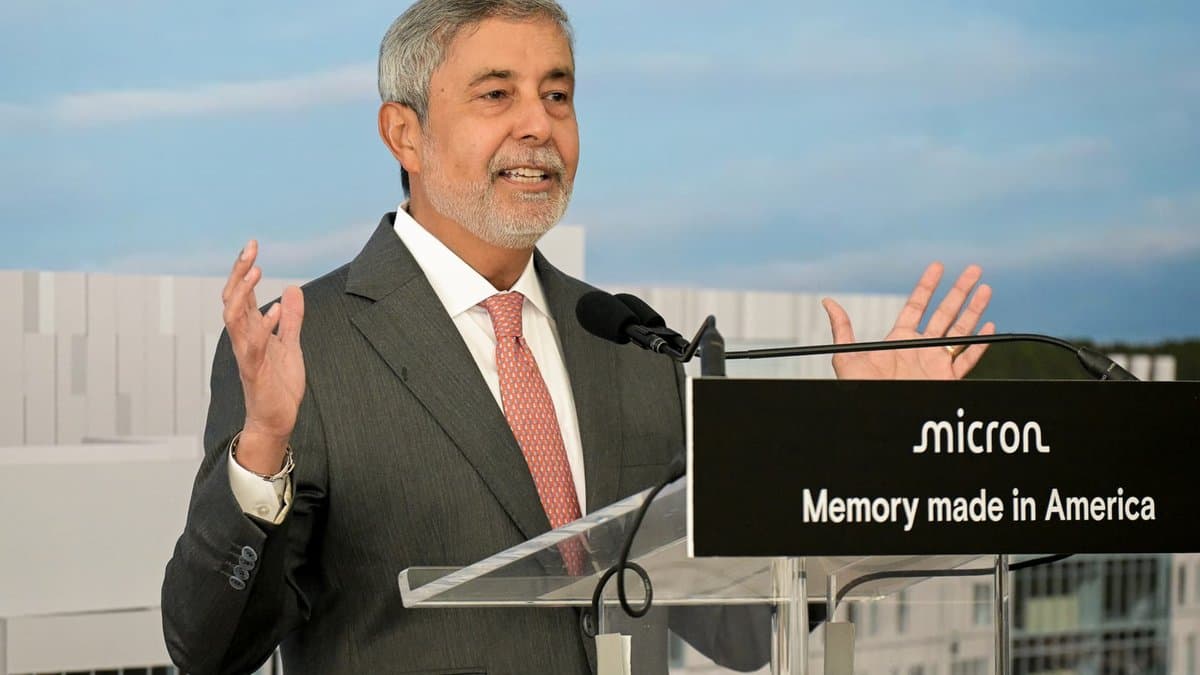
Two are internal. Chairman, President and CEO Sanjay Mehrotra said "the decisions we make today will determine who leads the AI economy of tomorrow, and America's AI future will be built on American-made memory." CTO Scott DeBoer framed the lab as giving Micron's legacy "a dedicated home for long-horizon innovation, the kind of research that sits upstream of every product we build."
The rest is where it gets interesting. Commerce Secretary Howard Lutnick, White House OSTP Director Michael Kratsios, National Academy of Engineering President Tsu-Jae King Liu, Stanford President Jonathan Levin, and UT Austin President Jim Davis all supplied quotes.
A Commerce Secretary and an OSTP Director commenting on a corporate R&D center is not routine. Kratsios tied "the first dedicated memory research lab" to the administration's mission; Lutnick framed memory as a core component of American technological leadership. This announcement is wrapped in the language of industrial policy.
There's something else in that framing. Calling this the first dedicated memory research institution in the US quietly admits an industry reality: memory has been an unfashionable research subject in America for thirty years. It was treated as a commodity, and the smart people went to logic and architecture. That the country had zero memory-focused research institutions until now is the shape of that gap. It took AI turning memory into a bottleneck for anyone to call the gap a problem.
Who gains what
Micron gains three things. First, talent. An organization that has publicly committed to long-horizon research recruits PhD researchers better. In a cyclical industry, the standing anxiety among R&D staff is "does my project survive the next downturn." A ten-year budget is an answer to that.
Second, policy position. With Washington still pushing money and attention at domestic semiconductor capability, the title "America's first dedicated memory research lab" is a card that gets played at negotiating tables for years. The quote list is evidence the card already works.
Third, narrative. Micron has long been perceived as a fast follower rather than a technology leader relative to Samsung and SK Hynix. The lab is an attempt to move that perception. Whether it works is a 2036 question.
Two university presidents and the NAE president aren't decoration either. Micron named universities, government, startups, and other chipmakers as collaborators — an arrangement that recognizes the binding constraint in semiconductor R&D is people, not just capital. Stanford and UT Austin are both strong in semiconductors and materials, and the lab is signaling it plans to plug directly into those pipelines. Tsu-Jae King Liu's presence is particularly worth noting: an academic with a long career in semiconductor device research vouching for the facility functions as a guarantee that it will actually be coupled to academia rather than orbiting it.
Idaho gains something concrete. A facility sized for hundreds of researchers is a major regional economic event, and Boise already has Micron's headquarters and fabs, so agglomeration effects compound.
Washington gains a symbol. Attracting production has produced results for a few years now, but fundamental research remained the weak link. A research institute is a good picture for closing that gap.
What history says about corporate research labs
The track record of the corporate central lab is split roughly evenly between spectacular success and cautionary tale.
The success archetype is Bell Labs. The transistor and information theory came out of it, and the semiconductor industry was built on top of those results. But Bell Labs ran on the excess profits of a regulated monopoly. A company in a competitive market attempting the same thing has a much harder problem.
The failure archetype is Xerox PARC. It produced the GUI, Ethernet, and the laser printer, and Xerox couldn't turn any of it into product. The research changed the world; it didn't change the company. That's the classic failure mode — the bridge between research and product snaps.
There's a signal Micron is aware of the trap, and it's in the CTO's quote. Describing the lab as sitting "upstream of every product we build" reads as an intention not to sever it from the product organization. But that's easy to say and hard to run. Couple it too tightly upstream and product deadlines eat the long-horizon work; hold it too far away and you get PARC. How Micron balances that will decide the ten-year verdict.
There's precedent inside memory too. Samsung and SK Hynix have run large in-house research organizations for a long time, and that accumulation converted into real advantage during the early HBM investment window. What Micron is doing now is less invention than acquiring a weight class its competitors already have.
And HBM itself is the industry's proof that long research pays. It didn't appear overnight — it was a decade-plus accumulation of stacking, bonding, and interposer work. The companies that funded that direction long before the AI boom are the ones collecting now. Micron's $10 billion is a literal copy of that lesson: nobody knows what the next bottleneck is, but whoever is ready when it arrives takes it.
How competitors respond
Samsung and SK Hynix have nothing urgent to do. This is a ten-year announcement and both already run comparable research organizations. But if "domestic US fundamental memory research" hardens as a policy frame, it could create subtle differences in access to American customers and government programs.
The more interesting competition is outside memory. Nvidia and other AI chip designers have been steadily pulling the memory hierarchy into their own design scope — how compute and memory are joined in packaging now determines performance, so there's a territorial fight along that seam. Micron explicitly listing packaging and memory/compute architectures in the lab's scope reads as a refusal to concede that seam.
For emerging-memory startups this could be an opening, since Micron named startups as collaborators. Anyone holding a candidate post-DRAM technology now has a channel to a major manufacturer.
That said, a channel isn't a door. Collaboration between large chipmakers and startups has historically had a low hit rate. The cost of inserting a new material or structure into a production process is enormous, so incumbents don't touch running lines without an overwhelming advantage. A lab means a conversation exists. Adoption is a separate problem.
So what actually changes
If you're in semiconductors — nothing about near-term supply or pricing. This is a ten-year program breaking ground in 2027. But Micron putting post-DRAM and post-NAND on the official research agenda means the baseline of the roadmap conversation has moved.
If you design AI infrastructure — this is one more confirmation of the industry consensus that memory bandwidth stays a central design constraint for the next decade. That's precisely where Micron is putting $10 billion.
If you're a researcher or grad student — this is genuinely actionable. A research organization sized for hundreds of people is being created, with Stanford and UT Austin named as partners. One more door opened for careers in memory, devices, and packaging.
If you're an investor — the financial impact is limited. A billion a year is absorbable within Micron's existing R&D spend and won't move an earnings model. The thing to watch is whether the company keeps this promise through a downcycle. That's the real test.
If you live in Boise — construction starts in 2027 and hundreds of high-end jobs arrive. Boise already hosts Micron's headquarters and production, so adding the lab deepens regional dependence on a single employer. Good news, and also more eggs in one basket.
One thing this announcement explicitly does not do: it does nothing for the HBM supply tightness AI data centers are living with right now. That's a capacity problem, and this facility doesn't make anything. A 2027 ground breaking sits on a completely different time axis from near-term supply. Anyone trying to price this news into memory forecasts is reading it wrong.
🥄 Three Things You're Probably Wondering
— Isn't $10 billion enormous? Split across ten years it's about a billion a year, which by semiconductor standards is less than one fab. What's big here isn't the number, it's the nature of it: a cyclical company publicly committing a research budget across a span that will certainly include downturns.
— What's "post-DRAM"? What are they actually building? The announcement named no specific candidate technologies. There are directions the industry has debated for years, but Micron didn't disclose which it favors. All that's certain is that the goal is stated as the successor to the category, not the next node.
— Is government money involved? The release describes it as Micron's own investment and doesn't specify separate subsidies. Given that the Commerce Secretary and OSTP Director both supplied quotes, it's reasonable to assume some policy coordination occurred. The specific funding structure hasn't been disclosed.
Sources
- Micron Investor Relations — Micron Unveils Micron Research Labs (2026-08-20, full official press release)
- GlobeNewswire — Micron Unveils Micron Research Labs, a U.S.-Based Long-Horizon Innovation Hub to Shape the Future of Memory and AI (2026-08-20)
- Tom's Hardware — Micron commits $10 billion to new US-based Research Labs, Boise hub to target post-DRAM and NAND technologies and packaging (2026-08-20)
- BoiseDev — Micron to build $10 billion research lab in Boise (2026-08-20)
- Boise State Public Radio — Micron announces new $10 billion research facility in Boise (2026-08-21)
- Unite.AI — Micron Unveils Micron Research Labs With $10B Decade-Long Memory and AI Research Push (2026-08-21)
Numbers and criteria are as of announcement and may change. Investment calls are yours to make!