₩60T
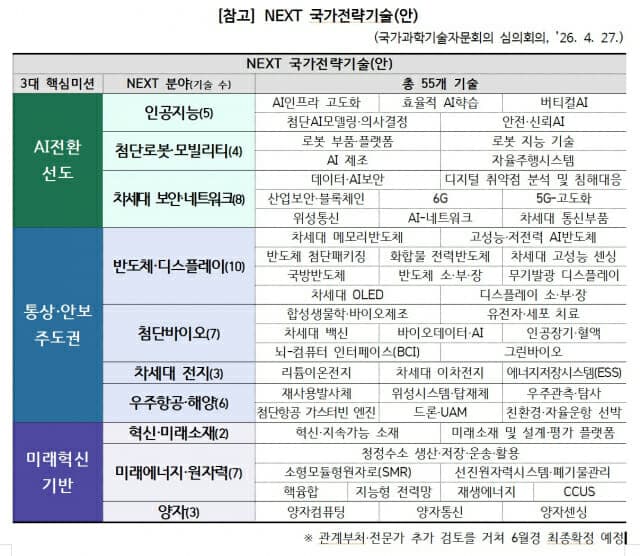
South Korea will spend ₩60 trillion (~$43B) over five years on 55 strategic technologies. The April 27 joint MSIT/MOEF announcement is not just an R&D budget. It bundles subsidies, tax credits, private-matching funds, and international cooperation tracks into a single package. For the first time, fragmented sectoral policy is unified into one program — that's the real headline.
The 55 technologies span AI, semiconductors, bio, quantum, space, robotics, displays, and batteries. AI direct lines total about ₩12T; semiconductors lead at ₩18T. Together those two account for half of the entire program. The signal: Korea is treating AI and semiconductors as one bundle.
President Lee Jae-myung framed it as security: "Technology sovereignty is a security issue." Five years ago this would have been straight industrial policy. The security frame says Korea wants to maintain sovereign tech capability inside an intensifying US-China contest. The same-week DeepMind Seoul campus announcement fits this larger picture.
Why each side is moving
Government. ₩60T marks a new template for industrial policy. Previously, R&D budgets, subsidies, and tax credits were issued separately by ministry. Bundling them into one package both reduces administrative friction and signals seriousness — "this is a real bet." Beyond efficiency, it's a coordination device.
Private sector. The match. Minister Yoo's "real game-changer" comment is about the ₩5T public matching pool unlocking up to ₩108T of private capital at 1:1 to 1:2 ratios. Samsung, SK, LG, Naver, Kakao plus mid-caps and startups all qualify. Selection criteria explicitly weight "technological differentiation" and "strategic contribution."
Foreign capital. Sweetened FDI incentives target foreign R&D centers in Korea. DeepMind's same-week Seoul announcement isn't coincidence; the two announcements pulled each other into the news cycle.
Allocation table
| Sector | Gov 5-yr | Private match target | Prior 5 yrs |
|---|---|---|---|
| Semiconductors | ~₩18T | ~₩36T | ~₩7T |
| AI | ~₩12T | ~₩24T | ~₩4T |
| Bio | ~₩7T | ~₩14T | ~₩3T |
| Batteries | ~₩5T | ~₩10T | ~₩2T |
| Quantum | ~₩3T | ~₩4T | ~₩0.5T |
| Space | ~₩4T | ~₩5T | ~₩1.5T |
| Robotics | ~₩3T | ~₩5T | ~₩1T |
| Other | ~₩8T | ~₩10T | ~₩5T |
| Total | ₩60T | ₩108T | ~₩24T |
Public + private targets to ₩168T. Government investment alone is up 2.5× over the prior five years; including matching, ~3×. Roughly 1.7% of Korean GDP. Comparable scales: US CHIPS Act (~$53B / 5 yrs), Japan semiconductor policy (~$20B), EU Chips Act (~$43B). Korea sits at EU Chips Act size, but spread across more sectors.
Quantum stands out: lower private match (1:1.3 vs. ~1:2 elsewhere). Commercial timelines remain too far for private capital to step in equally — government carries more of the load.
Who wins what
Samsung / SK / LG. The biggest semiconductor matching pool. Advanced packaging, next-gen HBM, and foundry node migration most directly benefit. Beyond cash: foreign-talent visa preference and land/utility incentives stack.
Korean LLM labs (HyperCLOVA, KT, Kakao, Samsung Gauss). The reported ~₩4T sub-line for in-house LLM development is roughly 5× the prior five years. Allocation between players is the next political fight.
Korean startups and mid-caps. Series A/B-stage AI tools, robotics, and bioinformatics companies have a fundraising tailwind. Korean VC liquidity broadly improves.
Foreign companies. Stronger incentives for Korean R&D centers. DeepMind first; OpenAI, Anthropic, NVIDIA next-12-month announcements likely.
Korean technical talent. More local hiring pulls average compensation up — senior ML, semiconductor device, bioinformatics roles especially.
Historical pattern
1980s-90s memory drive. Government concentrated R&D and infrastructure on Samsung, LG, and Hyundai Electronics (now SK Hynix). Output: 30 years later, global memory leadership. Success.
2000s ICT talent push. Built games, mobile, content. AI and semiconductor senior talent still tight. Partial success.
2010s green growth. Solar, wind. Lost share to Chinese competitors. Partial failure.
2021 K-Semiconductor Strategy (₩510T plan). Predecessor. Actual execution rate was ~60-70%. In progress.
Three takeaways: industrial policy plays out over 30-year cycles, private matching is the real lever, and diversifying across sectors reduces risk — which the 55-sector design honors.
How rivals counter
US CHIPS Act. ~$53B over 5 years; semiconductor-focused, security framing. Korea matches the pattern but spreads wider. Japan. ~$20B + Rapidus support. Direct competitor in many sectors. China. Officially smaller; effectively larger. Korean ₩60T collides directly with PRC sovereign LLM and semiconductor pushes. EU Chips Act. ~$43B; member-state distribution slows execution. Korea's centralized model likely deploys faster.
Five-way industrial-policy escalation. National champions benefit; global free-trade norms strain.
What this changes for you
Engineers. More AI / semi / bio openings inside Korea. Track which companies received matching funds — they're the ones hiring. Founders. Check whether your stage and tech qualify. Series A/B AI / robotics startups have the clearest window. Application paperwork is heavy; consider specialist consultants. Investors. Korean VC liquidity rises; Series B+ round pricing should re-rate. KOSPI/KOSDAQ AI and semi names get a re-rating window. General users. Direct effect is small now. But Korean LLMs (HyperCLOVA, Gauss) should improve on Korean-language tasks faster — re-test every six months.
Stakes
- Wins: Samsung / SK / LG (top of semi matching), Korean LLM labs (5× line item), Korean startups (Series A/B acceleration), foreign labs (sweeter FDI).
- Loses: Asian rivals (TSMC, Rapidus, Mediatek — sharper Korean competition), free-trade norms (subsidy escalation).
- Watching: US CHIPS Act follow-on speed, matching-fund execution rate (will it again land at 60-70%?).
Skeptics, named
Lee Geun (Seoul National University, economics) wrote in Hankyoreh that "this may be a 30-year-old industrial policy template applied at larger scale." A WTO/FTA dispute risk is non-trivial in today's trade environment.
Oh Jung-keun (Korea Economic Research Institute) argues the 55-sector spread reduces risk but dilutes impact. Whether the diversified bet outperforms the US CHIPS Act's semiconductor concentration plays out over five years.
Execution-rate skepticism is the third concern. The 2021 ₩510T plan delivered 60-70%. If this repeats, the headline ₩60T public + ₩108T private becomes ~₩40T + ~₩70T effective. Worth tracking quarterly.
Tomorrow morning
Engineers: Check whether your specialty maps onto the 55 strategic technologies (MSIT publication). Track which firms receive matching funds — those are the hiring channels. Founders / PMs: Self-assess against "technological differentiation" + "strategic contribution" criteria. June 1st is the first cut for round-1 applications. Investors: Track Korean VC Series A/B round pricing. Map KOSDAQ AI / semi names against the matching-fund recipient list quarterly. Users: Run the same Korean-language prompts on HyperCLOVA, Gauss, Gemini, GPT, Claude. Score now; re-score in six months. The delta is the real signal.
Sources
- ZDNet Korea — ₩60T strategic tech: https://zdnet.co.kr/view/?no=20260427163411
- MSIT (Ministry of Science and ICT): https://www.msit.go.kr/
- MOEF (Ministry of Economy and Finance): https://www.moef.go.kr/
- Hankyoreh — analysis: https://www.hani.co.kr/
- Bloomberg — Korea tech sovereignty: https://www.bloomberg.com/asia