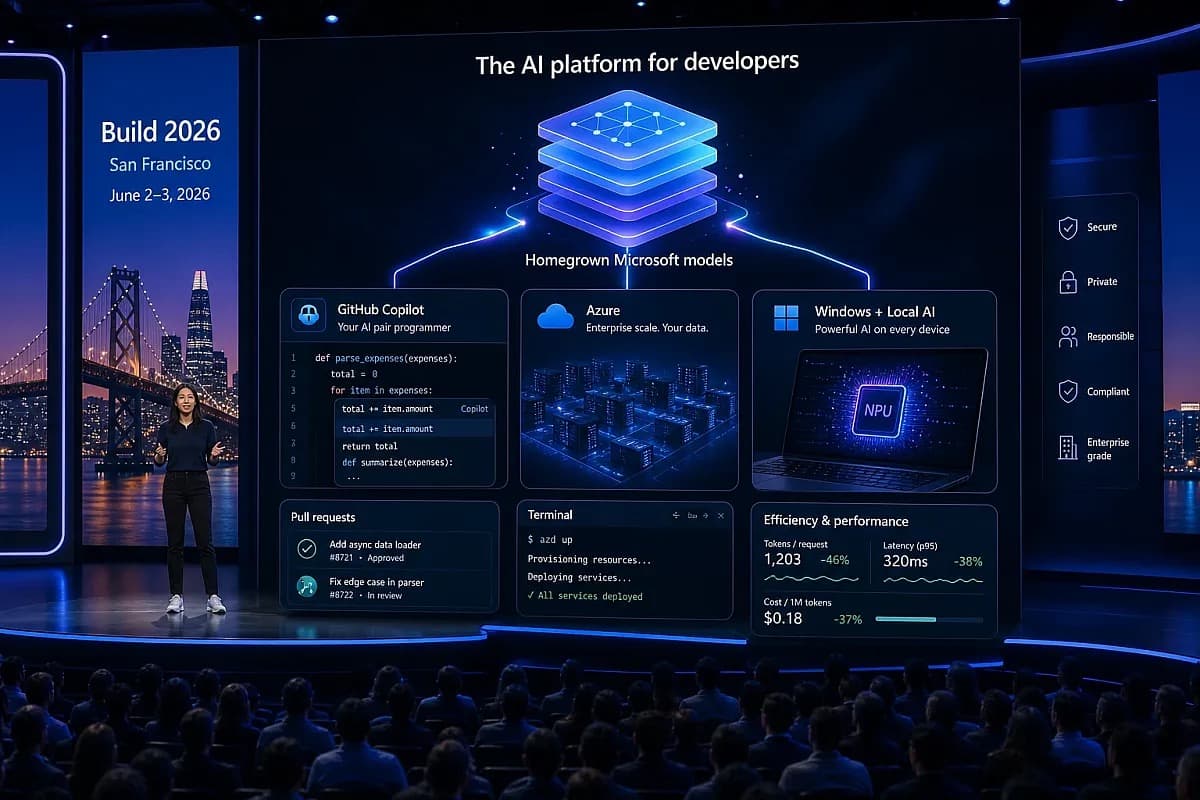
Day one was about models. Day two was about Windows itself
Build 2026 ran June 2–3 in San Francisco, and day one was all models — the in-house MAI suite and Project Polaris. But on day two Microsoft played a different card entirely. Not "we built one more model," but "we're rebuilding Windows into an operating system where AI agents live and run."
Here's the deal, in four pieces. (1) Microsoft open-sourced the Windows Agent Framework — an SDK that abstracts agent lifecycle management — under an MIT license. (2) It unveiled Azure Agent Mesh, a control plane that federates agent execution across on-prem Windows servers, Windows 365 Cloud PCs, and Azure Arc edge devices (GA in Q4 2026, consumption-based pricing). (3) It shipped WSL 3 with GPU/NPU passthrough that brings near-native local AI to Windows. And (4) it stood up the Windows Agent Store to distribute third-party agents. This is the platform/runtime layer — distinct from yesterday's model layer (MAI and Polaris).
Why is this the bigger story? Because Microsoft is trying to move the battlefield of the AI era from "who builds the smartest model" to "where do agents actually run." Models are swappable. The OS that agents run on — and the developer ecosystem stacked on top of it — is not. Microsoft is extending its seat under the PC OS straight into "the default infrastructure of the agent era."
The players — Nadella, Windows, and a full-stack agent strategy
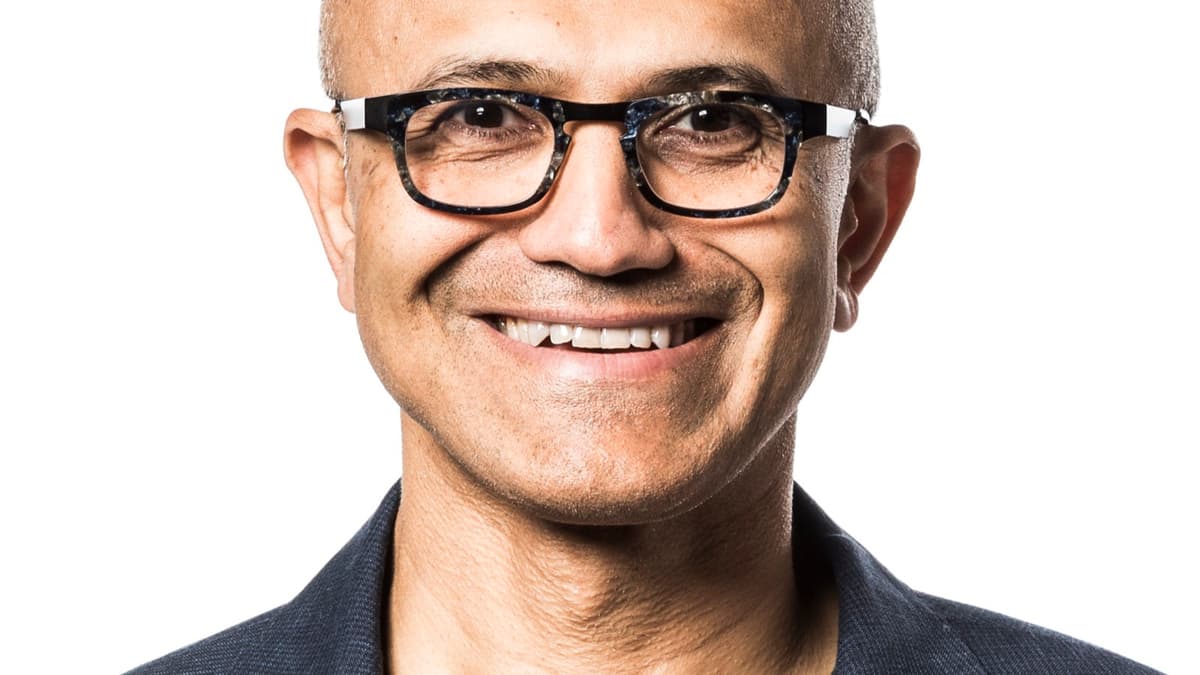
The person drawing this picture is Satya Nadella. His consistent message: a company that owns the PC OS (Windows), the cloud (Azure), the productivity suite (Microsoft 365), and the developer platform (GitHub) should hold the steering wheel of the AI era directly. Yesterday's models (MAI, Polaris) and today's platform (Agent Framework, Mesh) are two pieces of the same picture.
Windows has, until now, been a place where you use AI — Copilot bolted on, apps calling APIs. At this Build, Microsoft redefined Windows as the operating environment where an agent is born, runs, and terminates. Windows becomes the agent's runtime and OS. The ambition: make "building an agent" as standardized an act as "building a Windows app."
The keyword is full stack. Model layer (MAI, Polaris) → platform layer (Agent Framework, Azure Agent Mesh) → runtime layer (Windows Agent Runtime, WSL 3) → distribution layer (Windows Agent Store). Microsoft bundled all four under its own flag. Not excelling at one layer, but presenting a vertically integrated stack from model to deployment — that's the real message of this Build.
What was actually announced — breaking down the four pieces
The headline was open-sourcing the Windows Agent Framework (WAF) under MIT. WAF is a library/SDK bundle that abstracts agent lifecycle — creation, execution, teardown — so a developer can write one agent, with one API, that runs identically on a local Windows machine and on a Windows 365 Cloud PC. The MIT license matters: it's the most permissive open-source license, so enterprises can take it, modify it, and ship it with zero friction. Microsoft is signaling "we'll seed the ecosystem first."
Second is Azure Agent Mesh — a control plane that federates agent execution across environments. It binds on-prem Windows servers, Windows 365 Cloud PCs, and Azure Arc edge devices into one fabric. Developers target the Mesh with the same local WAF APIs, and the Mesh routes each task to the nearest available node based on latency and GPU availability, with no per-environment deployment config. GA is targeted for Q4 2026, priced as consumption-based on a dedicated agent-compute SKU.
Third, WSL 3 is the gift for local AI developers. It's a full re-architecture that moves the Linux kernel into a lightweight VM with paravirtualized access to the Windows GPU and NPU. That lets you run Ollama, PyTorch, and llama.cpp inside Linux on Windows at near-native GPU/NPU speed. NPU passthrough currently works on Qualcomm Snapdragon X Elite and Intel Meteor Lake–Lunar Lake platforms, with AMD support slated for later. Fourth, the Windows Agent Store is a marketplace to distribute and install third-party agents — think app store, agent edition.
| Announcement | One line | Status |
|---|---|---|
| Windows Agent Framework | Agent lifecycle SDK, MIT open source | Released / open-sourced |
| Azure Agent Mesh | Control plane federating local/cloud/edge agents | Q4 2026 GA, consumption-based |
| WSL 3 | GPU/NPU passthrough, near-native local AI | Announced (NPU: Qualcomm/Intel first) |
| Windows Agent Store | Marketplace for third-party agents | Announced |
Who gains — Microsoft, developers, and the cloud rivalry
For Microsoft, this extends platform lock-in into the AI era. The model can be OpenAI's or its own MAI — swappable. But if Microsoft owns the OS agents run on, the dev framework on top, and the distribution marketplace, developers build agents inside the Windows/Azure ecosystem first. Once you start building there, leaving is hard. Microsoft wants to be the default of the agent era.
For developers, it's double-edged but a short-term win. You write local and cloud agents with the same API, WAF is MIT so you can use it freely, and WSL 3 lets you run sizable models on a laptop without expensive cloud GPUs. Agent distribution gets standardized through the Agent Store, so the build-and-sell path is suddenly clear. The barrier to entry drops sharply.
For the cloud rivalry, it pressures AWS and Google. "AI infrastructure" has mostly meant the API business of calling models. Microsoft is grabbing a layer beneath the cloud — OS + runtime + control plane. While AWS holds model distribution via Bedrock and Google attaches via Vertex, Microsoft is laying an agent platform on top of Windows' overwhelming install base — a different starting line.
Historical parallels — the upside and downside of "laying a platform"
Bundling a core component or platform under your own flag is a recurring tech move, with both wins and losses.
Success — .NET and Visual Studio. Microsoft has done this before: lay down a dev platform (.NET) and tooling (Visual Studio) to dominate the Windows dev ecosystem. Once developers build apps inside it, they get pulled toward the company's other products (servers, cloud). Agent Framework and Agent Store follow the same formula. "Win the developers first, the platform follows" — nobody knows this better than Microsoft.
Success — Android's open-source play. Google open-sourced Android to attract OEMs and developers, then monetized via its own services (Play Store, Search) on top. Open-sourcing WAF under MIT rhymes with that: give the core away free to grow the ecosystem, and make the money on cloud consumption like Azure Agent Mesh.
Failure risk — Windows Phone and half-built platforms. Conversely, Microsoft has painful failures like Windows Phone — "we laid the platform but developers didn't come." A platform play lives or dies on whether genuinely useful killer agents show up on top. If the Agent Store doesn't fill with worthwhile agents, the MIT open source and the Mesh become an empty highway. A flashy announcement and a living ecosystem are different things.
Competitor counter-plays — how AWS, Google, and the open-source camp respond
AWS is already drawing a similar picture from a different angle. Just yesterday (June 1) it brought OpenAI's frontier models and Codex to GA on Bedrock. AWS's weapon is "#1 cloud share + a neutral, multi-model platform." If Microsoft owns the client OS (Windows), AWS owns the server-side model-distribution hub — the layers diverge. Expect AWS to counter with neutrality: "we're not tied to one model or OS."
Google has Gemini, Vertex AI, and its own client ecosystems in Android and Chrome. If Microsoft targets the desktop agent, Google will push the agent standard on mobile and web. In particular, Google can play the open-standard card on agent interoperability protocols (think A2A) to offer an alternative to "Microsoft lock-in."
The open-source/neutral camp is a wildcard too. Frameworks like LangChain and CrewAI already offer a "not tied to one cloud" developer experience. Microsoft open-sourced WAF under MIT, sure — but if it becomes clear the structure funnels revenue into Azure Agent Mesh, developers may drift to more neutral open-source stacks. The gap between "the open-source banner" and "actual lock-in-free freedom" is exactly what developers will be judging.
So what actually changes — by persona
If you build AI apps or agents, now's the time to look hard at the Windows Agent Framework. It's MIT, so you can experiment freely, run models locally via WSL 3, and later push the same code to the cloud through the Mesh. If you're wary of Azure lock-in, design an extra abstraction layer around the cloud-federation (Mesh) part from the start.
If you're in enterprise IT/infra, watch Azure Agent Mesh's consumption pricing. A dedicated agent-compute SKU means "the more your agents work, the more you pay," so simulate the cost model before running agents at scale. On the flip side, binding on-prem and edge into one fabric is a genuinely attractive card for companies that can't send data outside for regulatory or security reasons.
If you're a general user or founder, nothing changes today, but the direction is clear: AI agents will become things you install and use like apps. Once the Windows Agent Store takes hold, a solo developer's agent can be distributed like an app-store listing. In other words, "building and selling agents" could become a new one-person business model. The infrastructure is being laid now; what you build on top is the game from here.
References
- Microsoft DevBlogs — Agent Framework at Build 2026
- Build 2026: Microsoft Makes Windows an Agent Platform for AI Developers (Windows News)
- WSL 3 at Build 2026: Near-Native GPU and NPU Passthrough (TechTimes)
- Microsoft Build 2026: Windows Agent Framework, WSL 3, Azure Agent Mesh, Windows Agent Store Explained (AIToolsRecap)
- Microsoft Build 2026 Recap: Windows Is Now an Agent Platform (ChatForest)