Humanoid money just flowed to Europe — $1.4 billion of it, in one shot
Here's the deal: on June 10, 2026, German robotics startup NEURA Robotics announced it closed a Series C of up to $1.4 billion at a valuation of roughly $7 billion. The company calls it the largest single capital raise ever for a full-stack robotics company. In a humanoid race that had been mostly a US–China story, a European company just flipped the board in a single move.
The investor list is the real headline. The round was led by stablecoin issuer Tether — followed by NVIDIA, Amazon, Qualcomm Technologies, Bosch, Schaeffler, the European Investment Bank (EIB), imec.xpand, Lingotto Horizon, and InterAlpen Partners. Semiconductors (Nvidia, Qualcomm), cloud and logistics (Amazon), industrial-parts giants (Bosch, Schaeffler), and crypto capital (Tether) all sat at one table. You don't often see capital this heterogeneous converge on a single company.
NEURA plans to use the money to accelerate its Physical AI platform and scale serial production of cognitive robotic systems. The numbers it's putting up are provocative: it already claims a roughly €1 billion order backlog, and it's targeting 5 million robots by 2030. Saying "5 million" at a moment when building even one humanoid is hard tells you this round isn't research money — it's a declaration of intent to build factories.
The players — NEURA, Tether, and the Physical AI battlefield
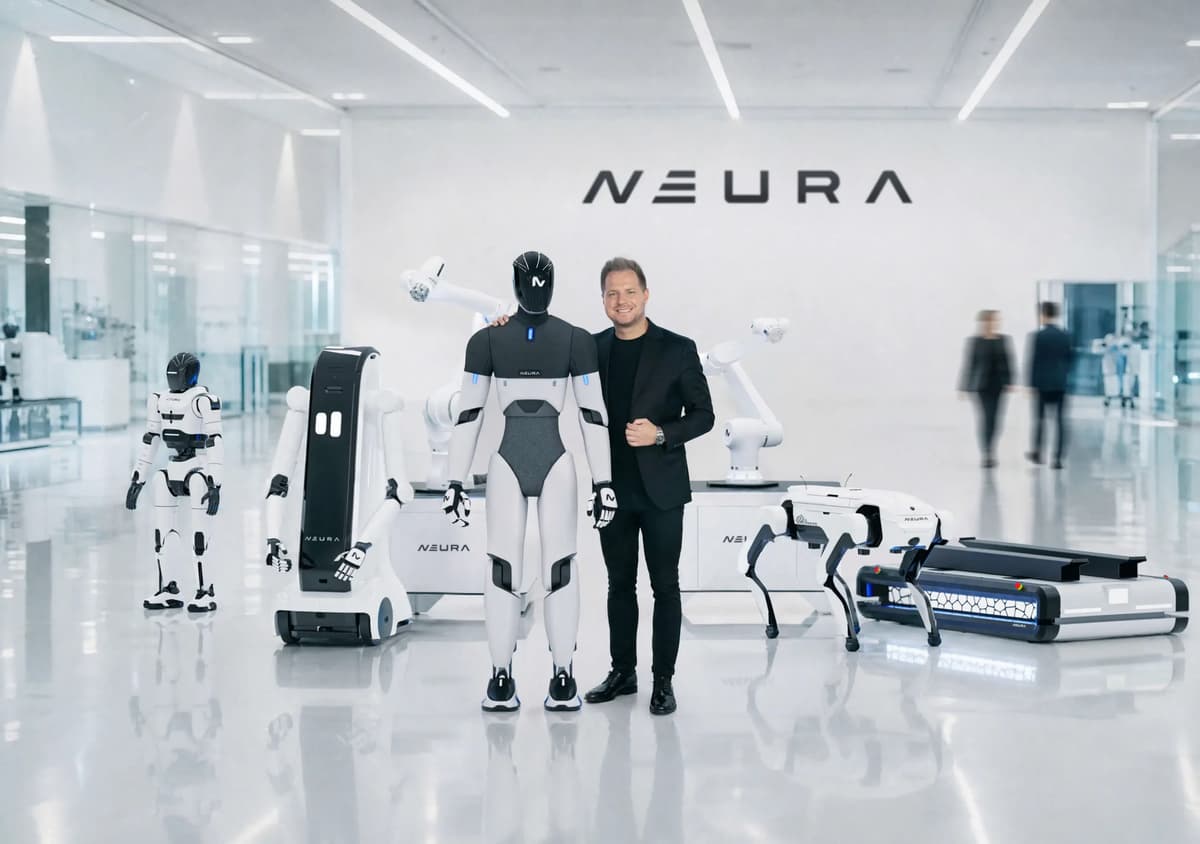
The first protagonist is NEURA Robotics and founder David Reger. Headquartered in Metzingen, Germany, the company isn't building just one humanoid — it spans a whole robot lineup: quadrupeds, collaborative arms, mobile platforms, all under one roof. The core bet is a full-stack strategy: develop both the hardware and the AI "brain" in-house, rather than depending on someone else's chips and someone else's models.
The second is the unexpected lead investor, Tether. A stablecoin company funding robots isn't an obvious picture. But Tether isn't just writing a financial check — it plans to embed its crypto-wallet tech and edge-AI runtime directly into NEURA's robotic systems. It's sketching a future where robots can transact on their own and run AI on-site without the cloud. Tether sitting on a massive cash pile and choosing robotics as its "expand into the real economy" play is genuinely interesting.
The third protagonist is the concept itself — Physical AI. AI exploded in text and images over the past few years, but its ability to move a body through the physical world stayed clumsy. The humanoid race is precisely the race toward "AI with a body." Nvidia's reason for joining is clear: training and running robots demands enormous compute, and Nvidia sells the chips. Amazon brings warehouses as a demand sink; Bosch and Schaeffler bring the factory floor.
The substance — this round by the numbers
| Item | Detail |
|---|---|
| Announced | June 10, 2026 |
| Round | Series C, up to $1.4B |
| Valuation | ~$7B |
| Lead investor | Tether |
| Key participants | NVIDIA, Amazon, Qualcomm, Bosch, Schaeffler, EIB |
| Order backlog | ~€1 billion |
| Production target | 5 million robots by 2030 |
| HQ | Metzingen, Germany |
Two numbers prop each other up here: the €1B order backlog and the 5-million production target. A real backlog means customers are already lined up to buy these robots — and that's the single strongest reason this raise happened. Many humanoid companies hit the "great demo, no buyers" wall; NEURA, at least on the demand side, is showing a different picture.
Tether's "edge-AI runtime" matters technically too. For a robot to decide on the spot without pinging the cloud every time, you need powerful on-device inference — doubly so in factories or warehouses where networks are flaky and latency is fatal. Bolt a crypto wallet onto that and you get the rough sketch of a machine-to-machine (M2M) economy where robots become transacting units. It's still a vision, but it tells you which way the capital is pointing.
What's in it for whom
NEURA gets the obvious thing: ammunition to clear manufacturing, the most expensive gate. Humanoids tend to die in mass production, not design — supply chains, assembly lines, quality control, unit-cost reduction all eat enormous capital. The $1.4B is the ladder that lets NEURA cross from "demo company" to "manufacturing company."
The investors each chase something different. Nvidia and Qualcomm are betting on future customers — more robots means more demand for their chips. Amazon locks in a partner to attack logistics automation, its biggest cost problem. Bosch and Schaeffler watch up close the robots that may enter their own plants, claiming industrial demand early. The EIB's presence is its own signal: Europe doesn't want to cede humanoid leadership to the US and China, and that political will is showing up as capital.
Tether's math is the most distinctive. It diversifies a mountain of stablecoin cash into "physical infrastructure" while wedging its own tech (wallet, edge AI) into a new hardware ecosystem. If a world actually arrives where robots become payment agents, whoever laid the standard wins. Tether is aiming for that standard-setter seat.
Historical echoes — the wins and flops of humanoid money
Big humanoid funding isn't new. In the US, Figure reached a multibillion-dollar valuation with capital from Microsoft, Nvidia and OpenAI; in China, firms like Unitree and Agibot surged via cheap mass production. NEURA's $7B valuation signals that a European front-runner has now seriously entered this global race. This round isn't a vacuum event — it's Europe answering an already-heated competition with capital.
A useful success story is the rise of collaborative industrial robots. "A robot working next to humans" once sounded like fiction, but companies like Universal Robots changed the factory floor by mass-producing safe, affordable cobots. NEURA's path is similar — not flashy humanoid demos, but robots that actually sell and actually work. The €1B backlog is evidence it's heading that way.
There's a failure pattern to watch, though. Robotics is littered with "dazzling demo, collapsed in production" stories — Boston Dynamics' viral videos famously never translated straight into runaway commercial success. Mass production is a battle of supply chains, unit costs and reliability, not technology. Whether NEURA can actually fill that 5-million number will be decided by boring manufacturing details, not slick videos.
How rivals counter-play — the US and China
The US camp, especially Figure and Tesla Optimus, will read NEURA's rise as an escalation of the capital war. Humanoids are ultimately a fight over who reaches mass-production economies of scale first, and $1.4B landing in Europe means one more well-funded runner just joined the race. The US camp will try to widen the gap with faster production and stronger AI brains.
China counters with a different weapon: price. Companies like Unitree are shaking the market with shockingly cheap humanoids. If NEURA goes premium and full-stack, China can dominate the bottom of the market with low-cost mass supply. The humanoid market may well split into "premium vs. value," and NEURA's $7B valuation is a bet on the premium side.
The wildcard is "sovereign AI" sentiment. As the EIB's involvement shows, Europe views robotics and AI as strategic assets. If reluctance to depend entirely on US/Chinese products for whole factories grows, NEURA can enjoy a political "made-in-Europe" premium. Lean too hard on that shield, though, and global competitiveness slips. Striking that balance is NEURA's next challenge.
So what actually changes — by who you are
If you're in manufacturing or logistics, this signals that humanoids are moving from the demo stage into the purchase-evaluation stage. If that €1B backlog is real, your competitor is probably already weighing robot adoption. Even if not now, it's smart to slot "humanoid" into your 2–3-year headcount and automation planning as an option.
If you're an investor or founder, read the capital shifting from "software AI" to "physical AI." Even vision-style capital like Tether moving into robots is a bet that the next big narrative is "AI with a body." But this field is extremely capital-intensive, so a few winners may take all. If you enter, don't forget that "manufacturing capability" is the real moat.
If you're a general reader, honestly, no humanoid is walking into your home soon. This round's center of gravity is industrial sites — factories and warehouses — not households. Still, it's worth registering that "the era of robots actually working" has moved from video-future to something capital is seriously betting on.
🥄 Three Things You're Probably Wondering
— So what does this mean for me? No direct impact yet. But if you work in manufacturing or logistics, it's worth considering that within a few years some coworkers may be replaced by humanoids or shift into "robot supervisor" roles. Consumer robots are much further out.
— Why is Tether putting money into robots? On the surface, cash diversification; underneath, planting its tech early in a future where robots become payment agents. Too early to call it a win, but read it as one example of stablecoin capital flowing into physical infrastructure. Whether it pays off is a separate question.
— Five million robots — is that actually possible? Feel free to doubt it. Mass production is the graveyard of the humanoid industry. The €1B backlog is a positive sign, but target numbers and actual shipments are always different stories. We won't know if "5 million" is vision or reality until real shipment data lands in 2027–2028.
Sources
- NEURA Robotics Announces Record Series C of up to $1.4B — NEURA Robotics
- Humanoid robotics company raises up to $1.4 billion from Nvidia, Amazon and others — CNBC
- Tether, Nvidia and Amazon Back Humanoid Robotics Firm NEURA in $1.4 Billion Round — Decrypt
- Neura Robotics raises up to $1.4 billion at $7 billion valuation — Tech Startups
- Amazon, NVIDIA and Tether back NEURA Robotics' $1.4B raise — Tech Funding News
Numbers and criteria are as of announcement and may change. Investment calls are yours to make!