When one model went dark, enterprises started looking for a 'second option'
Here's the deal: you know last week's story — Anthropic's flagship Fable 5 and Mythos 5 went dark worldwide under U.S. export controls. But behind the headlines, something quieter and maybe more important was happening that week: enterprises started shifting weight toward open-weight models.
The New Stack's title captures it: "Fable 5 ban: 4 open models responded before Anthropic could restore access." While Anthropic negotiated to revive its models, Llama 3.3, Qwen3-235B, and DeepSeek V4 slipped into the void and saw meaningful enterprise adoption gains.
This is more than reflexive opportunism, because the shift was driven not by price or performance but by a new axis — trust and control. Having watched a model go globally offline on an external directive, companies started re-asking, "how dependent are we on one supplier?" Let's unpack this quiet move and its long-term implications for the AI supply chain.
The players — the open camp, anxious enterprises, and closed models
The open camp — Llama (Meta), Qwen (Alibaba), DeepSeek (China) — shares one trait: open weights, so a company can self-host and run them on its own infrastructure, unlike API-only closed models. Long seen as "the cheaper, slightly weaker option," they just had a new strength spotlighted. Anxious enterprises — those depending on Fable 5 or piling core workloads onto one closed frontier model — faced "what if ours goes dark tomorrow?" Once that question lands, it's hard to keep everything with one supplier. The closed frontier camp — Claude, GPT, Gemini — still leads on complex reasoning and certain tasks; this isn't their end, but the assumption that "these are all you need" has cracked.
What drove the shift
| Factor | Closed frontier | Open weights |
|---|---|---|
| Top-task performance | Edge | Catching up |
| External policy risk | Can be blocked/halted | Unaffected if self-hosted |
| Data control | Depends on external servers | On-prem possible |
| Cost | Relatively higher | Relatively lower |
| Lesson of this episode | Single-dependence exposed | "Stability" card rises |
The decisive row is external policy risk. Closed API models can go dark on a provider's policy or — as here — a government directive. A self-hosted open model can't be switched off from outside; once you've downloaded and are running it, whatever happens in Washington, your servers keep going. That's the newly spotlighted strength. Second, this is diversification, not wholesale replacement — companies didn't dump Claude; they kept top workloads on closed frontier while putting an open model alongside as insurance. Third, tools once adopted rarely leave — the painful part for Anthropic: even when Fable 5 returns, the open model brought in during the crisis likely stays. Trust is lost in a moment and recovered slowly.
Who's smiling this round
The open camp got its strongest ad for free — "we're still on" was the message — adding "geopolitical stability" to its existing cost and privacy strengths, elevating it from "cheaper, weaker" to "strategic diversification choice." Enterprises gained the realization itself: an expensive tuition, but they learned in practice that single-supplier dependence is risky, and a multi-model strategy buys operational resilience — short-term cost converted into long-term durability. Even the closed camp gets a paradoxical benefit — a wake-up call that availability guarantees, multi-region deployment, and policy transparency now matter more competitively.
Past parallels — déjà vu of multi-cloud
Seen this in cloud history. Early on, many put everything on AWS; after big outages, price hikes, and lock-in worries, they moved to multi-cloud — spreading core workloads across two or more to cut risk. What's happening in AI models now is exactly that déjà vu. The lesson from success: an abstraction layer — multi-cloud worked because a middle layer avoided deep lock-in and eased switching; abstracting model calls likewise lets you pivot fast when one is blocked, and this episode made that design's value clear. But multi has costs — more management complexity and per-model tuning — so not everyone goes multi; the point is that the higher the dependence, the greater the value of diversification — no need to multi everything.
Counter-play — the closed camp's cards
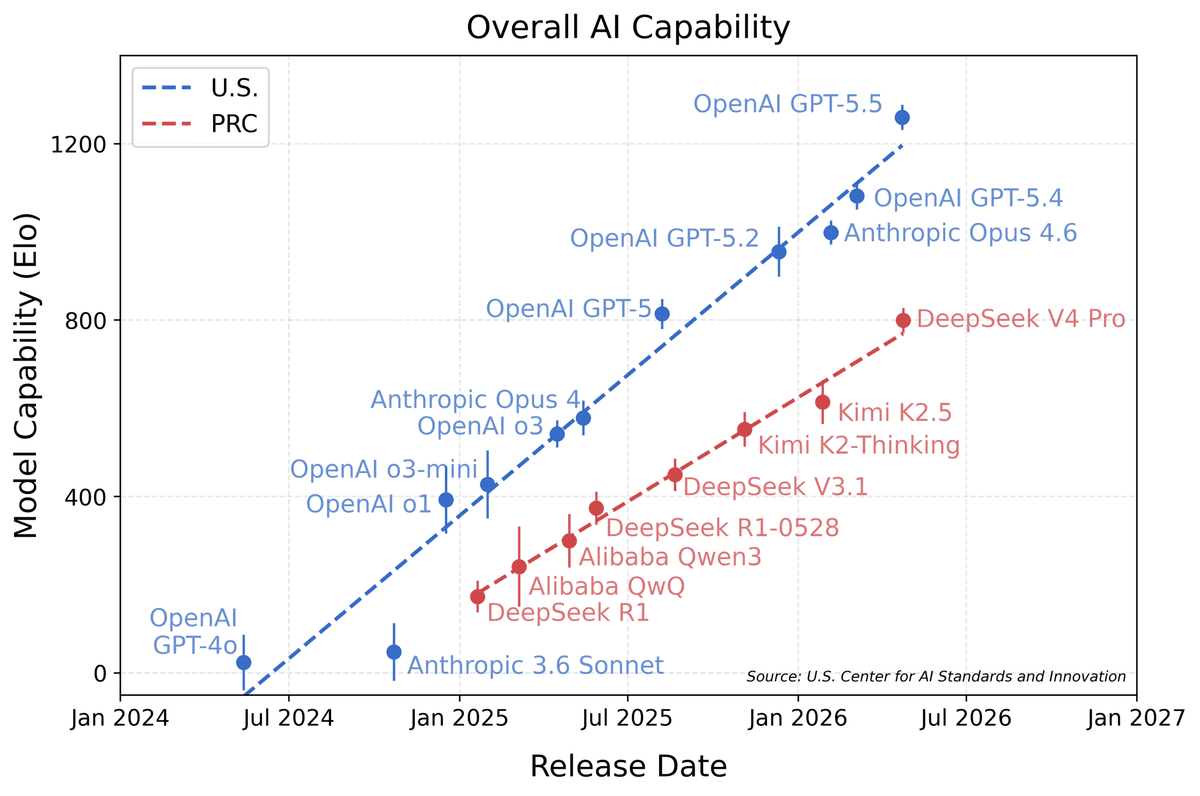
The closed frontier camp won't sit still. Its cards are the performance gap and trust recovery — widening the lead on complex reasoning and specialist tasks open models can't match, and institutionally guaranteeing availability to prove "we don't just go dark." Notably, Anthropic is itself the party here: reviving Fable 5 fast and in a "won't recur" form ties beyond service restoration to the bigger task of rebuilding trust — a key reason it's hurrying is to stem this drift to open weights. The open camp's counter-counter-play is closing the gap — Llama, Qwen, and DeepSeek are improving fast, and as the gap narrows they become "stable and good enough," tilting diversification further their way.
So what actually changes
If you build on AI, this is a "revisit your architecture" signal — abstract model calls for easy swaps and put a fallback behind your critical path; no need to change everything today, but single dependence is worth an audit. If you follow open-source AI, you're watching an inflection where open-weight models rise from "cheap alternative" to "strategic choice," with self-hosting's value freshly spotlighted. For the industry, this is a catalyst accelerating AI supply-chain diversification — with single-supplier risk now demonstrated, companies will plan multi-model strategies more carefully, which can lead to healthier market diversification long-term.
🥄 Three Things You're Probably Wondering
— So what does this mean for me? If you build on AI, yes — single-model dependence risk is now proven, so audit your fallback design. As a service user, little direct impact, but it may push the services you use toward more resilient design.
— Did open weights beat closed models? Too early. This is diversification, not wholesale replacement — closed still leads on top tasks, and companies are running both. It's "both," not "either."
— Should I switch to open models now? No rush. The lesson is "don't depend on one." Abstract model calls and add fallbacks starting with your highest-dependence areas — gradual diversification is the practical takeaway.
Sources
- Fable 5 ban: 4 open models responded before Anthropic could restore access — The New Stack
- Fable 5 is banned, and Anthropic has started issuing refunds — 36Kr
- When Will Fable 5 Be Available Again? What We Know — explainx.ai
Numbers and criteria are as of announcement and may change.