The first long crack in the AI rally
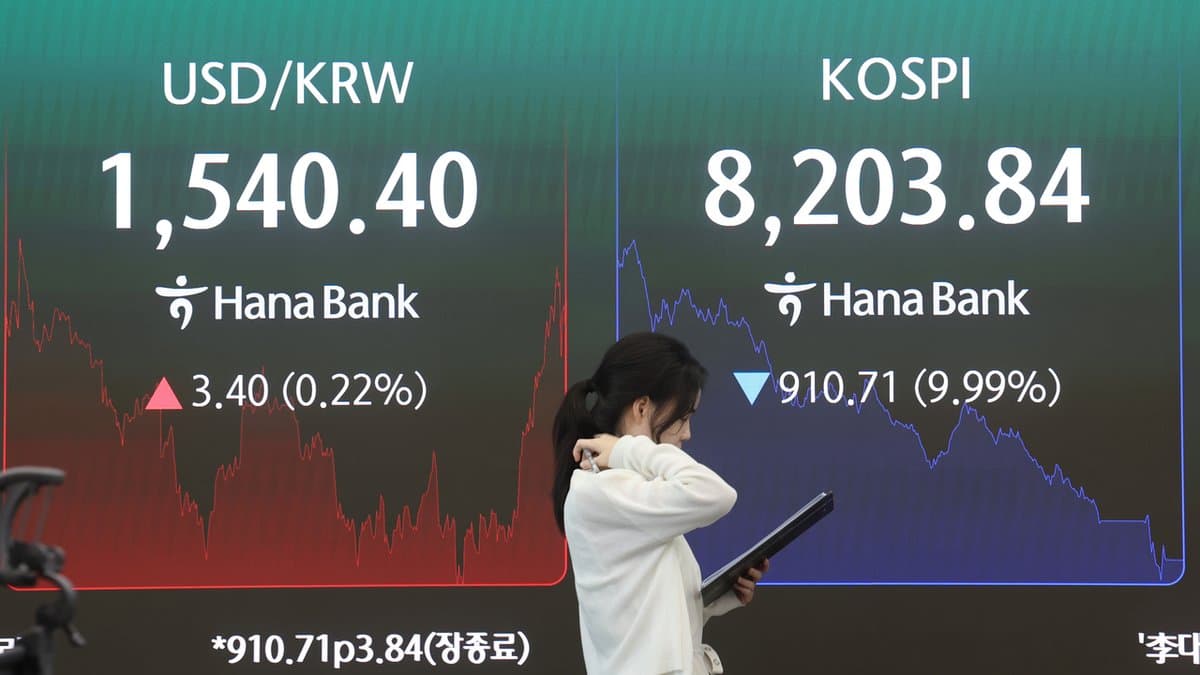
Here's the deal: On June 23, South Korea's KOSPI plunged 9.99% in a single day to around 8,203, triggering a market-wide circuit breaker that halts all trading. Samsung Electronics fell about 12.3% and SK Hynix about 12.5%, while foreign investors dumped 5.79 trillion won (roughly $3.8 billion) of stock. And the shock didn't stay in Korea. The US chip ETF SOXX fell 7.88%, ARM Holdings dropped 10.1%, and the Philadelphia Semiconductor Index slid 8% — the first long, clear crack in the AI-chip rally.
Why is this a big deal? For two years, AI semiconductors behaved like an asset that only goes up. Samsung, SK Hynix, Nvidia, and ARM got bundled under one phrase — "AI supercycle" — and climbed without pause. June 23 is the day that story wobbled hard for the first time. A national index dropping 10% isn't an ordinary pullback; it's a signal of structural unease. The market started asking itself whether it had priced in too much of AI's future too soon.
What makes this heavier is that it wasn't one bad headline but several fuses blowing at once. Fears that MSCI would drop Korea from its Developed Markets watchlist; regulatory warnings about leveraged single-stock ETFs on Samsung and SK Hynix that had only listed a month earlier; and the Fed's June 17 meeting, where nine of 18 participants penciled in at least one more 2026 rate hike. All three had been building in the market's bloodstream all week, then detonated together.
So today's story is this: what created the crash, why a fire in Korea's market jumped to America's ARM and SOXX, and whether this is "the start of an AI bubble" or "a healthy correction." Nail down three players and the picture clicks.
The players — KOSPI, the US chip indices, and the Fed
First, the KOSPI. Korea's headline index, weighted heavily toward semiconductor and memory names like Samsung Electronics and SK Hynix. That makes it a de facto weathervane for the "AI memory supercycle": when AI booms, demand for HBM (high-bandwidth memory) rises, and Samsung and SK Hynix catch that wave directly. A 10% KOSPI drop means the market just threw doubt at the supercycle narrative itself.
Next, the US chip indices and ARM Holdings. SOXX is an ETF holding major US chip stocks like Nvidia and AMD; ARM owns the core IP behind much of the world's chip design. Both trade under the single "AI chip" theme, beating with the same heart as Korean memory stocks. So the selling that began in Korea jumped to them with a lag. SOXX -7.88% and ARM -10.1% are, paradoxically, proof that "AI chips are one global asset class."
The third isn't a company but a variable — and it's the trigger. The US Federal Reserve. At its June 17 meeting, the Fed signaled more hawkishness than expected: nine of 18 participants saw another hike this year. Higher rates are a direct hit to growth and tech stocks that were richly valued by pulling future profits forward. The more an asset front-loads "future growth" — as AI chips do — the harder it sways on a single rate notch. The Fed's hawkish signal struck the AI rally's weakest link precisely.
Tie the three together in one line: when the AI-memory weathervane (KOSPI) broke, the global chip assets bundled under the same theme (SOXX, ARM) shook with it — and the trigger was rate anxiety (the Fed). That's the skeleton.
The substance — what happened on June 23
Words scatter, so let's put the confirmed numbers in a table.
| Item | Detail |
|---|---|
| Date | June 23, 2026 |
| KOSPI | ~9.99% crash to ~8,203; circuit breaker (~20-min halt) triggered |
| Samsung Electronics | ~-12.3% |
| SK Hynix | ~-12.5% |
| Foreign net selling | ~5.79 trillion won (~$3.8 billion) |
| US SOXX | -7.88% |
| ARM Holdings | -10.1% |
| Philadelphia Semiconductor Index | ~-8% |
| Nasdaq | ~-2.2% |
| Main catalysts | MSCI watchlist fears · leveraged single-stock ETF warnings · June 17 hawkish Fed |
Row by row. First, the word circuit breaker is the key. It's a safety mechanism that force-halts the market when an index falls past a threshold, to cool panic selling — and its very triggering is evidence of a not-ordinary day. With reports that this was the KOSPI's second circuit breaker in a month, you can see how on edge the market had been all June.
Second, the 5.79 trillion won of foreign net selling is telling. This wasn't retail panic; it was big money pulling out of Korean chips fast. With MSCI watchlist-exclusion fears in the mix, mechanical "trim Korea weighting" selling likely piled on. This isn't simple profit-taking — there's a re-rating of foreign exposure to Korean chips baked into it.
Third, leveraged single-stock ETFs acted as kindling. Products tracking Samsung and SK Hynix at 2x had just launched a month earlier, and as prices fell, those products likely vomited out mechanical additional selling that amplified the drop. By design they "rise more on the way up and fall more on the way down," making them an accelerator pedal for volatility. It's also a case study in the shadow new financial products can cast on market stability.
Who wins and loses
Start with the obvious losers. Holders of Korean memory names like Samsung and SK Hynix, and of US chip names like ARM and Nvidia, took a big mark-to-market hit in a single day. Those who bought 2x leveraged single-stock ETFs saw losses doubled. The harder you'd leaned into the AI supercycle near the highs, the worse it stung. The companies' fundamentals didn't collapse — but the price the market assigns them got sharply cut overnight.
So who gains? Paradoxically, investors who sat in cash and waited. A crash is fear to some and a discount to others. Communities like r/LocalLLaMA floated the view that this is "an overheated AI-chip correction, so a short-term buying chance." But that bet assumes you know the bottom, and catching a falling knife carries equal risk. There's no solid basis yet to be sure of a rebound.
And an unexpected beneficiary is the "reduce Nvidia dependence" camp. Underneath this crash is "the risk of over-concentration in one AI-chip theme." So advocates of RISC-V alternative chips, inference-only silicon, and multi-sourced supply chains get to say, "See — put it all in one basket and this happens." A crisis strengthens a particular camp's narrative. Market fear translating straight into someone's opportunity is the nature of capital markets.
Net it out: short-term, it's clearly negative for memory and chip shareholders, but whether this is "structural collapse" or "a healthy breather" will be told by the next few days. If fundamentals (HBM demand, AI capex) are intact and only price fell, it's a correction; if the demand narrative itself cracked, it's a deeper problem. It's too early to split the two now.
Precedents — successes and failures
Crashes and circuit breakers aren't a first sighting. The KOSPI hit circuit breakers during the 2020 COVID shock and the August 2024 yen-carry unwind. The lesson was always similar: panic-driven crashes with intact fundamentals were largely retraced over time. Spots where fear dragged prices down too far often became launch points for rebounds. In fact, this site ran an "AI chip stocks rebound" piece on June 11 — there was a similar wobble a month ago, and it recovered.
But fairness means staring at the failures too — the crashes that never came back. The 2000 dot-com bust was a case where the narrative itself, not fundamentals, broke. "The internet is the future" was right, but the problem was that too much of that future was already priced in. AI chips stand before the same question. "AI matters" is true, but how much of that future today's price has front-loaded is a separate matter. Whether this crash is "a correction" or "a crack in the narrative" splits exactly here.
Another balanced view: don't conclude from a single metric. A -10% day is shocking, but it doesn't by itself confirm a bubble bursting. Conversely, 5.79 trillion won of foreign selling and MSCI-exclusion fears are too heavy to dismiss as "just a correction." Both extremes overstate. The honest read: "a structural-unease signal turned on, but whether fundamentals truly broke needs more data."
So the balanced conclusion: history says 'panic gets retraced when fundamentals are alive,' but it also warns that 'when the narrative runs too far ahead of price, it can't be retraced.' Which one this crash is will be decided by how HBM demand and AI capex figures print over the coming weeks.
Competitors' counter-play — the market's next move
A crash is always followed by a camp fight over "what's next." First is the bull case shouting "buy the dip." AI demand is fine, HBM is still in short supply, and only the price fell — so this is a discount. They point to early June, when stocks fell similarly and recovered. It's a bet that fundamentals are alive.
Second is the bear case: "now the froth comes out." If the Fed hikes further, AI names valued on pulled-forward profits sway more, and foreign outflows plus MSCI-exclusion fears are too heavy to read as a mere correction. They see "AI chips were over-concentrated in one theme, and that crowding is unwinding." It's a focus on the unwind of crowding, not the price.
Third is the structural view: "diversification is the answer." If the essence of this episode is "too much in one AI-chip basket," the fix is diversifying supply chains and architectures — away from Nvidia-only, toward RISC-V, inference-only chips, and multi-cloud. It dovetails neatly with the Qualcomm-Tenstorrent acquisition talks that surfaced the same week. The crisis pours fuel on the "alternative chip" narrative.
And don't forget the variable: the regulator's hand. With a second circuit breaker in a month and complaints that leveraged ETFs amplified volatility, financial authorities may move to regulate single-stock leveraged products. On top of the market's self-correction, an exogenous "regulation" variable could shake the next phase. This crash isn't the end — it's the opening shot in a bigger debate over how to handle AI assets.
So what actually changes — by role
If you're an investor. The key is "don't get whipsawed by a single day — watch fundamentals." That AI chips fell together as one theme means, conversely, that an individual company's true value and its market price can diverge. First separate whether real-demand signals (HBM demand, AI capex) are intact or whether the narrative itself cracked. And the market just showed, in the flesh, that leveraged products fall 2x as hard as they rise. This isn't investment advice — just material for your own judgment.
If you work in chips or AI. The lesson: stock prices and the business run on different clocks. A 10% KOSPI drop doesn't make HBM orders vanish overnight. But a price crash changes sentiment and funding conditions, which can affect capex and hiring pace with a lag. The point is to watch whether market fear bleeds into the industry's actual decisions.
If you just caught this in the news. The meaning: AI isn't invincible. For two years the mood was "AI = guaranteed up," and this is the day a big question mark got stamped on that for the first time. What matters is the balance of neither rushing to "the bubble burst" nor shrugging it off as "just a correction." The sense to separate the value of AI the technology from the price of AI stocks — that's the real lesson here.
The one line across all three: the first long crack in the AI-chip rally is the market's warning to separate 'AI's importance' from 'the price of AI assets.' The real answer will come from the demand data of the next few weeks.
🥄 Three Things You're Probably Wondering
— Did the AI bubble just burst? Too early to call. A -10% day is clearly a structural-unease signal, but it doesn't by itself confirm a bursting bubble. If real demand like HBM and AI capex truly cracked, it's a deep problem; if only the price overheated and cooled, it's a correction. The next few weeks of data split the two — there isn't enough to say which yet.
— So is now a buying opportunity? Nobody can say for sure. The bull case ("fell and recovered a month ago") and the bear case ("this time it's foreign outflows and MSCI exclusion — different") are evenly matched. Catching a falling knife and grabbing a discount are two sides of one coin. This isn't a recommendation — just both sides' logic for you to judge.
— Why did US ARM crash when it was Korea's market that fell? Because Korean memory stocks and US chip stocks trade under one "AI chip" theme and beat with the same heart. Global money treats them as one basket. So when big selling erupts in one place, it spreads across the whole theme with a lag. SOXX -7.88% and ARM -10.1% are the numbers that, paradoxically, prove that linkage.
References
- Kospi crashes nearly 10% on massive tech sell-offs — The Korea Herald
- AI Stock Selloff Hits Nasdaq 2.2%: KOSPI Circuit Breaker Signals a Divided Market — TechTimes
- ARM Holdings and chip-equipment stocks lead global semiconductor rout, SOXX -7.88% — StartupHub.ai
- KOSPI Circuit Breaker Triggered: SK Hynix Crashes 12%, Samsung Drops 10% on June 23 — Niftytrader
- Asian Stock Market Crash: KOSPI Leads Sharp Decline on Tech Selloff — IndexBox
Numbers and criteria are as of announcement and may change. Investment calls are yours to make!