"Probably the largest product launch in the history of Taiwan" — Jensen Huang, June 1, Taipei
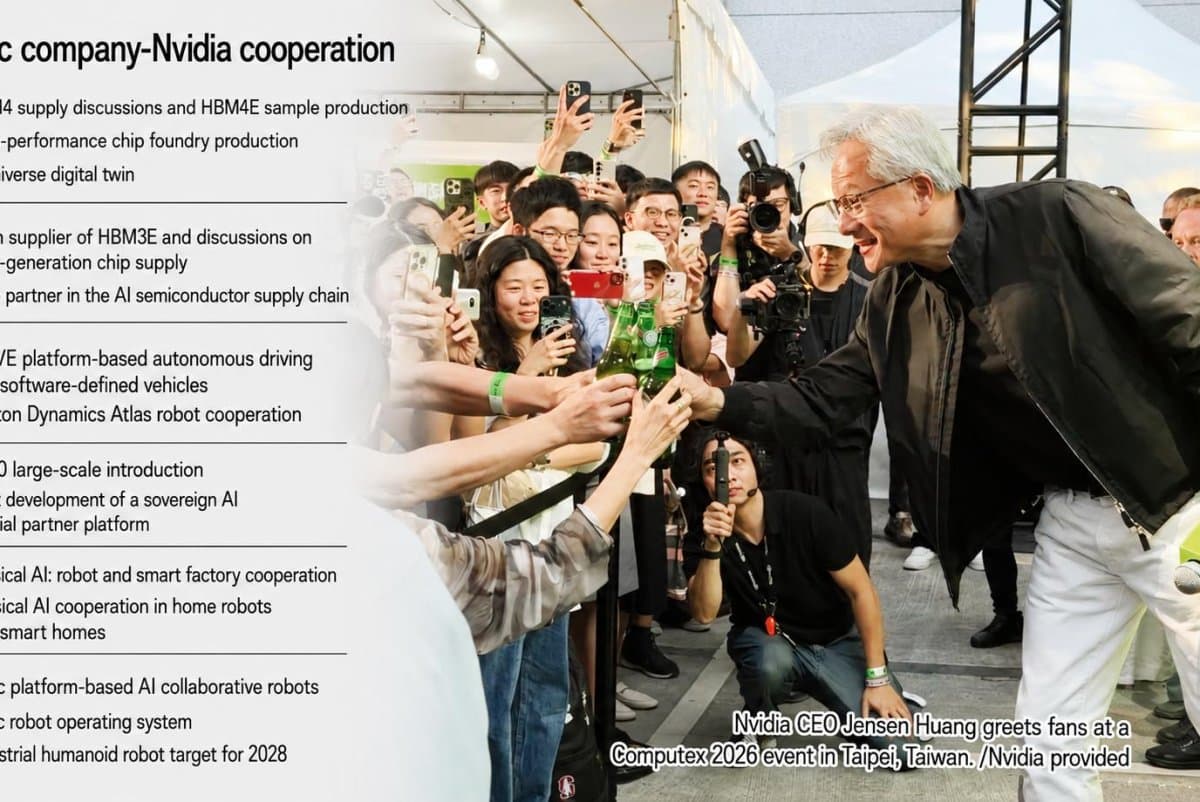
Here's the deal: at 11 a.m. Taiwan time on June 1, Jensen Huang took the GTC Taipei stage — one day before COMPUTEX opens — and pointed at Vera Rubin. "Vera Rubin is the largest product launch, probably in the history of Taiwan," he told a packed Taipei Music Center. "Each one of the Vera Rubin systems consists of almost 2 million parts, and it includes 150 different ecosystem partners here in Taiwan to build it."
That one sentence carries the whole keynote. NVIDIA isn't "a company that sells GPUs" anymore. From an ARM chip small enough to live in a laptop (N1X) to a supercomputer that swallows a full datacenter rack (Vera Rubin NVL72) to the physical-AI stack that drives robots and autonomous machines — NVIDIA wants its silicon on every path AI travels. And the heart of that assembly line is Taiwan.
One clarification first: the Vera Rubin platform itself isn't brand-new. It debuted at CES in January 2026, complete with a full-production announcement. So the genuinely new cards in this Taipei keynote are two: the first formal reveal of the N1X ARM SoC for laptops and PCs, and the ramp/partner/award news around Vera Rubin NVL72 plus the physical-AI strategy. In one keynote, NVIDIA showed you exactly how far the AI supercycle has traveled.
And the timing is no accident. Holding this on June 1, the eve of COMPUTEX, lets NVIDIA set the agenda for the entire week before a single competitor takes the stage — every OEM booth, every partner announcement, every analyst note that follows gets framed against the roadmap Huang just laid down. When the world's biggest chip CEOs all fly to the same island in the same week, the company that speaks first writes the narrative. That's a soft power most hardware companies can only dream of, and NVIDIA has spent a decade earning it: the keynote isn't just a product reveal, it's the starting gun for a supply chain that builds to NVIDIA's clock.
The players — NVIDIA, and what GTC Taipei really is
NVIDIA needs no introduction as the infrastructure king of the AI era. It's the de facto standard for datacenter AI accelerators and a full-stack company that sells GPU, CPU, networking, and software (CUDA) as one bundle. Its strategy for the last few years has been clear: don't sell "a chip," sell "a rack," and ultimately "an AI factory" — a finished supercomputer the customer just plugs in.
GTC Taipei is where that strategy plays out on home turf for the supply chain. Why Taiwan? Because NVIDIA's most advanced chips are made by TSMC, and the companies that assemble them into servers — Foxconn, Quanta, Wistron, Gigabyte — are mostly Taiwanese too. The AI hardware supply chain is concentrated on the island. So GTC Taipei, timed to COMPUTEX week, isn't a press event so much as NVIDIA gathering its partner army in one room to nail down the next year's roadmap. This year, the CEOs of the world's biggest chip companies flew in for it.
N1X was the most unexpected card of the bunch. It's an ARM-based SoC NVIDIA co-developed with MediaTek, and it's designed to live inside a laptop or PC, not a rack. It's the first NVIDIA chip built to live in your bag rather than a server hall — and a direct shot at the x86 (Intel/AMD) camp that has effectively owned the Windows PC.
What dropped — N1X for your lap, Vera Rubin for the datacenter
Here are the numbers, with manufacturing and an ecosystem behind them — not marketing slides.
| Item | Detail | Note |
|---|---|---|
| Vera Rubin NVL72 | 72 GPUs + 36 CPUs | rack-scale supercomputer |
| Scale-up bandwidth | 260 TB/s | NVLink fabric |
| Rubin GPU inference | 50 PFLOPS (NVFP4) | 5x vs Blackwell |
| Rubin GPU training | 35 PFLOPS (NVFP4) | 3.5x vs Blackwell |
| HBM4 per GPU | 288 GB | 22 TB/s memory bandwidth |
| Cost per token | 1/10 of Blackwell | the inference-economics line |
| Install time | 120 min → 5 min | cable-free, fanless trays |
| Parts per system | ~2 million | 150 Taiwan partners |
| N1X | ARM SoC (with MediaTek) | first laptop/PC reveal |
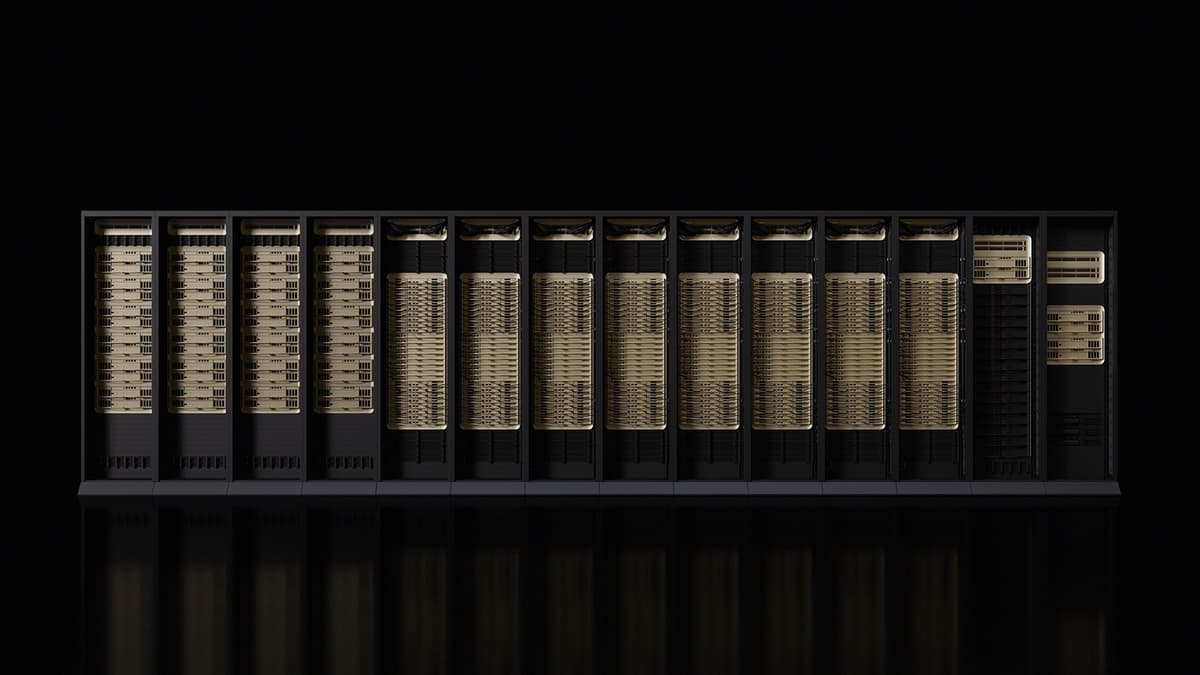
Vera Rubin NVL72 crams 72 GPUs and 36 CPUs into a single rack and ties them together with an absurd 260 TB/s of internal bandwidth. But the real story isn't raw performance — it's economics. Inference is 5x faster than Blackwell, and cost-per-token drops to a tenth. In an era when the unit cost of an AI service maps directly to token cost, "same answer at one-tenth the price" is a number that moves an industry's break-even line.
NVIDIA also bragged about install simplicity. These systems used to take 120 minutes to rack; with cable-free, hose-free, fanless trays, that's down to 5 minutes. They want a 2-million-part monster to behave like an appliance you plug in and switch on. And this NVL72 took home a COMPUTEX Best Choice Golden Award.
N1X is the opposite extreme. Built with MediaTek, it puts "NVIDIA inside a laptop" for the first time, right next to the datacenter monster. It's a bet that AI inference runs not just in the cloud but in the device in your hand — and a long game to pull the Windows PC market from x86 toward ARM. Add DLSS 5 for gaming and a Jetson Thor–based physical-AI strategy for robotics and autonomy, and NVIDIA stitched cloud, edge, and the physical world into one line.
Who wins — NVIDIA, Taiwan, the customer
For NVIDIA, this keynote is lock-in, extended. Selling a rack — or a whole AI factory — makes the customer far harder to pry out of the ecosystem than selling a single GPU. CUDA software, NVLink networking, finished system design — it all standardizes on NVIDIA. Add a foothold in laptops via N1X, and NVIDIA graduates from "datacenter company" to "every-layer-of-compute company."
For Taiwan, it's another confirmation of its status as the home base of the AI supercycle. Huang's "2 million parts, 150 partners" wasn't a throwaway line. TSMC's leading nodes, Foxconn/Quanta server assembly, and hundreds of component suppliers beneath them — one Vera Rubin system means the whole Taiwanese manufacturing ecosystem running flat out. It's a map of where the AI boom's money actually flows.
For customers (cloud and enterprise), the payoff is direct: the same work, cheaper. One-tenth cost-per-token and 5x inference aren't abstract benchmarks — they land straight in AI operating budgets. Just days ago Microsoft reportedly killed internal Claude Code over runaway AI coding costs; the hardware-side answer to that "AI cost crisis" is exactly this kind of generational jump. Add 5-minute installs and your time-to-revenue on a new datacenter shrinks too.
History — does the "platform in one shot" play always work?
NVIDIA throwing an entire next-gen platform off the GTC stage isn't new. The track record tells you how to read Vera Rubin's odds.
Win — Hopper/Blackwell domination. NVIDIA bundled Hopper (H100) and Blackwell (B200) as systems (DGX/NVL), not chips, and effectively monopolized AI accelerators. Each time, a "Nx performance, 1/N cost" upgrade story pushed customers to switch, and CUDA lock-in left rivals no crack to slip through. Lesson: NVIDIA's real weapon isn't chip specs, it's the system+software bundle — and Vera Rubin follows the exact formula.
Caution — the gap between announcement and units. NVIDIA's early generational jumps always had a "supply can't keep up with demand" bottleneck. Early Blackwell slipped on CoWoS packaging and HBM supply, and customers waited long after the reveal. Lesson: "largest launch in Taiwan's history" also means "a scale only the Taiwan supply chain can support." Yields and capacity on those 2 million parts are the real variable in ramping Vera Rubin.
Challenge — ARM PC's repeated stumbles. The "ARM Windows PC" that N1X targets has been tried several times and stalled on software compatibility and performance. Even Qualcomm's Snapdragon X converted share slower than hoped. Lesson: N1X needs more than chip performance — it has to clear the "software wall" of Windows and apps running smoothly on ARM. NVIDIA's edge is AI acceleration; breaking x86's inertia in ordinary PC experiences is a different fight.
Rivals' counter-play
AMD answers with "MI series + open ecosystem." It leans on inference price-performance each year to crack NVIDIA's lock-in and pitches open software like ROCm as a CUDA alternative. Vera Rubin's cost-per-token is so aggressive that AMD will press the "same work, more open, cheaper" angle into hyperscalers' multi-vendor strategies.
In-house silicon (Google TPU, Amazon Trainium, MS Maia) is a threat from another angle. These players want to run their own inference and training without NVIDIA, on their own ASICs. The more NVIDIA sells finished "AI factories," the more hyperscalers — paradoxically — invest in their own chips to control cost. Vera Rubin's economics are therefore a cost race against custom silicon too.
Intel and Qualcomm must defend the PC front N1X is entering. Intel holds on with x86's overwhelming software compatibility and its share outside the datacenter; Qualcomm, the ARM-PC first mover, wields power efficiency. If N1X opens an "AI laptop" category, the market becomes a two-front war: x86 vs ARM, and within ARM, NVIDIA vs Qualcomm.
So what actually changes
For companies and developers running AI infra, it's a signal that the floor on inference cost just dropped again. One-tenth cost-per-token makes large-model and agent workloads that were too expensive to run suddenly economical. For any company in an AI cost crunch, the timing of a hardware migration is the P&L — and Vera Rubin resets the math. The caveat: the gap between reveal and volume delivery, and supply-chain capacity, are still real.
For Taiwan and the semiconductor ecosystem, it's confirmation the AI supercycle runs at least one more generation. "2 million parts, 150 partners" flows straight into orders, expansions, and hiring across the chain — from TSMC to the smallest supplier — over the next year or two. The boom's upside spreading from one GPU company to the entire Taiwanese manufacturing chain is the keynote's real message.
For investors and general readers, the big picture is AI moving past the cloud into the device in your hand and the physical world. Putting N1X (laptops), Vera Rubin (datacenter), and physical AI (robots, autonomy) on one stage declares that AI's next battlefield widens to "where you run inference." Just remember NVIDIA's "Nx / 1/N" marketing is always best-case; until next quarter's real-world benchmarks and production yields land, cool the numbers by a notch.
Further reading
- NVIDIA Blog — GTC Taipei / COMPUTEX 2026 news
- NVIDIA News — Rubin platform: six new chips, one AI supercomputer
- VideoCardz — Vera Rubin NVL72 detailed (72 GPU, 36 CPU, 260 TB/s)
- VideoCardz — Jensen Huang GTC Taipei keynote confirmed for June 1
- Yahoo Finance — The world's biggest chip CEOs descend on Taiwan