The President Stood Between the Samsung and SK Hynix Chiefs and Announced $576 Billion
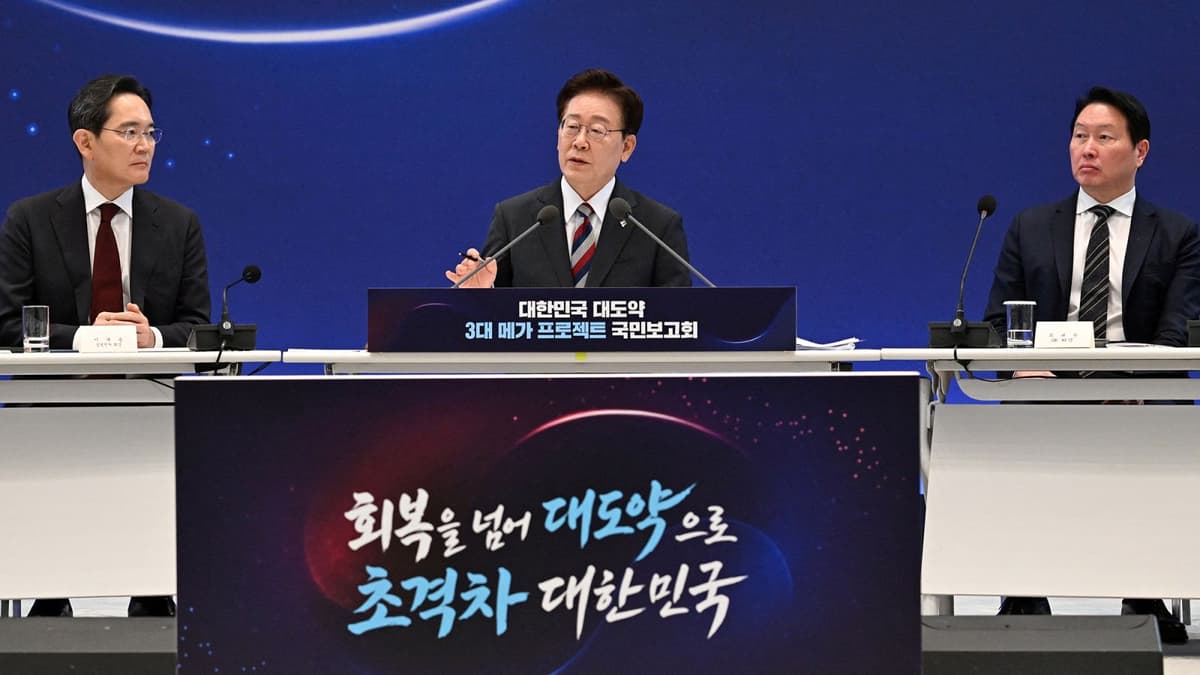
Here's the deal: on June 29, President Lee Jae-myung, flanked by the heads of Samsung Electronics and SK Hynix, unveiled a $576 billion AI-and-semiconductor mega-project. On live television, with the leaders of the world's two largest memory makers at his side, he pledged to "cement overwhelming industry leadership." This isn't one company's capex announcement — it's the state laying the board itself.
Break it down. Samsung and SK Hynix, with suppliers, will invest 800 trillion won (~$518B) to build two new fabs each — four total — in South Korea's southwest (South Jeolla, North Jeolla). Gwangju and South Jeolla add 5–20 trillion won, and an 81 trillion won advanced-packaging cluster lands in the Chungcheong area near Seoul. The official headline is $576B, but counting Samsung's separately previewed 10-year, 1,000 trillion won blueprint, analysts say the total flirts with $1.3 trillion.
Lee called it a "great leap forward," centered on a "triple axis" — semiconductors, physical AI, and data centers. So it's not just making more chips; it's building the AI infrastructure those chips will run, all in one package. SK Group, GS Group, and Naver adding 550 trillion won for AI data centers fits the same logic.
Here's what we'll unpack: why Korea swung this national-scale haymaker now, where the money flows, and what changes for Korea's economy, the global chip market, and ordinary people. Three players: the government that set the board, Samsung and SK Hynix who put up the money, and the rival nations — the U.S., Taiwan, Japan — who'll push back.
The Players — Government, Samsung/SK Hynix, and the Regions
First, the government. Lee campaigned on easing the capital-region concentration and reviving provincial economies. So placing the new fabs in the southwest rather than Seoul is pointed — using a strategic industry as an engine of balanced regional development. It's also industrial strategy: in a global AI-chip boom, "Korea grabs not just memory but the whole AI-infrastructure stack."
Next, Samsung and SK Hynix — #1 and #2 in global memory. In HBM (high-bandwidth memory), the core AI-boom component, the two hold the vast majority of global supply. More AI data centers means surging HBM demand, which means more fabs. This investment is their bet to lock in that demand — and it dovetails neatly with the government's policy drive.
Third, the regions and the supplier ecosystem. One fab pulls hundreds of equipment, materials, and parts suppliers and tens of thousands of jobs. Gwangju, the Jeollas, and Chungcheong adding trillions directly is aimed at that ripple effect — executing the "chip plant = regional economic engine" formula at national scale.
One line: the government wants regional balance and industrial dominance, the companies want to lock in AI demand, the regions want jobs — and three interests fused into one $576B bet. That's the spine.
What's New — By the Numbers
| Segment | Investment | Backers | Detail |
|---|---|---|---|
| Chip fabs | 800T won | Samsung, SK Hynix + suppliers | 4 new fabs in the Jeollas |
| AI data centers | 550T won | SK, GS, Naver | AI infrastructure |
| Packaging cluster | 81T won | (Chungcheong) | Advanced packaging |
| Local governments | 5–20T won | Gwangju, South Jeolla | Regional investment |
| Samsung's own blueprint | 1,000T won (10yr) | Samsung Group | Fabs, AI, packaging, batteries, displays |
Two things stand out. First, the official figure ($576B) differs from the press tally ($1.3T) — because Samsung's decade-long internal plan overlaps the government project. So "$576B or $1T" is a question of where you draw the boundary, not a fabricated number. Second, over half the money is on the "AI infrastructure" side — not just making more chips, but laying the data centers those chips will run domestically.
Execution is staged over many years. A single fab takes years; building four at once is astronomical. So this is less "factories tomorrow" and more "Korea just set the coordinates for the next decade of its chip industry." The numbers are so large that actual execution rate and timing may flex with economic conditions.
Who Wins
Samsung and SK Hynix bank both demand capture and state support. As AI data centers explode, demand for high-margin memory like HBM soars, and laying fabs early lets them ride the wave. With the state smoothing permits, infrastructure, and power, construction gets faster and cheaper. The core: "the state backs a scale no company could do alone."
The government captures industrial dominance and a political promise at once. It's a rationale to lift Korea from "memory powerhouse" to "AI-infrastructure powerhouse," and a vehicle to scatter jobs to the provinces, executing the balanced-development pledge. The big live broadcast made the political message clear.
The regions and suppliers expect jobs and inflows. But one party could struggle — power and water. Fabs and data centers devour electricity. Running four new fabs and massive data centers at once requires a power-infrastructure buildout; without it you get a "money but no electricity" bottleneck.
Precedents — Wins and Misses
We've seen this before. The U.S. CHIPS Act, Japan's Rapidus and TSMC Kumamoto fab, Taiwan's clusters are the templates. Through the 2020s every major power poured state money in under "chips are security." Korea's move answers that global subsidy race, Korean-style — distinguished by overwhelming scale and bundling in "AI data centers."
The key to the win is demand and timing. With the AI boom genuinely exploding HBM demand now, building the fabs to catch it early is a rational bet. The failure lesson is just as clear: chips are a cyclical industry, and oversupply crashes prices. If everyone builds fabs at once, a few years out an oversupply could hurt everyone — the memory chicken-games of the 1990s–2000s taught that.
Another risk is execution. Announcing is easy; actually spending $1T on schedule is another matter. Recession, rates, and power-infrastructure delays can stretch or shrink the plan. History is full of grand investment announcements trimmed by changing conditions. So watch "how much actually gets spent over how many years," not the headline figure.
There's a geopolitical lesson too. Korea's chip champions don't operate in a vacuum — they sell into a world where the U.S. sets equipment-export rules and China is both a giant customer and a strategic rival. A previous generation of Korean fab investments got entangled in exactly this: plans drawn up for one trade environment had to be re-routed when export controls shifted mid-build. So the $576B isn't just an engineering and financing question; it's a bet that the trade map stays navigable for a decade. If the U.S.-China tech split deepens, where these fabs can sell — and which tools they can buy — becomes as decisive as how fast they're built.
Rival Counter-Plays
The U.S. will keep pulling advanced fabs onshore — TSMC Arizona, Samsung's Taylor, Texas fab. If Korea builds big at home, the U.S. may press harder on "core production on American soil," complicating the tightrope Korean firms walk in allocating investment between the two.
Taiwan (TSMC) will accelerate leading-edge process investment to defend its foundry #1 spot. Korea's push leans toward memory and packaging, so it's not a head-on clash with TSMC — but competition across the AI-chip ecosystem intensifies.
Japan wields Rapidus's next-node catch-up and its strength in materials and equipment. Korea-Japan is a tangle of cooperation and rivalry in chip materials/tools, so Korea's big fab build is actually a demand opportunity for Japanese equipment and materials makers. Friends and foes are mixed.
So What Changes
If you're an investor — the HBM/memory/equipment/materials value chain likely catches policy momentum. But before getting excited about the headline, weigh the actual execution timeline and the chip cycle (oversupply risk). A grand announcement doesn't guarantee a near-term stock pop. Remember it's a cyclical industry.
If you live in or job-hunt in Korea — expect large-scale construction and jobs in the Jeollas and Chungcheong over coming years, opening opportunities in chip, construction, and infrastructure roles. But staged execution means the effects take time to feel.
If you work in AI — a big jump in domestic AI data centers improves conditions for running large AI workloads in Korea, which is positive for local AI startups' and researchers' infrastructure costs and access. The open question remains whether power price and supply keep up.
🥄 Three Things You're Probably Wondering
— Is it $576B or $1T? Why the different numbers? Both are right. $576B is the government's official project size; $1T+ adds Samsung Group's 10-year internal blueprint on top. It's a question of boundary, not inflation.
— Will all of it actually get spent? Too early to say. Announcement and execution are different things. Pace can flex with the economy, rates, and power infrastructure, and chip cyclicality could delay plans during oversupply. Read it as "a direction over the next decade."
— Is there enough electricity? This is the real crux. Four new fabs and massive AI data centers devour power. Without parallel power, transmission, and water buildout you get a bottleneck. Many analysts argue the project's real success hinges on "power" more than "money."
Sources
- South Korea to invest $576 billion in AI chip production — CNN
- Samsung, SK Hynix back South Korea's $576 billion AI-chip plan — Business Standard
- Korea taps Samsung, SK Hynix in $576 billion AI-chip drive — Yahoo Finance
- Samsung, SK Hynix reported $1.3 trillion spending plans — CNBC
- South Korea announces more than $1 trillion AI, chip drive — Al Jazeera
Numbers and criteria are as of announcement and may change. Investment calls are yours to make!