The World's Most Valuable Startup Wants to Hand Equity to the U.S. Government
Here's the deal: on July 2, a genuinely hard-to-believe story broke out of Washington. OpenAI has reportedly been quietly discussing handing the U.S. federal government a 5% stake in the company. How much is that worth? OpenAI closed a record-breaking funding round back in March at a post-money valuation of $852 billion. Five percent of that is roughly $42.6 billion. So we're talking about a startup offering to just gift the government more than $40 billion worth of equity. It sounds like the kind of deal that doesn't exist in the real world — but CNBC broke the story first, and Time, Forbes, Euronews, and Tom's Hardware all picked it up right after.
What's even more striking is that this isn't just about OpenAI. Sam Altman took it a step further. His pitch isn't limited to OpenAI — he wants the other major American AI labs, Anthropic, Google, and Meta among them, to each hand over a similar 5% cut to the government too. The idea is to pool all that equity into a kind of AI sovereign wealth fund, then distribute the returns back to the public like dividends. The model he's explicitly citing is the Alaska Permanent Fund — a fund the state of Alaska set up in 1976 by investing surplus oil revenues, and which is still famous today for cutting annual checks to residents. Altman is basically painting a picture where AI takes the place oil once held.
Altman's own words capture the core of the pitch pretty well: "Giving the public a financial interest in the company is the best way to share the upside of AI." On the surface, it sounds wildly altruistic and unprecedented — the fastest-appreciating company on earth voluntarily offering to hand a big chunk of its equity to the state. But flip the story over even slightly, and you'll see this isn't pure altruism. There's a very calculated piece of political positioning underneath it. Let me unpack what's really going on, piece by piece.
The Players
Let's start with the protagonist of this story: OpenAI. Yes, the company that made ChatGPT. It started as a nonprofit research lab in 2015, but it's now effectively the most influential AI company on the planet. In the funding round it closed this past March, it was valued at $852 billion — a figure unprecedented in startup history. That puts it shoulder to shoulder with mega-cap public companies like Apple and NVIDIA. A private startup commanding that kind of valuation is itself a symbol of just how hot the AI boom has gotten.
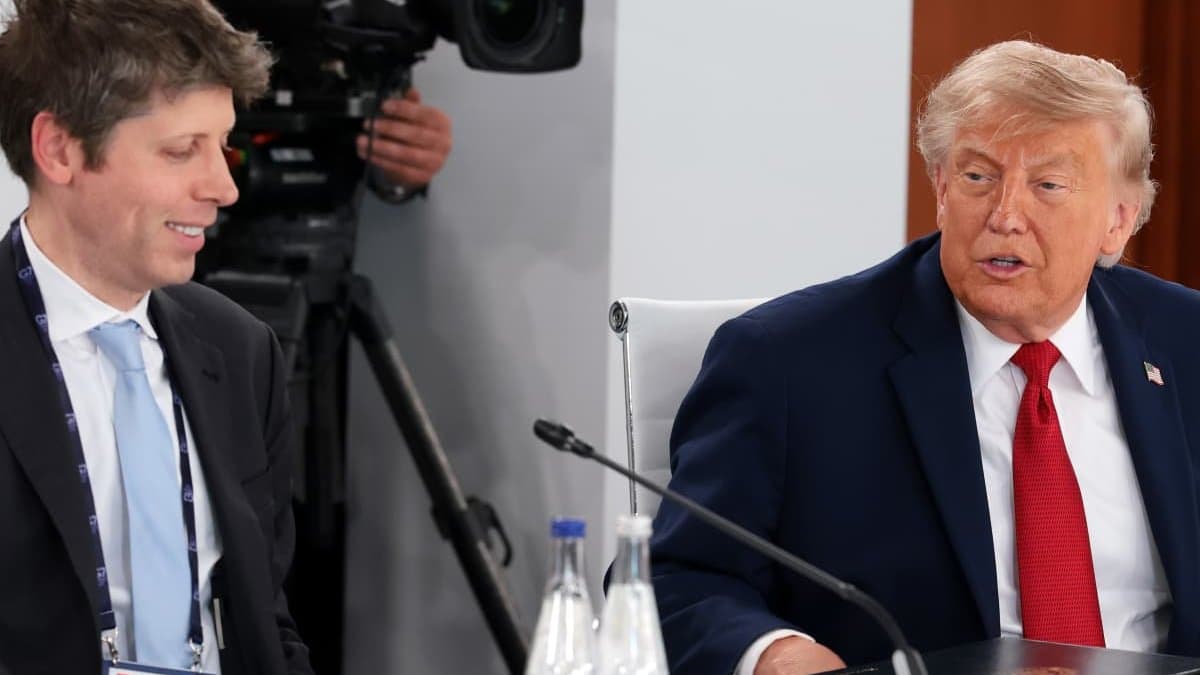
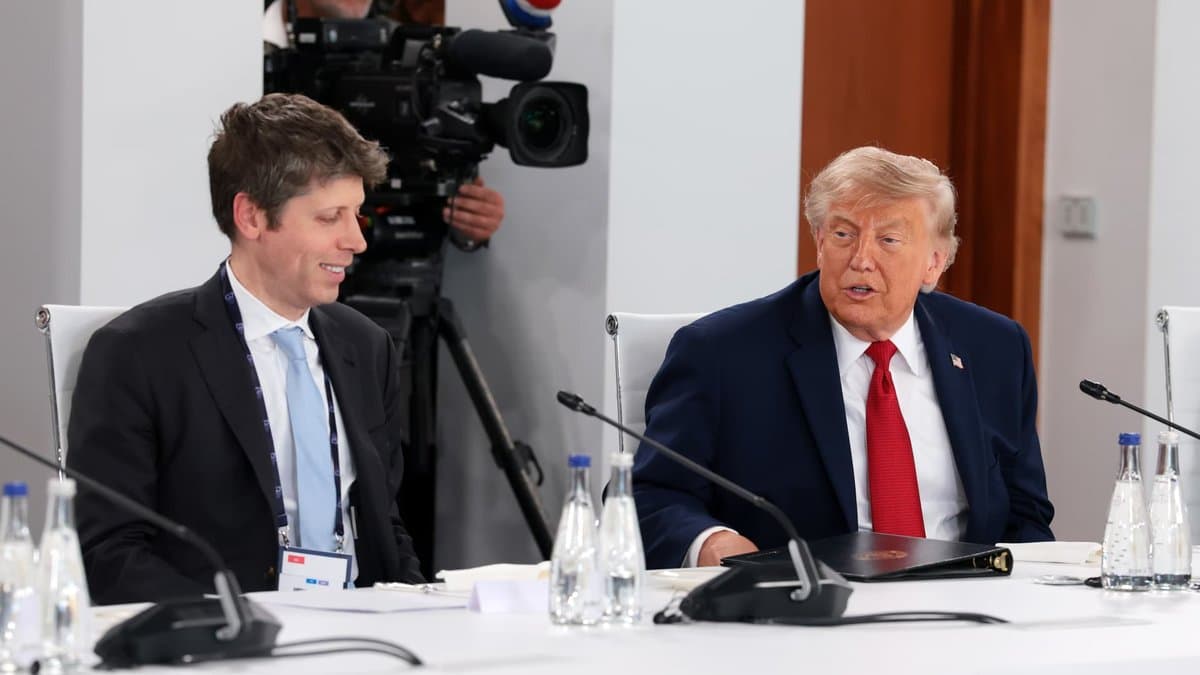
And the man steering the ship is Sam Altman. Altman is regarded in Silicon Valley as one of the most politically savvy and skilled negotiators around. He's not just a CEO who understands the tech — he knows exactly how to build relationships with Washington, and what language to speak when talking to regulators. This equity proposal reeks of that kind of Altman calculation. According to CNBC, Altman didn't spring this idea out of nowhere — he'd reportedly been floating it with the Trump administration since early 2025. In other words, this is a concept he's been quietly laying groundwork for over a year.
On the other side — the party that would receive the stake — is the Trump administration. Per the reporting, Altman has been in direct discussions with President Trump himself, as well as key economic figures like Treasury Secretary Scott Bessent and Commerce Secretary Howard Lutnick. The fact that the Treasury and Commerce lines are involved suggests this isn't just casual idea-swapping — it's advanced to a stage where they're seriously weighing whether it could actually become policy. Of course, nothing is finalized. I'll come back to that point.
And we can't leave out the other AI labs whose names keep coming up in this plan: Anthropic, Google (DeepMind), and Meta. If Altman's vision plays out, all of them would have to cough up 5% stakes too. The problem is whether they'll actually agree. OpenAI is the one who floated the card, so fine — but from Anthropic's or Meta's point of view, expect pushback along the lines of "why should we hand tens of billions in equity to the government because of Altman's idea?" This is the single biggest Achilles' heel of the whole concept.
What Actually Happened — the Substance Behind a $42.6B Idea
Here's the skeleton of the plan. OpenAI gives the government a 5% stake — about $42.6 billion at the $852 billion valuation. And it doesn't stop there: other major American AI labs would each contribute 5% too, pooling it all together. That giant pool of AI equity becomes a kind of sovereign wealth fund, and the dividends or returns it generates get distributed to the American public. It's the Alaska oil-dividend model, but for the entire country and powered by AI instead of oil.
Here's an important piece of context. As Tom's Hardware pointedly noted, the timing of this proposal is exquisite. It landed right after Washington delayed OpenAI's GPT-5.6 launch. The government put the brakes on the new model's release, citing regulatory or safety review — and immediately after, OpenAI pulls out the "we'll give you 5% of our equity" card. Look at that sequence and it becomes natural to read this less as a purely goodwill gesture and more as a bargaining chip against regulatory pressure.
Another thing that absolutely has to be underlined: this is still at the concept stage. Nothing is locked in. For it to actually happen, it would have to clear two enormous hurdles. First, it would require U.S. congressional legislation. The government holding large stakes in private companies isn't something the executive branch can just decide on its own. Second, it would need the buy-in of the other AI labs. Altman shouting "let's all pitch in" doesn't mean Anthropic or Meta will follow. So the right way to read this news is as "a proposal that's been thrown out there," not "a decided policy."
Here's a table laying out the key numbers and conditions of the plan.
| Item | Detail |
|---|---|
| Revealed | July 2, 2026 (CNBC first report) |
| Proposing party | OpenAI / CEO Sam Altman |
| Recipient | U.S. federal government (Trump administration) |
| Proposed stake | 5% of OpenAI |
| Stake value | ~$42.6 billion (at $852B valuation) |
| Expanded vision | Anthropic, Google, Meta also contribute 5% each |
| Model | Alaska Permanent Fund (oil → AI) |
| Discussion partners | President Trump, Treasury Sec. Bessent, Commerce Sec. Lutnick |
| Talks began | Early 2025, behind the scenes (over a year) |
| Conditions to realize | Congressional legislation + other AI firms' consent (unsettled) |
As the table makes clear, the numbers are staggering, but the conditions sitting next to them are every bit as daunting. The $42.6 billion figure is perfect headline material, but as long as it comes attached to two giant preconditions — "congressional legislation" and "competitor consent" — nobody can guarantee right now whether this actually becomes reality.
Everyone's Angle — What Is Altman Really After?
The question that nags at everyone is this: why would OpenAI volunteer to give away $42.6 billion worth of equity? It looks like a losing trade on its face. But there are a few calculations underneath it. First, it's a pre-emptive move to soften regulation. Washington is in a heated debate right now over how to regulate and tax AI giants — antitrust, safety rules, excess-profit taxes, the pressure keeps mounting. In that environment, if OpenAI extends its hand first and says "we'll share our equity with the public," it becomes far more awkward for the government to come after OpenAI. It's hard for a regulator to swing hard at a company it holds a stake in.
Second, it's a strategy to pull the government in as a stakeholder. Once the government owns 5% of OpenAI, it benefits whenever OpenAI thrives. In other words, the government's interests and OpenAI's interests end up in the same boat. That's likely to work in OpenAI's favor when future regulation and policy get written. Even a move like the GPT-5.6 delay becomes harder to pull when the government holds equity — if the company's value drops, so does the value of the government's own stake. Essentially, Altman is trying to swap out "regulatory risk" for "shared interest."
Third, it's about winning public opinion and moral high ground. The criticism that AI destroys jobs while fattening the wallets of a handful of companies and rich people is fierce worldwide right now. In that climate, a message like "we'll share the upside of AI with all citizens" becomes a powerful moral shield. Altman's line — that "giving the public a financial interest is the best way to share AI's upside" — targets exactly that. Regardless of whether it ever materializes, simply floating the proposal lets OpenAI bank the image of being "a company that thinks about the public good, not a greedy corporation."
There's an angle for the Trump administration too. The government holding stakes in mega AI companies means the U.S. as a nation directly shares in the fruits of the AI industry's growth. Externally, it earns the political narrative of "a government that looks after its citizens in the AI era," and practically, it means securing an enormous asset. That said, a government holding large private-company stakes is a sensitive matter that can invite "state capitalism" controversy — so it's a double-edged sword the administration can't just embrace unconditionally either.
Precedents: Wins and Failures
Start with the blueprint itself — the Alaska Permanent Fund. Created in 1976, it has invested surplus oil revenues and been running ever since, paying an annual dividend to every single Alaska resident. It's been a fairly successful sovereign wealth fund model for decades. The underlying idea — that everyone shares in the excess profits from natural resources — is essentially proven. Altman citing this model specifically is meant to underline that there's a successful precedent, which lends credibility. But there's a fundamental difference: oil is a finite resource you dig out of the ground, while AI is a technology that keeps evolving — so whether it copies over cleanly is an open question.
There are also plenty of historical cases of the government holding stakes in private companies. During the 2008 financial crisis, the U.S. government bought large stakes in General Motors and major banks. But those were bailouts meant to save failing companies, and it wrapped up reasonably successfully when the government later sold its stakes and recovered the money. Back then, though, the justification — "using taxpayer money to rescue a dying company" — was crystal clear, which is a totally different flavor from today's "a thriving company voluntarily gifts equity." Different character means the political and legal controversies play out completely differently.
Conversely, there are cases closer to failure. In several countries, governments trying to hold large stakes in specific industries or firms ended up mired in "state capitalism" controversy and political-interference problems. Once the government becomes a shareholder, political influence starts seeping into that company's management, and you get a conflict of interest where the state is both regulator and shareholder. OpenAI's plan is highly vulnerable to criticism at exactly this point. If the government is both a shareholder in an AI company and the authority regulating AI, the fundamental question inevitably arises: can that regulation possibly be fair?
So the fate of this concept will likely be decided on a tightrope walk between "moral justification" and "conflict of interest." It can lean on the attractive banner of citizen dividends, à la the Alaska model, but it also carries the unsolved homework of how to resolve the conflict of the government becoming a shareholder in the very companies it regulates. How those two get reconciled will determine whether this idea follows a successful precedent or ends up as a failed controversy.
Rivals' Counterplay
The parties put in the most awkward spot by Altman's plan are the other AI labs — Anthropic, Google, and Meta. Altman said "let's all pitch in 5%," but that's genuinely thorny for these companies. If they agree, each has to gift the government tens of billions in equity. If they refuse, they risk taking public-opinion arrows: "you're against sharing profits with the public?" The fact that Altman floated this proposal publicly is itself a slick move that boxes competitors into a lose-lose. He's already claimed the goodwill-proposer position for himself, leaving everyone else at a disadvantage whether they follow or resist.
Meta in particular is in an even more complicated spot. Meta has already staked out the "we don't monopolize AI, we open it up" high ground by releasing its models as open source. From that position, Meta could argue: "we're already contributing to society via open source — why should we hand over equity on top of that?" Anthropic, a company that emphasizes safety and the public good, could likewise sidestep the proposal with its own logic about "contributing to the public good in a different way." In other words, rather than flatly refusing, competitors are more likely to try to selectively dodge the plan by invoking their own respective justifications.
Looking at Big Tech as a whole, this concept is a card that could shake the entire framing of the AI regulation debate. Until now, Big Tech has lobbied to delay or soften regulation as much as possible. But if OpenAI steps up first and says "we'll offer equity," the regulatory conversation's frame could shift from "should we regulate or not" to "how do we share the profits." That's a variable capable of scrambling the lobbying strategies the other Big Tech players have set up. So competitors are now in an awkward position where they can neither simply ignore the proposal nor eagerly grab it.
On another front, this proposal could force other AI companies into a defensive response. If public opinion turns favorable toward the plan, Anthropic and Google could face pressure to roll out some kind of similar "public-good contribution card" of their own. Even if it's not equity donation, they might come out with alternatives like citizen-dividend-style programs or public-benefit funds. In the end, Altman's single move could carve out a whole new axis of competition across the AI industry: "how do we bank public-good justification amid regulatory pressure?"
So What Changes
For developers and people working in AI, this news doesn't immediately change a single line of code. But it's worth watching for the direction it points. Once the government holds stakes in AI giants, the tenor of AI regulation and policy could shift. If the government, as a shareholder, wants the company to grow, hard brakes like the GPT-5.6 delay might ease up. Conversely, if the government starts leaning on internal company decisions, political considerations could creep into which models get released and how. For developers, it's smart to read this news as a signal for gauging which direction the regulatory environment is drifting.
For investors, this is a genuinely delicate matter. On its face, OpenAI handing over a 5% stake means existing shareholders' stakes get diluted — your slice shrinks. But if the trade-off is a big reduction in regulatory risk and the government becoming a friendly stakeholder, it could actually be a net positive for the company's long-term growth. In other words, it's a "near-term dilution vs. long-term stability" trade-off. On top of that, if a precedent forms of the government holding AI-company stakes, it could ripple across the regulatory and investment environment for other AI startups too — so anyone investing in the AI sector should keep a close eye on where this debate heads.
What about ordinary citizens? In theory it's a good story — you'd get to receive some slice of the enormous wealth AI generates, as a dividend. Just like Alaska residents get their annual oil check, Americans would get an AI check. But soberly, this is still just a concept, and realizing it means clearing the huge mountains of congressional legislation and competitor consent. How many years until a dividend actually lands in citizens' hands — or whether it ever materializes at all — is too early to call right now. Rather than pinning big hopes on a good idea, the wise move is to watch how this actually takes shape.
And underneath this whole discussion sits a much bigger question: how do we share wealth in the age of AI? The worry that AI supercharges productivity while its gains concentrate among a tiny few has already become reality. Altman's proposal is one answer to that worry. Whether the method is the best one, whether it's sincere, whether it's even feasible — all of that is heavily up for debate. But it does carry meaning in that it officially put "sharing AI's upside with society" on the table from the industry's front line. How this discussion ends up steering the broad direction of AI policy going forward — that's the real thing to watch.
🥄 Three Things You're Probably Wondering
— So do I actually get an AI dividend? That's the picture in theory. But it's still just a concept — realizing it means Congress has to pass a law and the other AI companies have to agree. When, how much, or even whether you'd actually get one is too early to call right now.
— Is Altman really just being generous by giving away equity? It's reasonable to assume it's not pure goodwill. The proposal landed right after the GPT-5.6 launch got delayed, so the dominant read is that there's a calculation to defuse regulatory pressure baked in. That said, it's clearly a clever move that banks both moral high ground and self-interest at once.
— Will the other AI companies really each cough up 5%? Seems unlikely. There's no clean reason for Anthropic or Meta to willingly hand over tens of billions in equity. That said, if public opinion turns favorable toward the plan, they'll feel pressure to come out with some similar public-good card of their own.
References
- CNBC — OpenAI proposes U.S. government own 5% stake to address political blowback
- OpenAI proposes 5% government stake days after GPT-5.6 delay — Tom's Hardware
- OpenAI wants to invest in AI with the Trump administration — Time
- OpenAI Reportedly Pitches Granting U.S. Government 5% Stake — Forbes
- OpenAI offers the US government a 5% ownership stake — Euronews
Numbers and criteria are as of announcement and may change. Investment calls are yours to make!