OpenAI Just Told the US Government to Take 5% of the Company
Here's the deal: on July 2, the Financial Times reported that OpenAI is in talks to hand the US government a 5% equity stake in the company. Do the math against its March valuation of $852 billion and that's roughly $42.6 billion. This isn't lobbying. This is offering to seat the government at the cap table as a shareholder.
The point isn't "OpenAI writes a check." It's that the most valuable startup on the planet raised its own hand to donate a slice of itself to the state. And Sam Altman went a step further. It's not just OpenAI — Altman reportedly proposed that America's leading AI labs each contribute a similar 5% share into a fund modeled on the Alaska Permanent Fund, the thing that cuts every Alaskan a dividend check every year from oil money. The pitch is that the wealth AI creates should get shared with the public.
But the timing is what makes this loud. Just days before this proposal surfaced, Washington forced OpenAI to delay the rollout of its newest model, GPT-5.6. The White House had said, essentially, "hold the broad release until the security review is done." So the government's knife was at the throat, and right after that came "here, take 5% of us." Read this story without that sequence and you're seeing half the picture.
Why does this matter? Because it's the first real flare of frontier AI turning toward state capitalism. Until now Silicon Valley treated government as the regulator — the thing you keep at arm's length. Inviting the state in as an equity holder is basically an admission that AI has gotten so big and so sensitive that riding in the same boat as the government is now unavoidable. Whether that's a public dividend or a giant bribe to make regulation go away is exactly what Washington is arguing about right now.
Let's Line Up the Players
The protagonist is obviously OpenAI — the company behind ChatGPT and the most valuable private startup on Earth right now. Its March valuation was $852 billion, which makes it bigger than most top public companies you can name. This is the company that said, on its own, "we'll give the government 5%." Five percent sounds small until you remember it's $42.6 billion in absolute terms — and more than that, the symbolism of "the government becomes a shareholder in a private firm" is enormous.
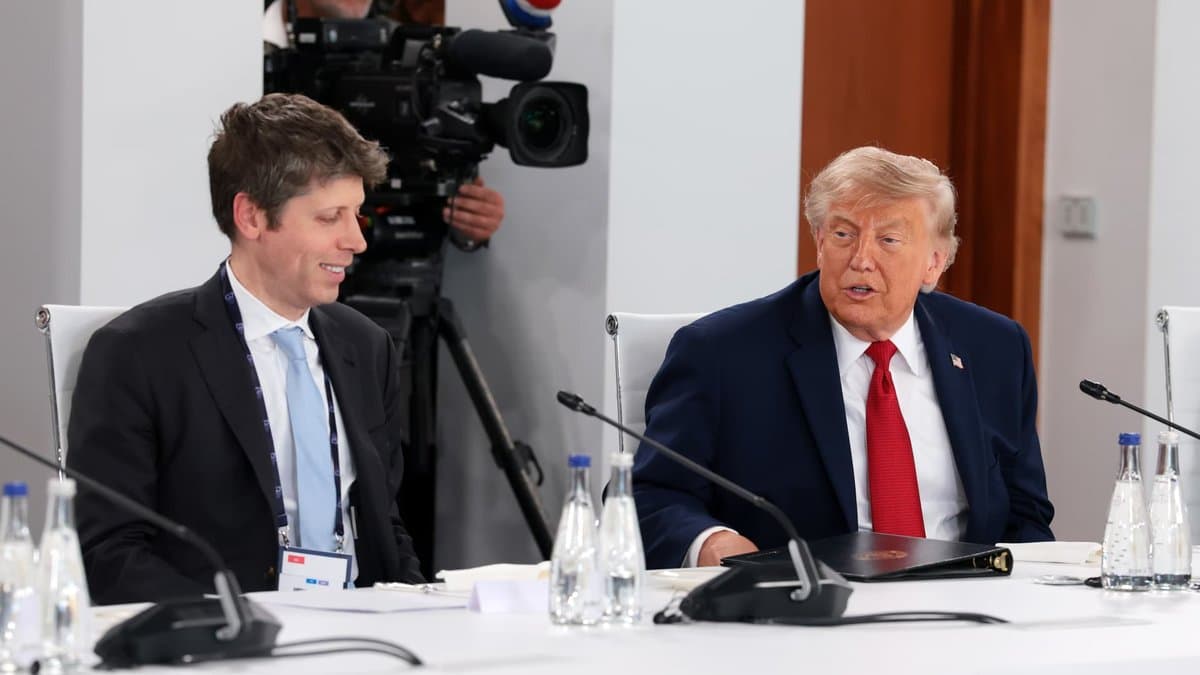
The person driving it is CEO Sam Altman. Altman has been saying "the wealth AI creates should be shared with society" for years. Back in April, OpenAI even published a policy paper titled "Industrial Policy for the Intelligence Age," floating the idea of a public wealth fund that invests in AI labs and distributes the returns directly to citizens. This 5% proposal is that blueprint actually landing on a negotiating table. And per reporting, Altman had been quietly pitching the concept to the Trump administration since early 2025.
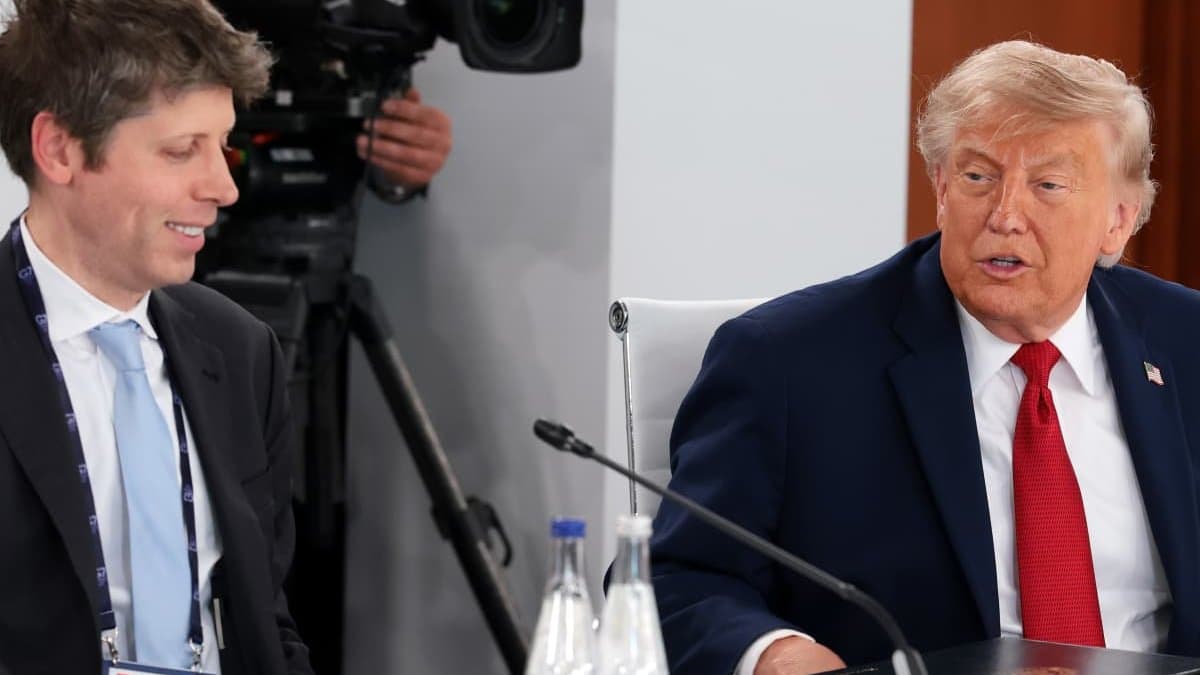
On the government side, the counterpart is President Trump. He's already publicly floated the idea of "pieces of companies being given to the American public" so citizens become "partners with the companies." The working negotiations reportedly involve Commerce Secretary Howard Lutnick and Treasury Secretary Scott Bessent. When Commerce and Treasury are in the room, that's a signal this has moved past idle idea and into actual policy design.
The model is the Alaska Permanent Fund. That's a real, working system where the state of Alaska invests oil revenue and pays out an annual dividend to every single resident. What Altman is sketching is the AI version of that: instead of oil, the wealth AI generates funds the payout, and American citizens get a cut. It's a bet on a world where "intelligence," not a natural resource, becomes the source of national wealth.
One more thing to know: this isn't OpenAI's picture alone. Per the FT, Altman proposed that leading US labs — Google, Anthropic, Meta, xAI — each put 5% into the fund. But whether the others agree is completely up in the air, and notably, Anthropic and the Trump administration reportedly haven't even discussed the government taking a stake. So right now this is OpenAI going out on a limb and setting the table by itself.
What Was Actually Proposed — In Numbers
The proposal has three bones. One, OpenAI hands the government a 5% stake. Two, other leading labs participate at a similar scale to build a shared fund. Three, that fund gets run Alaska-style and pays dividends to the public. The catch is that all of this is still "preliminary." The FT, and everyone who picked it up — CNBC, TechCrunch, CNN — leaned hard on that word.
The biggest hurdle is Congress. A government taking an equity stake in a private company tangles up constitutional, budget, and governance questions, and the consensus is that actually executing this would almost certainly need congressional approval. It's not something the Trump administration can just snap into being. Here's how the core numbers shake out.
| Item | Detail |
|---|---|
| Proposed stake | 5% of OpenAI |
| Stake value | ~$42.6 billion |
| Reference valuation | $852 billion (March 2026) |
| Broader ask | Google, Anthropic, Meta, xAI — 5% each |
| Benchmark model | Alaska Permanent Fund (public dividend) |
| Counterparts | President Trump, Commerce Sec. Lutnick, Treasury Sec. Bessent |
| First reported by | Financial Times (2026-07-02) |
| Immediate backdrop | Govt-requested GPT-5.6 delay (June 25) |
| Execution requirement | Likely needs congressional approval; preliminary stage |
| Competing bill | Bernie Sanders' 'American AI Sovereign Wealth Fund Act' (June; 50% one-time tax on AI stock) |
Dig into the numbers and it sharpens. That $42.6 billion is the chip OpenAI is willing to lay down to buy a relationship with the government. But is it really a "donation"? That's murky too. Once the government owns 5%, it has a stake in OpenAI succeeding. The entity doing the regulating suddenly also needs the company to thrive so it collects a dividend. That conflict of interest is the live wire running through this whole thing.
Also worth watching is the bill Bernie Sanders introduced in June. Sanders wants a 50% one-time tax on AI-company stock to seed a public fund. So the big direction — "AI's wealth to the people" — actually has bipartisan sympathy, but the methods are opposites. Altman's version is companies "voluntarily" contributing equity; Sanders' version is the state "forcibly" taxing it away. Those two tracks are headed for a collision in Washington.
Who Gets What Out of This
Start with OpenAI. The clearest win is softening regulatory risk. Its GPT-5.6 rollout got frozen at the government's request just days earlier — a painful reminder that the state holds the release switch. In that context, "take 5% of us" is a card that converts the regulator from adversary into a partner in the same boat. Once the government owns OpenAI stock, killing OpenAI with regulation means shredding its own asset. Read it plainly: OpenAI is buying a regulatory umbrella for $42.6 billion.
For the government and the public, the nominal upside is the dividend. Instead of a handful of shareholders and founders hoarding the astronomical wealth AI is about to generate, the idea is that Americans share in a slice — the way Alaskans get their oil check. If it works, it's one real answer to the wealth-inequality problem of the AI era. And for Trump, it's a powerful political story: "I made the American people partners in the AI companies."
Don't discount Altman's personal upside either. He's spent years cultivating an idealist image around "society should share AI's wealth." This proposal completes that image while, in practice, staking out OpenAI's position as the AI company most tightly aligned with the government. If rivals dig in and say "we won't contribute," the framing leaves OpenAI looking like the one patriotic company in the room.
But there's a serious counterargument here. Critics call this regulatory capture on steroids. If the government becomes a shareholder in a specific company, can it possibly regulate that company fairly? It arguably gets an incentive to hobble OpenAI's rivals or write rules that favor OpenAI. Peel off the pretty "public dividend" wrapper and you might find a dangerous experiment in which the world's most powerful AI firm and state power fuse together through capital. How that tension gets resolved is what decides whether this proposal lives or dies.
Past Parallels — Wins and Flops
Government owning a slice of a private company isn't new. The obvious reference is the 2008 financial crisis, when Washington took huge stakes in banks like Citigroup through the TARP bailout and briefly nationalized GM to the point of majority ownership. That had a clear justification — "unavoidable intervention to save companies from collapse" — and the government later sold its stakes back, in some cases at a profit. It's the case showing the state as shareholder isn't automatically a disaster.
On the win side, there's the model Altman named directly — the Alaska Permanent Fund — and, more broadly, Norway's sovereign wealth fund. Norway runs its oil revenue through a fund that invests in stocks worldwide and channels the returns into public welfare. Alaska cuts residents a direct cash dividend. What they share is "sharing wealth from a depleting resource across future generations." Altman is arguing AI is the 21st-century version of that resource. As benchmarks go, it's a genuinely compelling one.
On the flop-scented side, countries where the state has embedded itself deep into industry through capital — especially state-enterprise-heavy economies — have often sunk into inefficiency and cozy government-business entanglement. When the government is shareholder, regulator, and biggest customer all at once, the company starts steering by politics instead of the market. Innovation slows, rivals cry foul, and consumers end up paying. In an industry that has to move as fast as AI, tying OpenAI up in a government equity knot could make it sluggish — that's the worry.
And there's one decisive contrast. The 2008 bailouts were "the state rescuing failing firms." This is the exact opposite. The hottest, $852-billion company on the planet is offering the state a stake with no one forcing it. That directional difference is the whole thing. Crisis nationalization is cleanup after the fact; a thriving company voluntarily handing over equity looks a lot more like a political investment — buying the future relationship in advance. Which is why the "calculated insurance, not pure public good" read keeps gaining weight.
The Competitor Counter-Play
OpenAI set this table alone, but the ripples hit the whole field. The moment Altman said "the other labs should each put in 5%," Google, Anthropic, Meta, and xAI all got shoved in front of an awkward choice. Follow along and you're conceding OpenAI led the play; refuse and you eat the political heat of "you don't care about the national interest?" Either way, OpenAI framed it first.
The trickiest spot is Anthropic's. Per reporting, Anthropic and the Trump administration haven't even discussed a government stake. Anthropic pitches itself as the AI-safety-first company, so it likely prefers independent regulatory cooperation over getting tangled up with the government through capital. But once OpenAI grabs the patriot card, Anthropic will keep catching the "why aren't you doing this?" question unless it responds somehow.
Google and Meta have a different calculus. They're public companies, so handing equity to the government runs straight into shareholder interests. A public company offering to gift 5% of its stock to the state for nothing is shareholder-lawsuit bait. So they'll more likely dodge the equity gift and stress other forms of contribution — "we pay plenty of taxes and create tons of jobs." xAI's math flips entirely depending on the state of the Elon Musk-Trump relationship.
Meanwhile, on the other side of the aisle, the Sanders-style forced-tax approach is sitting there as the alternative. If Altman's version is the soft path — "companies voluntarily contribute equity" — Sanders' is the hard path — "the state takes it via tax." If Altman's voluntary proposal fizzles, a Sanders-style mandatory tax debate could fill the vacuum. Which means, for the AI companies, Altman's proposal might actually be a seawall against a worse scenario. Voluntarily giving up 5% beats getting 50% ripped away by force — that's the calculation.
So What Actually Changes
For developers and people working in AI, this is the signal that the distance between AI companies and the state is collapsing fast. If the pattern sets in — government makes a company delay a model (GPT-5.6), company offers up equity in return — then the development and deployment of frontier models becomes a negotiated outcome with Washington, not a pure engineering call. The release cadence and feature limits of the API or model you use could get decided in a DC conference room. Your code doesn't change today, but the rules of the board do.
For enterprises, it's a double-edged sword. If the government owns OpenAI stock, OpenAI can wear a premium brand as "the safest, government-endorsed" AI — a powerful sales point for compliance-heavy finance, healthcare, and public-sector buyers. On the flip side, if one AI company gets bound to the state through capital, the rest start crying foul and the market risks splitting along political lines. Picking an AI vendor becoming a political choice is a headache for enterprises.
For the investing/policy crowd, this is a genuinely big signal — an inflection point where frontier AI shifts character from "pure private industry" to "national strategic asset." The moment the government holds a stake, AI effectively joins the ranks of regulated industries like defense and energy. Even that $852 billion valuation takes on a different flavor once the government's a shareholder and "too big to fail" logic attaches. Just don't forget this is all still preliminary and the mountain of congressional approval is still standing. And that $42.6 billion figure moves with the valuation — change the number and the stake value shifts too.
Go one level deeper and this proposal hits the era's foundational question head-on: who gets to share the wealth AI creates? If AI really does replace labor and mint colossal wealth, will society tolerate all of it piling up with a few founders and investors? Altman's answer is "companies voluntarily give equity to a public fund"; Sanders' answer is "the state forces it via tax." Either way, the common thread is that a bipartisan consensus has settled in — you can no longer leave AI to pure market logic. But since "public dividend" and "regulatory capture" are two sides of one coin, whether this becomes a model of public good or a dangerous fusion of power and capital is too early to call.
🥄 Three Things You're Probably Wondering
— So is the government actually becoming an OpenAI shareholder? Not yet. The FT itself pinned this as "preliminary," and actually doing it would mean clearing the mountain of congressional approval. It's not something the Trump administration can just conjure. The direction is clear, but whether it actually happens is too early to call.
— Is this good or bad for the public? It's both. Read charitably, it's Americans sharing AI's wealth like an Alaska dividend. Read cynically, the government becomes a shareholder in a company it's supposed to regulate — a recipe for regulatory capture. The upside and the risk are two sides of the same coin, so the design is everything.
— What does the GPT-5.6 delay have to do with it? Timing is the whole thing. GPT-5.6's rollout got frozen at the government's request just days earlier, and then "take 5% of us" surfaced right after. Reading it as a peace offering to ease regulatory pressure is natural. That said, OpenAI has reportedly floated this idea for a while, so calling it pure coincidence — or a pure quid pro quo — is hard either way.
Sources
- OpenAI in talks to give Trump administration a 5% stake, FT reports — CNN Business
- OpenAI proposes U.S. government own 5% stake to address political blowback — CNBC
- OpenAI proposed donating 5% of its equity to a US sovereign wealth fund — TechCrunch
- OpenAI floats 5% government stake days after Washington delayed GPT-5.6 — Tom's Hardware
- OpenAI Reportedly Pitches Granting U.S. Government 5% Stake — Forbes
- Trump administration asks OpenAI to limit release of GPT-5.6 — Axios
Numbers and criteria are as of announcement and may change. Investment calls are yours to make!