A Korean Memory Maker Just Grabbed the Seat Right Behind SpaceX
Here's the deal: South Korea's second-largest chipmaker is raising a historic pile of money — not in Seoul, but in New York. On July 7, SK Hynix formally filed with the U.S. Securities and Exchange Commission (SEC) and started the countdown to a Nasdaq listing. The ticker is 'SKHY,' the offering is 17.79 million American Depositary Receipts (ADRs), and the target is roughly $28 billion. Pricing lands on July 9, and the first trade is scheduled for Friday, July 10.
Chew on that number for a second. $28 billion isn't just big — it slots in right behind SpaceX's $85.7 billion IPO that upended the market just last month. In other words, it's the second-largest equity offering anywhere in 2026, and by the measure of a foreign company listing on a U.S. exchange, it's essentially the largest ever. It tops both Saudi Aramco's $25.6 billion in 2019 and Alibaba's blockbuster New York debut in 2014.
The obvious question is: why would a Korean company bother listing in the U.S. at all? SK Hynix is already listed on the Kospi and has, at times, been valued above Samsung Electronics. The reason it's minting new shares to pull cash from Wall Street comes down to one thing — AI memory demand is exploding faster than the company can build for it. To crank out more HBM (high-bandwidth memory), the parts Nvidia and Google are lining up to buy, SK Hynix needs to pour astronomical sums into fabs and equipment, and it wants to raise that money in the deepest capital market on Earth.
There's another reason this listing is turning heads. Global heavyweights — Baillie Gifford, Coatue Management, and a fund called Situational Awareness Partners — signaled they'd buy up to a combined $7 billion worth of the ADRs before the offering even opened. That means the deal is effectively oversubscribed before it starts. I'll unpack what that signals as we go.
So Who Exactly Is SK Hynix
SK Hynix is a Korean memory-chip company that makes DRAM and NAND flash. It's the world's number-two DRAM maker behind Samsung Electronics, and over the past few years it's been one of the biggest winners of the AI boom. The weapon that put it where it is today is HBM. HBM is a specialized memory that stacks DRAM chips vertically so data can move dramatically faster, and it sits right next to Nvidia's AI accelerators (GPUs) to run large language models.
This is where SK Hynix's real edge shows. It's been the first and most reliable HBM supplier to Nvidia. While rivals Samsung and Micron struggled with HBM qualification, SK Hynix pre-sold much of its latest-generation HBM output well in advance. For the Big Tech firms building AI data centers, a GPU alone is useless — you need HBM stacked beside it, and that HBM is in chronic short supply. So SK Hynix has become one of the rare chipmakers that can sell everything it makes the moment it's made.
On the ownership side, the SK Group controls SK Hynix through its holding company SK Square. SK Group is one of Korea's top three conglomerates, led by Chairman Chey Tae-won. When the group acquired Hynix back in 2012, plenty of people asked why anyone would buy a loss-making memory company. Today it's the cash cow driving the entire group's earnings — a striking reversal.
There's a human story worth adding here too. Among the heavyweights that anchored demand for this listing is a hedge fund called Situational Awareness Partners, reportedly founded by a former OpenAI researcher. The narrative that caught the market's attention: someone who watched the AI industry from the inside decided that "the real bottleneck of the AI era is memory," and bet on SK Hynix. Someone who helped build AI putting money into the company that fuels AI is a pretty symbolic image.
Running the mechanics of the deal are Wall Street's top-tier investment banks. BofA Securities, Citigroup, Goldman Sachs, and J.P. Morgan are the global coordinators, joined by nine more financial institutions as bookrunners. Getting a lineup that deep onto a single deal tells you everything about the size and the stakes.
What's Actually Happening
Boil it down and it looks like this. SK Hynix isn't selling existing stock — it's minting 17.79 million brand-new shares to sell. Those new shares are packaged as ADRs for the U.S. market, with 10 ADRs equal to one common share, so the listed volume comes out to 17.79 million ADRs. The reference price, based on SK Hynix's Seoul close, was set around 242,500 won per ADR, and multiplying that by the new-share count gets you to roughly $28 billion in total proceeds.
The filing also spells out exactly where the money goes. Nearly all of the proceeds are earmarked for expanding advanced manufacturing capacity in South Korea. Specifically: building the first fab (Y1) at the Yongin semiconductor cluster, constructing and equipping the Cheongju P&T7 advanced-packaging fab, and buying extreme-ultraviolet (EUV) lithography scanners from the Netherlands' ASML. Every line item is about making more AI memory — including HBM — with greater precision. In effect, SK Hynix is borrowing money in the U.S. to build fabs in Korea.
The timeline is tight. The price range is already out, the final offering price gets set Thursday, July 9, and the very next day — Friday, July 10 — 'SKHY' starts trading on the Nasdaq Global Select Market. Of course, the company itself has flagged that the dates and terms are tentative and subject to market conditions, so leave room for that to shift.
| Item | Detail |
|---|---|
| Market / Ticker | Nasdaq Global Select Market / SKHY |
| Offering size | 17.79M ADRs (new shares, 10 ADRs = 1 common share) |
| Target raise | About $28 billion |
| Size ranking | 2nd-largest ever, behind SpaceX ($85.7B) |
| Pre-buy interest | Baillie Gifford, Coatue, Situational Awareness Partners — up to $7B |
| Global coordinators | BofA, Citi, Goldman Sachs, J.P. Morgan (+ 9 bookrunners) |
| Use of proceeds | Yongin Y1 fab, Cheongju P&T7 packaging fab, ASML EUV tools |
| Key dates | Pricing Jul 9 (Thu), trading opens Jul 10 (Fri) |
One more number worth noting: at the initial filing, the company had targeted around $29.4–29.65 billion. But as SK Hynix's stock pulled back over the past few weeks, the actual raise slid to the $28 billion range. That's less a sign the listing wobbled and more the automatic result of the Seoul reference price dropping and recalculating the total. Either way, it's still a record-class offering.
Who Wins What
Start with SK Hynix itself. There are two clear wins. One is obviously cash. With close to $28 billion flowing in, it can push HBM expansion without leaning heavily on debt. The memory industry swings between boom and bust in multi-year cycles, and stockpiling ammunition while demand is exploding — like now — gives the company room to outrun rivals in the next cycle. The second win is access to U.S. capital markets itself. Until now, many U.S. institutions couldn't easily hold a Kospi-listed name because of rules or convention. Once SKHY appears on Nasdaq, that wall disappears — American investors can finally buy one of the most important chipmakers in the world with ease.
For SK Group and Chairman Chey Tae-won, there's a bigger-picture payoff. Planting the group's crown-jewel asset in the heart of the global capital market lifts the standing of the entire SK brand. And being a U.S.-listed company can become a useful card in future U.S. investment or policy negotiations. With Washington pushing to reshore chip production, positioning yourself as "a company with American shareholders" carries political value too.
The heavyweights that pre-booked stock — Baillie Gifford, Coatue, Situational Awareness Partners — are grabbing a seat at the best-located bottleneck in AI infrastructure. Nvidia's stock is already priced for the moon and hard to add to, AI software companies have murky profitability, and in between sits SK Hynix as a relatively cheaper channel to bet on the simple logic that "however big AI gets, it will always need more memory." That up-to-$7-billion pre-order is a measure of just how big that conviction is.
Finally, the Wall Street bookrunners. The fees on a $28 billion deal are enormous on their own. On top of that, the reference of having pulled off a U.S. listing for Asia's biggest chipmaker becomes a powerful marketing point for landing future U.S.-bound listings from other Asian giants. That's why BofA, Citi, Goldman, and J.P. Morgan all piled onto the same deal.
Past Parallels — the Wins and the Flops
The first success that comes to mind is Alibaba in 2014. The Chinese e-commerce giant listed on the NYSE, raised around $25 billion, and set the record for the largest IPO at the time. Alibaba was "the window for U.S. investors to bet directly on Chinese growth," and its stock jumped early on. SK Hynix shares a similar narrative — "the window for U.S. investors to bet directly on the AI memory cycle." That said, it's worth remembering Alibaba then went through years of turbulence from U.S.-China tensions and Chinese regulatory risk.
Another useful reference is Saudi Aramco in 2019. The world's largest oil company raised $25.6 billion and took the record-IPO crown. Aramco was a listing built on oil — the defining resource of the 20th century — while SK Hynix is a listing built on AI memory, the defining resource of the 21st. The contrast between eras is stark. And tellingly, SK Hynix's raise this time surpasses Aramco's record, a symbolic snapshot of the center of gravity shifting from oil to semiconductors.
There's a flip side lesson too: big doesn't automatically mean successful. Uber listed in New York in 2019 amid enormous hype, then slid below its offering price on day one. WeWork collapsed at the doorstep of its IPO entirely. The common thread was a dazzling story with weak profitability underneath. SK Hynix is a different animal in that it's actually selling HBM and booking huge profits — but that doesn't make it risk-free. Memory is fundamentally a cyclical industry, and if AI spending ever cracks, earnings can swing hard with it.
The most recent warning sign arrived in the middle of this very listing. Around the same time, Samsung Electronics posted an earnings surprise, yet chip stocks fell anyway. When even good results can't hold up the stock, it means a growing chorus is asking whether AI valuations have run too hot. The fact that SKHY is debuting right in the thick of that debate is exactly why you can't be blindly optimistic about the deal.
How Rivals Might Counter
The most direct rival is obviously Samsung Electronics. Samsung is number one in DRAM and NAND and SK Hynix's biggest competitor — yet it was seen as lagging in the HBM race for a while, having lost the pole position on Nvidia qualification to SK Hynix. Samsung is prepping a counterpunch: pushing the quality of its latest-generation HBM and bundling foundry and packaging into a "turnkey" strategy. Watching SK Hynix restock its war chest on Nasdaq, Samsung has little choice but to spend even more aggressively on capacity and qualification. In short, the HBM arms race between the two Korean giants is about to intensify another notch.
You can't leave out Micron of the U.S. either. Micron rides the geopolitical advantage of being America's only large memory maker and has benefited heavily from U.S. government chip support (the CHIPS Act). As a domestically listed company, Micron already had good access to U.S. capital markets — but once SK Hynix walks in as SKHY, Micron's relative scarcity as "the AI memory stock U.S. investors can own" shrinks. From Micron's seat, SK Hynix's U.S. listing may not be welcome news.
Step back and the real battleground is simply "who can crank out HBM faster and in greater volume." The market is in chronic shortage right now, so everything made gets sold. That's why the essence of this listing isn't just fundraising — it's securing ammunition to win a speed war on HBM expansion. If SK Hynix takes its $28 billion and races to build fabs in Yongin and Cheongju, rivals have to either match that pace or cede market share. There's no third option.
And don't forget the "demand-side" players like Nvidia and Google. They're huge HBM buyers, but they also don't want the supply chain overly concentrated in a single vendor. So the stronger SK Hynix gets, the more incentive Big Tech has to spread orders to Samsung and Micron and diversify its supply. Paradoxically, SK Hynix's success opens opportunities for its rivals — in a supply-starved market, the second and third players can eat well too.
So What Actually Changes
For everyday investors, the biggest change is access. Until now, U.S. retail and institutional investors had to route around to Korea to buy SK Hynix; now they can just search 'SKHY' on Nasdaq. A direct, dollar-denominated path opens up to invest in the company making a core component of the AI boom. Just be clear-eyed that day-one volatility can be sharp, and this is landing smack in the middle of the AI-valuation debate. The $7 billion in pre-booked demand is reassuring, but it doesn't guarantee the stock goes up.
If you work in the industry — especially semiconductors, servers, or data centers — read this as a signal of "accelerated HBM expansion." Now that SK Hynix has committed to pouring $28 billion into fabs and EUV tools, the next few years will likely bring waves of large investment, hiring, and supplier orders centered on Yongin and Cheongju. As HBM supply loosens even slightly, it could reshape AI-server cost structures, and equipment and materials vendors get direct order opportunities.
If you follow investing or policy, watch two layers at once. One is that this deal shows the shifting center of gravity in capital markets. Asia's biggest chipmaker raising a record sum in the U.S. rather than at home reaffirms that Wall Street is still the deepest reservoir of capital on the planet. The other is geopolitics. A Korean company with American shareholders carries subtle implications inside the U.S.-Korea chip partnership and the broader effort to counter China.
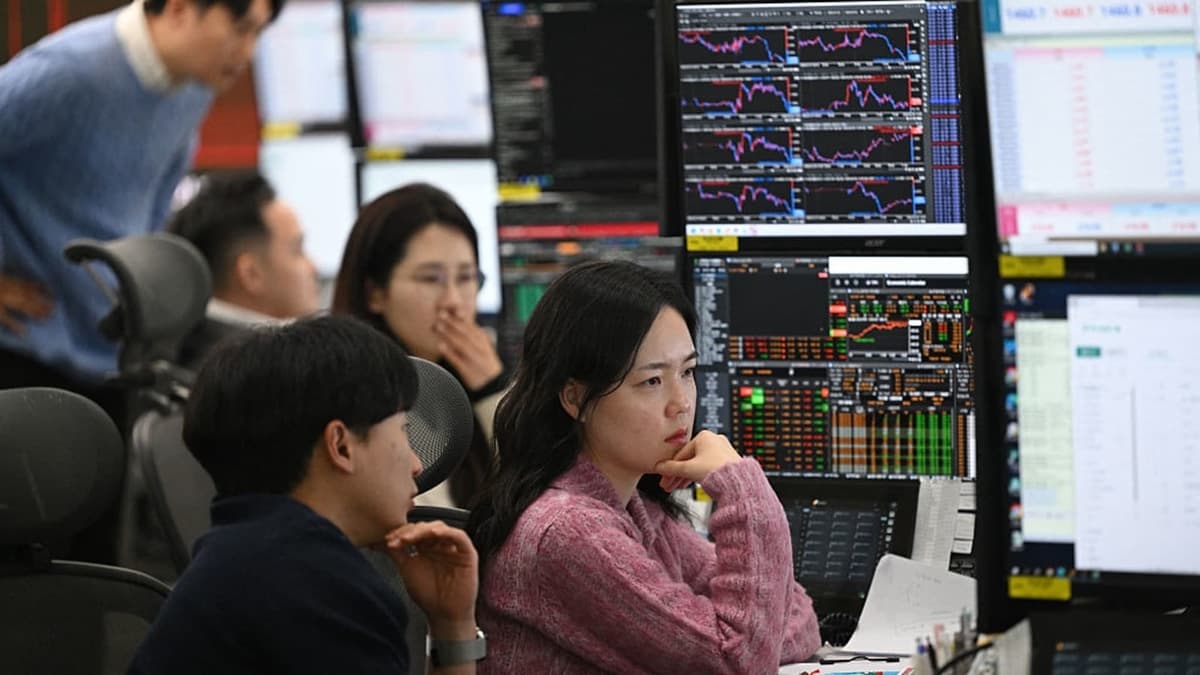
And the variable everyone should watch together is timing. This mega-listing is proceeding at the exact moment chip stocks are falling despite Samsung's earnings surprise, with the AI-overheating debate running hot. If the listing gets absorbed smoothly, it becomes powerful evidence that "the AI cycle is still very much alive." If it wobbles, it could become a symbol of "AI rally fatigue." Either way, SKHY's first trading day will be a litmus test for the temperature of the entire AI industry.
🥄 Three Things You're Probably Wondering
— So what does this mean for me? If you follow AI stocks, you can now buy SK Hynix directly on Nasdaq under SKHY. It opens one more path to bet not on the GPU (like Nvidia) but on the memory bolted next to it. That said, early volatility is real and the AI-valuation debate is loud right now, so whether to buy today is too early to call.
— Why now, of all times? Because HBM demand is exploding faster than the company can handle. Meeting the orders Nvidia and Google are lined up for requires astronomical spending on fabs and EUV tools, and SK Hynix wants to raise it all at once in the deepest capital market in the world. There's also a calculation that with the AI boom near its peak, this is the moment to fetch the highest valuation.
— Is it ahead of Samsung and Micron? In the HBM race, yes — SK Hynix got Nvidia qualification first and leads there. This big raise widens its room to pull ahead on expansion speed too. But Samsung is countering with a turnkey strategy and Micron with its geopolitical edge, so whether that lead holds is something to watch over the next few years.
Sources
- Reuters — South Korea's SK Hynix launching $28 billion US listing
- SEC EDGAR — SK hynix Inc. Form F-1 (SKHY)
- CNBC — SK Hynix plans $29 billion Nasdaq ADR listing
- Investing.com — SK Hynix launches $28 billion US listing, draws $7 billion interest
Numbers and criteria are as of announcement and may change. Investment calls are yours to make!