In the Same Week Chip Stocks Wobbled, TSMC Dropped a Report From a Different Planet
Here's the deal: on July 16, right as the global semiconductor market was getting a little nervous, Taiwan's TSMC posted its second-quarter 2026 numbers — and it was, frankly, playing a different game than everyone else. Net income jumped 77.4% from a year earlier to an all-time record. That's the fifth consecutive record quarter. The result didn't just "look good," it blew past the analyst consensus of roughly NT$632.6 billion in net income, demolishing expectations rather than merely beating them.
The context makes it more dramatic. That week, the market was genuinely spooked about chip names. Intel was still struggling to make its foundry business work, and Samsung was weighing on the sector with worries about advanced-node yields and customer wins. So when TSMC walked in with hard proof that AI demand wasn't cooling — it was getting hotter — this wasn't just an earnings beat. It read like a verdict on the entire AI cycle.
And the real symbol of this quarter was a single line item: the first revenue from the 2-nanometer process. The 2nm node, which entered volume production in Q4 2025, contributed 3% of wafer revenue for the first time in Q2 2026. Three percent sounds tiny, right? But it's the signal that "the most expensive, most advanced process TSMC makes has started printing money" — the trigger that tells you where the growth curve heads next. Let me walk through why this is a board-shifting event, one piece at a time.
The Players — TSMC, and the AI Whales Standing Behind It
TSMC (Taiwan Semiconductor Manufacturing Company) is the world's largest contract chip manufacturer, or "foundry." In plain terms: companies like Apple, Nvidia, AMD, and Qualcomm say "we'll do the design, you actually build the chips," and TSMC etches those designs onto real silicon wafers. On leading-edge nodes (7nm and below) it holds a position close to a monopoly, which means in the age of AI silicon, TSMC effectively controls the bottleneck on the world's computing capacity.
What makes this company scary isn't just its size — it's its position. Nvidia's GPUs at the front line of the AI boom, Google's TPUs, AMD's MI series, and the custom AI chips from hyperscalers like Amazon, Microsoft, and Meta — all of it ultimately rolls out of TSMC's fabs. So when money pours into AI data centers, a big chunk of that money ends up flowing straight into TSMC's revenue. This quarter, 66% of revenue came from the HPC (high-performance computing) platform, which shows exactly that dynamic. Smartphones used to be TSMC's bread and butter; AI has now completely taken that seat.
CEO C.C. Wei offered an intriguing framing on the earnings call. He argued that the "shift from generative AI to agentic AI" is pushing compute demand up another notch. Move beyond generative AI — the ask-once, answer-once chatbot model — to agentic AI, which reasons through multiple steps, uses tools, and completes tasks on your behalf, and the required compute explodes. Wei even said agentic AI is "bringing CPUs back into a larger role" in the data center. It's not just GPUs selling; demand for silicon across the board is rising.
One more line worth flagging. Wei said it will "take a long time" to meet customer demand. For a foundry CEO, that's about the strongest expression of confidence there is — it means demand is outrunning supply, and even the fabs already built can't absorb all the orders. That's why TSMC raised its full-year capital-expenditure plan from a prior $52–56 billion to $60–64 billion. It's willing to pour even more money in to capture this demand.
The Core Story — By the Numbers, This Is Just Domination
Let's line up the facts. For Q2 2026 (ended June 30), TSMC posted revenue of NT$1,270.38 billion, or $40.20 billion — up 36.0% year over year and 12.0% quarter over quarter. Net income came in at NT$706.56 billion, a 77.4% year-over-year surge, an all-time high and the fifth consecutive record quarter. Diluted EPS was NT$27.25 (US$4.31 per ADR).
The profitability metrics are the truly scary part. Gross margin of 67.7%, operating margin of 60.3%, net profit margin of 55.6%. For a chip manufacturer to run margins like that is almost software-company territory — more than half of every dollar of revenue drops to net profit. It works because TSMC effectively monopolizes the leading edge, so it has pricing power, and AI customers are in a "we'll pay whatever, just give us volume" posture.
Break it down by node and the trend is clear. Advanced processes at 7nm and below made up 77% of wafer revenue: 5nm at 33%, 3nm at 30%, 7nm at 11%, and the newcomer 2nm at 3%. The 2nm node started volume production in Q4 2025, making Q2 2026 effectively its first full quarter of revenue — and it opened at 3% right out of the gate. By platform, HPC was 66% (up 20% quarter over quarter in revenue) and smartphones were 22% (down 4%), the classic AI-cycle shape where AI pushes and mobile softens.
| Metric | Q2 2026 Actual | YoY | QoQ |
|---|---|---|---|
| Revenue (NT$) | 1,270.38 bn | +36.0% | +12.0% |
| Revenue (US$) | $40.20 bn | +33.7% | +12.0% |
| Net income (NT$) | 706.56 bn | +77.4% | +23.4% |
| Diluted EPS | NT$27.25 (US$4.31/ADR) | +77.4% | — |
| Gross margin | 67.7% | — | — |
| 2nm share of wafer revenue | 3% (first revenue) | new | new |
| HPC platform share | 66% | — | +20% (revenue) |
And the forward guidance hit harder than the actuals. TSMC guided Q3 2026 revenue to $44.6–45.8 billion, which would set yet another record. It raised its full-year revenue growth outlook from a prior "above 30%" to "slightly above 40%" in U.S. dollar terms. Bloomberg summed it up as TSMC lifting both its sales and spending outlook to catch the AI "megatrend." One honest caveat, though: the company admitted the 2nm ramp will dilute gross margin by about 3–4 percentage points going forward, because a brand-new node runs high costs until yields improve. TSMC's position is that strong demand and cost improvements partly offset that drag.
Who Won From This Print
TSMC itself won biggest — not just because it made a lot of money, but because it now holds a counterargument to the "AI-demand-has-peaked" thesis. There's been a persistent worry that AI capex is about to overheat and correct, and by actually raising its full-year outlook, TSMC nailed down the message that supply still can't keep up with demand. That hardens its pricing power and customer lock-in.
Nvidia and the other AI chip designers win indirectly. TSMC lifting capex to $60–64 billion means more leading-edge wafers and CoWoS (advanced packaging) capacity coming online. One of the biggest bottlenecks on Nvidia GPUs right now is precisely that advanced-packaging capacity. When TSMC says it'll build more fabs, that means the total number of chips Nvidia and AMD can sell goes up — so the whole AI ecosystem gets some breathing room.
Taiwan the country, and shareholders are winners too. TSMC is a core pillar of Taiwan's GDP and exports, so this print is also a read on the health of the Taiwanese economy. And for shareholders, a company running a 55.6% net margin just declared it expects to grow more than 40% for the year — the long-term growth story stays intact. That said, the stock actually slipped about 1.5% in after-hours trading right after the report — the classic "so good that expectations were already fully priced in" hangover at the highs.
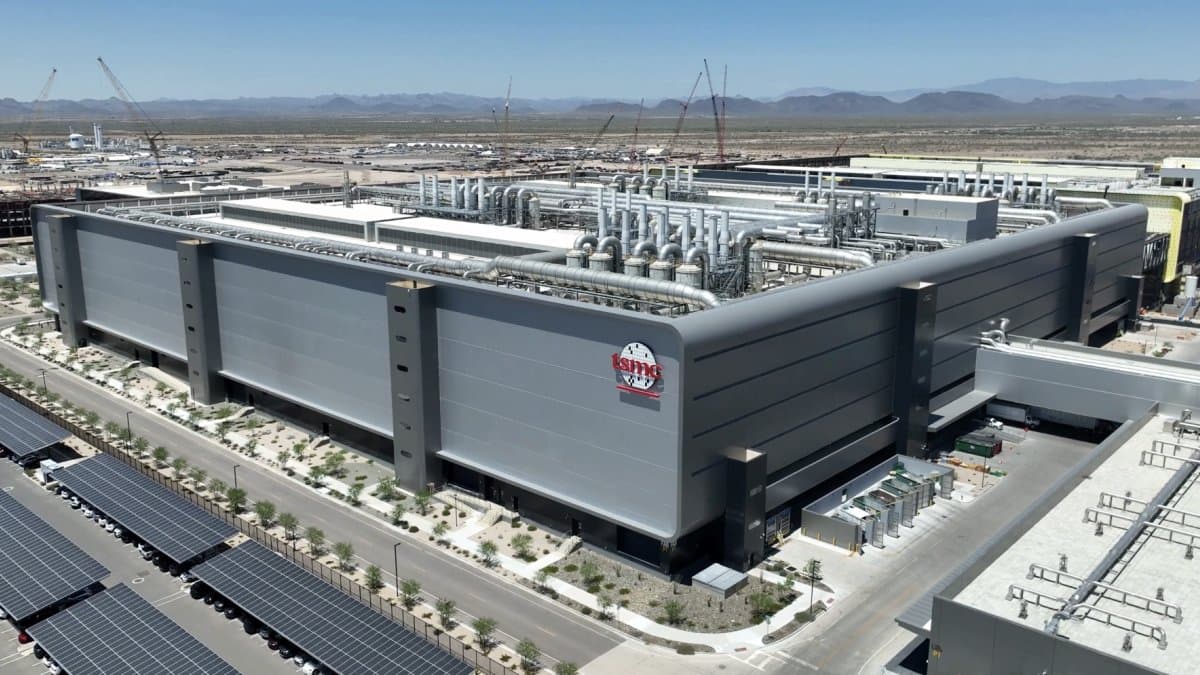
The U.S. (Arizona) is a quiet beneficiary. Wei said the Arizona investment funds would go toward 2nm mass-production fabs and advanced packaging facilities. Expanding TSMC's leading-edge production on U.S. soil dovetails with America's chip-independence strategy, so it carries political weight too — the U.S. gains another square in the "silicon sovereignty" game of the AI era.
Historical Echoes — The Fork Between Success and Failure
We've seen a scene like this before: the 2017–2018 crypto-mining boom. Back then, GPU and chip demand exploded, and earnings at Nvidia and TSMC shot up. But mining demand was "fake demand" tethered to coin prices, and when the crypto market collapsed in late 2018, chip demand cratered with it and related stocks got cut in half. The lesson: whether an explosive surge in demand is structural or one-off is the whole game. TSMC's emphasis on the "generative-to-agentic AI shift" is precisely a move to convince the market that this demand isn't a one-off but keeps growing structurally.
For the success case, look at the post-COVID semiconductor super-cycle of 2020–2021. Remote work and cloud demand exploded, and TSMC rode the wave perfectly, pushing hard on leading-edge investment. That pre-emptive spending translated directly into today's dominance in the AI era. In other words, TSMC itself proved that "whoever spends on capex without flinching when demand is hot eats the next cycle." This latest capex hike is exactly that playbook again.
The painful failure cases sit on the competitors' side. Intel was once the world's premier chipmaker, but it stumbled repeatedly on the 10nm and 7nm transitions and handed leading-edge leadership entirely to TSMC. Its foundry push has been sluggish, and this very week Intel's weakness dragged down sentiment across chip stocks. It's living proof of how long it takes to catch up once you lose technology leadership.
Then there's Samsung. Samsung is a powerhouse in memory but has struggled in foundry with advanced-node yields and landing large customers. It announced GAA-based 3nm volume production ahead of TSMC, yet has had a hard time actually locking in big clients. It's a case study in how being first to ship a technology and actually making money from it are completely different problems — a sharp contrast to TSMC "quietly, reliably" booking its first 2nm revenue.
Competitor Counter-Play — How Do Samsung and Intel Fight Back?
Samsung's counter ultimately comes down to real-world results from its 2nm GAA process. Samsung bet on adopting gate-all-around transistors early to catch TSMC at the leading edge. The problem is yield. Shipping an advanced node "first" isn't enough; you need the yield and reliability strong enough that mega-customers like Nvidia and Qualcomm actually trust you with volume. For Samsung, red-hot AI demand is actually the opportunity — if TSMC's capacity falls short and overflow orders spill over, Samsung could catch them and use that as a foothold to claw back foundry share. But judging by this week's market reaction, investors aren't yet convinced Samsung's foundry is turning the corner.
Intel's counter is a combination of "landing external foundry customers + leaning on U.S. policy support." Intel is pushing its 18A (1.8nm-class) process to grow an external-customer foundry business and positioning itself as the top beneficiary of U.S. chip-independence and reshoring policy. But Intel's fundamental problem is execution. The roadmaps always looked dazzling, but real production timelines and yields kept tripping it up. TSMC stepping up to build 2nm fabs in Arizona can be read as a move to neutralize even Intel's "made-in-America advanced chips" card head-on.
The hyperscalers' custom-silicon strategy is a kind of counter-play too. Google (TPU), Amazon (Trainium, Inferentia), Microsoft (Maia), and Meta are designing their own AI chips to reduce their dependence on Nvidia. But here's the fun part: those custom chips are, for the most part, also built at TSMC. So the hyperscalers' "de-Nvidia" push ironically feeds into TSMC's customer diversification. Even the moves meant to check Nvidia turn into revenue for TSMC.
This is where TSMC's real moat becomes visible. Competitors try to counter from different angles, but the physical manufacturing of those counters largely circles back to TSMC. In the AI chip war, no matter who wins, the arms dealer selling the bullets — the leading-edge wafers — is still TSMC. This print re-confirmed, in hard numbers, that this structure won't crack in the short term.
So What Actually Changes
If you're a developer or engineer — TSMC's capex hike ($60–64 billion) and record Q3 guidance are a signal that "the supply of AI compute keeps expanding." As the GPU and advanced-packaging bottlenecks ease, securing cloud GPU capacity may loosen up a bit. Wei's line that "agentic AI also lifts CPU demand" is a hint that AI workloads are moving from a single GPU bottleneck to a composite-infrastructure game tangled up with CPU, memory, and networking — worth keeping in mind when you design agent architectures.
If you're an investor — the real message here is less "the results" and more "the guidance raise." Lifting full-year growth from the 30s into the 40s is the crux. But don't forget the stock slipped about 1.5% after-hours. Even great results can fail to move a stock if expectations are already fully baked in. Also weigh that the 2nm ramp dilutes margin by 3–4 points, and that the fundamental debate over whether AI demand is structural or one-off isn't fully settled.
If you're a business decision-maker — this print shows where the base cost of AI infrastructure gets decided. The bottleneck is leading-edge wafer supply, and TSMC holds the price and the volume. When you build an AI adoption roadmap, it's safe to assume "compute unit costs may not fall easily for a while." At least until 2nm scales broadly and yields stabilize, the cost burden of premium nodes is likely to persist.
If you're a general user — you won't feel it immediately. But zoom out: the heart of the data centers running the chatbots, AI apps, and recommendation services you use is exactly these TSMC chips. When this company says it "can't keep up with demand," it means AI services will keep getting heavier and more sophisticated. Conversely, if something in this supply chain (including Taiwan geopolitical risk) shakes, the world's AI services could all catch a cold at once.
🥄 Three Things You're Probably Wondering
— So what does this mean for me? It looks unrelated, but nearly every AI service you use runs on this company's chips at the bottom of the stack. If TSMC says it "can't keep up with demand," AI keeps growing — and if the supply chain shakes, the price and speed of AI services shake with it.
— Isn't 3% of revenue from 2nm basically nothing? On the number alone, it's small. But the point is it hit 3% in its first full quarter. If it tracks the growth curve 3nm walked, it could reach double digits within a few quarters. That said, it eats 3–4 points of margin early on, so it's too soon to call it a pure win.
— If AI is a bubble, isn't this print a mirage too? That debate isn't over. TSMC insisting demand is structural by leaning on the "agentic AI shift" is real, but whether it truly lasts has to be proven by the hyperscalers' actual return on investment. Too early to call.
Sources
- TSMC Official Press Release — Q2 EPS of NT$27.25
- SEC Form 6-K — TSMC 2Q26 results and guidance (primary filing)
- Bloomberg — TSMC Hikes Sales, Spending Outlook to Catch AI 'Megatrend'
- Investing.com (Reuters) — TSMC Q2 profit jumps 77% to record
- Investing.com — TSMC earnings call transcript: 2026 outlook lifted
- DIGITIMES — TSMC 2Q26 profit surges 77% on AI demand, first 2nm revenue
Numbers and criteria are as of announcement and may change. Investment calls are yours to make!