Two months from first pilot to robots pulling 8-hour shifts on a real car line
On July 15, a startup based in Cambridge, Massachusetts stepped out of stealth mode and landed a quiet but heavy punch on the robotics world. The name is Walden Robotics. It closed a $300 million seed round, and its valuation jumped straight to $1.1 billion — meaning a company that just introduced itself to the world was already a unicorn out of the gate.
But the part of this news that actually makes your eyes widen isn't the money. It's that Walden's general-purpose robots have been doing real production work at a North American Toyota plant since February. Not a demo reel, not a staged showcase — actual robots pulling 8-hour shifts alongside human teams on a line where real cars get built. The time from first pilot to real deployment? Under two months.
The robot-startup space has been drowning in flashy demos and "coming soon" promises for years. Walden flipped the script. Instead of hyping first and deploying later, it quietly deployed first and then went public. Let's unpack why this is a bigger deal for the robotics and AI world than the headline number suggests.
Who they are — a team that walked straight out of Toyota's lab
Walden Robotics was founded in 2026, so it's new — but its roots are anything but. The company spun out of Toyota Research Institute (TRI) in January 2026. TRI is Toyota's US-based AI and robotics lab, a place that's done world-class work in autonomous driving and robot learning.
The founding team is the company's real asset. CEO and co-founder Russ Tedrake is an MIT professor — the university's Toyota Professor of electrical engineering and computer science — who spent nearly a decade at TRI as SVP of Large Behavior Models. His long-running research obsession has been building AI that lets robots operate in the real world without direct human control. The rest of the founding lineup is no lightweight either. Head of hardware Andy Marchese spent more than a decade at Amazon Robotics. Head of software Joe Romano came from Berkshire Grey and Kiva Systems. Chief product officer Dave Johnson worked at Draper Labs and the Cambridge robotics startup Dexai. In short, it's a squad of physical-AI veterans pulled from MIT, Toyota, Amazon, and Stanford.
The investor lineup tells you how much weight this company carries. The $300 million seed round was co-led by Toyota Motor Corp. and Deviation Capital, with Toyota's strategic-investment and early-stage venture arms (Toyota Ventures and others) joining in. On top of that came Nvidia, Boeing, Samsung Ventures, AE Ventures, CoreWeave Ventures, Prologis Ventures, and Menlo Ventures, among others. Semiconductors (Nvidia), aerospace (Boeing), electronics (Samsung), logistics real estate (Prologis), cloud (CoreWeave) — the heavyweights of every industry a robot might walk into are on the cap table. That's not just capital; it's effectively a list of prospective customers who each want to try this robot on their own floor.
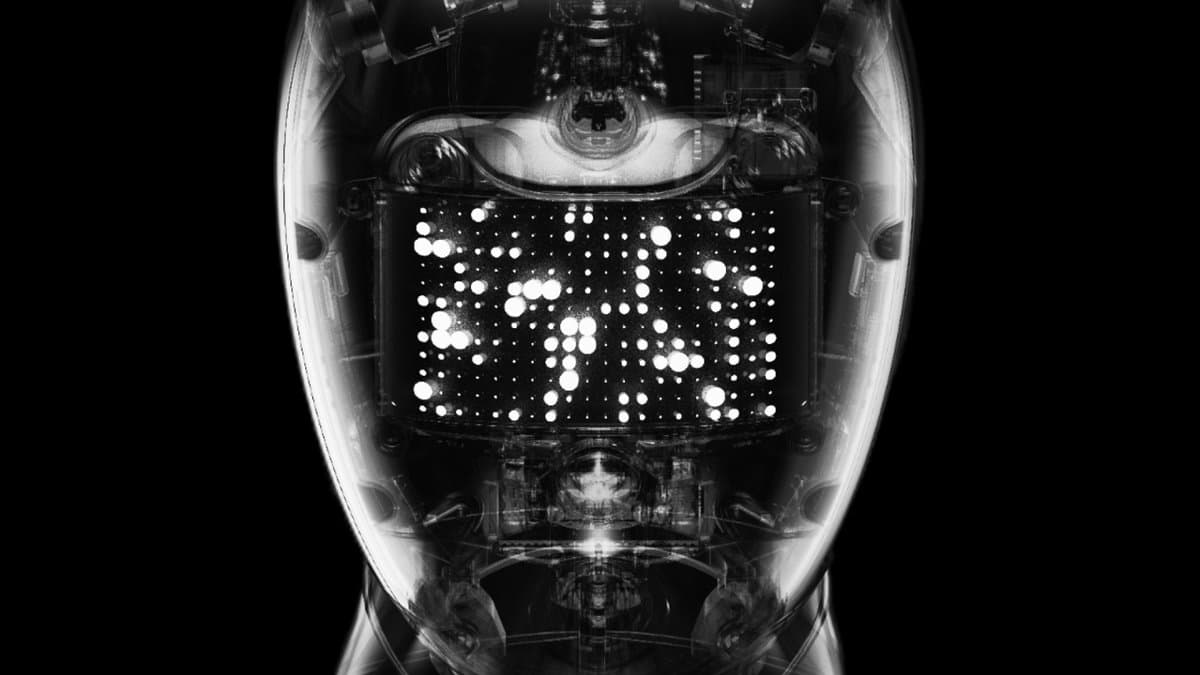
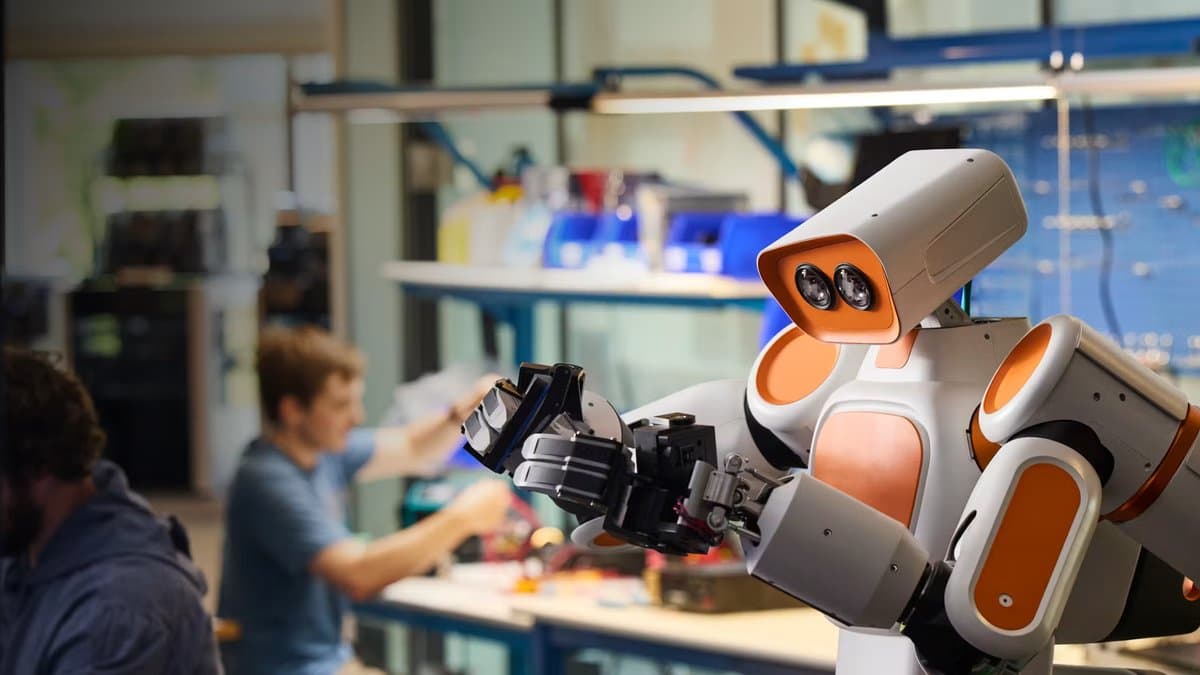
One thing worth clarifying up front. Walden's robot isn't the walking, two-legged humanoid you probably picture. The upper half is human-shaped, with two arms and a head carrying two eye-like sensors — but the lower half swaps legs for a wheeled mobile base. Tedrake said of the bright orange-and-white machine that not having legs "makes it easier to certify for safety in factories." The design philosophy — pick deployment over spectacle — shows up right here.
The core of it — not a demo, but a robot that's already working
Let's get to the heart of it. What Walden builds isn't a single-task specialty robot but a general-purpose robot that learns multiple tasks and improves on its own. The company calls its physical-world AI models "Large Behavior Models." As the name hints, think of it as the robot equivalent of the large language models (LLMs) that handle text. The goal is to let a robot keep learning and getting better while it works in real environments.
And these robots are, at this very moment, doing real production work at a North American Toyota plant. They've been deployed since February, and the jobs are concrete — moving car parts, cleaning machinery, kitting assembly parts, machine tending, tool setting, and parts prep. The key detail is that they share the same floor as human teams and pull 8-hour shifts. This ranks among the earliest large-scale commercial deployments in robot-startup history.
What's genuinely striking is the speed. From first pilot to real production took less than two months. In robotics, that's almost unheard of. Bolting a new robot onto a factory line usually takes months to years for safety validation, line redesign, and worker retraining. Walden pulling it off in under two months is real-world proof that the Large Behavior Model approach adapts to new tasks far faster than the traditional method of programming each task by hand.
| Item | Detail |
|---|---|
| Round | Seed round |
| Raised | $300 million |
| Valuation | $1.1 billion (unicorn) |
| Co-led by | Toyota Motor Corp. · Deviation Capital |
| Key participants | Nvidia · Boeing · Samsung Ventures · CoreWeave · Prologis · Menlo Ventures |
| HQ | Cambridge, Massachusetts, USA |
| Robot form | Semi-humanoid (two arms + head, wheeled base, no legs) |
| AI approach | Large Behavior Models |
| Deployment | North American Toyota plant, real production since Feb 2026 |
Laid out on a timeline, the pace gets even more dramatic. January 2026: spun out of TRI → February 2026: starts real deployment at a North American Toyota plant → July 15, 2026: official launch with a $300 million seed. That's spinout to unicorn in exactly six months. Worth noting: the company's own release also refers to the round as a "Series A," but Bloomberg and other major outlets — and the launch's central message — frame it as a large seed-stage raise unveiled alongside the stealth exit. Whatever you call it, the essence is the same: $300 million piled into a company that just appeared.
Who wins — the payoff for each player
Toyota sits in the most strategic spot. It isn't just an investor — it's the customer and test bed where the robot actually works, and, via TRI, the parent that seeded the underlying tech. Car manufacturing is labor-intensive and squeezed by aging workforces and labor shortages, so if a general-purpose robot genuinely earns its keep on the line, Toyota gets a double win: higher productivity in its own plants and a rising equity stake in the robot company. Spinning tech out of a lab, growing it as a startup, then bringing it back onto your own floor is a textbook version of the "spin out, then re-adopt" playbook big corporations love right now.
Nvidia is a clear winner too. General-purpose robots are a flagship "Physical AI" domain that demands massive real-time compute. The more robots there are, the more demand there is for Nvidia's robotics chips and simulation platforms. Nvidia investing directly in a promising bet like Walden is a way to pre-plant the robot ecosystem its hardware will run on. The same logic applies to Boeing (aerospace manufacturing), Samsung (electronics), and Prologis (logistics warehouses) — each represents latent demand saying, "our floor needs this robot too."
Investors bet that robotics and physical AI are the next big theme. For the past few years, capital piled into software-style generative AI; now the center of gravity is shifting toward "AI that uses a body in the real world." A company like Walden, which already has evidence of live deployment and revenue, inevitably commands a premium in this shift. That's why a seed-stage company got tagged with a $1.1 billion valuation.
Manufacturing broadly is a quiet beneficiary. Advanced-economy manufacturing suffers chronic labor shortages. If general-purpose robots can fill the dangerous, repetitive, undesirable jobs people avoid, the door to automation opens even for the high-mix, low-volume lines that were hard to automate before. If Walden proves this out at Toyota, that reference becomes a powerful adoption case for other manufacturers.
Past parallels — the wins and losses of humanoid and general-purpose robots
To understand this field, look at the companies that walked ahead. The headline name is Figure AI. Figure became a symbol of the space, pulling in enormous valuations and funding for its humanoid robots. It grabbed attention with pilots like the one at a BMW plant, but skepticism always trailed it: "a demo and real large-scale commercial deployment are very different things." Walden drove straight at that exact gap — showing deployment before hype.
1X Technologies belongs in the picture too. Backed by OpenAI, 1X pushed humanoids for home and commercial use, drawing notice for its soft, human-friendly design direction. It too faced the core question: when does it actually do useful work at scale? That's the shared homework of general-purpose robot startups — plenty of impressive demos, rare deployments that earn their keep eight hours a day.
The archetype of success sits somewhere a little different: Boston Dynamics. The company spent decades showing off the world's best robot athleticism (the backflipping Atlas, and so on), but the money actually came not from the flashy humanoid but from Spot, its four-legged robot, and the warehouse-focused Stretch. The lesson: it's not the "coolest robot" that makes money, it's the "robot that's genuinely useful on the floor." Walden dropping legs for a wheeled base and prioritizing safety certification is a direct extension of that lesson.
There's a cautionary tale too. Kiva Systems (now Amazon Robotics), acquired by Amazon, is a huge logistics-automation success — but that was a specialty robot optimized to the extreme for one fixed job (moving shelves). Making a "do-anything" general-purpose robot actually earn its keep on a real floor is a far harder problem, and most startups have collapsed at exactly that point. If it's true that Walden is handling multiple tasks in a live Toyota plant, it has cracked open that hard door. That said, whether "success at one pilot" scales to "rollout across dozens of plants" remains an unproven piece of homework.
Rivals' counter-play — how Figure, Optimus, 1X, and Physical Intelligence hit back
Figure AI's counter ultimately comes down to competing on deployment numbers. Now that Walden has played the "we're already live at Toyota" card, Figure faces pressure to more aggressively disclose real uptime data and deployment scale at its own partner plants. Brand recognition and the humanoid-hardware polish it has built up are Figure's strengths — but the era has arrived where you have to answer "how many robots are earning their keep every day?" with actual numbers.
Tesla Optimus's counter is economies of scale and vertical integration. Tesla owns a giant test bed in its own car plants, mass-production muscle, and its AI-chip and self-driving stack. If Optimus starts working broadly across Tesla factories, it collides head-on with Walden's "deployed in a Toyota plant" story. This setup — a carmaker putting its own robot in its own factory — also takes on the flavor of a proxy war between Toyota and Tesla.
The 1X and Physical Intelligence counter is the universality of the AI model. Physical Intelligence in particular has drawn attention for a software-centric approach aimed at "one foundation model for every robot" — a philosophy that squares off directly against Walden's Large Behavior Models. The thing to watch: does Walden's vertically integrated approach — building the hardware too and going deep on specific floors — win, or does the horizontal approach of selling a general-purpose brain that drops onto many robots? It's the Android-vs-iOS showdown of robot AI, and it's just kicking off.
Here's where Walden's real weapon shows. While most rivals are still stuck at "about to deploy," Walden holds actual data from being "six months into real deployment." Robot AI is a field where real-world data essentially is the skill, so starting to accumulate data in an actual factory before everyone else can turn into a gap that widens over time. Of course, you also have to weigh that rivals with bigger capital and stronger brands can catch up fast.
So what actually changes
If you're a developer or engineer — keep an eye on the concept of "Large Behavior Models." Where LLMs handled text, this is a model that learns and generalizes a robot's physical actions. It signals rising demand for skills like data pipelines, simulation, and real-world fine-tuning in physical AI. It's a live case showing the game shifting from programming a robot task by task to training a model that adapts quickly to new tasks.
If you're a manufacturing or logistics company — this news shakes the assumption that "general-purpose robots are still far off." Two months from pilot to production, one robot handling multiple tasks, 8-hour shifts on the same line as people — if those conditions hold, it's worth seriously evaluating adoption, starting with high-mix low-volume production or labor-strapped processes. That said, this is a single Toyota reference for now, so whether it reproduces on other floors and what the adoption and upkeep costs are still need confirmation.
If you're an investor — this is a strong signal that capital's center of gravity is moving from software generative AI to physical AI. A $1.1 billion seed-stage valuation shows the heat of the theme. But the cautions are clear too — robot startups burn hardware capital heavily, and there's a graveyard of cases where pilot success never scaled. "Already in live deployment" is this company's differentiator, but remember the valuation already prices in a big chunk of future success.
If you're a general user — your life doesn't change tomorrow. But in the big picture, the way the cars and electronics you buy get made is quietly shifting right now. As robots start filling the dangerous, repetitive factory work people avoid, manufacturing costs and supply-chain structures could change over the long run. At the same time, the old question — "are robots replacing human jobs?" — resurfaces. Walden emphasizes a collaboration frame, "working side by side with human teams," but how that balance actually plays out is something to keep watching.
🥄 Three Things You're Probably Wondering
— Isn't this just another robot demo? That's the twist at the heart of this news. Walden reversed the usual order of demo-first, deployment-promised. Its robots have been doing production work in 8-hour shifts at a real Toyota plant since February — and it only went public after getting all that done. Sure, whether "one plant pilot" scales to "dozens of plants" is still unproven, but the starting point is ahead of most rivals.
— Why a half-humanoid with no legs? It chose practicality over spectacle. Tedrake said a legless wheeled base is far easier to certify for safety in factories. Two-legged walking is technically flashy but carries big fall and safety risks and takes long to certify. If deployment is the top priority, the right answer is the form you can run safely on a factory floor today.
— A $1.1B valuation on a $300M seed — isn't that a bubble? That debate is open. A unicorn valuation at seed stage is undeniably aggressive. But it's propped up by real evidence of live deployment and revenue, plus strategic investors like Toyota, Nvidia, and Samsung who double as prospective customers. The real test is done when this robot spreads to floors beyond Toyota and its productivity-per-deployment-cost is proven in numbers. Too early to call.
References
- Walden Robotics official announcement — Launches with $300 Million to Put General-Purpose Robots to Work Today
- Bloomberg — Toyota-Backed Startup Walden Robotics Comes Out of Stealth With $1.1 Billion Valuation
- The Robot Report — Walden Robotics launches at $1.1B valuation for general-purpose robots
- Boston Globe — Boston-area AI startup Walden Robotics raises $300 million
- The Next Web — Walden Robotics launches with $300M, and no legs
Numbers and criteria are as of announcement and may change. Investment calls are yours to make!