The robot that used to phone the cloud now thinks with its own head
July 16, Tokyo. Nvidia introduced a model called Cosmos 3 Edge. Parameter count: 4 billion. By 2026 standards that's tiny — put it next to the trillion-parameter frontier models and it looks almost cute. So why is it news? Because this small model doesn't live in a data center. It's a world model that runs inside the robot's body.
Quick primer on world models, since the term gets thrown around loosely. A world model is a model that has learned a feel for how physical reality behaves. Push that cup at that angle and it tips over. That person walking at that speed will be roughly here in one second. Humans do this prediction unconsciously; a world model is the attempt to make an AI do it deliberately. If a language model predicts the next word, a world model predicts the next scene. For a robot, that's a far more fundamental capability than language will ever be.
Until now, that kind of heavy inference mostly got shipped upstairs. The robot's camera captures a frame, the frame goes over the network, a server crunches it, a command comes back down. On a factory line that round trip is brutal. It adds latency. It means a flaky network makes your robot stupid. And, quietly but importantly, it means footage of the inside of your factory leaves your building. Cosmos 3 Edge is Nvidia declaring the round trip is over. It's built on Nvidia Nemotron, and it's designed so robots and vision AI agents can perceive, reason, and generate actions right there on the machine.
Here's the deal: the venue matters as much as the model. This didn't launch from Santa Clara, and it didn't launch from a GTC keynote stage. It launched in Tokyo. Nvidia is moving to lock in the physical-AI stack the exact same way it locked in the training stack, and the country it picked as its beachhead is Japan. Let's unpack why Japan, and what this actually does to the robotics industry.
The players — the company that locked the training stack now wants the body
Nvidia hardly needs an introduction, but understanding this story requires being honest about how it got where it is. Nvidia didn't become the landlord of the AI era purely by making good GPUs. It put CUDA on top of the GPUs, libraries on top of CUDA, frameworks on top of the libraries, and then pretrained models and dev toolkits on top of those. Whichever layer a researcher chooses to start from, they end up inside Nvidia's stack. The company didn't sell hardware. It paved the entire floor.
What it's attempting now is the same maneuver, replayed in "physical AI." Physical AI means AI that moves a body through real space rather than emitting text inside a screen — robot arms, autonomous vehicles, warehouse logistics bots, factory inspection cameras. That domain has been fragmented forever. Every vendor brought its own sensors, its own controllers, its own software. No standard. And no standard means one thing: nobody has paved the floor yet.
Nvidia's weapon has three layers. First, the model — Cosmos 3 Edge. Second, the hardware — the newly announced Jetson T2000 and T3000 modules. Jetson is Nvidia's long-running embedded AI board line, the "small brain" that gets bolted inside a machine. And Cosmos 3 Edge isn't limited to the new Jetsons; it also runs on RTX GPUs and DGX systems. That means what you build on a dev workstation can drop straight down onto the robot without changing worlds. Third, the ecosystem — the Cosmos Coalition.
And the person selling this picture from the stage is Jensen Huang, Nvidia's founder and CEO. In Tokyo he said: "The next frontier of AI is in the physical world, and this is a once-in-a-generation opportunity for Japan." It reads like a sales line, and it is one — but there's arithmetic underneath it. The country holding more of physical AI's hardware assets than anyone else on earth — robot arms, machine tools, sensors, factories — is Japan.
What actually happened — 4 billion parameters, tuned to your robot in about a day
The most interesting spec in Cosmos 3 Edge isn't its size. It's the adaptation time. Nvidia says developers can tune the model to a specific robot, a specific sensor, or a specific environment in about one day using the open Cosmos framework. That matters because the real bottleneck in robot AI was never raw model quality — it was site fit. Every factory has different lighting. Different conveyor speeds. Different part geometries. Different camera placement. Getting a model to cope with all of that has historically taken weeks to months. Compress that cycle to a day and the adoption economics change shape entirely.
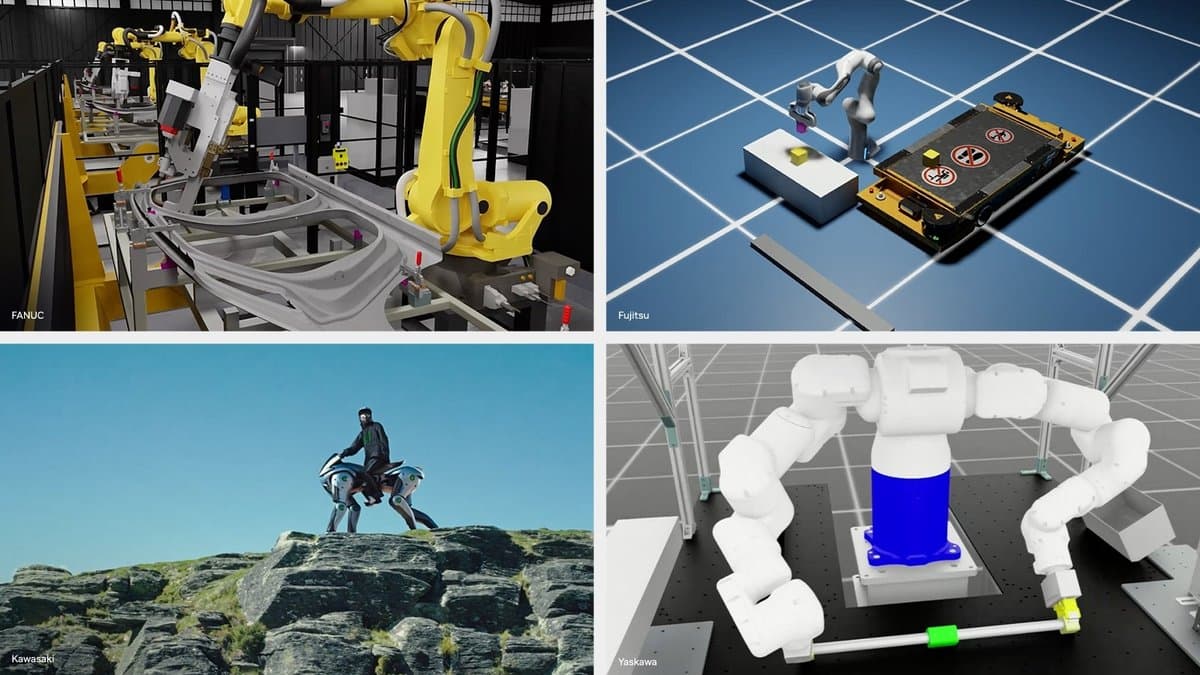
The second axis is the Cosmos Coalition. Nvidia announced that more than 20 Japanese organizations intend to join. Read the names and the weight lands immediately. Fanuc and Yaskawa Electric — two of the top industrial robot makers on the planet. Then Kawasaki Heavy Industries, Sony Group, SoftBank Corp., Fujitsu, Hitachi, NEC, Kubota, Honda R&D, GROOVE X (of Lovot companion-robot fame), Telexistence (the convenience-store shelf-stocking robot company), Enactic, and Toyota-backed Preferred Networks. One caveat worth flagging: that list is a subset, not the full roster in the release. More organizations signaled intent than are named here, so don't read this as exhaustive.
Third, and less flashy but big for practitioners, are the updated Metropolis libraries. Metropolis is Nvidia's toolkit bundle for building vision AI that understands camera feeds, and Nvidia claims this update lets developers build vision AI agents at least 6x faster. Robots aren't the only physical AI. The inspection camera bolted to a factory ceiling and the safety camera at a warehouse door are "physical AI that doesn't move" — and by unit count, they vastly outnumber the robots. Nvidia wants that market pulled into the same stack.
Then, the same day, a separate announcement landed. This one should be kept distinct from the Cosmos 3 Edge launch. Japan's government, industrial leaders, and Nvidia launched what they're calling the world's first national AI infrastructure for physical AI. A company called Noetra Corp. will build an Nvidia Vera Rubin AI factory packing 27,500 Rubin GPUs and 13,750 Vera CPUs, drawing roughly 140 megawatts. That facility underpins METI's FRONTia Project — formally, "Development of Multimodal Foundation Models with a View to AI Robotics and Physical AI." Per reporting, though, the AI factory is slated to come online in 2028. It does not exist today.
Money, briefly. METI's approved subsidy to Noetra for fiscal 2026 is about ¥387.3 billion (roughly $2.4 billion). That's not the whole program — it's the first year of a five-year subsidy plan projected to total around ¥1 trillion (roughly $6.2 billion). Japan has also set a target of capturing more than 30% of the global AI robotics market by 2040, an opportunity Nvidia and partners size at $133 billion. Say it plainly: both of those are projections from Japan and Nvidia, not results.
On the infrastructure deal Huang said: "Japan invented modern manufacturing. Now, it is building the AI factories that will power the next industrial revolution." And at the Tokyo events he added: "Forty years ago was the beginning of the PC revolution. Now, forty years later, instead of a personal computer, you can now have your own personal AI." Also present: Ryosei Akazawa, Japan's Minister of Economy, Trade and Industry, and Takahito Tokita, president and CEO of Fujitsu.
| Item | Detail |
|---|---|
| Announcement | Cosmos 3 Edge |
| Date / place | July 16, 2026 (Tokyo dateline) |
| Model size | 4 billion parameters, built on Nvidia Nemotron |
| Role | On-device vision reasoning + robot policy (action) execution |
| Runs on | Jetson T2000 / T3000 modules (new), RTX GPUs, DGX systems |
| Adaptation | About one day per robot / sensor / environment (open Cosmos framework) |
| Ecosystem | 20+ Japanese organizations intend to join the Cosmos Coalition |
| Names cited | Fanuc · Yaskawa · Kawasaki Heavy Industries · Sony · SoftBank · Fujitsu · Hitachi · NEC · Kubota · Honda R&D · GROOVE X · Telexistence · Enactic · Preferred Networks (partial list) |
| Tooling update | Metropolis libraries — vision AI agents built at least 6x faster (Nvidia's claim) |
| Same day, separate | Noetra's Vera Rubin AI factory — 27,500 Rubin GPUs · 13,750 Vera CPUs · ~140MW · online 2028 |
| National project | METI FRONTia Project, FY2026 subsidy ~¥387.3B (first of a ~¥1T five-year plan) |
| Projections (not results) | Japan targeting 30%+ of global AI robotics by 2040 / $133B opportunity estimate |
One more thing to nail down. Nvidia's release explicitly states that many of the products described "remain in various stages and will be offered on a when-and-if-available basis." Don't read Cosmos 3 Edge or the Jetson T2000/T3000 as things anyone can buy and deploy today. And the coalition companies haven't "joined" — they've stated an intent to join. That gap is bigger than it looks.
What each side gets — why everyone showed up in Tokyo
Nvidia's payoff is the clearest. In training, Nvidia is already effectively a monopoly. But training saturates eventually. The place where inference happens, on the other hand, still has explosive room to grow. Picture a GPU inside every robot arm, every inspection camera, every autonomous logistics cart on earth. Data-center GPUs sell in units of tens of thousands. Edge GPUs sell in units of millions. Cosmos 3 Edge is the software nail that makes sure those millions of units only run comfortably on Nvidia silicon. What CUDA did in the research lab, Cosmos is meant to do on the factory floor.
Japan's manufacturers need this badly. Fanuc, Yaskawa, and Kawasaki are the world's best at the robot body. Precision, durability, service networks — no weak spots. What they haven't kept up with over the last decade is software intelligence. Repeating a programmed path to sub-millimeter tolerance? Best in the world. "Pick up that object you've never seen before"? Weak. Building a foundation model in-house means finding GPUs, talent, and data centers they don't have. When Nvidia says "we'll supply the brain, you bolt it into your robot," that's a hard offer to refuse.
Japan's government is running industrial policy math. Japan lost the language-model race to the US and China by a wide margin, and there's no obvious way to flip that board. Physical AI is different. There, the assets are robots, machine tools, precision sensors, and decades of accumulated factory operations data — and Japan sits at the very top on all of them. So: a national FRONTia program, subsidies poured into the Noetra AI factory, and a publicly declared 30%-by-2040 share target. The strategy is to restart in physical the game that was lost in language.
Robotics startups win quietly too. Telexistence, GROOVE X, and Enactic don't have the balance sheet to train their own foundation models. But if you can take a 4-billion-parameter model and fit it to your robot in a day, the AI gap between you and a conglomerate narrows fast. The price is going deep into Nvidia's stack — but for a startup that has to ship a product this year, that's a tomorrow problem.
Precedents — what worked and what didn't
The obvious success case is CUDA. When it shipped in 2006 it was just "a way to do general computation on a GPU." Nobody thought it would rule the world. But Nvidia stacked libraries on it for over a decade, seeded it into universities, and nudged the field into publishing reproduction code that assumed CUDA. By the time deep learning detonated, researchers physically could not work without it. The moat wasn't a hardware performance gap — it was software inertia, which is far more durable. Rounding up 20-plus Japanese firms into a Cosmos Coalition is best read as the physical-AI remake of that screenplay.
The half-success case is the DRIVE platform in autonomous vehicles. Nvidia has been selling automakers an autonomous-driving compute platform for years and genuinely landed a lot of partners. But full autonomy commercialized far more slowly than anyone forecast, and a big share of those announced partnerships took a long time to turn into production volume. The lesson: there is a multi-year valley between "stated intent to join" and "actually running on the line." Apply that same discount rate to this coalition roster.
There's a near-failure case too. During the mid-2010s IoT boom, several giants rolled out "industrial internet platforms" — connect all the factory equipment, pool the data, do predictive maintenance. Huge partnership announcements followed one after another, national smart-factory programs poured out. The result? A lot of them were quietly wound down or sold off. The reason was simple: factories are far more conservative than outsiders assume, and far more different from one another. Stopping a line costs real money, so nobody installs unproven technology. Nvidia hammering the "about a day" number is a message aimed squarely at that wall.
Worth remembering as well: Japan's earlier national AI programs. In the 1980s Japan poured enormous public budget into the Fifth Generation Computer project, but the technical bet (logic programming) drifted out of step with where the field actually went, and it never converted into industrial results. There are reasons to think this time differs — back then the state was trying to invent a technology from scratch, whereas now Japan is laying its real-world physical assets on top of an already-proven stack. But FRONTia's verdict will be settled by whether the Noetra AI factory actually runs in 2028, and whether the models it produces actually end up on Fanuc's and Yaskawa's lines. Too early to call.
How rivals counter
The most direct counter comes from Qualcomm and the edge-silicon camp. Chips that go inside robots play a different game than data-center GPUs. Power draw, thermals, unit cost, and industrial-grade durability matter as much as raw performance, and this territory is already occupied by companies that survived decades in mobile and embedded. Their pitch writes itself: "Does your robot really need a data-center-class chip? Ours does the job at half the power." Nvidia's answer can't be performance alone — it has to be the software ecosystem, engineering a world where using Cosmos and Metropolis is simply easiest on Nvidia silicon.
The second counter is robot makers building their own models. Nobody knows a robot better than the company that built it. A large manufacturer with the resources to train its own foundation model has every reason to be wary of outsourcing the entire brain to someone else's stack. In an era where intelligence becomes the source of margin, leasing that intelligence from Nvidia sends the value-add somewhere obvious. That coalition participation is still framed as intent rather than membership can fairly be read as a signal that several of these firms are still weighing exactly this.
The third counter is the open-source robotics camp. The trend of releasing robot foundation models as open weights has been building for years, and the logic is Linux's logic: don't lock your intelligence to one vendor, take a public model and fit it to your own hardware. What's interesting is that Nvidia is trying to take that card off the table preemptively. Positioning Cosmos as an open framework, shipping it at a manageable 4 billion parameters, and hammering the one-day adaptation claim all look like moves to absorb the open camp's weapons before they get used.
The fourth is the national counter. Japan staking a national AI infrastructure and a national project on physical AI applies immediate pressure to every other manufacturing power. Countries competing with Japan on robot density and industrial capacity can't avoid the internal debate: "we need a physical-AI national strategy too." And that's where the real thing to watch sits. Do those countries build their own stack, or do they do what Japan did and rent Nvidia's stack to buy speed? Every chapter of AI history so far says the renters moved faster. That's Nvidia's single strongest sales point.
So what actually changes
If you're a developer — the number to watch isn't 4 billion or 27,500. It's "about a day." The actual pain in robotics and vision AI work was never model training; it was site adaptation, the grind of re-collecting data and re-tuning every time the lighting shifts or the parts change. If that loop compresses to a day, your entire workflow reshapes. That said, this is Nvidia's own claim and the thing isn't generally available yet, so keep expectations calibrated until independent benchmarks land. What is clearly true is that now is the moment to get hands-on with the Jetson line and the Cosmos framework.
If you're an investor — the story here isn't revenue, it's market structure. Nvidia is pivoting its angle of attack from training GPUs (a tens-of-thousands-of-units market) toward edge inference (a millions-of-units market), and it's laying the software lock along the approach road before the traffic arrives. Weigh the risks in the same breath: the coalition is at the intent stage, the Noetra AI factory is slated for 2028, and the $133 billion and 30%-share figures are projections, not results. Also remember that physical AI runs on longer cycles than software. The gap from announcement to revenue can be years.
If you're a regular user — nothing changes for you this week. But the direction is worth knowing. Most robot intelligence today lives in the cloud, which is why a dropped network makes a robot dumb. When a model like Cosmos 3 Edge moves inside the machine, the robot can judge offline, react faster, and needs to ship less store or factory footage outside the building. If the shelf-stocking robot at your convenience store or the bot in a logistics warehouse feels noticeably smoother a few years from now, this shift to on-device world models is the root cause.
🥄 Three Things You're Probably Wondering
— So what does this mean for me? Right now, nothing directly. But the responsiveness and flexibility of the robots you run into at stores, factories, and delivery hubs is likely to change over the next few years. When intelligence drops from the cloud into the robot's body, latency disappears — and the store footage with your face in it may no longer need to leave the building.
— Isn't 4 billion parameters way too small to do anything useful? Small by language-model standards, sure, but reasoning about physical reality isn't an encyclopedia-knowledge task. You don't need trillions of parameters to know that pushing that thing makes it fall. If anything, it has to be small to fit inside a robot. How much messy real-world complexity it can actually handle at this size is a question only independent testing will answer. Too early to declare.
— Will Japan really own 30% of the robotics market in 2040? That's a target and a projection from Japan's government and Nvidia, not a settled future. Japan's strength in robot hardware and factory data is real, but the centerpiece of the national infrastructure — the Noetra AI factory — isn't slated to run until 2028, and the coalition members are still at the intent stage. The commitment is serious. Calling the outcome is premature.
Sources
- Japan's Robotics and Manufacturing Leaders Build on NVIDIA Cosmos to Advance Physical AI Frontier — NVIDIA Newsroom
- Japan Government, Industrial Leaders and NVIDIA Launch the World's First National AI Infrastructure — NVIDIA Newsroom
- NVIDIA and Japan Bring Full-Stack AI and Robotics to Every Industry — NVIDIA Blog
- Nvidia unveils new AI model and expands Japan's physical AI ecosystem — CNBC
- Nvidia launches Cosmos 3 Edge model and expands its physical AI push in Japan — SiliconANGLE
- Japan's Robotics and Manufacturing Leaders Build on NVIDIA Cosmos to Advance Physical AI Frontier — GlobeNewswire (full press release text)
- Japan Government, Industrial Leaders and NVIDIA Launch the World's First National AI Infrastructure — NVIDIA Investor Relations
Numbers are as of announcement and may change.