The crown changed hands for about an hour, and that hour was the whole story
Friday, July 17, 2026. Somewhere in the first stretch of the New York trading session, Apple's market capitalization ticked above Nvidia's and, for the first time since April 2025, Apple was the most valuable company on earth. Reuters clocked it at 9:28 AM Eastern: Apple around $4.88 trillion with the stock roughly flat, Nvidia around $4.86 trillion after sliding about 3.5%. Headlines fired everywhere within minutes.
Here's the deal, though: it didn't hold. Nvidia's 3.5% drop was an early-morning print, not a closing number. Forbes reported Nvidia fell as much as 3.9% shortly after the open — knocking its value down to roughly $4.82 trillion — and then clawed most of it back. By the closing bell, per Fox Business, the scoreboard read Nvidia $4.92 trillion, Apple $4.89 trillion. Apple finished up 0.14% (+$0.48). Nvidia finished down 2.21% (-$4.59). Nvidia went home still wearing the crown.
So if you read a headline on Friday saying Apple "reclaimed" the title, gently correct it. The accurate verb is briefly overtook. Apple traded past Nvidia intraday, held it for part of a session, and gave it back before the close. One more caveat before we go further: exact market caps differ by a few tens of billions of dollars across outlets depending on the timestamp and the share-count assumption used, so treat every number here as approximate rather than a ledger entry.
And yet — this is not a nothing story. A one-day intraday flip between two companies separated by 0.6% of value is statistically noise. What isn't noise is why the flip was even close enough to happen. Nvidia has shed roughly $1 trillion in market value since peaking on May 14, 2026, down about 16-17% from its high. Apple is up about 23% year to date. Two of the biggest companies in history swapped roughly a trillion dollars of relative value in ten weeks, and the market is loudly rethinking what an AI-exposed company is actually worth. Let's dig into that.
The two companies, and the two completely different AI bets they made
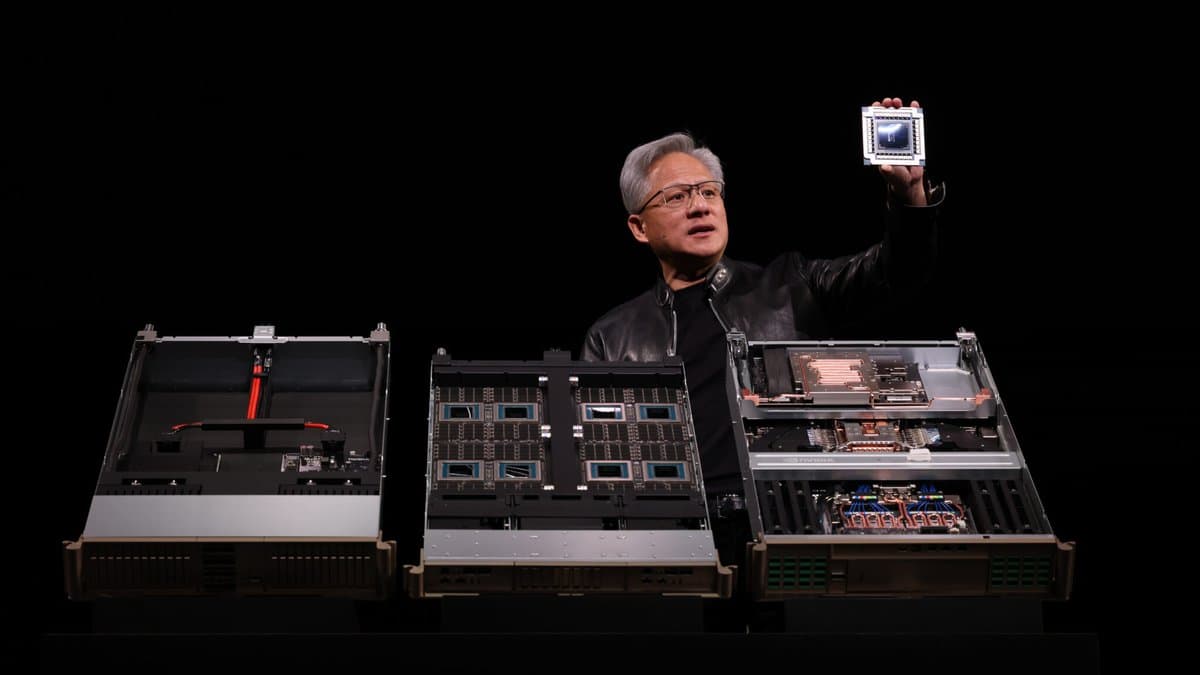
Nvidia needs no setup. It is the company that built the shovel every AI gold rush participant is required to buy. It passed Apple in June 2024 to become the second-most-valuable company on earth, grabbed the top spot two weeks later, and in October 2025 became the first company in history to cross $5 trillion. It held the number-one slot for the better part of a year. Its business model is beautifully simple and terrifyingly concentrated: hyperscalers, sovereign AI programs and neoclouds spend enormous sums on AI infrastructure, and a very large fraction of that spend converts into Nvidia revenue. When capex expectations rise, Nvidia rises. When capex expectations wobble, Nvidia wobbles harder than anything else.
Apple spent the last three years being written off as the Magnificent Seven's AI laggard. It didn't train a frontier model. It didn't announce a hundred-billion-dollar data center program. Its Siri overhaul slipped so many times it became a running joke. And then, in a market that had spent two years paying up for AI capital intensity, the absence of AI capital intensity quietly turned into a feature.
Apple finally shipped the thing in June 2026. Unveiled at WWDC 2026 at Apple Park, "Siri AI" launched alongside iOS 27, iPadOS 27 and macOS 27 "Golden Gate." The interesting part is the architecture: Siri AI runs on a custom Google Gemini foundation model — reported at roughly 1.2 trillion parameters — executing through Apple's Private Cloud Compute. CNBC first reported the Gemini arrangement on January 12, 2026, and Google confirmed it in April 2026. The frequently cited figure that Apple pays Google around $1 billion a year for that model is press reporting, not confirmed by either company — treat it as a well-sourced estimate, not a disclosed contract term. Siri AI launched in English first and, for regulatory reasons, is not available at launch in the EU or China.
There's a leadership story running underneath all of this too. On April 20, 2026, Apple announced that Tim Cook (65) becomes executive chairman and John Ternus (50) — SVP of Hardware Engineering, a 25-year Apple veteran — becomes CEO effective September 1, 2026. That's the first CEO handoff since Steve Jobs passed the job to Cook in August 2011. Arthur Levinson, non-executive chairman for 15 years, becomes lead independent director the same day. So the company briefly touching the top of the world rankings is also, in six weeks, going to be run by someone new.
Financially, Apple is not coasting. FY2026 Q2 (the March quarter) revenue was $111.2 billion, up 17% year over year, with a March-quarter iPhone record on iPhone 17 demand. Apple reports FY2026 Q3 on Thursday, July 30, 2026 at 2:00 p.m. PT. Consensus sits at roughly $108.9 billion revenue and $1.89 diluted EPS — and those are third-party estimates, not company guidance.
What actually happened on the tape
The intraday sequence went roughly like this. Nvidia opened weak and fell as much as 3.9% in the first minutes, dropping its market value to about $4.82 trillion. Apple was flat to slightly positive. At the crossover moment Apple was around $4.91 trillion against Nvidia's $4.90 trillion — a gap of about 0.2%, which at this scale is a rounding error dressed up as a historic event. Then Nvidia pared its losses through the afternoon, closed down 2.21%, and ended the day ahead again.
The year-to-date picture is where the real divergence lives.
| Metric | Apple | Nvidia |
|---|---|---|
| Close, July 17, 2026 (market cap) | ~$4.89T | ~$4.92T |
| Move on the day | +0.14% (+$0.48) | -2.21% (-$4.59) |
| Intraday low/high point of the flip | ~$4.91T peak | ~$4.82T at the -3.9% low |
| Year to date 2026 | about +23% | +7.3% |
| Distance from 2026 high | at/near highs | about -16~17% from the May 14 peak |
| Value change since that peak | — | roughly -$1 trillion |
| Last held #1 before this | April 2025 | held it most of the past year |
| Milestone on record | — | first company ever past $5T (Oct 2025) |
| Next catalyst | FY26 Q3 earnings, July 30 | next quarterly report, ~96% growth modeled |
Two details in that table deserve more weight than the headline number. First, Nvidia is up only 7.3% in 2026 — an unremarkable year for the company that defined the last three. Second, the Philadelphia SE Semiconductor Index (SOX) is down nearly 19% from its all-time high yet is still outperforming Nvidia year to date. Read that twice. The AI-chip trade did not collapse; it rotated within semis, away from Nvidia specifically. The clearest evidence is Micron, up roughly 229% in 2026 and crossing $1 trillion in market value in May, powered by the global RAM and memory shortage. Money didn't leave AI hardware. It moved down the stack to where supply is genuinely scarce.
That memory shortage, incidentally, boomeranged back into Apple's own story. Apple pushed through what 9to5Mac described as "unprecedented price increases" on Macs and iPads tied directly to RAM costs. The stock dipped on the news and recovered within about a week — a small but useful data point on how much benefit of the doubt the market is currently extending Apple.
What each side actually gets out of this moment
Apple gets a repriced narrative, essentially for free. The prevailing read — and it is a read, not a measurement — is that investors are rotating out of AI capex plays and into asset-light AI monetizers. Toni Meadows, head of investment at BRI Wealth Management, put it on the Reuters wire: "Apple was seen as a laggard in the AI race because it wasn't spending to develop models, but now sentiment has changed." And: "Apple is less exposed to capex intensity and better positioned to monetize AI via services, ecosystem lock-in, and hardware upgrades."
That framing is worth flagging carefully. It is analyst interpretation, not fund-flow data. Nobody has published a measurement showing dollars physically moving from NVDA into AAPL. What we have is a plausible story that fits the price action, told by people whose job is to tell plausible stories that fit price action. It may well be right. It is not established fact.
Nvidia gets a valuation debate it would rather not have, and an arithmetic defense. The bear case is straightforward: the hyperscalers cannot indefinitely spend hundreds of billions a year on AI infrastructure when no generative-AI pure play has yet demonstrated durable profitability. Meta signaling that it now views some of its AI capacity as surplus worth monetizing was read by the market as a hint that the capex cycle may be approaching an inflection. If capex peaks, Nvidia's growth rate compresses, and a compressing growth rate at this multiple is a long way down.
But whether the cycle has actually peaked is genuinely contested. Benjamin Hall of Segal Marco Advisors was blunt on the same Reuters wire about the Apple/Nvidia flip: "I don't see any meaningful distinction. Nvidia [is] likely to be a significant participant in whatever happens going forward." He also offered a broader frame that has nothing to do with either company: "The new entrants to the market could spread out the focus away from the pure Magnificent Seven names into a wider number of names." In other words, this may be less "Apple beats Nvidia" and more "the Mag 7 concentration trade is loosening."
One more thing to keep straight: nobody is "on track" to $5 trillion. Apple is close to it, and it would be the second company to get there. Whether it does is speculation, full stop, and the phrasing in some coverage overstated it.
For scale, Forbes offered a genuinely useful reference point: at these valuations, Apple and Nvidia would rank as roughly the fourth- and fifth-largest economies in the world, behind only the U.S. (~$32T), China (~$20.8T) and Germany (~$5.4T). Two American companies, sitting where nation-states sit.
Two precedents: the flip that meant everything, and the one that meant nothing
The one that worked: Nvidia itself, June 2024. Nvidia passed Apple to become the second-most-valuable company, took the top spot two weeks later — and immediately gave it back, falling roughly 13% over three sessions in late June 2024. At the time, plenty of people called it a blow-off top. It wasn't. The underlying earnings trend was real, Nvidia went on to hold the title for most of a year, and in October 2025 it became the first $5 trillion company ever. Lesson: an intraday flip is noise. The multi-quarter earnings trend is signal. Anyone declaring a regime change on the basis of a Friday morning should sit with that one.
The one that failed: Cisco Systems, March 2000. Cisco became the world's most valuable company at roughly $555 billion, at the peak of the telecom infrastructure buildout, on an argument that will sound extremely familiar: whoever sells the picks and shovels wins, and the buildout has barely started. The thesis was directionally correct — the internet buildout absolutely happened. But the spending arrived slower, and at lower margins, than the price had assumed. Cisco's stock fell more than 80% and it has never held the title again. That is, almost line for line, the bear case now being applied to Nvidia: right about the technology, wrong about the timing and the margin structure priced in.
There's a milder third precedent worth having in your pocket. Exxon Mobil and Apple traded the crown repeatedly through 2011-2012 before Apple pulled decisively ahead. Sometimes a handoff at the top really is a handoff — it just tends to take several rounds and a few quarters of earnings to confirm, not one session.
The honest read on Friday, then, is that we cannot yet tell which precedent we're in. If Nvidia's next two earnings reports land near consensus, this is June 2024 again and it will be forgotten. If hyperscaler capex guidance moderates over the summer, this is the early chapter of something more like Cisco. The market is pricing both possibilities at once, which is exactly why the two companies are within 1% of each other.
How the rest of the board responds
Nvidia's counter is arithmetic, not rhetoric. Revenue grew about 85% in its most recent quarter, and Wall Street models roughly 96% growth for the following one. When your numbers look like that, you don't debate valuation — you point at backlog, Blackwell and Rubin-generation demand, and sovereign AI deals, and let the print do the arguing. Jensen Huang has publicly doubled down on the AI thesis through the July selloff and is unlikely to change register now.
Microsoft, Alphabet and Amazon face the mirror image of this problem on their own summer earnings calls, and it's a genuinely awkward one. Every incremental dollar of AI capex they guide to is simultaneously Nvidia's revenue and their own free-cash-flow drag. Guide capex up and their own stock takes the hit while Nvidia's holds; guide it down and they get rewarded while Nvidia's multiple takes the damage. There is no answer that's good for everyone, and the summer guidance season is where that tension gets resolved in public.
Broadcom and the custom-ASIC camp are direct beneficiaries of exactly this rotation. If the story is "AI spend continues but shifts toward cheaper, more targeted silicon," custom accelerators built for a specific hyperscaler's workload are the obvious destination. Same logic applies to the memory complex — Micron, SK hynix and Samsung — where the shortage is physical rather than narrative, and pricing power is currently real.
Meta is the swing narrative. Its positioning of surplus AI capacity as a monetizable asset is the single most-watched signal in this whole debate, because it's the first time a major buyer has publicly framed its own capacity as more than it strictly needs. If other hyperscalers echo that language, the "capex has peaked" thesis gets a lot more credible very quickly. If Meta is alone, it reads as company-specific.
And Apple's own counter is the July 30 earnings report. All of this repricing rests on the premise that Apple can monetize AI through devices, services attach and ecosystem lock-in without building frontier models. The March quarter's $111.2 billion and 17% growth supported that. The June quarter needs to as well — and it lands ten days from now.
So what actually changes
If you're a developer — nothing about your stack changed on Friday, but the incentive structure around it might be shifting. The market is currently rewarding the "buy inference, don't build frontier models" posture, which is precisely the architecture Apple chose when it licensed a Gemini model instead of training its own. If that read persists, expect more companies to conclude that the smart move is renting frontier capability and differentiating on distribution, product surface and data. That's good news if you build on top of model APIs and less good if your pitch is "we train our own." Also worth tracking: the memory shortage that made Micron a trillion-dollar company is the same shortage raising Mac and iPad prices — hardware cost curves are no longer moving reliably downward, and that touches capacity planning.
If you're an investor — separate the event from the trend, ruthlessly. The event is a sub-1% intraday flip that reversed before the close, and it means very little on its own. The trend is more interesting: Nvidia down roughly $1 trillion from its May 14 peak, Apple up about 23% YTD versus Nvidia's 7.3%, and the SOX down 19% from its high while still beating Nvidia. That last one is the sharpest fact in the whole story — the AI-chip trade rotated within semiconductors rather than out of them. Hold the caveats firmly: the rotation thesis is analyst interpretation rather than measured flows, whether capex has peaked is actively disputed, the $108.9 billion/$1.89 Q3 figures are third-party estimates ahead of July 30, and Nvidia's next report models ~96% growth. The calendar does the work here, not the ticker tape.
If you're a general user — the practical translation is short. Nothing about your iPhone or your Nvidia-powered chatbot changes because of a market-cap ranking. What may eventually reach you is the second-order effect: the memory shortage driving Micron's run is the same one that pushed Mac and iPad prices up, so device costs are the part of this story you actually feel. And if you're using Siri AI, it's worth knowing what's under it — a custom Google model running through Apple's Private Cloud Compute, English-first, and not available in the EU or China at launch. The most valuable company in the world outsourced its assistant's brain, and the market decided that was the smart move.
🥄 Three Things You're Probably Wondering
— So what does this mean for me? Directly, almost nothing — a market-cap ranking doesn't change your phone or your chatbot. Indirectly, the memory shortage inside this story is already showing up in Mac and iPad prices, and that part you do pay for.
— Did Apple actually become the most valuable company or not? Briefly, intraday, yes — and then no. Apple traded past Nvidia during the session on July 17 for the first time since April 2025, but Nvidia closed at about $4.92 trillion versus Apple's $4.89 trillion. "Briefly overtook" is accurate; "reclaimed the title" is not.
— Is the AI spending boom over, then? Nobody knows, and serious people disagree out loud. Meta treating some AI capacity as surplus fed the "capex has peaked" read, but Segal Marco's Benjamin Hall flatly rejected the idea that this flip signals anything about Nvidia's prospects — and Nvidia's next quarter is modeled at roughly 96% growth. The summer earnings calls decide this, not one Friday.
Sources
- Apple unseats Nvidia to become world's most valuable company as AI bets shift — Reuters
- Apple, Nvidia vie for title of world's most valuable company — CNBC
- Apple Briefly Unseats Nvidia As World's Largest Company — Forbes
- Apple briefly overtakes Nvidia as world's most valuable company amid AI investment doubts — Fox Business
- Apple reclaims most valuable company title from Nvidia as it barrels toward $5T — 9to5Mac
- Tim Cook to become Apple Executive Chairman, John Ternus to become Apple CEO — Apple Newsroom
- Apple reports second quarter results (FY2026 Q2) — Apple Newsroom
- Apple picks Google's Gemini to run AI-powered Siri coming this year — CNBC
- Tim Cook stepping down as Apple CEO, John Ternus taking over — TechCrunch
Numbers and criteria are as of announcement and may change. Investment calls are yours to make!