A pork-belly dinner in Seoul turned into a Silicon Valley roundtable
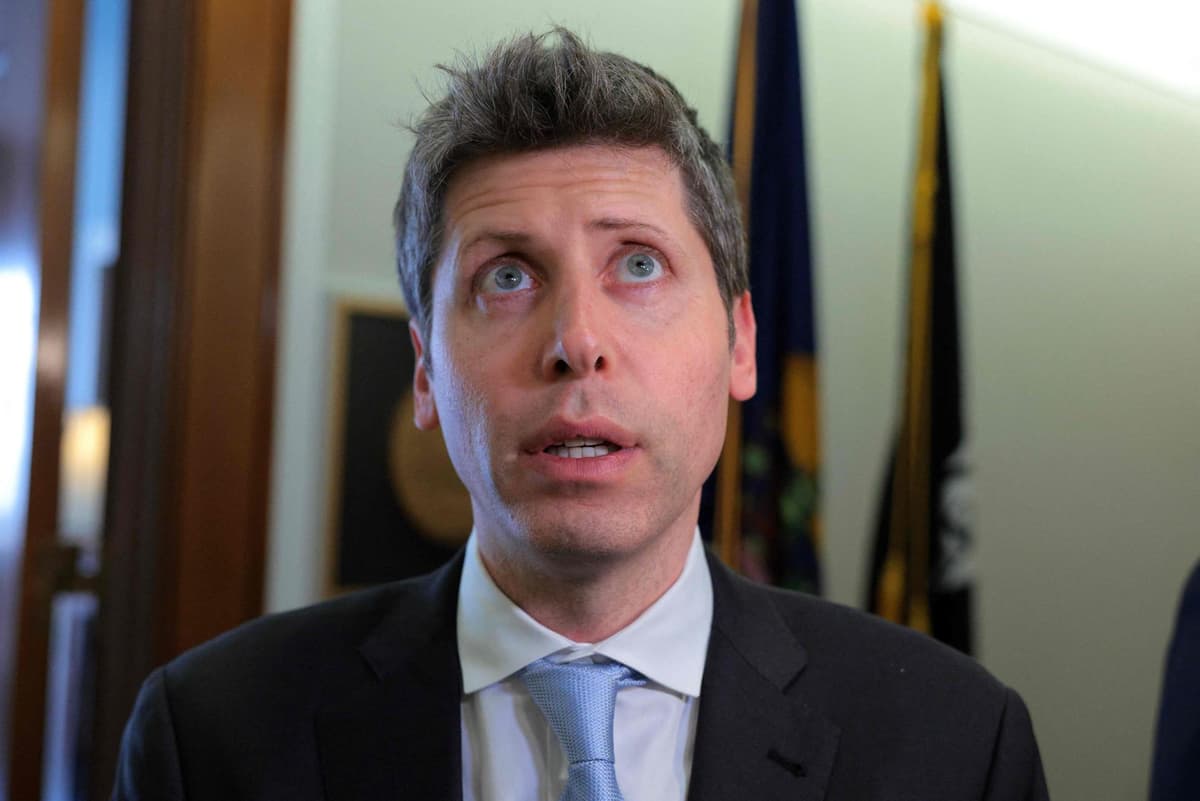
Here's the deal: on July 24 local time, a table gets set somewhere near Silicon Valley. Around it are Jay Y. Lee, chairman of Samsung Electronics; Chey Tae-won, chairman of SK Group; Lee Hae-jin, board chair of Naver; and Jensen Huang, CEO of Nvidia. Hyundai Motor Group chairman Euisun Chung is reportedly a possible add. OpenAI's Sam Altman and Anthropic's Dario Amodei have both been floated as attendees too.
The format matters. This is a roundtable, not a press event. Nobody's shaking hands in front of a step-and-repeat. They're sitting down to reconcile numbers.
Read the guest list by role and the shape of it gets obvious. Samsung Electronics and SK hynix are the two pillars supplying HBM, the high-bandwidth memory that sits at the heart of every Nvidia AI accelerator. Naver is the customer that buys those accelerators and racks them, and now a business partner sharing profit and loss with Nvidia. Hyundai is the physical-AI demand side, autonomous driving and robotics. OpenAI and Anthropic are the model companies that ultimately burn all of it down as compute. Memory, chips, infrastructure, models, applications — all in one room. Industry people are calling that a first.
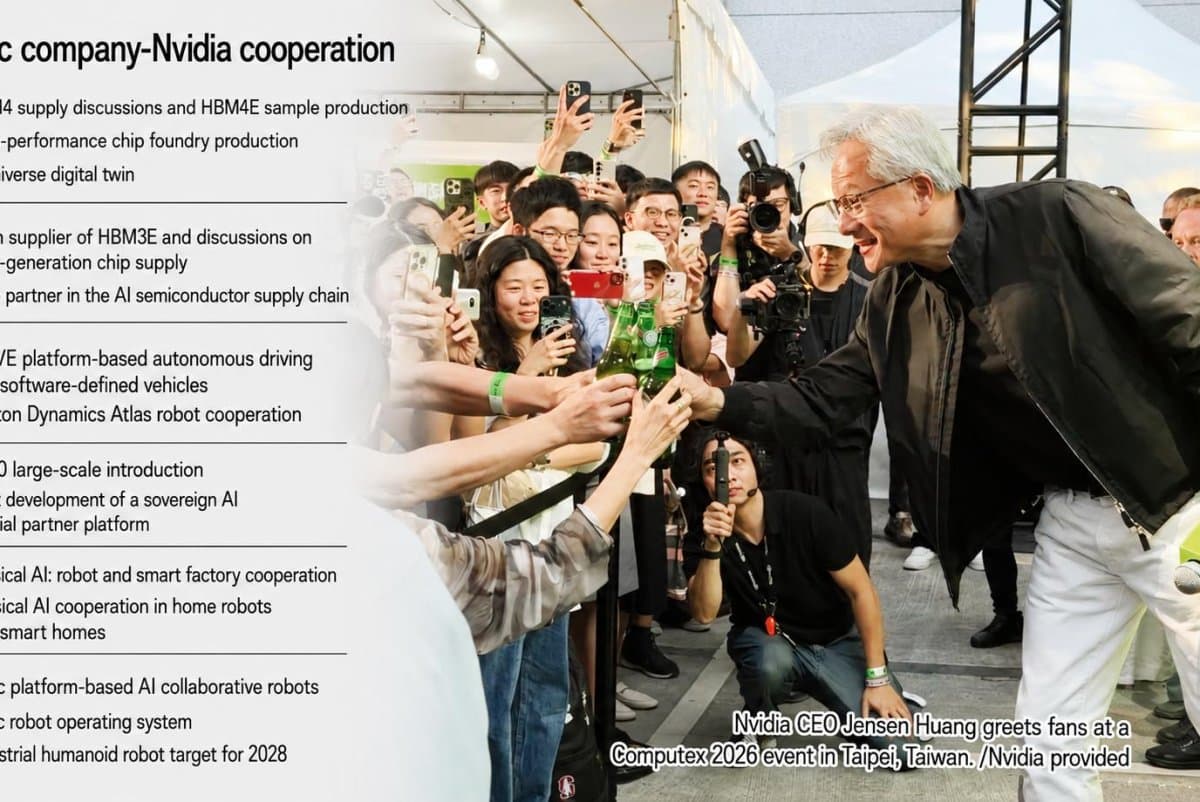
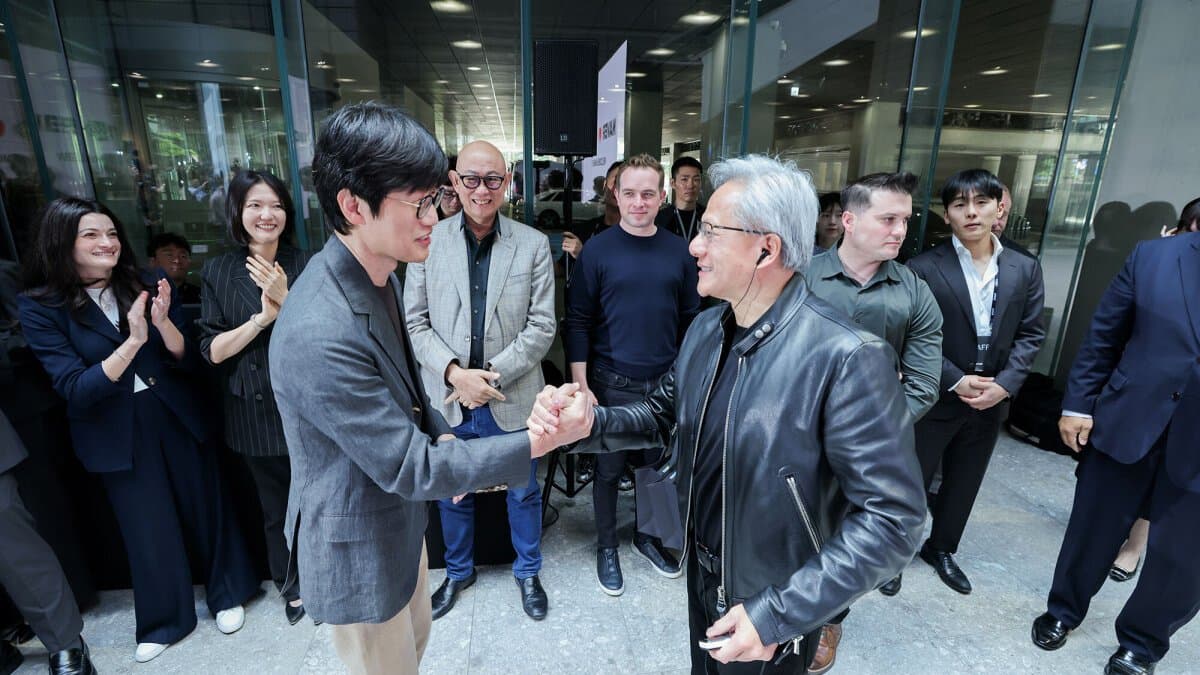
The timing isn't accidental either. Jensen Huang was in Seoul from June 4 to June 8. On June 5 he sat in a pork-belly joint near Hongdae drinking soju with Lee, Chey and Lee — the meeting Korean media nicknamed the "samso" dinner. Three days later, on June 8, Naver and Nvidia formally announced a gigawatt-scale AI factory alliance. That was the second off-the-record hang, after the "chimaek" fried-chicken-and-beer session during the APEC summit in October 2025. A conversation that started over drinks in Seoul is now being restated in contract language in California, six weeks later.
Underneath all of it sits a very unglamorous problem: money. Korea JoongAng Daily reported on July 20 that Lee Hae-jin, traveling with Naver CFO Kim Hee-chul and other executives, is stopping in Canada to see Brookfield first, then continuing to Silicon Valley. Brookfield is said to be seriously interested in Naver's AI factory project, and industry chatter puts the investment being discussed at north of 10 trillion won, roughly $6.8 billion. Chey Tae-won left for the US the same week. Three chairmen moving to the same continent in the same week isn't coincidence — it's what happens when everyone's homework converges on one man's calendar.
Four people at the table, four completely different problems
Jensen Huang is running a company where demand is certain and supply isn't. In Nvidia's June 7 newsroom release he put it as "useful AI has arrived, and demand for AI factories is extraordinary." What he said in Seoul in June was blunter: "You have everything you need. We came here to be partners." For Nvidia, Korea is three things at once — an HBM supplier, a customer that buys GPUs by the tens of thousands, and a forward base for absorbing demand across Asia, the Middle East and Europe. Not many countries play all three roles.
Lee Hae-jin stepped back from Naver's front line in 2024 and returned as board chair in 2025. The stated reason for coming back was AI. Now he has to show the work. Naver built HyperCLOVA X, making it the third company in the world to develop a hyperscale LLM in-house. Its Gak Sejong facility is the largest hyperscale data center in Korea, and Naver has actual operating experience running GPU clusters — not a small thing. The gap is capital. Gigawatt-scale infrastructure isn't a trillion-won game, it's a tens-of-trillions game, well past what Naver can self-fund at its market cap.
Jay Y. Lee and Chey Tae-won have a different problem. Both companies are negotiating HBM4 supply for Vera Rubin, Nvidia's next-generation accelerator. At the same time, both signed up for the Korean government's "three mega-projects" announced June 29: four memory fabs in the Honam region, 400 trillion won each, 800 trillion won total, with a plan to double DRAM capacity within five years. Capacity expansion at that scale without locked-in demand is suicide. Confirming how much Nvidia will buy over the next several years comes before the first shovel goes in the ground.
Then there's Brookfield. The Canadian alternative asset manager runs over $1 trillion and is better known in Korea as the owner of Seoul's International Finance Center. On November 19, 2025, it launched a $100 billion AI infrastructure program alongside Nvidia and the Kuwait Investment Authority. The core vehicle, the Brookfield AI Infrastructure Fund (BAIIF), targeted $10 billion in equity and had already secured $5 billion in commitments. Its stated top investment target: AI factories built on Nvidia's DSX reference design. That is precisely what Naver is trying to build. The puzzle fits a little too well to be luck.
Finally, OpenAI and Anthropic. Whether they actually show up won't be confirmed until the meeting's over, but the fact that their names came up tells you where the agenda points. Anthropic is shopping for a foundry to make its own AI chips on a 2nm process, and Samsung Foundry keeps getting mentioned as a candidate. OpenAI has been talking to Samsung and SK about memory for Stargate. Model companies are walking down into the silicon value chain themselves, and this table reflects that.
The numbers on the table: from 55 megawatts to a gigawatt
The real center of gravity here is the Naver-Nvidia AI factory. Per Naver's June 8 announcement, this is not a GPU purchase order. Naver's press release framed the tie-up as an "integrated alliance spanning the entire value chain" and a "global core partnership sharing business risk and results." That's deliberately different language from a normal technology agreement. The two companies build the infrastructure together and go find global customers together. If it works, they both make money. If it doesn't, they're both stuck.
The technical skeleton is Nvidia's DSX platform — a reference architecture bundling chips, servers, software and data center operations into one AI factory design, aimed at cutting training and inference cost while speeding up buildout. Naver bolts on its Gak Sejong operating know-how and GPU cluster experience. Side projects include a "Seoul World Model" combining Naver's spatial data with Nvidia's Cosmos foundation models, and the next generation of HyperCLOVA X, which trains on this same infrastructure.
The roadmap is staged. First half of 2027: 55 megawatts. By the end of that year: 100MW combined domestic and overseas. 2028: 200MW. Long-term target: a gigawatt-class network — roughly four times the capacity of Gak Sejong. Coverage isn't meant to stop at Korea; the plan reaches into Asia-Pacific, the Middle East and Europe. The product being sold is sovereign AI, the idea that each country secures AI independence with its own data and infrastructure. That's the exact narrative Nvidia has been pushing in the Gulf and Europe for two years.
| Item | Detail |
|---|---|
| Meeting date | July 24, 2026 (local time), near Silicon Valley |
| Attendees | Jay Y. Lee (Samsung), Chey Tae-won (SK), Lee Hae-jin (Naver), Jensen Huang (Nvidia); Euisun Chung (Hyundai), Altman and Amodei possible |
| Naver AI factory phase 1 | 55MW in H1 2027 (Gak Sejong based) |
| Expansion roadmap | 100MW end-2027 → 200MW in 2028 → 1GW long term |
| Funding under discussion | Brookfield, figures above 10 trillion won (~$6.8B) cited |
| Brookfield AI fund | Launched Nov 2025 with Nvidia and KIA; up to $100B in asset acquisitions targeted |
| Oct 2025 GPU supply | 260,000+ units to Korea (government 50K; Samsung, SK, Hyundai 50K each; Naver Cloud 60K) |
| Memory expansion | Samsung + SK hynix, 4 Honam fabs, 400 trillion won each, 800 trillion won total |
Go back to that 260,000-GPU agreement from APEC in October 2025 and the character of this meeting sharpens. That supply was mostly GB200 Grace Blackwell plus some RTX 6000 series. At $30,000 to $40,000 per GB200, the total penciled out to roughly 10 to 14 trillion won. Naver Cloud's 60,000 units was the largest private allocation. That negotiation was about how many chips you get. This one is about where you find the building, the electricity and the capital to plug them into. The unit of discussion changed from chips to megawatts.
What each side walks away with
Naver is the most desperate party and has the most to gain. What it needs is capital. Whether the 10-trillion-won-scale Brookfield discussion lands as an equity investment, project finance, or a jointly capitalized SPC has not been settled — and the structure completely changes both Naver's financial burden and its upside. One thing tilts the table Naver's way: Nvidia is an LP in the Brookfield AI Infrastructure Fund. A fund Nvidia backed putting money into a project Nvidia picked as its partner is a favorable setup to negotiate inside.
Nvidia locks in demand. With "peak AI semiconductor" arguments cycling through the market on repeat, the fact that Korean conglomerates are executing infrastructure plans measured in tens and hundreds of trillions of won is the best defense Jensen Huang can hold up. He also gets to coordinate HBM4 volume directly with both suppliers and confirm fab expansion scale. Nvidia's bottleneck has never been GPU die — it's HBM and advanced packaging, and multiple quarters of earnings calls have said so.
Samsung Electronics is chasing three things: HBM4 allocation, demand justification for the 800-trillion-won Honam buildout, and foundry. The possibility of winning Anthropic's custom chip on a 2nm process matters symbolically. To fix a structure where memory earns and foundry burns, you need an anchor customer, and AI chip designers are the obvious candidates. That said, this is still at the "being mentioned" stage, not the contract stage.
SK Group starts with defending its HBM lead. SK hynix got there first on Nvidia-bound HBM, and keeping that position from eroding under Samsung's push is Chey Tae-won's job. Layered on top is the gigawatt-scale AI cloud plan SK Telecom announced during Huang's June visit. SK ends up selling memory and buying AI infrastructure at the same time — Naver's position and Samsung's position stacked on one company.
The Korean government isn't at the table but is very much a stakeholder. The June 29 national briefing on the "three mega-projects for Korea's great leap" set out semiconductors, data centers and physical AI as the pillars, including a 17-trillion-won national AI data center at Solaseado in Haenam, South Jeolla. How much these executives actually bring home from Silicon Valley determines how credible that plan looks.
Precedents: the ones that worked and the ones that didn't
The success story everyone cites is SK hynix. It worked with Nvidia starting from HBM2E in 2019, effectively became the sole supplier at HBM3, and cashed that head start into earnings through the 2023–2025 AI boom. The lesson wasn't technology, it was timing — being on the customer's roadmap before the market opened. The HBM4 negotiation on this week's agenda has the same shape. Whatever gets agreed now shows up on 2027 and 2028 income statements.
The counterexample exists too. Stargate, announced by SoftBank and OpenAI in January 2025, opened with a $500 billion headline, and reporting has repeatedly noted that early funding and site acquisition moved slower than the announcement implied. That's the standard trap for large AI infrastructure projects. MOUs and roadmaps are easy to publish. Grid interconnection, substation buildout, cooling water and permitting are not solved by publishing. The 800-trillion-won Honam plan sits in the same category: the direction is set, but specific sites, groundbreaking dates, and power and water plans haven't been disclosed.
Viewed as a Korean tech company's global infrastructure bet, Naver's move invites comparison to LINE. LINE genuinely succeeded in Japan and Southeast Asia, and then in 2024 pressure from the Japanese government over shareholding forced Naver out of management control. The takeaway: running infrastructure abroad isn't only a question of technology and capital, it exposes you to another country's political judgment. Selling sovereign AI into Asia, the Middle East and Europe stands on exactly that risk.
Saudi Arabia's HUMAIN is worth a look as well. Launched in May 2025, it announced hundreds of thousands of Nvidia GPUs, with the sovereign wealth fund supplying capital and Nvidia supplying technology. The decisive difference from Naver's model is where the money comes from. HUMAIN had PIF behind it. Naver has to negotiate with private capital like Brookfield, and private capital is far stricter about exit timelines than a sovereign fund. The terms attached will decide what this deal actually is.
How the competition responds
The most immediate reaction comes from inside Korea. KT and Kakao have paired off with Microsoft and OpenAI respectively, and LG Group announced an AI factory collaboration spanning robotics, autonomous driving and GPU cloud during Huang's June visit. Now that Naver holds the "global partner" title with Nvidia, everyone else has to redraw their differentiation. GPU cloud especially is a scale-economics business, so the unit-cost gap between whoever gets 55MW live first and whoever arrives later becomes the competitive gap.
Abroad, the hyperscalers are the variable. AWS, Google Cloud and Microsoft Azure already run Korean regions and want to absorb Asian AI demand into their own infrastructure. When Naver pitches sovereign AI across Asia, the Middle East and Europe, these are the incumbents it runs into. Their counterplay is predictable: push unit costs down with in-house silicon — Trainium, TPU, Maia — and sell a lower-Nvidia-dependency stack on the argument that it's simply cheaper. The fight gets decided by where national governments land between sovereignty as a principle and price as a reality.
On the memory side, Micron is quietly turning up the pressure. It has closed ground on Samsung and SK hynix in HBM, and it carries a geopolitical premium as a US company. From Nvidia's side, keeping three suppliers alive is the obvious call for negotiating leverage. How good a deal Korea's two companies extract at this meeting depends, a little perversely, on how well Micron is doing.
The AI chip landscape itself matters too. Google has moved toward selling TPUs externally, Anthropic is evaluating its own chip design, and OpenAI is building custom silicon with Broadcom. The more that trend grows, the tighter Nvidia's relationship with Korean memory and foundry has to get. Custom chips still need HBM, and HBM still gets made in Icheon and Pyeongtaek.
So what actually changes
For developers, nothing changes right now. When 55MW actually comes online in the first half of 2027, the total pool of GPU hours available in Korea rises, and that's when pricing and queue times move. If you're blocked on training runs today because you can't get capacity, planning against a 2027 baseline is the realistic move. One unknown matters a lot: how much of that 55MW is for external sale versus Naver's own HyperCLOVA X training. Nobody has disclosed the split, and that split decides what Korean startups actually feel.
If you're an investor, three things to watch. First, the structure of the Brookfield investment — equity means dilution for Naver shareholders, project finance means debt load. Second, the volume and duration of the HBM4 supply contract. Third, the groundbreaking schedule for the 800-trillion-won Honam plan. The third one matters most, because until power and water plans exist, that's a number on a slide. When the first shovel goes in tells you more than the announced total.
For ordinary users, this is distant. Still worth remembering: the next generation of HyperCLOVA X trains on this infrastructure, and the response speed and quality of AI features in Naver Maps and search ultimately come out of total GPU capacity. If something like the Seoul World Model ships as a real product, maps, real estate and logistics are the likely places you'd see it first.
Zoom out to Korean industry and this meeting is a position check. Korea holds a triple position with Nvidia that no other country has — supplier, customer, and sales channel. That's a strength and it's also another word for dependency. The more you tune your infrastructure to Nvidia's architecture, the higher your switching cost climbs. How to feel about talking sovereign AI while outsourcing silicon sovereignty to an American company is a real question, and it isn't getting answered this week.
🥄 Three Things You're Probably Wondering
— So what does this mean for me? Not much directly. But if you rent GPUs in Korea for a living, the first half of 2027 is a real inflection point, and supply likely stays tight until then. Plan against that date rather than hoping capacity loosens sooner.
— Why is this happening now? Building the AI factory announced on June 8 takes capital, and the capital is in North America. The HBM4 supply negotiation and the 800-trillion-won fab decision landed in the same quarter, with peak-AI-semiconductor talk floating around the market. Several deadlines converged on late July.
— Is Korea ahead of its competitors? On pure infrastructure buildout speed, Saudi Arabia and the UAE are ahead on capital mobilization. Korea's difference is that it physically controls the memory supply chain, and that's the card that plays at the table. Whether this meeting turns into binding contracts hasn't been disclosed, so calling it early would be a mistake.
Sources
- Korea JoongAng Daily — Naver needs deep pockets for AI factory with Nvidia, and it's heading to North America to find them
- NVIDIA Newsroom — NAVER Expands AI Infrastructure With NVIDIA to Serve Surging Global AI Demand (2026.06.07)
- NAVER Corp Press Release — NAVER and NVIDIA Join Forces to Build Gigawatt-Scale AI Factory (2026.06.08)
- NVIDIA Blog — Korea AI ecosystem 2026 (record of Jensen Huang's June Seoul visit)
- Brookfield Asset Management — Brookfield Launches $100 Billion AI Infrastructure Program (2025.11.19)
- Herald Business — Lee Jae-yong, Chey Tae-won and Lee Hae-jin to meet Jensen Huang in the US
- Financial News — Korea's chairmen meet Jensen Huang in the US, testing the peak-AI-chip thesis
- The Korea Herald — Nvidia, Naver team up for gigawatt-scale AI cloud push in Korea
Numbers and criteria are as of announcement and may change. Investment calls are yours to make!