A 63-year-old CEO's first tweet was a policy document
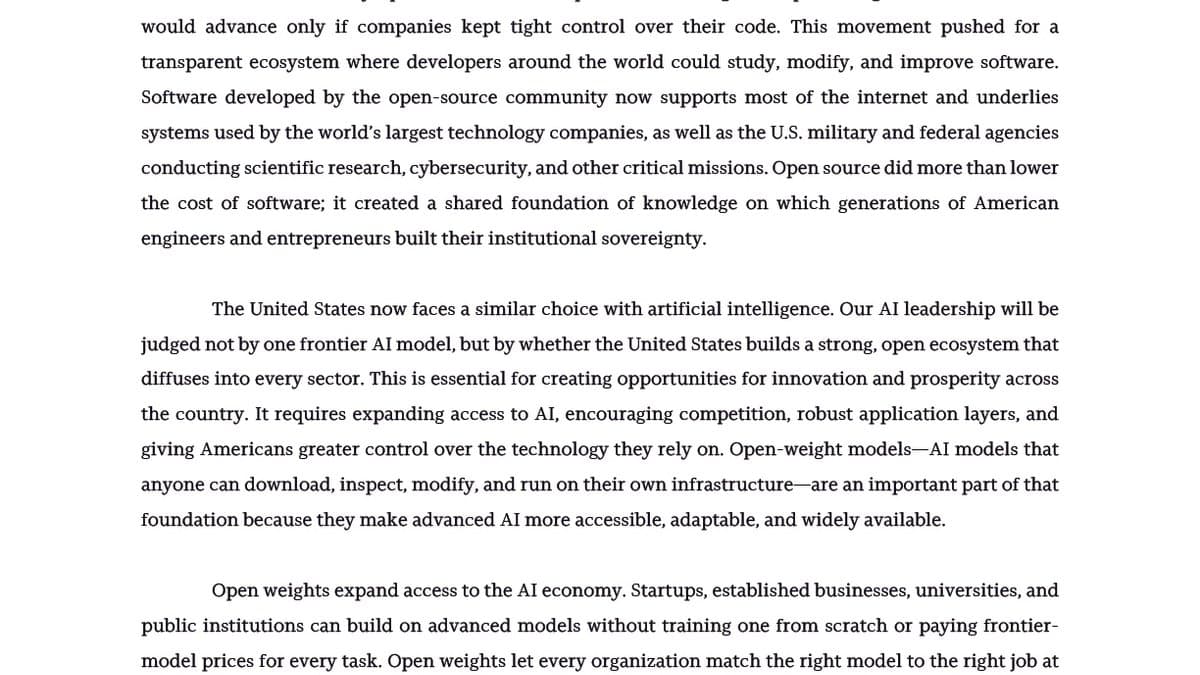
Jensen Huang was known for essentially not using X. He barely surfaced on LinkedIn either — a stage-and-interview communicator, not a social media one. Then on Friday, July 24, 2026, he posted for the first time in his life. Not a selfie. Not a product teaser. A joint letter titled "Open Weights and American AI Leadership."
His accompanying line: "Open models strengthen safety and cybersecurity, accelerate innovation and diffusion, and enable sovereignty."
The post cleared eleven million views, and the letter's signatory count doubled from 25 to 50 within a day. But the most-read part of this story wasn't who signed. It was who never did.
What the letter says, and who wrote it
Terminology first. Open weights means publishing a trained model's weight files for anyone to download. It's distinct from open-source software: training data and training code usually stay private, and what gets released is the finished model artifact. Meta's Llama, DeepSeek R1, and Moonshot AI's Kimi K3 — whose weights dropped today — are the canonical examples.
The letter compresses into three asks. One, don't impose premature restrictions on downloadable models. Two, address legitimate security concerns with targeted legal frameworks rather than broad bans. Three, expand compute access for researchers and startups. The core argument: America keeps its AI lead by building an open model ecosystem, not by locking up a single best system.
The backdrop is a live fight in Washington. The Trump administration has reportedly weighed Entity List designations, federal procurement exclusions, and security-liability rules aimed at Chinese AI developers. No blanket ban has been announced, but pressure has been building to slow the rapid spread of Chinese open-weight models through American infrastructure.
The problem is that such rules struggle to distinguish by nationality. Any regulation restricting "Chinese open-weight models" has to legally define what an open-weight model is, and that definition lands with equal force on Meta's Llama and Mistral's releases. That's the practical reason Nvidia, Meta and Microsoft signed. The fire next door is structurally connected to their house.
Nvidia also has a more direct interest. More open models means more GPU demand. If capability stays locked inside a handful of labs, compute demand concentrates in those labs. If models are open, tens of thousands of companies and institutions each buy their own inference infrastructure. Huang defending open weights is business before it is ideology. That doesn't make the argument wrong — but knowing who's making it and why is part of reading it properly.
Who signed, and who didn't
The sequence:
| When | What happened |
|---|---|
| Fri, July 24 | 25-company letter published; Huang shares it in his first X post |
| Same day | Post passes 11 million views |
| Sat, July 25 | Signatories double to 50 — OpenAI, Google and AMD join |
| Throughout | Anthropic and Amazon absent from every version |
The initial 25 included Nvidia, Microsoft, Meta, IBM, Dell Technologies, Palantir, Andreessen Horowitz, Mistral, Mozilla, Hugging Face, The Linux Foundation, Perplexity and Y Combinator. Chip makers, hyperscalers, open-source foundations and venture firms, fairly evenly mixed.
Among the overnight additions, the two that mattered were OpenAI and Google. Their initial absence had already generated a "frontier labs quietly welcome regulation" reading, and signing within 24 hours broke that frame. AMD joined in the same wave, and Elon Musk publicly endorsed Huang's position — though per multiple outlets' tallies, xAI itself does not appear on the signatory list.
Which leaves two companies. Anthropic and Amazon. Forbes put both names in a headline, which is a fair signal of where the actual news landed.
Anthropic's absence reads as a stated position. The company has consistently argued that releasing powerful model weights is irreversible: software vulnerabilities can be patched, cloud APIs can revoke access, but weights on the open internet cannot be recalled. That argument sits at the center of Anthropic's founding rationale, so the odds that not signing was an oversight are close to zero.
Amazon's absence is harder to read. Amazon is one of Anthropic's largest investors, owns its own Trainium silicon, and simultaneously serves a great many open models through Bedrock. Business-relationship complexity is a likelier explanation than ideology. Absence alone doesn't establish opposition — a company can miss the ask or lose a week to internal approvals.
What each side gets
Nvidia gets a demand curve and a political position. A larger open ecosystem means more distinct buyers of GPUs, which is the market structure Nvidia most wants. Standing publicly on the side of openness is also a useful shield in a period of rising antitrust attention.
Meta gets legitimacy. Meta bet its AI direction on Llama and open weights, and tightening regulation would hit it most directly. Whether it's 25 companies or 50, having most of the industry on record in the same position is a lobbying asset.
Hugging Face and the Linux Foundation are defending their reason to exist. Hugging Face is the de facto distribution layer for open-weight models, and any rule that attaches legal liability to model distribution threatens the platform itself. For them this is existential, not strategic.
OpenAI and Google, joining a day late, bought their way out of a frame. While they were missing from the list, a narrative was forming that closed-model incumbents quietly welcome restrictions — bad positioning for a company heading toward an IPO and worse for one under antitrust scrutiny. The cost of signing is near zero; the narrative cost of not signing was real. That math resolves fast.
Anthropic gets consistency. In the short term it carries the cost of being the conspicuous holdout. But a record of forgoing commercial convenience on safety grounds is the single most valuable asset Anthropic brings into conversations with regulators. Place it next to Anthropic appearing on AMD's stage as a compute partner the same week and you see a company that runs policy positions and procurement strategy on entirely separate tracks.
Have coalition letters like this ever worked?
The success case is the 1990s crypto wars. The US government then treated strong encryption as a munition subject to export control and pushed backdoored schemes like the Clipper chip. Industry, academia and civil society campaigned against it for years, and restrictions were substantially relaxed by the late 1990s. The result is the HTTPS you use today. It gets cited constantly because of its conclusion: an attempt to restrict technology diffusion in the name of national security mostly eroded domestic industry competitiveness. The letter's nod to software history points at exactly this.
The limited-effect case is AI lobbying in 2023–2024. Industry assembled a large coalition against California's SB 1047 and the bill was ultimately vetoed — but regulation didn't disappear. It returned in modified form, and the EU AI Act took effect regardless. The honest lesson of the past decade is that coalition letters are better at reshaping regulation than at preventing it.
The failure case exists too. Google employees' 2018 letter against Project Maven cancelled one contract but didn't change industry direction; defense AI contracts returned at greater scale within a few years. A letter's leverage depends heavily on how urgent the issue is to the people writing the rules.
This letter's timing is unusually favorable. No actual regulation has been published yet and the framing of the debate isn't settled. Intervening at that stage is far more effective than opposing a finished rule — that's basic policy lobbying. As interventions go, the timing is well chosen.
How the other side counters
The safety argument is short and strong. Weights cannot be recalled. Software vulnerabilities get patched, cloud APIs get cut off, but a downloaded checkpoint has no revocation path. If a dangerous capability is discovered after release, there is essentially no remedy — which is Anthropic's repeated point, and it directly contradicts the letter's claim that open models strengthen safety.
The security argument comes from a different angle. If a model built by a Chinese lab runs inside American infrastructure, that's a software supply chain problem. Model weights are exceptionally hard to audit; a backdoor or embedded bias can't be surfaced the way a code review surfaces a bug. If that framing wins, regulation likely appears first as procurement exclusions and critical-infrastructure usage limits rather than an outright ban.
There's a competition-policy rebuttal too. The fact that Nvidia sits at the center of the pro-open-weights coalition is itself an argument. More open models means more GPU demand, and the dominant GPU vendor is leading the campaign. Good arguments lose persuasive force when the interested party is the one making them, and that discount belongs in any honest reading of the letter.
And Washington's likely play isn't a blanket ban. Entity List designations, federal procurement limits, critical-infrastructure usage rules, liability attached to distribution platforms — precision instruments come first. The letter asking for "targeted legal frameworks" reads partly as pre-conceding that direction in order to negotiate the terms.
What actually changes for you
If you deploy open models, nothing shifts today, but policy risk belongs in your planning now. If a Chinese open-weight model is a load-bearing component of a commercial product, it's reasonable to assume procurement or compliance requirements could appear within six to twelve months. Building a model-swappable abstraction layer now is cheap insurance.
If you're a founder, watch the letter's third ask — expanded compute access for researchers and startups. If that becomes policy it shows up as subsidy programs or national compute allocations, and similar proposals are circulating in other countries.
From a Korean perspective, two things are in play. First, US restrictions on open-weight distribution would narrow the model options available to Korean companies. Second, and conversely, a stronger "every country needs its own model" argument fuels sovereign AI policy. The word "sovereignty" in the letter is American domestic rhetoric and, simultaneously, an extremely quotable phrase for governments building their own case.
If you're an investor, the practical scoreboard for this fight shows up in Nvidia's and Meta's results. A regulated-down open ecosystem changes the long-run GPU demand picture; an open one broadens the buyer base. Regulatory processes move in quarters, though, so this isn't a short-term catalyst.
If you're a user, the outcome determines the variety of AI tools you'll have. A living open ecosystem keeps producing locally-runnable tools, small models fine-tuned for narrow jobs, and cheap services. Shut it down and your options converge on APIs from a handful of large labs.
🥄 Three Things You're Probably Wondering
— Does signing a letter actually change anything? It carries no legal force. What it does is put the industry majority's position on the record early, while rules are still being drafted, and that record genuinely gets cited in hearings and comment periods later. Think of it as a tool for reshaping regulation rather than blocking it.
— Is Anthropic not signing really a big deal? It won't change policy by itself. But being the only frontier lab that stayed off the list through every version reads as a deliberate signal to regulators. Anthropic keeps accumulating a record of choosing safety over commercial convenience, and that consistency converts into standing in regulatory conversations. Note that Amazon's absence is probably about business entanglements rather than ideology, so it'd be a mistake to read the two absences as the same statement.
— Why did Huang start using X now, of all times? There's no official explanation. But opening the account on the letter's publication day and using the first post for it suggests this wasn't the start of a personal social media habit — it was a campaign needing a megaphone. Eleven million views and a doubled signatory count in 24 hours says the call was right. Whether he keeps posting is another question entirely.
References
- Jensen Huang (@JensenHuang) — first X post
- Nvidia, Microsoft, Meta warn against 'premature restrictions' of open-weight models — CNBC
- Nvidia and 24 other companies sign open-weights letter as Washington weighs Chinese AI model ban — Tom's Hardware
- Jensen Huang just used his first ever X post to warn the AI industry — Fortune
- Huang's Open Weights Letter Doubled To 50 Without Amazon And Anthropic — Forbes
- Nvidia, Microsoft, Meta back open AI. OpenAI didn't. — The Next Web
- NVIDIA's Jensen Huang joins X, uses first post to discuss AI — VideoCardz
Numbers and criteria are as of announcement and may change.