The Earnings Aren't Out Yet. The Battle Lines Already Are.
Here's the first thing to get straight, because a lot of coverage is getting it wrong: as of today, August 2, 2026, neither Naver nor Kakao has reported second-quarter results. Go to Kakao's investor relations archive and the newest deck is still Q1 2026. Go to Naver's earnings page and it's the same story. Kakao reports on August 6. Naver reports on August 7. Every "Naver did 3.37 trillion won" figure circulating right now is a consensus estimate — an average of brokerage forecasts, not a company filing. We're in the pre-game locker room, not the post-game presser.
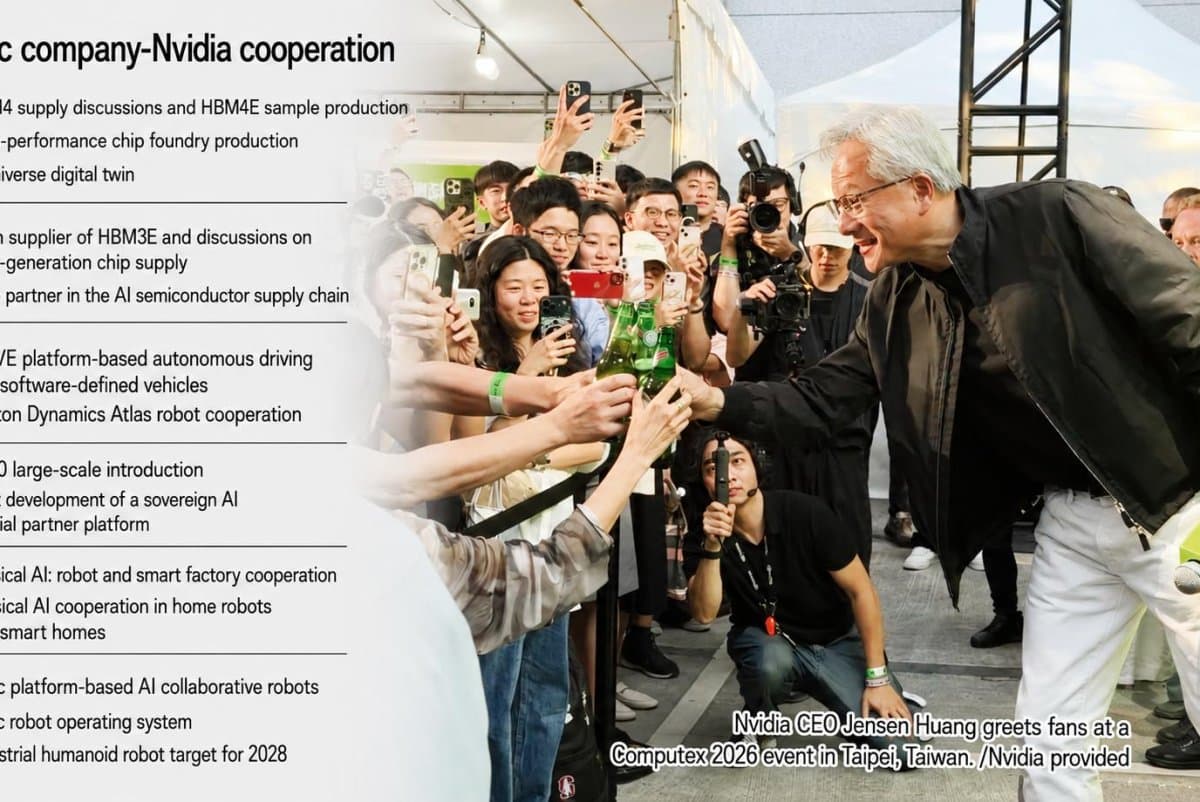
And the locker room got loud. Ten days before those calls, Naver announced it had lined up $10 billion in AI infrastructure capital from NVIDIA and Brookfield, with NVIDIA taking an equity stake in Naver itself. Days later, on July 31, LG AI Research dropped K-EXAONE 2.0 — 750 billion parameters — onto Hugging Face under an Apache 2.0 license, meaning anyone can use it commercially without paying anyone. Meanwhile the market is broadly expecting Kakao to reveal, sometime in early August, an agent inside KakaoTalk that chains search, recommendation, and payment into one flow.
Why does the sequencing matter? Because the Q2 numbers themselves are, in a real sense, already old news. Both companies are expected to post solid quarters. Commerce held up. Advertising held up. Fintech pushed. Everybody's models already say that. The question that actually moves the stock is the one after it: what pays for all the GPUs? Naver and Kakao have both been spending against an AI thesis, and the revenue line that justifies that spend is supposed to arrive in the second half of 2026. The preview of that revenue line landed in the past week.
What makes this genuinely interesting is that the two companies have arrived at opposite answers. Naver is running a vertical integration play — own the data center, own the model, own the search surface, own the ad inventory, then rent out the leftover compute. Kakao is running a horizontal distribution play — own the messenger, rent the model, spend as little capex as possible, monetize attention. One of those is probably going to look badly wrong in two years. Possibly both are half right. August 6 and 7 are the first time we get to put mid-term report cards for both strategies side by side.
And behind all of it sits an uncomfortable question neither company likes to say out loud. South Koreans are already using ChatGPT at a scale that dwarfs anything domestic. So why, exactly, would anyone reach for a Naver or Kakao agent instead? That's not a model-quality question. It's a distribution question. And distribution is exactly what both of these companies are betting their second half on.
Who's Actually in the Ring
Naver. Start with numbers the company itself published, because those are the only ones you can lean on. In Q2 2025, Naver reported revenue of 2.9151 trillion won and operating profit of 521.6 billion won, with net profit of 497.4 billion won. Revenue was up 11.7% year over year and operating profit up 10.3%. The segment split was Search Platform 1.0365 trillion won, Commerce 861.1 billion, Fintech 411.7 billion, Content 474.0 billion, and Enterprise 131.7 billion. Naver Pay transaction value hit 20.8 trillion won that quarter, up 18.7%.
Then look at Q1 2026, also company-reported: revenue of 3.2411 trillion won, up 16.3% year over year, and operating profit of 541.8 billion won, up only 7.2%. Net profit actually fell roughly 31%. That gap between a 16% top line and a 7% operating line is the entire AI story in one number. Naver is buying more revenue while keeping less of it, and the difference is going into GPUs, depreciation, and the marketing needed to get people to try new AI surfaces. CEO Choi Soo-yeon told the Q1 call that generative AI ads combining shopping and local would be tested inside AI Briefing starting in Q2, with monetization ramping in Q3.
Naver's weapons are three. First, search itself — still the default habit for a large share of Korean internet users, and now being rebuilt around AI Briefing and AI Tab. Second, AI Tab, the conversational search product that went into beta for Naver Plus members on April 27 and launched to all users on June 26. Third, and most different in kind, the AI Factory — a compute infrastructure business, which is a fundamentally different animal from selling ads.
Kakao. Kakao posted Q2 2025 revenue of 2.0283 trillion won and operating profit of 185.9 billion won, a record at the time, again per the company's own release. In Q1 2026 it reported revenue of 1.9421 trillion won, up 11%, and operating profit of 211.4 billion won, up 66%, for an 11% operating margin. That 66% is eye-catching but it is not a story about the business doubling — it's largely a story about the company getting smaller and cheaper. The platform division did 1.1827 trillion won (up 16%), with TalkBiz at 608.6 billion (up 9%), advertising inside that at 338.4 billion (up 16%), business messaging up 27%, and commerce at 270 billion won (up 1%) on gross merchandise value of 2.9 trillion won (up 10%).
The past eighteen months at Kakao have essentially been a diet. In March 2026 it cut its Kakao Games stake from 37.93% to 14.68%, handing the largest-shareholder position to an investment vehicle backed by LY Corp. In May it sold AXZ, the operator of the Daum portal, to Upstage — an AI model developer — in a share-swap structure that left Kakao holding newly issued Upstage stock. On the Q1 call management said the affiliate count was down to 87. There's a delicious irony in a company selling its web portal and then announcing it will win at AI search, but read it the other way and it's an identity statement: we are not a portal company, we are a messenger company, and the messenger is where the agent goes.
The third parties reshaping the board. NVIDIA is now a Naver shareholder, not just a supplier. Brookfield is a global alternative asset manager with deep data center and energy holdings and a reported ~$100 billion AI infrastructure program. OpenAI signed what Kakao described as Korea's first strategic partnership with the company back in February 2025, putting OpenAI APIs inside KakaoTalk and Kanana. LG AI Research, participating in the government's sovereign foundation model program under the Ministry of Science and ICT, just open-sourced a frontier-scale Korean model. Each of these actors is planting a stake in Korea for its own reasons, and every stake narrows the option space for Naver and Kakao.
The opponent that actually matters. ChatGPT. Per WiseApp's tracking, in April 2026 ChatGPT had roughly 23.45 million monthly active users in Korea, Gemini about 8.45 million, and Claude about 2.41 million. In a country of about 51 million people, ChatGPT is past the "mainstream app" threshold. Naver and Kakao talk about competing with each other. The number that should scare both of them is that one.
The Numbers: What's Confirmed and What's a Guess
This distinction deserves its own section, because it's where most coverage gets sloppy. Everything published about Q2 2026 right now is an estimate. Etoday reported on July 26, citing FnGuide consensus, that Naver would post revenue of 3.3663 trillion won and operating profit of 566.0 billion won. Financial News reported on July 29, citing Yonhap Infomax consensus, revenue of 3.3686 trillion won (up 15.6%) and operating profit of 567.4 billion won (up 8.8%). Those two sets differ slightly because they're different data providers polling on different days. Neither came from Naver.
The Kakao side is messier still. Depending on the outlet, the Q2 revenue consensus is 2.0444 trillion, 2.0492 trillion, or 2.0529 trillion won, and the operating profit consensus is 223.4 billion, 223.9 billion, or 226.3 billion won. And there's an inconsistency worth flagging. Several reports described Kakao's expected Q2 operating profit as rising "9.81%" year over year. But Kakao's own press release put Q2 2025 operating profit at 185.9 billion won. Divide 223.9 by 185.9 and you get about a 20% increase, not 9.8%. Other outlets ran with roughly +21.7%, which lines up with the company-reported base. So when I read these estimates, I anchor to Kakao's own filing and call it "roughly 20% growth expected" — and I'd treat the 9.81% figure as using some other base. This is precisely why you don't just copy consensus tables.
| Item | Naver | Kakao |
|---|---|---|
| Q2 2026 earnings date | August 7, 2026 (scheduled) | August 6, 2026 (scheduled) |
| Q2 2025 actual (company-reported) | Revenue KRW 2.9151tn / OP KRW 521.6bn | Revenue KRW 2.0283tn / OP KRW 185.9bn |
| Q1 2026 actual (company-reported) | Revenue KRW 3.2411tn / OP KRW 541.8bn | Revenue KRW 1.9421tn / OP KRW 211.4bn |
| Q2 2026 consensus (estimate only) | Revenue KRW 3.3663–3.3686tn / OP KRW 566.0–567.4bn | Revenue ~KRW 2.0444–2.0529tn / OP ~KRW 223.4–226.3bn |
| Implied YoY growth (estimate) | Revenue ~+15%, OP ~+8% | Revenue ~+1%, OP ~+20% |
| Flagship AI products | AI Tab, AI Briefing, HyperCLOVA X | Kanana in KakaoTalk, Kanana Search, ChatGPT for Kakao |
| Model strategy | In-house plus NVIDIA Nemotron-based advancement | Lightweight in-house models plus OpenAI APIs |
| Infrastructure strategy | Own data centers (GAK Sejong) plus AI Factory as a business | Minimal capex, external APIs and partnerships |
| H2 monetization trigger | CPC ads in AI Briefing, then AI Tab ads in Q4 | In-app agent commerce, expanded KakaoTalk ad surfaces |
The row to stare at is the growth row. Naver's revenue is expected to grow more than 15% while operating profit grows around 8%. Analysts attribute the gap to GPU depreciation, World Cup broadcast rights costs, and marketing. Kakao's revenue is expected to grow about 1% while operating profit grows around 20%, attributed to affiliate divestitures and cost discipline. These two companies are running in opposite directions right now. One is getting bigger and thinner. The other is getting smaller and fatter. Neither is obviously the right answer heading into an agent war.
Now the infrastructure numbers, which are the most consequential and the most misreported. On July 24 in San Francisco, Naver, Brookfield, and NVIDIA announced they would expand the NVIDIA DSX AI factory deployment at Naver's GAK Sejong hyperscale data center from an initial 55 megawatts to 200 megawatts, targeting that scale by 2028, with Naver stating a long-term ambition of 1 gigawatt. Of the $10 billion total, Brookfield would fund up to $9 billion as exclusive capital partner, NVIDIA $1 billion, and Naver the remainder. The hardware is NVIDIA's DSX platform built on Vera Rubin and Blackwell architectures.
Read that paragraph again with one caveat attached: Brookfield's $9 billion is a nonbinding term sheet. NVIDIA's own newsroom release says so explicitly. That is not committed capital. It's a negotiating framework that can be repriced or walked away from if conditions change — and conditions in AI infrastructure financing change fast. Anyone treating $10 billion as money in Naver's bank account is reading a headline, not a document.
The NVIDIA equity piece is firmer. Per Korean disclosure coverage, Naver is issuing 7,241,564 common shares to NVIDIA in a third-party allotment worth roughly 1.4809 trillion won, giving NVIDIA about 4.5% of the company post-issuance. Reports noted this is Naver's first third-party allotment in 22 years and the first since its KOSPI listing move in 2008. Because these specifics surfaced through regulatory filings and press coverage rather than the company's own English release, the final terms are worth re-checking against the filing itself and the August 7 call. On the technology side, Naver said it will advance HyperCLOVA X models built on NVIDIA's Nemotron 3 Ultra open models, became the first Korean company to join the NVIDIA Nemotron Coalition, plans to launch an AI agent platform in Korea in the second half of 2026, and is developing a Seoul World Model using proprietary urban data.
What Each Side Actually Gets Out of This
Naver's payoff. The biggest one is time. Building a 200-megawatt AI factory purely off internal cash flow would consume years of free cash and a lot of board patience. If Brookfield funds the infrastructure layer, Naver can scale without shredding its own balance sheet. The second payoff is supply certainty — when your GPU vendor is also your shareholder, you tend not to be last in the allocation queue. The third is narrative, and it may be the most valuable of all in the short run: shifting the valuation frame from "Korean ad company" to "AI infrastructure company" changes the multiple investors are willing to pay. Reports noted Naver shares spiked into double-digit intraday gains on the announcement. The fourth payoff is model economics. Building on Nemotron rather than training a frontier model from scratch is a pragmatic retreat that saves an enormous amount of money, and joining the Nemotron Coalition formalizes it.
NVIDIA's payoff. Straightforward: a customer. Putting $1 billion into a partner that then commits to a 200-megawatt DSX deployment is, on a revenue-per-dollar-invested basis, extremely good business. Layer on the sovereign AI narrative — every government that decides its national data must run on national infrastructure creates net-new NVIDIA demand — and Korea becomes a showcase for a story NVIDIA wants told in a dozen more countries. And because NVIDIA holds equity, it also captures upside if Naver's AI business reprices.
Brookfield's payoff. For an infrastructure fund, an AI data center is a bundle of power, real estate, and long-term contracts. If the tenant is creditworthy and the contract is long, you can underwrite it something like a bond. Brookfield isn't buying Naver's growth story; it's buying predictable cash flow with an inflation hedge attached. Which is exactly why the nonbinding term sheet matters — if the contracted offtake doesn't materialize on acceptable terms, the rational move for Brookfield is to not fund it.
Kakao's payoff. Kakao opted out of the infrastructure race entirely. It rents models through the OpenAI partnership and runs lightweight proprietary models on-device. Reports put "ChatGPT for Kakao" at around 8 million users, up roughly fourfold from the 2 million cited on an earnings call three quarters earlier. What Kakao gets is AI reach with almost no capex. When your app is already opened daily by tens of millions of people, your customer acquisition cost for a new AI feature rounds to zero. CEO Chung Shin-a has been explicit about the target: lift average daily time spent in KakaoTalk by 20% year over year, then convert that time into ad inventory and commerce transactions.
OpenAI's payoff. Distribution into Korea without building a Korean go-to-market. Meeting users inside KakaoTalk is far cheaper than convincing them to install and open a separate app. The flip side is dependency risk running the other way too: if Kakao shifts weight toward its own models or adds another frontier partner, OpenAI loses its Korean shelf space. There was reporting in February 2026 that Kakao had selected Google as a new AI partner. That's closer to single-outlet reporting than confirmed fact, so I wouldn't treat it as settled — but the general direction, that Kakao does not want to be locked to one model vendor, shows up consistently across coverage.
The uncomfortable shared payoff. Both companies get to tell shareholders an AI story before either has a material AI revenue line to show. That's not cynicism, it's just the stage of the cycle. The August calls are where "story" has to start turning into "guidance."
Déjà Vu: How Fights Like This Ended Before
Start with the success case, because it's instructive. During the early-2010s mobile transition, Naver and Kakao made almost exactly opposite bets and both won. Naver ported search to mobile and stacked webtoons and web novels on top of it. Kakao took the messenger, won the app market outright, and then layered games, gifting, and taxis onto the relationship graph. What made both work was that each company built on the asset it already understood. Naver was good at converting traffic into advertising. Kakao was good at converting relationships into transactions. Look at the current agent war and you'll notice the exact same grammar: Naver is trying to attach ads to answers; Kakao is trying to attach payments to conversations. Companies rarely escape their own core competency, and mostly shouldn't try.
Now the failure case, which is also Kakao's. The affiliate sprawl that once ran past a hundred companies is now being unwound — 87 affiliates and falling, the Kakao Games controlling stake handed off, the Daum portal sold to an AI startup. That entire cleanup is the invoice for the assumption that "we have the platform, so we can bolt anything onto it." It turned out that owning attention did not automatically mean owning taxis, or banking, or entertainment, or webtoons. The relevant warning for 2026 is obvious: having 50 million people in a messenger does not automatically mean 50 million people want an AI agent inside that messenger. Traffic is a necessary condition, not a sufficient one.
There's an infrastructure failure case too, and it's the one that should worry Naver. Through the mid-to-late 2010s, Korean telcos and conglomerates poured capital into data centers and domestic cloud platforms. The public cloud market in Korea nonetheless ended up dominated by AWS, Azure, and Google Cloud, with domestic providers surviving largely inside the protected enclave of public-sector procurement. The AI factory carries the same shape of risk. If you build 200 megawatts and there aren't enough domestic buyers for that compute, you haven't built an asset — you've built a depreciation schedule. I read Naver's explicit framing of serving "Korea- and U.S.-based AI innovators" as an acknowledgment that Korea alone may not absorb the capacity.
And then the infrastructure success case, which is the one Naver is consciously imitating. Amazon built infrastructure for itself, discovered the surplus was sellable, and turned AWS into the segment that now carries a majority of its operating profit. Naver's pitch is structurally identical: it needs enormous compute anyway to run HyperCLOVA X, AI Tab, and AI Briefing, so it may as well sell the slack. The catch is timing and competition. AWS took the better part of a decade to become that machine, and for most of that decade it had the field largely to itself. The 2026 AI compute market has hyperscalers, neoclouds, sovereign projects, and NVIDIA itself all bidding for the same customers.
Competitor Counterplays
OpenAI and Google. Their counterplay is already deployed and it's simple: pull the agent out of the app and put it where the transaction happens. ChatGPT's checkout capability and Google's commerce protocol work with major retailers both aim at the same thing — if you can buy and book inside the chat window, you never need to pass through Naver search or KakaoTalk at all. When Korean executives insist that their agents "understand Korean users' context," this is precisely the moat they're describing. Local execution layers — maps, restaurant reservations, domestic payment rails, same-day delivery, hospital booking — are genuinely harder for a global model to wire up. That's the defensible ground, and it's narrower than either company would like.
LG AI Research. K-EXAONE 2.0, released July 31, is a strange gift and a strange threat at the same time. It uses a hybrid-attention mixture-of-experts architecture with 750 billion total parameters and roughly 37 billion active parameters per token, supports a 262,144-token context window, covers ten languages including Korean, English, Japanese, and Chinese, and averaged 70.1 across 24 benchmarks versus 63.3 for K-EXAONE 1.0. The decisive detail is the Apache 2.0 license — unrestricted commercial use. That removes one reason a Korean enterprise would pay for HyperCLOVA X API access. But free weights are not free inference: running a 750B-parameter model at production scale requires exactly the kind of GPU capacity Naver is building. So LG's release simultaneously erodes Naver's model business and feeds Naver's compute business. Which effect dominates is genuinely unclear, and I wouldn't pretend otherwise.
Upstage and the domestic AI startups. Upstage acquired AXZ, the Daum operator, from Kakao, with a stated plan to fuse its Solar LLM with Daum's search engine and content archive into a next-generation AI portal. The optics are almost too neat: an AI company picks up the asset a platform company discarded and points it straight back at search. Whether it works is an open question — Daum's share of Korean search has been small for years. But if the domestic search market becomes even slightly less of a Naver monopoly, the pricing power underneath Naver's AI search ads gets softer.
Each other. The most direct counterplay is mutual encroachment. Naver's AI Tab is designed to carry a user from question to reservation to purchase, which is exactly the agent-commerce territory Kakao is targeting. Kakao is running Kanana Search in beta as a portal-search substitute, which is exactly Naver's home turf. Neither is doing this out of ambition alone — AI agents dissolve the boundary between search, commerce, and messaging, and when the boundary dissolves, so does the moat that boundary created. Both companies are being pushed into each other's yard by the shape of the technology.
And finally, users. This is the counterplay nobody controls. The whole agent-advertising model presumes users trust the agent's recommendation enough to click or buy. The moment recommendations visibly contain paid placement, that trust starts eroding, and unlike a list of blue links, an AI answer has no obvious visual separation between "result" and "ad." I suspect that's why Naver is starting AI Briefing ads cautiously on a CPC basis and deferring AI Tab ads to Q4. Monetize too fast and you kill the product. Monetize too slow and you can't service the capex. There is no comfortable speed.
So What Actually Changes
If you're an investor. On August 6 and 7, revenue and operating profit are the least interesting lines on the page — consensus has already priced them. Three other things matter far more. One: whether Naver's call gives any concrete detail on how and when AI Factory revenue gets recognized, and how depreciation phases in against a 2028 buildout. Two: whether Brookfield's $9 billion has converted from a nonbinding term sheet into a binding agreement, because that single word changes the entire risk profile of the plan. Three: the actual specification and pricing model of the KakaoTalk agent Kakao is expected to unveil in early August — is it a free engagement feature, a commerce take-rate business, or an ad surface? Those three answers will tell you more about 2027 than any Q2 figure will.
If you're a developer. This is arguably the best-optioned moment the Korean AI ecosystem has ever offered. K-EXAONE 2.0 under Apache 2.0 means you can fine-tune a genuinely large Korean-capable model without a licensing conversation. Kakao's PlayMCP has opened a route for external agents into KakaoTalk and added support for the open-source agent OpenClaw. Naver has said it will launch an AI agent platform in Korea in the second half of 2026. Within a few months, "which national-scale app do I ship my agent into?" becomes a real distribution decision rather than a hypothetical. Just price in the usual platform tax: once you're inside someone's messenger, you inherit their policy changes, their revenue share, and their ability to build your feature themselves.
If you're a regular user. You're already feeling this. Naver's AI Tab went to beta on April 27, launched broadly on June 26, and was reported on July 15 to have passed 10 million users. The same reporting cited daily query volume at seven times beta levels, per-user queries up 1.7x, and time-from-search-to-decision cut by as much as 60–70%. Treat those last figures with appropriate skepticism — they're company-supplied metrics with company-chosen definitions. On the Kakao side, the direction is an assistant that reads your chat context and proposes gifts, places, and bookings. The convenience is real. So is the trade: your conversations and search history become the raw material for recommendations that are increasingly indistinguishable from advertising.
If you buy media for a living. Your allocation model is about to need a rewrite. When Naver ramps CPC generative ads inside AI Briefing in Q3, search inventory stops being a keyword auction against a ranked list and starts being placement inside a synthesized answer. The optimization craft that built Korean search marketing over twenty years doesn't transfer cleanly to that. On Kakao's side, business messaging grew 27% in Q1, and attaching an agent to that channel could collapse send-to-conversion into a single in-app flow. Whichever platform you lean on, carving out a modest experimental budget in H2 is cheap insurance against learning this in 2027 when everyone else already has.
If you care about the Korean AI ecosystem as a whole. The past week was unusually legible. A government-backed foundation model program produced a genuinely open frontier-scale model. The largest private platform company imported $10 billion of foreign capital to build domestic compute. The pattern that implies is: open the models, buy the infrastructure, differentiate on services. If it works, Korea becomes one of the few real success stories for sovereign AI — a country that neither ceded the stack to US hyperscalers nor wasted a decade trying to rebuild all of it alone. If it doesn't, the residue is a few very expensive GPU warehouses and an open-source model nobody deployed. August 6 and 7 are the first checkpoint on that road, and the tone of two conference calls will tell you more than a year of think pieces.
🥄 Three Things You're Probably Wondering
— So what does this mean for me? Not much this week. But when Naver's results page stops being a list of links and becomes a synthesized answer, and KakaoTalk starts suggesting what to buy next to your conversation, the path by which you decide things quietly changes hands. The blurring line between recommendation and advertisement is the real shift, not the earnings.
— Consensus estimates are usually close enough, right? Can I just trust them? For the direction of quarterly revenue, usually yes. This quarter has more room for error than most, because new-business accounting and affiliate divestitures are both in the mix. Look at the spread on Kakao's expected profit growth — different outlets published anywhere from 9.8% to 21.7% off the same quarter. Until the August 6 and 7 filings, it's too early to call.
— Is Naver's AI Factory actually a real business? Nobody knows yet, including Naver. NVIDIA's own release states Brookfield's $9 billion is a nonbinding term sheet, and the 200-megawatt target is dated 2028. Until there's a disclosed list of customers buying that compute, the honest description is "a funded plan," not "a revenue stream."
Sources
- NAVER Partners with Brookfield and NVIDIA to Expand Korea's National AI Factory Infrastructure Buildout — NAVER Corp. press release (2026-07-24)
- NAVER, NVIDIA and Brookfield to Expand Korea's National AI Factory Infrastructure Buildout — NVIDIA Newsroom
- NAVER Q2 2025 results: revenue KRW 2.9151 trillion, operating profit KRW 521.6 billion — NAVER press release
- NAVER launches conversational search 'AI Tab' to all users — NAVER press release (2026-06-26)
- Earnings Releases — NAVER Corp. Investor Relations
- Kakao Q1 2026 results: revenue KRW 1.9421 trillion, operating profit KRW 211.4 billion — Kakao press release (2026-05-07)
- Kakao Q2 2025 record results: revenue KRW 2.0283 trillion, operating profit KRW 185.9 billion — Kakao press release
- Kakao signs Korea's first strategic partnership with OpenAI — Kakao press release
- Kakao 'PlayMCP' adds support for open-source AI agent OpenClaw — Kakao press release
- Earnings Announcements — Kakao Investor Relations
- Naver secures $10 billion from Nvidia and Brookfield to expand global AI infrastructure — Korea JoongAng Daily (2026-07-25)
- LG unveils 750 bil.-parameter frontier AI model K-EXAONE 2.0 — The Korea Times (2026-07-31)
- LG unveils K-Exaone 2.0, Korea's largest open-source AI model on Hugging Face — Korea JoongAng Daily
- Naver, Kakao race to turn AI into personal shoppers — The Korea Herald
- Naver Q1 profit up 7% as AI begins to pay off — The Korea Herald
Numbers and criteria are as of announcement and may change. Investment calls are yours to make!