At 2am, the voice calling that truck driver wasn't human
There's a job in American freight called the check call. Somebody in a broker's office dials a truck driver and asks three questions: where are you, when will you arrive, is the load okay. Then they type the answer into a system. Two to four minutes per call. Dozens a day at a small shop, thousands a day at a big brokerage. Freight moves overnight, so there's a night shift, and the night shift churns.
Three things define this work. It's mind-numbing. Getting it wrong is expensive — enter the wrong arrival time and the warehouse appointment slips, the truck sits at a dock for hours, and detention fees start ticking. And, crucially, it has been nearly impossible to automate. The thing on the other end of the line isn't a system with an API. It's a person driving a truck. The United States has hundreds of thousands of one- and two-truck carriers who don't run EDI or anything like it. They run a phone. Which is why, after twenty years of logistics software getting better, a human still placed that call.
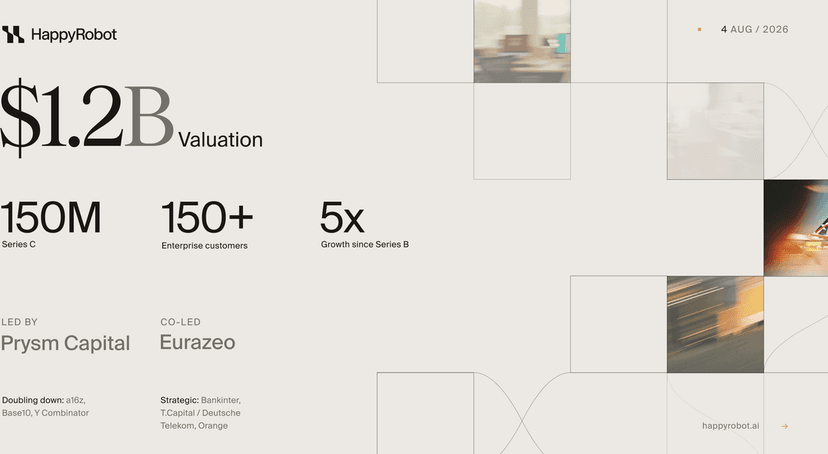
On August 4, 2026, the company that places that call for you became a unicorn. HappyRobot announced a $150 million Series C co-led by Prysm Capital and Eurazeo at a $1.2 billion post-money valuation, bringing total funding to roughly $200 million. Here's the deal, though: the number that should get your attention isn't the dollar amount. It's the clock. A $15.6 million Series A in December 2024. A $44 million Series B in September 2025. A $150 million Series C in August 2026. Three rounds in twenty months, ending at unicorn.
And the three founders are Spanish. Two of them are brothers. The third met one of the brothers on the second day of college in 2012.
How an auto-labeling startup ended up answering freight calls
None of this started in logistics. CEO Pablo Palafox holds a PhD in computer vision and worked on autonomous systems at Meta's Reality Labs. Co-founder Luis Paarup met him on day two of university in Spain back in 2012; he now runs product and engineering. The third co-founder, Javi Palafox, is Pablo's brother and took operations and early sales.
They incorporated in San Francisco in 2022 and got into Y Combinator's Summer 2023 batch with an auto-labeling tool for computer vision datasets — an idea that fit their doctorates perfectly and that roughly twenty other companies in that batch could plausibly have been building. After demo day, it went nowhere. So the team went somewhere completely different: the phone calls, emails, and paperwork that freight brokers grind through all day.
Understanding that pivot is half of understanding this story. Late 2023 was the moment large language models crossed from "writes plausible sentences" to "executes a defined procedure," and it was simultaneously the moment real-time speech synthesis and recognition costs fell off a cliff. What the founders went looking for wasn't work AI is good at. It was work AI had just barely become capable of, that is too expensive for humans to do at volume, and where the counterparty doesn't use software at all. Freight phone work sits precisely in that intersection.
Palafox's line to Fortune captures how that felt in practice: compared to what you see in a research lab, "the truth is a lot more messy." The hard part of call automation was never model quality. It's exception handling in the real world. The driver picks up on a loud highway. He code-switches between Spanish and English. He answers a question with a question. Asked for an ETA, he says "eh, running late." Converting that into structured data a transportation management system will accept is the actual product.
The cap table traces the growth path cleanly. The $15.6 million Series A in December 2024 was led by a16z. The $44 million Series B in September 2025 was led by Base10 Partners, with a16z, Array Ventures, Avra, Samsara Ventures, Tokio Marine, WaVe-X, WiL, and YC participating, bringing the total to $62 million. At that point the company had more than 70 enterprise customers, with DHL, Ryder, Schneider, and Werner among the named ones.
Then the character of the investor list changed at the Series C. Prysm Capital and Eurazeo co-led. New investors included Koch Disruptive Technologies, K Fund, Orange Ventures, T.Capital (Deutsche Telekom), Bankinter, Endeavor Catalyst, and WaVe-X. Existing backers a16z, Base10, and Y Combinator all came back in.
That list isn't money. It's a map. Koch Disruptive sits inside Koch Industries, which physically operates manufacturing, energy, and logistics assets. Orange and Deutsche Telekom's T.Capital are telecom carriers. Bankinter is a Spanish bank. WaVe-X is the corporate venture arm of Austria's WALTER GROUP, whose subsidiary LKW WALTER is one of Europe's largest road freight operators. In other words, a substantial share of this round came from prospective customers and distribution channels rather than pure financial investors — a composition that lines up exactly with the company's stated plan to take what it proved in logistics into telecom, energy, and financial services. Thomas Muscher, managing director at WaVe-X, summed up the strategic read: "Most AI startups solve single topics. HappyRobot replaces entire chains — emails, calls, calculations, decisions."
Why automating one phone call is a $1.2 billion problem
In one line, HappyRobot sells a platform for assembling AI workers that perform enterprise operational tasks. It covers four interfaces: voice calls, email, document parsing, and web portal operation. That last one matters more than it sounds. A huge share of logistics work is logging into a shipper's or a warehouse's web portal to grab an appointment slot, and those portals almost never expose an API. So a human opens a browser. Freight is one of the few industries where having an agent drive the browser instead is a real, monetizable capability rather than a demo trick.
The operating metrics the company disclosed are unusually concrete. More than 150 enterprise customers, with DHL, Kuehne+Nagel, Uber Freight, and LKW WALTER named on the logistics side, plus Spanish energy majors Naturgy and Repsol outside it. One customer is automating 28,000 hours of work per month — at a 40-hour week that's roughly 160 full-time people. Customer care satisfaction averages 9.4 out of 10. The autonomous resolution rate, meaning conversations that close without a human stepping in, averages above 70%. Time from signature to a first agent running in production is 4 to 12 weeks. On the revenue side, the company points to sales teams seeing 5x lifts from channels they'd previously left unworked because nobody had the headcount.
The financials are half-disclosed. Per Fortune, revenue grew more than 5x in the under-twelve months since the Series B, and net dollar retention runs above 150%. One large U.S. supply chain customer expanded its contract 10x in a single year; others grew commitments up to 5x. What's missing is the absolute ARR number. More on why that matters in a moment.
| Item | Detail | Source |
|---|---|---|
| Founded | 2022, San Francisco (Pablo Palafox, Javi Palafox, Luis Paarup) | Fortune, FreightWaves |
| YC batch | Summer 2023; original product was computer-vision auto-labeling | Press reports |
| Series A | $15.6M, December 2024, led by a16z | PR Newswire |
| Series B | $44M, September 2025, led by Base10 Partners; $62M total | HappyRobot blog |
| Series C | $150M, August 4, 2026, co-led by Prysm Capital and Eurazeo | Business Wire, HappyRobot |
| Valuation | $1.2B post-money | Business Wire, Fortune |
| Total raised | ~$200M across three rounds in 20 months | FreightWaves |
| New investors | Koch Disruptive, K Fund, Orange, T.Capital (Deutsche Telekom), Bankinter, Endeavor Catalyst, WaVe-X | Business Wire |
| Returning investors | a16z, Base10, Y Combinator | Business Wire |
| Customers | 150+ (up from 70+ at Series B) | HappyRobot blog |
| Named customers | DHL, Kuehne+Nagel, Uber Freight, LKW WALTER, Naturgy, Repsol | HappyRobot, FreightWaves |
| Revenue growth | 5x+ since Series B; NDR 150%+ | Fortune (company-provided, unaudited) |
| Absolute ARR | Not disclosed | — |
| Automation scale | 28,000 hours/month at one customer | HappyRobot blog |
| Autonomy | 70%+ autonomous resolution, 9.4/10 satisfaction | HappyRobot blog |
| Deployment | First agent live in 4-12 weeks | HappyRobot blog |
| Offices | 2 → 8 across North America, Europe, LATAM, Australia | HappyRobot blog |
The most important row in that table is the blank one. Run the comparison and you'll see why. Germany's Parloa raised $350 million at a $3 billion valuation in January 2026, reportedly on $50 million-plus ARR. Bret Taylor's Sierra raised $950 million at $15.8 billion in May 2026 with roughly $200 million ARR. Both land in the 60-80x revenue range. If HappyRobot got a comparable multiple, its ARR would be somewhere around $15-20 million; at a more sober 25-30x, it'd be $40-50 million. Only the company knows which. That's not a scandal — it's normal at this stage — but when you look at $1.2 billion, remember there is no audited revenue figure sitting behind it.
One more thing. Palafox's quote on this round is short but points directly at where the company thinks it's going: "Getting agents to do work is the starting point, not the destination." And Prysm Capital partner Kerry Wei's framing explains the destination — what HappyRobot built, in his words, is "the missing link: governance, interfaces, and context layer." That sentence is the whole investment thesis. Anybody can buy a model that holds a decent phone conversation via API now. What's actually sellable is the plumbing that connects that model to a company's real systems, rules, and history so it can work safely.
Who actually gets something out of this
The most direct beneficiaries are logistics operations teams squeezed on headcount. Freight brokerage is structurally thin-margin — net margin on gross revenue often lands in single-digit percent — and labor is a huge slice of cost. Replacing an overnight check-call desk with agents drops straight to operating income. On top of that, the freight downturn that started in 2022 already forced brokers to cut as deep as they could. "We can't hire more people and the work isn't shrinking" is about the best sales condition software will ever get.
The second beneficiary is revenue channels that were sitting fallow, and this is the more persuasive argument. Every brokerage has work it doesn't do because nobody has time to make the calls. Example: dialing 3,000 small carriers you haven't traded with in six months to ask what capacity they have open. Do that with humans and labor cost exceeds expected revenue, so nobody does it. An agent does all 3,000 overnight. The examples the company cited at the Series B — better than 100x returns in collections, 19x-plus ROI on outbound sales, 5x on carrier sales — follow that logic. Those are individual customer results supplied by the vendor, so don't generalize them, but the direction is unambiguous: the real selling point of AI workers is not layoffs, it's the work nobody was doing. Layoffs trigger unions and internal politics. Work nobody was doing has no defenders.
Third: investors, and here the math gets interesting. Net dollar retention of 150% means existing customers spend half again as much a year later — revenue grows 1.5x annually even if new sales go to zero. Why does that happen? Because of how the product lands. A first deployment usually starts with one job, often check calls. When that works, appointment scheduling gets bolted on, then collections, then quote handling. LKW WALTER reportedly runs five to ten live use cases spanning dispatching, collections, and support. This company expands by type of work, not by seat count. That's the shape software investors like most.
There's also a group this round made life harder for: single-workflow startups. There are several companies doing only freight calls, or only quote-request emails. The moment HappyRobot shows up with 150 customers, $200 million raised, and the word "platform," their positioning narrows. Quili Peña, HappyRobot's head of strategy and operations, put the confidence plainly to FreightWaves: the earlier rounds were "more of a bet on the future," while growth rounds are "more fuel to continue delivering value."
And don't skip the cost structure. A 4-to-12-week deployment window is another way of saying forward-deployed engineers have to sit with the customer. That's exactly why the company says it's hiring simultaneously across engineering, deployment, and go-to-market. This model grows early revenue fast, but gross margin comes in lower than pure SaaS, and model inference plus telephony costs land directly in cost of revenue. For $1.2 billion to make sense, deployment has to get closer to self-serve over time and that ratio has to improve. It hasn't been proven yet.
Why Convoy died and C.H. Robinson didn't
Logistics tech has already been burned once, badly. Exhibit A is Convoy. Founded in 2015 by Amazon alumni Dan Lewis and Grant Goodale, the digital freight broker peaked at a $3.8 billion valuation with Jeff Bezos and Bill Gates on the cap table. It shut down in the fall of 2023. Flexport bought the assets for roughly $16 million and kept about fifty employees. Lewis attributed the collapse to "a massive freight recession and a contraction in the capital markets." The epilogue stings more: Flexport resold that technology stack to DAT Freight & Analytics for roughly $250 million less than two years later. The technology was worth something. The business model couldn't survive the cycle.
Convoy's failure separates what HappyRobot should learn from what it shouldn't. Convoy tried to replace brokers — it became the broker, matched shippers to trucks itself, and took the margin. When freight rates collapsed, the margin vanished with them. HappyRobot sells to brokers. Rates go up or down, the calls still have to be made, and a bad market actually increases the cost pressure that makes the software easier to sell. That positioning difference is this company's single biggest structural advantage. It's not full immunity, though. If pricing is usage-based, falling freight volumes mean fewer calls, and customers who go under take their contracts with them.
Now the success case. C.H. Robinson is the sharpest one, and it's instructive because the company didn't buy a startup's tool — it built its own. Robinson announced it had performed over three million logistics tasks with a fleet of more than 30 generative AI agents, delivering price quotes in 32 seconds, processing orders in 90 seconds, and automating appointments across more than 42,000 locations. Analyzing truckload shipments from January 2024 through January 2026, the company reported that loads where AI handled orders and appointments moved 11% faster to market on average and as much as 23%, saw on-time pickups improve 7% on average and as much as 35%, and cut unnecessary return trips from missed pickups by 42%. Fortune reported the company realized a 45% productivity gain from its AI agents.
That case is a double-edged sword for HappyRobot. The good edge: the industry's largest player proved, on someone else's dime, that AI agents genuinely work in freight operations. The bad edge: a company that could have been the single biggest customer chose to build instead. In logistics, the larger the operator, the more data and in-house engineering it has, and the stronger the incentive to build. That HappyRobot's customer list spans giants like DHL and Kuehne+Nagel as well as mid-market brokers is genuinely interesting — but the real test is what happens when a giant tries to move from pilot to company-wide rollout.
A third lesson comes from a different angle. Fleet telematics companies like Samsara and Motive became large public businesses by putting hardware on trucks, accumulating data, and then selling software on top. The takeaway is that in logistics software, what decides the winner isn't features — it's position in the workflow. Whoever owns a chokepoint everyone passes through daily eventually sells everything else too. If HappyRobot stays a "call automation tool," it's a swappable component. If it becomes the system of record where operational decisions accumulate, it's very hard to rip out. That's precisely why the company insists on the phrase "AI operating system."
The competition isn't standing still
The first line of counterattack comes from other logistics-vertical startups. FleetWorks raised $17 million total, including a $15 million Series A led by First Round Capital, and sells AI carrier reps that take 100% of inbound calls for smaller brokers who need round-the-clock coverage. Vooma pulled together more than $16 million across seed and Series A led by Index Ventures and Craft Ventures, starting from quote-request email handling and expanding out. Neither can match HappyRobot dollar for dollar at roughly a tenth of the capital, but going deeper in a narrow lane and competing on price is a live strategy. The fact that Vooma runs public comparison pages against both HappyRobot and FleetWorks tells you the temperature of this market.
The second line is horizontal agent platforms. Sierra raised $950 million at $15.8 billion in May 2026 and crossed $200 million ARR, with more than 40% of the Fortune 50 reportedly as customers. Parloa took $350 million at $3 billion in January 2026 with customers like Allianz, Booking.com, and SAP. Decagon has reportedly been in discussions above $4 billion. Their pitch is "we're industry-agnostic." HappyRobot's counter-pitch is that freight work isn't a contact-center script, it's operational execution, and you can't do it without domain knowledge. That fight is unresolved. But note that Sierra and Parloa are already inside telecom and financial services — meaning when HappyRobot walks out of logistics into those verticals, it isn't walking into an empty field.
The third line is incumbents building in-house, which we just covered with C.H. Robinson, and Uber Freight pushing its own AI features. What matters here is that these firms are customers and competitors simultaneously. Uber Freight appearing on HappyRobot's customer list reads as a strength, but if large shippers and brokers grow internal teams, contracts stall at pilot scale. Enterprise logistics IT has a long-established pattern: buy it, try it, then build our own version.
The fourth line is the model providers themselves. Real-time voice APIs keep getting better and cheaper, and the call interface itself is commoditizing fast. Two years ago "answers the phone naturally" was a product. Today it's table stakes. So the defensible ground for a company like HappyRobot isn't voice — it's everything behind voice. TMS integrations, the negotiating authority envelope a customer configures, audit logs, and the handoff procedure when things fail. Prysm's emphasis on "governance, interfaces, and context layer" is a description of exactly that perimeter.
The fifth line is the established logistics software vendors. TMS providers like McLeod and Turvo and visibility platforms like project44 already sit in the middle of a broker's daily workflow. If they ship agent features as standard, the contest becomes "free capability inside the system you already run" versus "a specialist product you have to procure separately." Observability, CRM, and security all went through this exact phase, and it usually ends with the specialist holding on via quality until it either gets acquired or becomes the category leader.
So what actually changes
For regular people, almost nothing changes directly. One indirect thing does: when you call a logistics company about a delayed delivery, the odds that a human answers are dropping fast. A 70%-plus autonomous resolution rate means seven of ten conversations end without a person — good news for hold times, and also a warning that your experience now hinges on the other three. Agent rollouts usually succeed or fail not on the 70% handled well but on how gracefully the stuck 30% gets escalated.
For developers and engineers, the product composition here is the lesson. HappyRobot isn't selling a new model. It's selling domain context, system integration, exception handling, and auditability layered on models anyone can rent. If you're building agents inside your own company right now, this is a four-year proof that the bulk of your time goes to those four things, not to prompts. Web portal automation in particular — driving a counterparty's API-less system through a browser — is spectacular in demos and hellish in production. Layouts change and selectors break, CAPTCHAs appear, sessions expire. How much engineering a company has poured into that is its real moat.
For enterprise decision-makers, three checks are worth doing now. First, build a list of work you don't do because you don't have the people, before you build a list of jobs to cut. It gets approval faster and the ROI math is cleaner. Second, put autonomous resolution rate and liability-on-error into the pilot contract as numbers. The 70% a vendor quotes is their customer average, not your workload's value. Third, read the data-return clause. The call transcripts and decision logs an agent accumulates become an asset over time, and who holds them in what format when the contract ends is the entirety of your next negotiation. Also do the calendar math: a 4-to-12-week deployment means a single pilot eats a quarter minimum, so if you want results inside this year, starting is a now decision.
For investors, two signals stand out. One is another confirmation of the pattern that vertical AI agents monetize before horizontal platforms do. Sierra and Parloa carry much larger valuations, sure, but HappyRobot ran three rounds in twenty months and produced a 150% NDR while doing it. Knowing a specific industry's procedures still pays. The other signal is the composition of this round. Koch, Orange, Deutsche Telekom, Bankinter, and the WALTER Group coming in together looks less like buying financial upside and more like buying strategic access. Rounds like that support the next round's price, but they also create the risk of the company getting tethered to a particular corporate ecosystem. And, to repeat: valuing $1.2 billion with no disclosed absolute ARR requires estimating a multiple, and an estimate is not a verification.
Compress the whole story into one sentence and it goes like this. Through 2023, the AI startup game was about who had the smartest model. In 2026 the game is about who will take responsibility for the boring work all the way to the end. That's why three computer-vision PhDs who abandoned auto-labeling to call truck drivers turned out to be right. Or as Palafox put it himself: getting agents to do work is the starting point, not the destination.
🥄 Three Things You're Probably Wondering
— So what does this mean for me? Almost nothing directly. But if you manage repetitive phone or email work at your company, odds are good you'll get a pitch to replace the tooling for it within a year or two. The question to judge it on isn't "is the AI good," it's "is our org ready to catch the 30% it can't finish."
— Why is this happening now? Through 2023, real-time voice AI was demo-grade and call costs were high. In 2025-2026 model quality and unit cost crossed their thresholds at the same time, which made "placing the call for you" a business with actual arithmetic behind it — and it happened while the freight downturn had logistics companies unable to add headcount. Technology curve met industry conditions. C.H. Robinson announcing three million-plus tasks handled by its own AI agents in 2025 is the same clock ticking.
— Is it ahead of companies like Sierra or Parloa? No, the scale is different. Sierra was at roughly $200M ARR and a $15.8B valuation as of May 2026, and HappyRobot hasn't even disclosed its absolute ARR. Inside the narrow lane of logistics, though, it's ahead on domain knowledge and customer roster, and 150% net dollar retention is a strong signal that accounts expand once they're in. Whether that edge travels into telecom or energy is an experiment that just started, so it's too early to call.
Sources
- HappyRobot — We've Raised $150 Million in Series C Funding
- Business Wire — HappyRobot Raises $150 Million Series C to Build Enterprise Superintelligence
- Fortune — HappyRobot is worth $1.2 billion. Its founder says it's just 'getting started'
- FreightWaves — HappyRobot Series C mints FreightTech's newest unicorn
- Tech.eu — HappyRobot lands $150M Series C to scale agentic AI for enterprise operations
- HappyRobot — HappyRobot Secures $44M to Scale Enterprise AI Workforces (Series B)
- PR Newswire — HappyRobot Raises $15.6 Million Series A Funding Led by a16z (Series A)
- C.H. Robinson — In-House Tech and AI Agents Expand Impact
- C.H. Robinson — AI Performs Over Three Million Shipping Tasks
- Fortune — C.H. Robinson achieved a 45% productivity gain with AI agents
- GeekWire — Flexport buys Convoy's tech; Convoy CEO Dan Lewis to join Flexport
- Supply Chain Dive — Flexport buys Convoy's tech stack, plans to relaunch truckload service
- TechCrunch — Parloa triples its valuation in 8 months to $3B with $350M raise
- DC Velocity — Startup gets $16 million to fund its AI tool for freight brokers (FleetWorks)
- Business Wire — Vooma Scores Over $16 Million in Seed and Series A Funding Led by Index and Craft Ventures
- Supply Chain Dive — CH Robinson expands AI use for LTL quotes, capacity acquisition
Numbers and criteria are as of announcement and may change. Investment calls are yours to make!