In a single day, OpenAI tried to push ChatGPT from "chatbot" to "coworker" — and shook three markets at once
On July 9, OpenAI held its second livestream of the week under the banner "the next chapter for ChatGPT," and dropped three things at once. There's ChatGPT Work, a work agent with Codex baked in that runs multi-day projects on its own. There's GPT-Live-1, a full-duplex voice model that listens and speaks at the same time. And there's Sites, a beta that spins up dashboards, reports, and web apps just from a chat. Add the GPT-5.6 model family (Sol, Terra, Luna) that shipped to general availability the same week, and OpenAI basically overhauled its entire product front in four days.
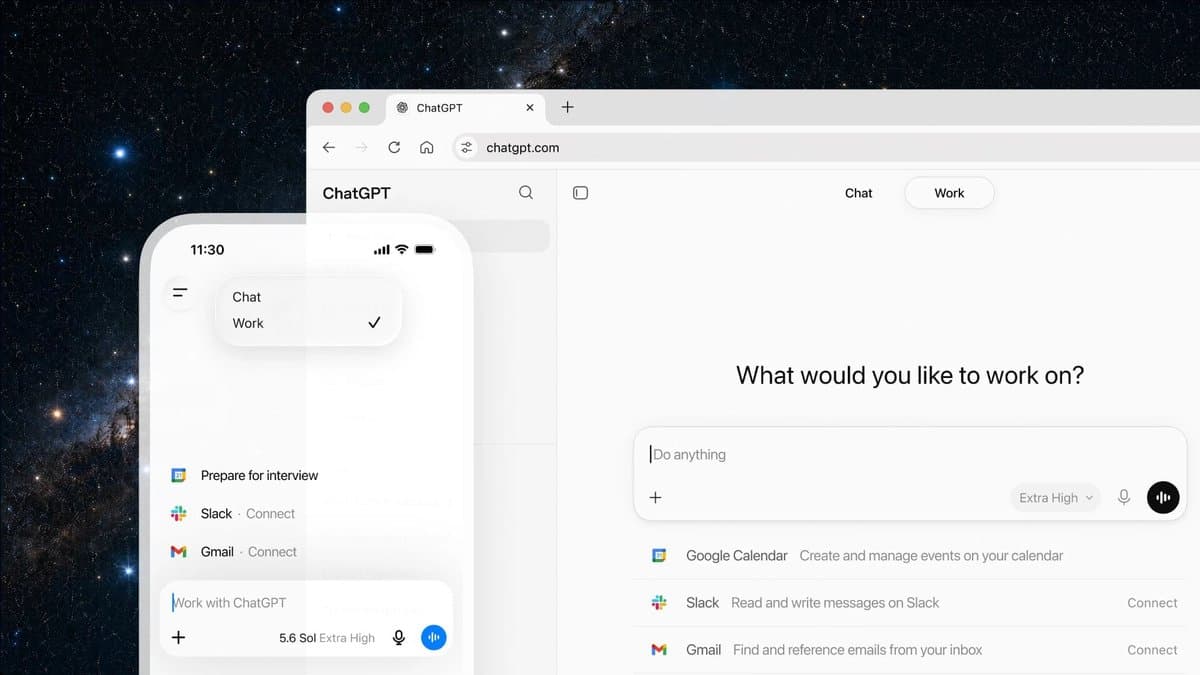
Here's the deal: the message is singular. OpenAI wants to turn ChatGPT from "a chatbot that answers when asked" into "a coworker that brings back finished work." You hand ChatGPT Work an outcome, it digs through your connected apps and files to gather information, breaks the job into steps, and stays on it for hours — returning finished spreadsheets, docs, slides, and even shareable web apps. Schedule it, and it runs while you sleep. This is OpenAI charging straight into the "agents ship finished deliverables" lane that Anthropic's Claude Cowork and Microsoft's Copilot Cowork have been pushing for months.
And here's why this is the top story of the day: each of the three products targets a different battlefield. ChatGPT Work goes after the enterprise-agent market, GPT-Live after the voice-interface market, and Sites after the no-code app-builder market. In one day, OpenAI knocked on three castle gates that different companies used to guard alone. Whether all three land is genuinely too early to call. But the direction is unmistakable: OpenAI is trying to move the axis of competition away from "how smart is it" toward "how completely does it finish the job."
Meet the cast: OpenAI, ChatGPT Work (+ Codex), GPT-Live, and Sites
First, OpenAI. The company needs no introduction, but the number does: in May 2026, ChatGPT crossed one billion monthly active users — faster than Google Maps, TikTok, Instagram, or YouTube, the fastest any app has ever reached that milestone. Its user base is overwhelming, but the catch is that most of those billion still use it the "ask a question, get an answer" way. OpenAI needs to pull that enormous pool into deeper (read: more monetizable) uses, and these three products are the answer.
Second, ChatGPT Work — the real star of this show. It's an agent that lives inside ChatGPT, and it absorbs Codex, the coding agent, so it handles not just code but general knowledge work autonomously. It runs across web, mobile, and desktop; it can touch local files and apps directly or crawl the web with a built-in browser; and it connects to external apps and systems through plugins. The interesting move: OpenAI folded the standalone Codex app on Mac and Windows into the ChatGPT desktop app. Chat, Work, and Codex now run inside one app. The line between developer tooling and general work tooling just got erased.
Third, GPT-Live — the voice story. GPT-Live-1 and GPT-Live-1 mini are full-duplex voice models, and "full-duplex" is the whole point. The old voice mode was walkie-talkie style (half-duplex): you speak, it listens, and when you're done, it replies. GPT-Live can listen and speak at the same time. It drops in cues like "mhmm," "yeah," or "right" while you're mid-sentence, yields naturally when you cut in, and stays quiet while you think. It makes the "should I speak or listen right now" decision several times per second, so the conversation flows the way a human one does.
Fourth, the Sites beta. It shipped quietly, but the potential isn't small. Sites builds interactive sites and web apps from a chat — reports, live dashboards, the lot — you describe it and it appears. It also acts as the exit ramp for ChatGPT Work, turning its output into a shareable web app. That's OpenAI slipping a foot into a market that Vercel's v0, Google's various no-code tools, and a crowd of app builders already guard.
What each product actually is, and how it works
Start with ChatGPT Work. The flow goes like this: you hand over an outcome. Say, "clean up this quarter's sales data and make me an exec-ready slide deck and a dashboard." ChatGPT Work then scrapes information from your connected apps (CRM, spreadsheets, docs), breaks the job into multiple steps, and executes each one on its own. For complex projects it stays on the task for hours. The output isn't a draft — it's finished sheets, slides, docs, and shareable web apps. Scheduling lets you say "run this every Monday morning," and because it runs in the background, you can check progress from your phone. The concept is nearly identical to Anthropic's Claude Cowork, except OpenAI layers on a billion-user base and Codex's coding chops.
The engine under ChatGPT Work is GPT-5.6. This model family, released to general availability the same week, has an unusual naming scheme. The flagship is Sol (state-of-the-art in coding, knowledge work, cybersecurity, and science), the balanced everyday model is Terra (GPT-5.5-class but cheaper), and the cost-efficient one is Luna. OpenAI claims GPT-5.6 makes a step change specifically in "design judgment" — producing "tasteful, ergonomic, and functional interfaces." API pricing runs Sol at $5 input / $30 output per 1M tokens, Terra at $2.50 / $15, and Luna at $1 / $6. There's also an "ultra" acceleration mode that coordinates multiple agents to grind through heavy work (Pro and Enterprise only).
GPT-Live's architecture is all about delegation. GPT-Live itself is not a frontier reasoning model — its specialty is keeping conversation smooth. So when a request needs web search, deep reasoning, or multi-step work, it hands off to GPT-5.5 in the background. GPT-Live-1 (instant) and mini use GPT-5.5 Instant; GPT-Live-1 Medium/High use GPT-5.5 Thinking at medium and high reasoning effort. GPT-Live carries the conversation while a heavier model does the number-crunching behind it — a division of labor. Human testers "strongly preferred" GPT-Live-1 and mini over the old Advanced Voice Mode across five-to-ten-minute conversations (rated on turn-taking, interruptions, flow, and naturalness), and automated benchmarks showed gains on GPQA (expert-level science reasoning), BrowseComp (agentic web search), and τ³-Voice Telecom (multi-turn support).
The Sites beta is thin on published specs, but the concept is clear: build dashboards, reports, and web apps by chatting, and serve as the export path for ChatGPT Work's deliverables. Here's how the three (plus GPT-5.6) shake out.
| Product | What it is | Engine | Launch / availability |
|---|---|---|---|
| ChatGPT Work | Autonomous work agent with Codex baked in (web/mobile/desktop, scheduling, background runs) | GPT-5.6 (Sol/Terra/Luna, ultra mode) | Desktop for all plans today; web & mobile rolling out to Plus, Pro, Business, Enterprise, Edu within days |
| GPT-Live-1 / mini | Full-duplex voice model that listens and speaks at once (backchannels, interruptions, translation) | Conversation native; reasoning delegated to GPT-5.5 Instant/Thinking | July 8, global rollout in ChatGPT. Paid default = GPT-Live-1, free default = mini. API later |
| Sites beta | Builds interactive sites, dashboards, and web apps from a chat | Wired to ChatGPT / GPT-5.6 | Shipped as beta alongside the others |
| (context) GPT-5.6 | Frontier model family | Sol / Terra / Luna | Rolling out across ChatGPT, Codex, and API from launch day |
Who gains what here
What OpenAI gains is usage time and lock-in. ChatGPT has a billion users, but for most of them it's a "occasionally I ask it something" tool. Start handing it hours-long projects via ChatGPT Work, and the story changes. Once it's wired into your CRM, your spreadsheets, your files, and you've stacked up weekly auto-running workflows, switching gets hard. OpenAI is repositioning from "a few questions" to "work infrastructure," and that makes the case for Plus/Pro/Business/Enterprise subscriptions far sturdier. Voice does the same: making GPT-Live-1 the paid default and mini the free default turns voice into a conversion lever.
What developers and power users gain is Codex's expansion. Codex started as a coding agent; now it's absorbed into ChatGPT Work and handles work beyond code autonomously. With the desktop app merged, Chat, Work, and Codex live in one place, so a developer can go from writing code to having the same agent build docs, slides, and dashboards. Add Sites, and "write code → ship a deployable web app" collapses into a single line of chat. That blurred boundary between dev tooling and work tooling is a convenience — and a threat (more on that below).
What enterprises gain is finished-deliverable shipping. Until now, in-house AI mostly produced drafts, and a human did the real work of cleaning and polishing. ChatGPT Work aims one step further: the finished result — sheets, slides, docs, even shareable web apps. Scheduling automates repetitive work so people can focus on review and judgment. Whether it works as advertised, and how safely it handles company data, is still to be proven. But the direction is exactly the picture enterprises have wanted for a long time.
Past cases: the wins and flops of agent and voice products
History says launches like this don't all land. Take the agent rush of 2025–2026. In April 2026, five big-tech firms shipped enterprise AI agents almost simultaneously — Anthropic's Claude Cowork, Microsoft's Copilot Cowork, Google, and OpenAI. Copilot Cowork hit general availability on June 16, and here's the twist: it runs not on Microsoft's own MAI models but on Anthropic's Claude Opus 4.8 and Sonnet 4.6 as its primary engines. It's a neat illustration that as the agent race heats up, the decider is "whose model actually finishes the job." ChatGPT Work will be judged by that same yardstick.
Voice history carries plenty of lessons too. OpenAI's Advanced Voice Mode was a sensation at its 2024 demo, but after release, latency, cutouts, and awkward turn-taking earned it "not as natural as the demo" reviews. Google Assistant and Amazon Alexa poured in years of investment yet never escaped setting timers and checking the weather. Voice is a domain where the gap between "technically works" and "people actually use it every day" is unusually wide. GPT-Live claims full-duplex closes that gap, but the real verdict comes from daily use.
No-code app builders tell a similar tale. The market Sites targets was already crowded by Vercel's v0, Google's no-code tools, and a pile of app builders. In demos, everyone conjures a slick web app; the split came from whether you can reliably produce something production-worthy. "Build an app by chatting" is a great demo, but the real contest is the boring stuff — maintenance, security, scalability. That Sites launched as a beta is itself a signal OpenAI still treats it as an experiment.
How rivals counter-play: Anthropic, Google, Microsoft, xAI
Anthropic was already ahead. Claude Cowork runs inside the Claude desktop app on Mac and Windows, touching local files directly, generating documents, and running scheduled workflows; in February 2026 it reached full feature parity on Windows. Claude posted a scary curve — 56 million monthly active users in Q2 2026, up roughly 640% year over year. The decisive edge is that Claude Cowork handles local files directly. ChatGPT's agents have traditionally been web- and browser-centric with weak local-file access. That ChatGPT Work now emphasizes touching local files and apps directly is precisely an attempt to plug that hole — and it's aimed squarely at Claude Cowork.
Microsoft sits in a strange spot. It shipped Copilot Cowork in June, but the engine is Anthropic's Claude. So Microsoft — an OpenAI shareholder — runs its flagship agent on a competitor's model, an odd triangle. If OpenAI pushes ChatGPT Work as an enterprise work agent, it collides head-on with Microsoft's distribution muscle baked deep into Office 365. Microsoft is strong on distribution (Windows, Office, Teams); OpenAI is strong on model and brand. How their relationship realigns in that overlapping zone is the thing to watch.
Google counters with integration. Gemini Enterprise, launched in October 2025, is a unified AI interface wired deep into Google Cloud and Workspace (Gmail, Docs, Sheets). Google's weapon is distribution: planting AI inside productivity tools billions already use. On voice, Google has long experimented with Assistant and Gemini Live. If OpenAI shakes voice again with GPT-Live, Google will fire back through the entry points of Android, Chrome, and Search. xAI (Grok) trails on all three fronts for now, but with X-platform integration and fast iteration it's a wildcard that could break in anytime.
Bottom line: OpenAI pushes with "model intelligence + a billion users + brand," Anthropic leads on "local-file handling + developer trust," Microsoft defends with "Office distribution," and Google with "Workspace and Android distribution." This launch shoves on all three fronts (agents, voice, app builder) at once — but the trap is that each front already has an entrenched leader. Dropping three in a day is bold, but winning all three means beating an incumbent in each. Whether that happens is too early to call.
So what actually changes: for workers, developers, and enterprise buyers
For workers, the biggest shift is going from "get a draft and polish it myself" to "get a finished product and review it." If ChatGPT Work performs as advertised, you can schedule repetitive data cleanup, report writing, and data aggregation to run while you sleep. Your role moves from "the maker" to "the reviewer and judge." Voice (GPT-Live) lands in daily practice too — dictate instructions on the move while the AI hands heavy work off to GPT-5.5 in the background. The catch: whether your company allows those data connections is the gatekeeper, so individuals may not get to use all of it right away.
For developers, with Codex absorbed into ChatGPT Work and the desktop app merged, the line between coding and general work disappears. You can have the same agent go from writing code to producing docs, slides, and Sites web apps, shortening the workflow. But it's double-edged: an agent that autonomously handles work beyond code means the relative value of "coding itself" keeps getting squeezed. That OpenAI stresses GPT-5.6's improved "design judgment" is a signal too. We're accelerating toward an era where whoever wields the tools best wins. Worth pre-reading the API pricing (Sol 5/30, Terra 2.5/15, Luna 1/6) when you plan projects.
For enterprise buyers, this is prime comparison-shopping season. ChatGPT Work, Claude Cowork, and Copilot Cowork all make nearly the same promise ("ship finished deliverables"), so the decision comes down to three things. One: how safely it connects to your data and apps. Two: whether the output is genuinely no-touch-needed quality. Three: distribution fit (compatibility with the Office 365 or Google Workspace you already run). The wrinkle is that, as with Copilot running on Claude, "brand" often isn't "actual engine." So don't fall for demos — run a pilot on your real work. Too early to be certain, but it's nearly guaranteed these three agents sit at the center of the second-half enterprise AI budget fight.
🥄 Three Things You're Probably Wondering
— So what does this mean for me? Right away: if you're on paid ChatGPT, voice gets noticeably more natural with GPT-Live-1 (free users get mini), and for work you can schedule an agent to run repetitive tasks. But ChatGPT Work's real power shows up only when it's wired into company data and apps — so if your employer doesn't allow it, what an individual can feel is limited.
— Isn't this just demo magic? Does it actually finish the job? Honestly, that's the core question, and it's too early to call. There is data that human testers clearly preferred the voice over the old mode. But whether ChatGPT Work finishes complex, hours-long projects without human hand-holding will only be clear in real use. Advanced Voice Mode had a flashy demo too, and the reality underwhelmed.
— Should I use this instead of Claude Cowork or Copilot? With all three making nearly the same promise right now, there's no automatic "use this one." Anthropic leads on local-file handling, Microsoft is strong on Office distribution (though the engine is Claude), and OpenAI's weapons are a billion users plus the GPT-5.6/Codex integration. If your workflow is web-centric, ChatGPT Work may fit; if it's local-file-heavy, Claude Cowork might. In the end, piloting on your real work is the only real answer.
Sources
- Introducing GPT-Live | OpenAI
- ChatGPT Work with GPT-5.6 | OpenAI
- GPT-5.6: Frontier intelligence that scales with your ambition | OpenAI
- Previewing GPT-5.6 Sol: a next-generation model | OpenAI
- OpenAI Debuts ChatGPT Work Agent and New GPT-5.6 Models | MacRumors
- OpenAI Releases GPT-Live and GPT-Live-1 mini: Full-Duplex Voice Models | MarkTechPost
- OpenAI unveils ChatGPT Work agent, GPT-5.6 models now available | 9to5Mac
Numbers are as of announcement and may change.