The word the president reached for was "computer cram school"
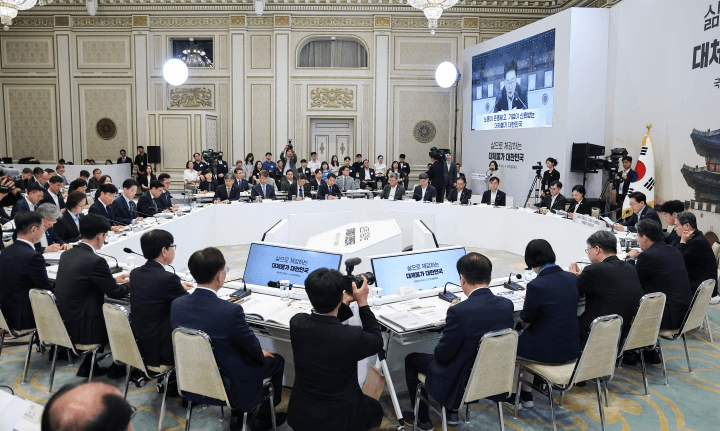
August 5, afternoon, Yeongbin Hall at the Blue House. The Ministry of Education, the National Education Commission, the Ministry of Culture, Sports and Tourism, and the Korea Heritage Service were there to report their second-half plans. Most of the session went to college-entrance exam reform and regional universities. Then President Lee Jae-myung reached back three decades. When personal computers first spread across Korea, he said, computer cram schools sprang up everywhere and did a decisive amount of work in getting the country digitized.
Then he attached a conclusion to the memory: "We have to create an AI usage boom by whatever means." Not just in schools, he said — ordinary citizens need everyday opportunities to use AI and everyday opportunities to learn it. In the same session he put it more plainly: "In the age of artificial intelligence, every citizen should be given the opportunity to learn how to use AI," and "AI education should be strengthened, deepened, and expanded."
The load-bearing sentence came next. "To live in this world, people need means of production. Now a revolutionary new production tool called AI has appeared, one we've never seen before." That's the frame that matters. The president did not describe AI as a useful skill worth picking up. He described it as a means of production. And if access to a means of production splits the population, that stops being an education gap and becomes a class problem. That's the logic underneath "give it to everyone."
Here's the honest caveat: the statement itself is not new. This administration has run on an "AI top-three power" slogan since taking office, and universal AI education was already scattered across several ministries' work plans. What's new is where the emphasis landed. Korea's AI spending is overwhelmingly tilted toward supply — chips, data centers, domestic models — and the president chose that exact moment to ask who is actually using any of it. Read it as a signal that the scorecard is shifting from how many GPUs were bought to how many people can operate them.
There's a shadow attached, too. Under the previous administration Korea spent 1.4093 trillion won over three years building AI digital textbooks, and in December 2025 the Board of Audit and Inspection reported that the average usage rate came in at 8.1%. Sixty percent of students never logged in once. That's why "AI education for every citizen" doesn't land as a purely inspiring phrase here. Korea has already fallen hard in this exact genre.
Two days, 27 agencies, and one word in every briefing book
Start with the venue. This round was branded "the second work report with the people," ran August 4 and 5, and put 27 ministries, agencies and commissions in front of the president with their second-half plans. The education block on the 5th brought the Ministry of Education, the National Education Commission, the culture ministry and the heritage service.
The education ministry's plan was titled "Education for everyone's future, an irreplaceable talent powerhouse." The headline the press pulled was the flagship regional-university program nicknamed "make ten Seoul National Universities" — pick three flagship national universities fast, fund branded colleges and convergence research institutes tied to each region's growth engine and to AI, and introduce two new mechanisms for aligning enrollment quotas with local industry demand. But the AI line items were dense in their own right. An "AI advanced research track" at every science high school and gifted school. AI-focus and AI-lead schools expanded to 4,000 by 2027. Broader basic AI coursework for undergraduates. An AI-assisted assessment system to be introduced by 2029.
The adult track is the more interesting part. The ministry told the president that starting next year, AI foundation courses will be folded into the Academic Credit Bank System and the self-study degree program — beginning with AI basic literacy and AI ethics, with roughly 400 credit-bank institutions expected to participate. The credit bank is how Korean adults who never attended university earn a degree. Planting AI courses there is, functionally, an attempt to reproduce the president's computer-cram-school model inside the formal system.
The president didn't confine himself to education. Pointing at the reality of every ministry building its own AI, he said: "Each ministry is building AI right now, and in the end this will get consolidated." He added that the whole chain of citizen complaint intake, classification, routing and resolution support needs to be upgraded onto an AI basis. Universal education and government system consolidation came out of his mouth in the same breath.
The exam reform thread belongs in the same reading. "Picking from multiple-choice options is something even a beginner-level computer could do easily," he said, and "continuing to educate people to be standardized isn't education, it looks more like ruining them." He also said that in the AI era, what matters is how well you can ask a question. The National Education Commission lined up its schedule accordingly: publish a college-admissions reform proposal in October, run a public deliberation process, finalize it in March 2027, and fold it into the long-range national education plan covering 2028 through 2037. Absolute grading for the national exam and school records, and the introduction of essay-format assessment, are both on the table.
The same word showed up elsewhere in the same week. In the public-administration block, the government said it would extend its intelligent work-management platform to 47 central agencies and train 20,000 AI specialists inside the civil service by 2030, plus pilot an automatic benefit-application service within the year so citizens receive entitlements without filing for them. The common language of this entire work-report cycle was AI. In the education session, the president pointed at the demand side of it.
The numbers tell a slightly different story
This is where figures circulating alongside the story need cleaning up. The "4.5 trillion won AI budget" number floating around is not the government-wide AI budget. Korea's 2026 baseline is much larger.
In the FY2026 budget proposal, the government allocated 10.1 trillion won to the "AI top-three power" transition — more than triple the 3.3 trillion won of the prior year. Inside that: 1.4 trillion won for securing AI talent, 2 trillion won to buy 15,000 additional advanced GPUs, roughly 900 billion won to embed AI into 300 everyday consumer products, and 200 billion won for AI adoption in the public sector. Narrow it to the Ministry of Science and ICT and the ministry's 2026 budget was finalized at 23.7417 trillion won, with the "AI transformation" line at 4.46 trillion won in the proposal; on a finalized basis the ministry's total AI transformation spend is 5.1 trillion won, about a fifth of its entire budget. Government-wide R&D landed at 35.5 trillion won, up 19.9% from 29.6 trillion won.
The "11,000 AI specialists" figure also deserves a translation. It does not mean 11,000 people taking an AI class. It's a target for high-end talent pipelines, delivered partly by growing AI and AI-transformation graduate schools from 19 to 24. The demand case behind it is concrete: Korea's AI workforce was estimated at roughly 57,000 people as of 2024, while the labor ministry projects shortfalls through 2027 of 12,800 AI specialists, 18,800 in cloud, and 19,600 in big data.
The GPU number is where sources diverge. "15,000 additional units" appears consistently. The cumulative figure does not — some material describes a running total of 37,000, other material describes reaching 50,000 by combining supplementary-budget purchases with private-sector co-investment. Different baselines, different counting. So this piece treats only "15,000 more, 2 trillion won" as settled.
| Item | Figure | Basis |
|---|---|---|
| FY2026 government "AI top-three" transition budget | 10.1 trillion won (vs. 3.3 trillion won prior year, more than 3x) | FY2026 budget proposal |
| Ministry of Science and ICT total FY2026 budget | 23.7417 trillion won (finalized, 74.6 billion won above proposal) | National Assembly final |
| Ministry "AI transformation" spend | 4.46 trillion won (proposal) → 5.1 trillion won (finalized total) | Ministry of Science and ICT |
| Additional advanced GPUs | 15,000 units / 2 trillion won | FY2026 budget proposal |
| AI talent target | 11,000 people (AI/AX graduate schools 19 → 24) | FY2026 budget proposal |
| AI education reach this year | 5.14 million people, across 12 ministries | Ministry work report, July 16 |
| Government-wide R&D | 35.5 trillion won (+19.9% YoY) | FY2026 finalized budget |
| Private AI data center investment to be catalyzed | 550 trillion won | Ministry work report |
Two numbers give the phrase "every citizen" any substance. The first is 5.14 million. In its July 16 second-half work report, the Ministry of Science and ICT said it would deliver AI education opportunities to 5.14 million people within the year in cooperation with 12 related ministries, including education and labor. The same report promised a general-purpose AI chatbot built on domestic models, offered to the public with no fees and no usage limits, and a "one AI agent per person" push starting next year.
The second number is far smaller. On August 3 the ministry launched a program called the "AI Growth Ladder for All." Deputy Prime Minister and Science Minister Bae Kyung-hoon showed up personally to frame the goal as "building an AI basic society where everyone can use AI and enjoy its benefits." The scale: up to 30,000 people by year-end. It has three pillars — an online learning platform, a vibe-coding sandbox, and physical offline hubs — and roughly 200 standout project teams get development resources worth 1 to 3 million won each. The National Information Society Agency and the Korea Foundation for the Advancement of Science and Creativity run it jointly.
| When | Universal / education AI milestone |
|---|---|
| January 22, 2026 | AI Framework Act takes full effect, with a grace period on investigations and fines |
| August 3, 2026 | "AI Growth Ladder for All" launches (up to 30,000 people by year-end) |
| H2 2026 | Broader undergraduate AI foundation courses; AI advanced research tracks at science and gifted schools |
| Within 2026 | 5.14 million people reached via 12-ministry collaboration; free domestic-model AI chatbot |
| October 2026 | National Education Commission publishes college-admissions reform proposal |
| March 2027 | Reform proposal finalized, folded into the 2028–2037 national education plan |
| 2027 | AI-focus and AI-lead schools expanded to 4,000; AI courses in credit bank and self-study degree tracks |
| 2029 | AI-assisted assessment system introduced |
| 2030 | 20,000 AI specialists in the civil service; new national assessment and test-development center |
Line the numbers up and one thing snags. The school-level targets don't match across documents. A November 2025 release said AI-focus schools would go from 730 in 2025 to 2,000 by 2028. A May 2026 document put AI-focus schools at 3,307 — 27.7% of all primary and secondary schools. The August 5 report said AI-focus and AI-lead schools combined would reach 4,000 by 2027. Whether you count "focus" alone or "focus plus lead" changes the number entirely, and once that happens, verifying performance later becomes very hard. That's the early stage of target inflation.
Who actually gets paid here
The biggest winner is the government's narrative. Korea's AI money is overwhelmingly on the supply side: 2 trillion won for 15,000 GPUs, 550 trillion won of private data center investment to be catalyzed, domestic foundation models. None of that is easy for a household to feel. You cannot win public support by counting data centers. Universal AI education fills that hole, and invoking computer cram schools was a precise political choice — that 1990s boom was built by the market, not the state, and the memory of it is broadly positive across generations.
The education ministry gets budget justification and a second chance. After the AI digital textbook program effectively collapsed under audit, the ministry restructured AI from one flagship textbook policy into a bundle of smaller distributed programs, with 334.8 billion won for state-backed AI talent development and science-and-engineering education support, plus new items like AI hub universities, AI-plus-domain bootcamps, and undergraduate AI foundation courses. Splitting the bet shrinks the size of any single failure. It also blurs accountability. Both effects arrive together.
The science ministry gets demand. Build a domestic model that nobody uses and it goes into the record as wasted budget. A free general-purpose chatbot and 5.14 million trained users are, among other things, a user-acquisition program for Korean models. The vibe-coding sandbox inside the Growth Ladder program fits the same logic: teach people, they use it; they use it, data accumulates; data accumulates, the model improves. That's a state-run data flywheel.
Regional flagship national universities are the most direct beneficiaries. Three get selected fast and receive package support for AI-branded colleges plus infrastructure costs including GPUs, with roughly 30 billion won cited for three institutions in 2026. There's also a plan to strengthen basic AI instruction for non-majors around those hubs and share strong courses and faculty with nearby universities. For regional universities that have spent years worrying about survival amid shrinking enrollment, AI is a new reason to exist.
Adult learners gain the least so far, and there's a measured number to prove it. The education ministry's adult-facing "AI and digital 30+" intensive camps and online course bundles drew 11,683 participants in 2025, and the operator base grows from 30 institutions to about 38 in 2026. Good programs. Still a long way from "every citizen." Same with 30,000 people by year-end in the Growth Ladder program. The gap between 5.14 million and the size of the actual intensive programs is where the real difficulty of this policy lives.
One party ends up ambiguous: the private tutoring industry. The computer cram schools the president invoked were private businesses. When a government says it will manufacture a usage boom, a large share of that boom flows to private academies and online course sellers. Add the essay-format exam debate and you get the conditions for a whole new tutoring category. Removing standardized education only to see standardized AI academies appear is an entirely plausible outcome.
The People's PC worked. The AI textbook didn't.
Korea's history of state intervention in mass digital literacy isn't short, and the results split violently.
The success case is the Kim Dae-jung administration's informatization drive. Coming straight out of the 1997 financial crisis, the government pushed broadband infrastructure and e-government while simultaneously running a "People's PC" program that put cheap desktops into ordinary homes. The state lowered the cost of access and let the market fill in the rest. The cram-school boom the president cited on August 5 was that market half. The lesson is specific: what the government did well was removing barriers to entry, not designing curriculum.
The failure case is recent and painful. AI digital textbooks consumed 1.4093 trillion won in development and preparation from 2023 to 2025. On December 17, 2025, the Board of Audit and Inspection reported that the program had been pushed through without gathering user input or running pilots, causing confusion in schools. Average usage: 8.1%. High school English, 1.5%. Middle school English, 2.4%. Sixty percent of students never logged in. Auditors also noted the adoption decision was made through seven internal meetings with no outside consultation, and recommended that any future new-format textbook be piloted for effectiveness first — advice that arrived after the money was gone.
In the ministry's 2026 plans, those textbooks lost their "textbook" designation and became "educational materials." The language changed; in practice, the program was shelved. And the core failure was not technical. Teachers couldn't find a reason to use the thing, and nothing happened if they didn't. Universal AI education sits on exactly the same trap. Counting how many courses opened is easy. Counting whether the person who took the course still uses AI the following week is not, and nobody is currently promising to.
There's a useful long-running foreign experiment too. Singapore's SkillsFuture started in 2015 by giving every citizen aged 25 and over a lifelong-learning credit, and in 2024 added a top-up worth S$4,000 for those aged 40 and up. After a decade, its main lesson is that you don't hand out one credit and walk away — the credits get renewed and the approved course catalog gets rebuilt against industry demand, repeatedly. The recurring failure pattern in other countries is the mirror image: hit the enrollment target in year one when the budget is fresh, then quietly disappear in year two. Which way Korea's 5.14 million goes will be visible in the 2027 budget documents.
China mandated eight hours. America offered incentives.
Universal AI education is not a Korean idea. It's now a category of national competition, and the approaches differ sharply.
China pushed hardest. Its education ministry issued 2025 guidelines for general AI education in primary and secondary schools alongside guidelines for generative AI use, and Beijing required every primary and secondary school to deliver at least eight hours of AI instruction per year starting September 1, 2025 — making AI literacy compulsory from age six. Hangzhou went further at ten hours. Schools may fold the material into existing STEM subjects or run it as standalone modules, but the hours are non-negotiable. Mandating hours makes compliance easy to measure. It also risks pure box-ticking.
The United States took the opposite route. On April 23, 2025, President Trump signed Executive Order 14277, "Advancing Artificial Intelligence Education for American Youth," creating a White House Task Force on AI Education chaired by the OSTP director and including the secretaries of Education, Agriculture, Labor and Energy plus the Special Advisor for AI and Crypto. The instruments are incentives rather than mandates: declare AI literacy a national educational priority across all grade levels, have the Labor Department launch AI-related Registered Apprenticeships, encourage dual-enrollment AI certification in high schools, make AI a focus area for federal fellowships and scholarships, and run a Presidential AI Challenge. That design reflects a hard constraint — the federal government can't set curriculum.
Korea sits in between. On the school side it looks Chinese: AI-focus and AI-lead schools to 4,000 by 2027, AI advanced research tracks at science and gifted schools, wider undergraduate AI coursework. On the adult side it looks American: AI courses inserted into optional credit-bank and self-study degree paths, plus a free chatbot and an online learning platform to cut the cost of trying. But there's a decisive difference. Nothing on the Korean adult side resembles China's eight-hour floor — a verifiable minimum standard. 5.14 million is an aggregate target, not a standard.
| Dimension | Korea | China | United States |
|---|---|---|---|
| Primary instrument | Budget allocation plus cross-ministry programs | Mandated minimum instruction hours | Executive order plus incentives |
| School benchmark | 4,000 AI-focus/lead schools by 2027 | 8+ hours/year, all K-12 (Beijing) | AI literacy declared a priority, all grades |
| Adult / lifelong track | AI in credit bank and self-study degrees, free AI chatbot | No clearly defined universal adult track | Registered apprenticeships, dual-enrollment certification |
| Enforcement strength | Low (program-level targets) | High (hours are compulsory) | Low (limited federal authority) |
| Headline figure | 5.14 million trained this year / 10.1 trillion won AI budget | 8 hours/year (10 in Hangzhou) | Executive Order 14277 |
There's also a competitor operating on a different layer: OpenAI, Google and Anthropic. They're already running de facto universal AI education by handing out free student and educator tiers and institutional programs. They ship product changes faster than any government writes curriculum. Korea's free domestic-model chatbot exists inside that competition. And if the government wants to win there, it won't win on capability — it'll win by covering the segments private vendors ignore: older citizens, low-income households, non-capital regions, small business owners.
Finally, look at the asset Korea already has. Per the science ministry's 2025 Internet Use Survey, released March 31, 2026, 44.5% of Koreans have used generative AI, up 11.2 percentage points year over year. Some 67.0% have experienced an AI service in daily life, more than double the 2021 figure. Internet penetration is 95.0%. So Korea is not a country that doesn't know AI exists. It's a country where half have tried it and half haven't. The target of this policy is the second half, and that half skews older and lower-income. That's harder than manufacturing a boom.
So what actually changes
For ordinary citizens, the near-term change is the cost of access. If a general-purpose chatbot built on domestic models really ships this year with no fees and no usage caps, that's one more option that doesn't require a subscription. The online learning platform and the offline hubs are open too. But keep the scale in view: the flagship program targets 30,000 people by year-end. Right now getting in means going and finding the application notice yourself. The moment "every citizen" feels it has not arrived.
For students and parents, two changes are on the calendar. One is exposure at school: AI-focus and AI-lead schools rising to 4,000 by 2027, AI advanced research tracks at science and gifted schools. The other is assessment. The National Education Commission publishes its admissions reform proposal in October and finalizes it in March 2027, which puts today's middle schoolers directly in scope. If wider essay-format assessment is actually adopted, preparation changes at the root. That's why the president's line about knowing how to ask a good question reads as a policy instruction rather than a flourish.
For working adults and small business owners, the concrete item is the adult pathway. From next year AI foundation courses enter the Academic Credit Bank System and the self-study degree program, with roughly 400 credit-bank institutions expected to participate. Putting AI on a track that leads to a degree means completion shows up on a résumé. Employee-focused programs in the "AI and digital 30+" family expand to about 38 host institutions in 2026. These are selective and calendar-bound, though, so the practical advice is simple: don't miss the first-half application notices.
For enterprises and institutions, the story runs on two rails — regulation and procurement. The AI Framework Act took full effect on January 22, 2026. It's the world's second comprehensive AI statute after the EU's, and given that the EU delayed applying its high-risk rules, Korea may end up being the first country to actually enforce a comprehensive regime. It uses a risk-based approach and includes a grace period on fact-finding investigations and fines, but high-impact AI obligations and generative-AI labeling are already operational compliance work. At the same time, procurement opens up. Training 5.14 million people, 20,000 AI specialists in the civil service, an intelligent work platform across 47 agencies, 200 billion won for public-sector AI adoption — all of that turns into contracts. And when the president says ministry-level AI systems will eventually be consolidated, that's a hint that today's fragmented per-ministry procurement may get bundled into platform-level buys later.
For investors, calibrate down. Only a portion of the 10.1 trillion won is education; the largest blocks are still GPUs and infrastructure. Expecting an immediate earnings inflection at education-sector listed companies is premature. Three indicators are worth watching instead. First, how 5.14 million reappears in the 2027 budget documents — completions versus sustained usage tells you how serious the policy is. Second, actual user counts for the free domestic-model chatbot. Third, whether admissions reform truly gets finalized in March 2027. That third one carries the most slippage risk.
For teachers and instructors, the burden and the opportunity arrive together. Teacher AI training and AI lead-teacher development are already running, at reported scales of 3,000 teachers in training and 7,000 AI lead teachers. The problem is the lesson the textbook program left behind: hand out a tool, run the training, and if there's no reason and no time to use it, you get 8% again. The inclusion of an AI-assisted assessment system in 2029 and a national assessment and test-development center in 2030 suggests someone understood that adoption follows workload relief. Those dates also fall outside this administration's term.
Put simply: the significance of August 5 is not a new program announcement. It's advance notice that the scorecard is moving. Until now the government has narrated AI progress through GPU counts and data center investment pledges. The moment the president demanded a usage boom, "how many people actually use it" gets added to the evaluation criteria. If that addition is real, this policy can end differently from the AI textbook. If it isn't, 5.14 million becomes one more completion statistic. The fork is in the metrics, not the money.
🥄 Three Things You're Probably Wondering
— So what does this mean for me? Not much immediately. If the free domestic-model chatbot ships this year you get one more option that doesn't need a subscription, and you can apply to free programs like the government's online AI learning platform. But the flagship intensive program is sized at 30,000 people through year-end, so for now you'd have to go hunt down the application notice yourself.
— Why is this happening now? Because Korea's AI budget tripled to 10.1 trillion won for 2026, and that money is heavily weighted toward supply — 15,000 GPUs, 550 trillion won of data center investment to be catalyzed. Spending like that is hard to keep justifying if the public can't feel anything. Reaching for the 1990s computer cram school boom is a signal that education is where the government wants that feeling to come from.
— Will this go better than the AI textbook did? Too early to call. Some things are genuinely different: the bet is split across schools, universities, adult learners and the civil service rather than piled into one giant program, and after the audit there's at least a procedural instinct for piloting. But the core trap is unchanged — course completions are easy to count and sustained usage is hard. Watch how 5.14 million gets reported in 2027 and you'll have your answer.
Reference Material
- Korea Policy Briefing — Ministry of Education H2 2026 work plan reported to the President, August 5, 2026
- Newspim — President Lee: "Every citizen should be given AI education and usage opportunities"
- Kyunghyang Shinmun — President backs college-entrance exam overhaul; national education council to open essay-format debate
- ZDNet Korea — President Lee: "Ministry-by-ministry AI systems will eventually be consolidated"
- Korea Policy Briefing — Ministry of Science and ICT FY2026 budget proposal
- Hankyung — FY2026 budget: 11,000 AI specialists and a GPU buying spree
- Korea Policy Briefing — 44.5% of Koreans have used generative AI, up 11.2 points (2025 Internet Use Survey)
- ZDNet Korea — Minister Bae Kyung-hoon launches the "AI Growth Ladder for All" program
- Korea Policy Briefing — Universal lifelong AI education: 2,000 AI-focus schools by 2028
- Kyunghyang Shinmun — Board of Audit and Inspection: AI digital textbook program rushed, average usage rate 8.1%
- Korea Policy Briefing — Government to catalyze 550 trillion won in AI data center investment
- Korea Policy Briefing — Government moves to lead the agentic AI ecosystem in pursuit of global AI top-three status
- Electronic Times — Government work report: AI pushed across public administration and disaster management
- Ministry of Education — Support so any adult can learn AI and digital skills anytime, anywhere
- Korea Policy Briefing — Expanding "education the state is responsible for": AI talent development and care
- Global Times — China issues guidelines to promote AI education in primary and secondary schools
- GovInfo — Executive Order 14277: Advancing Artificial Intelligence Education for American Youth
Numbers are as of announcement and may change.