The Company Selling the Chips Now Arranges the Money to Buy Them
On August 10, Nvidia put out a press release with an unusually long headline: NVIDIA Partners With Apollo, BlackRock, Blackstone, Brookfield, Goldman Sachs and KKR to Establish AI Compute Infrastructure Financing Platforms to Mobilize Over $500 Billion of Third-Party Capital.
Compressed to one sentence: Nvidia is no longer content to sell GPUs. It's designing the financial machinery that lets its customers borrow the money to buy them.
Jensen Huang's justification is blunt. "NVIDIA compute is uniquely suited for this role. It is broadly adopted, flexible across models and workloads, fungible and transferable across customers and operators." Elsewhere the release is even more direct: Nvidia compute is "an investable asset — one which provides the lowest token cost, highest revenue and longest life."
Fungible and transferable. Those two words carry the entire announcement. In finance, that phrasing means collateralizable. Commercial real estate, aircraft, and toll roads can attract enormous pools of cheap capital precisely because their value is set by the market independent of who owns them, and because they can be handed to somebody else. Nvidia is arguing that H100s, Blackwells, and Vera Rubins now belong on that list.
One caveat matters a lot. These are memorandums of understanding, not signed deals. Nvidia says so in the release: "These partnerships remain subject to execution of the final agreements." The $500 billion is a target to be mobilized over time, not money in hand.
Who's Actually at the Table
Each of the six is setting up an independent compute financing platform. This isn't one pool with Nvidia at the center; it's six vehicles, each carrying its sponsor's name and underwriting standards.
Apollo Global Management manages roughly $1.05 trillion as of June 30, 2026, and is the premier private credit house in the group. President Jim Zelter said "modern compute has emerged as a scarce, mission-critical asset class with compelling investment characteristics." Apollo's core competence is asset-backed lending — this is that lens applied to GPUs.
BlackRock is the world's largest asset manager. CEO Larry Fink said the deal "brings together NVIDIA's leadership in accelerated computing with BlackRock's ability to connect long-term capital to essential infrastructure." BlackRock has spent the years since its GIP acquisition building exactly that connection.
Blackstone manages over $1.3 trillion and is already a heavyweight in data centers through QTS — arguably the only partner here with hands-on experience operating the physical asset.
Brookfield manages more than $1 trillion with power and renewable infrastructure at its core. Given that the real bottleneck in AI data centers is electricity, not silicon, this may be the most practically important seat at the table.
Goldman Sachs brings structuring and syndication. Inventing an asset class is one thing; distributing it to the buy side is another, and that's Goldman's job here.
KKR spans infrastructure and private credit and has a track record in Asian and European data center deals.
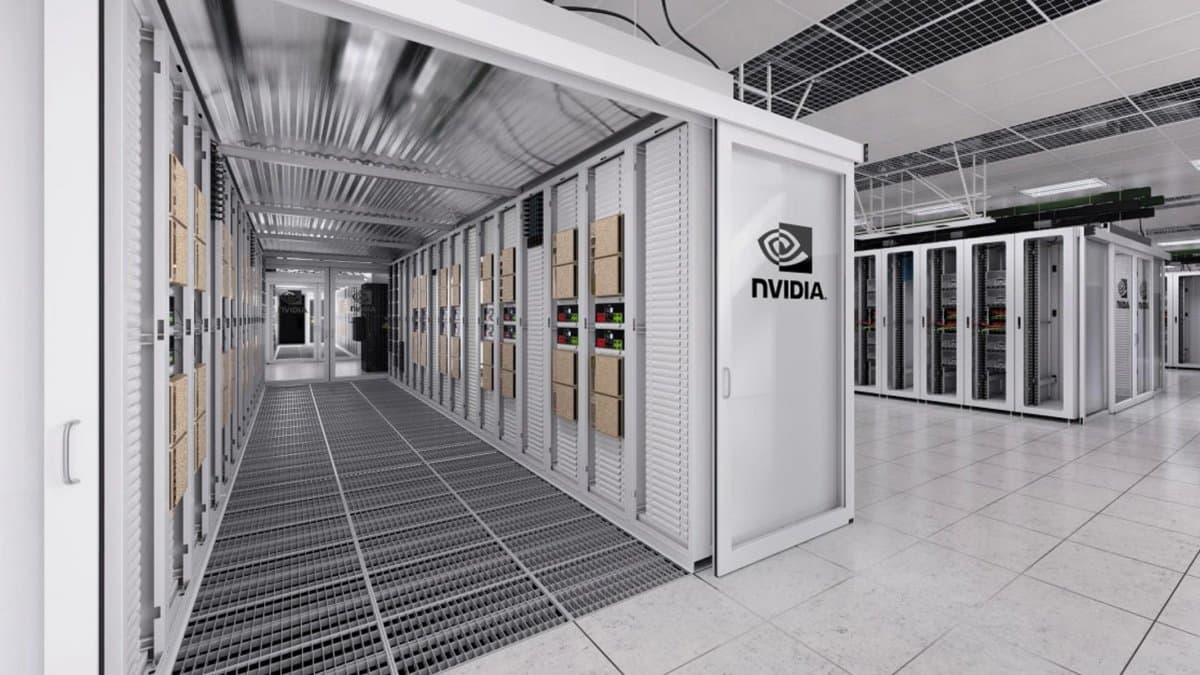
Nvidia's framing device for all of this is the "DSX AI factory" — a data center defined not as a building but as a plant that manufactures tokens, with cash flows modeled off that output. Build a power plant, sell electricity. Build an AI factory, sell inference.
What the Structure Actually Does
Until now there were three ways to fund AI infrastructure: pay cash (hyperscalers), issue equity or corporate debt, or take vendor credit. Frontier labs and neoclouds hit walls on all three. Cash is short, dilution hurts, and credit ratings don't support the bond math.
This is a bid to open a fourth path: asset-backed lending, where the loan is underwritten against the GPU rather than the borrower's balance sheet. In the release's own words, the goal is "dedicated pools of capital at scale and at attractive rates" for Nvidia customers spanning frontier labs, enterprises, and AI clouds.
Three things have to be true for that to work.
Residual value has to be predictable. A lender needs a defensible number for what the hardware is worth in three years. That's why Nvidia stresses "longest life" — and the fact that A100s remain in production inference service six years after launch is real evidence for the claim.
A liquid secondary market has to exist. If a borrower defaults, someone has to buy the collateral. That's exactly what "fungible and transferable" is aimed at. Today, used-GPU trading runs through brokers with opaque price discovery. Fittingly, the same week Nvidia made this announcement, a YC Summer 2026 startup called Stoa Markets launched a GPU and AI-server marketplace on Hacker News — and the top comment was that an H100 is effectively non-fungible because usage history and degradation are so hard to verify. The community put its finger on the weakest joint in Nvidia's structure on the same day.
The cash flows have to show up. Collateralizing an AI factory presumes the factory sells tokens profitably. That holds as long as inference demand keeps climbing and token prices stay above cost. But token prices move down fast — OpenAI cut GPT-5.6 Luna's API price 80% on July 30. If volume makes up the difference, fine. If it doesn't, the cash flow assumption under the collateral wobbles.
| Conventional approach | What this platform targets | |
|---|---|---|
| Source of funds | Equity, corporate debt, vendor credit | Third-party capital (private credit, infra funds) |
| Underwriting basis | Borrower's financials | Asset value and cash flow of GPUs / AI factories |
| Scale | Deal by deal | $500B+ cumulative target |
| Asset character | Fast-depreciating IT equipment | "Fungible and transferable" investable asset class |
| Current status | — | MOU, pre-definitive agreement |
Who Gains What
Nvidia gains demand certainty. You can build the best accelerator in the world and still not book the order if the customer can't raise the money. This platform removes that bottleneck and pulls orders forward. Crucially, Nvidia does it without heavily encumbering its own balance sheet — the capital comes from Apollo, BlackRock, and Blackstone; Nvidia's contribution is standing behind the asset's value.
The six managers gain an asset class. Private credit has spent several years with more capital than good places to put it. Commercial real estate got hit by rates and remote work; infrastructure deals got crowded and spreads compressed. Compute financing is large, lightly contested, and priced at a premium. That's what Zelter means by "compelling investment characteristics."
Frontier labs and neoclouds gain time. Anthropic's $10 billion, six-year deal with Volta — a cloud startup that didn't exist six months earlier — signed on August 4, is the same bottleneck seen from the other end. Somebody has to build the data center, and that somebody usually doesn't have the capital. This platform is an offer to fill that gap.
Power and construction get pulled along. If $500 billion actually moves, a large share of it lands in substations, cooling, land, and transmission. That's why Brookfield is in the room.
The party carrying the risk is the end investor. This capital ultimately comes from pensions, insurers, and sovereign funds — long-duration money being lent against semiconductors that turn over every three to five years. Commercial real estate lasts thirty years. GPUs do not.
The Last Times Someone Invented an Asset Class
Turning a physical good into collateral is a recurring move in financial history, and the outcomes diverge sharply.
The success case is aircraft leasing. Into the 1970s and 80s, airlines bought their planes. Then lessors like GECAS and ILFC changed the structure. Aircraft have standardized airworthiness certification, work on any carrier, and trade in a global secondary market. Those three properties made them financeable, and today more than half the world's commercial fleet is leased. Huang's "fungible and transferable" is precisely the test aircraft passed.
The second success is data center REIT-ification. Equinix and Digital Realty redefined data centers as real estate, which unlocked cheap long-duration capital and built the physical substrate of the cloud era. Blackstone buying QTS is the continuation of that arc.
The failure case is telecom-bubble vendor financing. In the late 1990s Lucent, Nortel, and Motorola sold equipment and lent buyers the purchase price. Revenue exploded — much of it customers buying vendor product with vendor money. When carriers collapsed in 2001, the revenue and the loan book evaporated together. Lucent wrote off billions in customer financing in 2000 alone.
The differences this time are real. The capital sits with third parties, not on Nvidia's balance sheet. The lenders are the largest professional allocators in the world, with underwriting capacity that Lucent's credit desk never had. And a GPU generates revenue the day it's installed, unlike dark fiber that sat unlit for years.
The similarity is also real. Nvidia is underwriting demand for its own product through financing it designed. It already holds equity positions in OpenAI, xAI, and multiple neoclouds that buy its chips; layering a $500 billion debt channel on top widens the radius of that circle. Whether that's ecosystem investment or demand manufacturing gets settled by exactly one thing — how much money the compute on the other end actually earns.
How Rivals Push Back
AMD is squeezed most directly. Lisa Su has narrowed the performance gap with the MI series, but this announcement moves the battle from performance to liquidity. If a lender says "we'll collateralize Nvidia silicon but we lack residual-value data on MI," the purchase decision turns on financing terms regardless of benchmarks. AMD's counter is to line up its own leasing partners, or to prove transferability through an open software stack that makes its hardware genuinely portable.
Google, Amazon, and Microsoft are playing a different game. With TPU, Trainium, and Maia, they need less outside capital and compete on internal cost. But custom silicon is by definition not transferable — nobody else can buy your TPUs and use them. If collateral value becomes a standard yardstick, that's a newly visible weakness in the custom-chip thesis. It also helps explain why Anthropic is building its own chip team while continuing to run on AWS, Google, and Nvidia hardware simultaneously.
Chinese players are locked out of this channel entirely. Moore Threads pursuing a Hong Kong listing after a 420% run on the STAR Market is the alternative: if you can't access US compute financing, raise from public equity markets instead. Different funding rails eventually mean different build speeds.
Traditional banks are the ones getting displaced. Goldman is in the deal, but regulated commercial banks struggle to warehouse fast-depreciating assets at this scale under capital rules. The decade-long migration of lending from banks to private credit is repeating itself in compute.
What Actually Changes
If you're founding an AI startup, the practical effect arrives a few quarters out. Securing GPUs has meant prepaying a cloud or locking into long contracts; a dedicated compute lending channel adds a financing option that didn't exist. Be realistic about sequencing, though — this capital reaches large labs and large clouds first, and takes time to trickle down.
If you're an engineer, nothing changes today, but the direction is worth noting. Once asset-backed financing takes hold, preserving GPU residual value becomes commercially important. Software compatibility that keeps older silicon useful, quantization, and inference optimization acquire accounting value, not just engineering value. The reflex to chase only the newest chip may cool slightly.
If you're watching Korea, it cuts both ways. For SK Hynix and Samsung, $500 billion of infrastructure capital eventually translates into HBM demand. For companies building data centers directly — the AI data center push SK Telecom highlighted in its Q2 results — it means competing against rivals backed by cheap American capital.
If you're an investor, the checkpoints are clear. First, do the MOUs convert into definitive agreements? Second, what size and rate does the first vehicle actually price at? Third, how is GPU residual value calculated — that assumption is the safety margin for the entire structure. The $500 billion is a goal, not a raise.
If you follow policy, a systemic-risk question just opened. Concentrating large volumes of private credit against a single, fast-depreciating asset class creates a transmission path from an AI demand slowdown into financial markets. Regulators have watched non-bank credit closely since 2008, and this structure is being built precisely outside the banking perimeter.
🥄 Three Things You're Probably Wondering
— So what does this mean for me? Nothing directly. But if this capital actually moves, AI service prices likely fall further — cheaper money to build data centers means cheaper inference. Worth knowing that the money comes from long-duration pools like pensions and insurance.
— Is the $500 billion already committed? No. These are memorandums of understanding, and Nvidia explicitly says final agreements haven't been executed. The figure is what the platforms aim to mobilize over time. The first vehicle's actual size will be the number to watch.
— Can GPUs really work as collateral? Aircraft and data centers both made that journey, so it isn't far-fetched. Two things are still missing, though: a trustworthy used-GPU price benchmark and a secondary market deep enough to liquidate at scale. Until those exist, lenders will mark conservatively — which makes how fast $500 billion fills up genuinely hard to call.
Further Reading
- NVIDIA Partners With Apollo, BlackRock, Blackstone, Brookfield, Goldman Sachs and KKR to Establish AI Compute Infrastructure Financing Platforms (NVIDIA Newsroom, 2026-08-10) — the primary source, containing the Huang, Zelter, and Fink quotes and the MOU caveat.
- Nvidia lines up $500 billion in financing as CEO Jensen Huang tells CNBC his chips are 'investable asset' (CNBC, 2026-08-10) — Huang explaining the investable-asset framing in his own words.
- Nvidia, Wall Street Firms in Talks on $500 Billion AI Funding, FT Reports (Bloomberg, 2026-08-10) — the pre-announcement FT reporting and market reaction.
- Nvidia and Wall Street partner on $500B AI financing (Axios, 2026-08-10) — analysis of the structure and the circular-financing debate around it.
- Nvidia sets up $500B deal with Wall Street giants to finance AI infrastructure (GamesBeat, 2026-08-10) — a straight write-up quoting the release language directly.
- Anthropic signs $10 billion deal with AI cloud startup Volta (TechCrunch, 2026-08-04) — the same bottleneck solved a different way: a frontier lab underwriting a capital-poor builder directly.
Numbers and criteria are as of announcement and may change. Investment calls are yours to make!