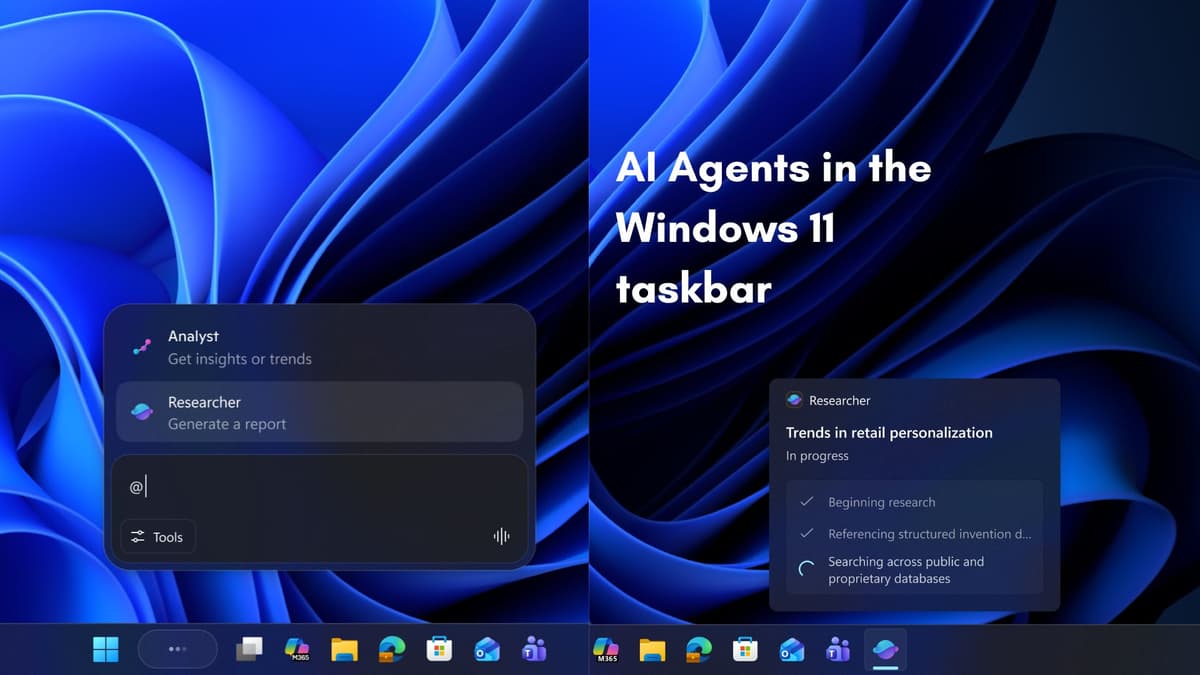
There's only one app called Copilot now
Here's the deal: during the week of August 13, Microsoft quietly started pushing a new Copilot app to a small group of Windows Insiders. On the surface it looks like an ordinary update — new icon, tidier navigation. What it actually is: the folding of two product lines Microsoft has run separately for more than two years into a single app.
Until now there were at least two apps carrying the Copilot name. The consumer Copilot you sign into with a personal Microsoft account, and Microsoft 365 Copilot you sign into with a work or school account. Different names, different icons, different web addresses, different features. The personal one had experimental things like podcast generation and group chats. The commercial one had grounding into SharePoint, Outlook, and Teams data. Now both live inside one app, and you move between them with an account switcher.
The schedule is already public. Mobile and web start rolling out worldwide in mid-August. The Windows and Mac apps follow in mid-September. In late August, the commercial web address m365.cloud.microsoft begins redirecting to copilot.cloud.microsoft. And the branding gets cleaned up: the name "Microsoft 365 Copilot app" goes away and it just becomes "Microsoft Copilot," with a refreshed icon.
But this merger comes with a price tag. Starting August 18, several features disappear from the consumer Copilot experience: Copilot Podcasts, Group Chat, and Deep Research. Mico, the animated voice-mode character, also drops out of the core consumer experience. That list tells you which direction this merger runs. The consumer experiments are being absorbed into the enterprise skeleton, not the other way around.
The people pushing this
Microsoft's Copilot organization got shaken hard in March 2026, when Satya Nadella consolidated the consumer Copilot team and the enterprise Copilot team under one leadership. The person who ended up in that seat is Jacob Andreou — 33 years old, a former Snap executive, now running an organization of more than 11,000 people.
A 1,200-word memo Andreou sent his team in July leaked, and it explains the logic behind everything happening now. The line everyone quoted: Copilot has to "earn the right to exist." The point was to stop chasing intelligence for intelligence's sake and start delivering measurable outcomes — and, implicitly, to cut features nobody actually used. The August 18 retirement list reads like the execution chapter of that memo.
Consumer Copilot sits in a position Microsoft doesn't enjoy discussing. It's preinstalled in Windows, wired into Edge, sitting on top of Bing — and still doesn't register as a standalone assistant the way its competitors do. Third-party estimates float around, but they agree on one shape: the gap to ChatGPT is an order-of-magnitude gap, not a percentage gap. Microsoft has never broken out a standalone monthly active user number for consumer Copilot on its own. That silence is itself a data point.
Microsoft 365 Copilot is the opposite story. It crossed 30 million paid seats. The prior quarter was 20 million, so net seat additions more than doubled quarter over quarter. Set that against the 450 million-plus total Microsoft 365 seats and penetration lands around 7% — big in absolute terms, early in relative terms, which is exactly why this line gets treated as the company's growth engine.
The super app plan is the frame around all of it. Since May, reporting has described Microsoft assembling Copilot chat, the GitHub Copilot coding assistant, Copilot Cowork, and an agentic workflow capability known internally as Autopilot into one destination. On the July 29 earnings call, Nadella said the super app would ship this quarter — meaning by the end of September. This app merger is the floor that thing gets built on.
What actually changes and what actually goes away
Here's the timeline in one place. Every date below comes from Microsoft's own support documentation or the August 13 reporting.
| When | What happens |
|---|---|
| Week of Aug 13 | Unified app begins deploying to a small set of Windows Insiders |
| Mid-August | Worldwide rollout starts on mobile and web |
| August 18 | Podcasts, Group Chat, and Deep Research start retiring for consumers |
| Late August | m365.cloud.microsoft begins redirecting to copilot.cloud.microsoft |
| Mid-September | Windows and Mac desktop apps roll out |
| End of September (target) | Super app ships — the deadline Nadella gave investors |
The retiring features behave very differently from one another, so they're worth separating.
| Feature | After August 18 | Replacement |
|---|---|---|
| Copilot Podcasts | Fully retired. Can't create or access | None. Download individual files beforehand |
| Group Chat | Threads, messages, and images don't carry forward; converts to individual conversations | None. Media others shared becomes inaccessible |
| Deep Research | Retired in the consumer app. Existing reports stay readable | Researcher — Microsoft 365 Premium subscribers only |
| Mico | Removed from the core consumer experience | None (may persist in some education features) |
The line that deserves the most attention is Deep Research, because it isn't being deleted — it's being moved behind a paywall. As of August 10, Microsoft sells Microsoft 365 Premium at $19.99 a month or $199.99 a year, and it discontinued the standalone Copilot Pro subscription. Advanced capabilities like Researcher, Analyst, Office Agent, and Agent Mode are bundled into that tier. A long-form research feature people used for free now sits inside a paid plan.
Group Chat is a different category of change entirely. This one actually destroys data. Microsoft's own documentation states that Group Chat threads, messages, and images created inside those chats will not carry forward. The guidance is explicit: before your account updates, copy any messages you want to keep into a document or notes app, and download any images you want to save. If you don't back it up yourself, it's gone.
Account separation is clearly the part Microsoft worried about most. The official documentation says personal Microsoft accounts and work or school Entra accounts are "separate by design." It states that data entered into the work experience does not flow into the personal experience, and vice versa. It also says commercial data boundaries, tenant controls, and compliance protections are not changing. Files consolidate into OneDrive.
The free tier survives. Microsoft says core Copilot chat stays free with usage limits and that nobody is forced to pay. Microsoft 365 subscribers get higher limits and the advanced features. The practical effect is that the line between free and paid got sharper on the way through this merger, not softer.
One more thing worth flagging: how this was announced. Microsoft communicated the change through a support article rather than a Microsoft 365 blog post or an entry in the Microsoft 365 Copilot release notes. The release notes as of August 11 contain nothing about the unified app or the retirements. The company is treating this as an advisory to process, not news to celebrate.
Who gets what out of this
Microsoft gets cost relief first. Two apps means two teams, two release pipelines, two QA surfaces. When Andreou inherited an 11,000-person organization, that duplication was the obvious first cut. Retiring low-usage features like Podcasts and Group Chat runs on the same logic — maintenance cost keeps accruing whether or not anyone shows up, and a lightly used feature quietly consumes an organization's attention.
The second thing Microsoft gets is distribution, and that matters more. Those 450 million-plus Microsoft 365 seats are already signed in with work accounts. When the unified app opens under that account, Microsoft can put consumer capabilities in front of a person without asking them to install anything new. It works the other direction too: the moment someone using Copilot on a personal account is prompted to add their work account, that's a sales touchpoint for growing paid Microsoft 365 Copilot seats inside an organization.
Enterprise customers get management simplification. Until now, "the Copilot my employees use" was several things at once from an IT perspective — the M365 Copilot the company bought, the consumer Copilot someone signs into personally, and whatever opens in a browser tab. Collapsing those into one app reduces the number of surfaces you have to reason about. That's simplification, not risk reduction, and the difference matters. More on that below.
Microsoft 365 Premium subscribers get a relative win. With Deep Research out of the free tier, Researcher becomes a paid-only capability. When the gap between paying and not paying widens, the felt value of the subscription goes up. That's almost certainly the intent — converting some slice of free users into $19.99 a month.
The losers are easy to name. People who used Podcasts, people who accumulated conversations in Group Chats, people who ran Deep Research for free. All three groups were probably small — that's why they got cut. But small doesn't mean painless, and Group Chat is the one entry on the list where the content itself disappears if you don't act.
We've merged consumer and enterprise apps before — the results split
Folding a consumer product and a business product into one app is a recurring move in software history, and the outcomes are not consistent.
There's a pattern that works. One app, multiple accounts, a switcher between them is already proven in collaboration tools and cloud storage. Two conditions made those succeed. First, the data boundary genuinely held and admins had a way to verify it. Second, switching accounts visibly changed the interface enough that users never lost track of which side they were on. Microsoft reportedly using different background colors for personal versus Entra accounts looks like a design decision aimed squarely at that second condition.
There's also a pattern that fails. It shows up when the stated rationale is user convenience but the real driver is internal cost. The symptom is a familiar complaint: fewer features, heavier app. Strip consumer capabilities while keeping the enterprise skeleton intact and casual users are left with an app full of menus that mean nothing to them. The fact that everything retiring on August 18 comes from the consumer side raises exactly this risk.
The third failure mode is migration loss. The app mergers people still talk about years later are almost always the ones where users said "you combined them and my stuff vanished." Group Chat sits precisely on that fault line here. Microsoft giving advance notice is a real improvement over how these things used to go. The percentage of users who read the notice, though, is never 100.
Finally, market structure. Microsoft has framed this merger as the groundwork for a super app — but super app strategy isn't a proven formula on its own. Putting everything in one place simplifies the entry point, and the usual cost is that each capability gets shallower than the dedicated tool it replaces. Whether coding, chat, documents, and agents can each hold their own inside a single app against specialized rivals is the actual test here.
How the rivals are solving it differently
Google chose the opposite. The consumer Gemini app and Gemini inside Workspace remain separate products. Workspace Gemini runs under the enterprise agreement and data processing terms — submissions aren't used to train models and aren't reviewed by humans. Personal-account Gemini is a consumer service where conversations may be used to improve Google's products and selected conversations can be reviewed by people. Google avoids the boundary problem by declining to put both in one app. The cost is that users have to move between them.
That contrast matters more than it looks. Google's risk is shadow usage — an employee opening personal Gemini in a browser tab, entirely outside the Workspace boundary IT believes is protecting them. Microsoft's risk is misfire — picking the wrong account inside one app and pasting company material into the personal side. Both are ultimately human-error problems, but Microsoft just shortened the distance to that error to a single tap.
OpenAI took a third route. One brand, ChatGPT, with personal subscriptions plus Business and Enterprise layered on as plans and workspaces rather than separate apps. ChatGPT Business runs roughly $20 to $25 per seat per month, and in January 2026 OpenAI added a Go plan at $8 beneath it. Enterprise remains quote-based. So OpenAI never had two apps to merge; it built plan tiers on a single app from the start. Structurally, OpenAI was already standing where Microsoft is now trying to arrive.
Other labs are converging on the same shape, splitting individual and team usage inside one product rather than shipping two. Seen against that backdrop, Microsoft's decision reads less like an original strategy and more like a late alignment. What made Microsoft unusual was running two apps separately for as long as it did — a consequence of consumer and commercial being different organizations internally, which is exactly what the March reorganization fixed.
From a European or Korean enterprise IT chair, the competitive framing matters less than the contract documents. Microsoft's own documentation spells out exceptions worth reading closely: the EU Data Boundary does not apply to web search queries, and Anthropic models are currently excluded from the EU Data Boundary and, where applicable, from in-country processing commitments. A unified app doesn't erase those carve-outs. If anything, mixing web grounding and multiple models inside one interface makes it harder to tell which request fell inside which boundary.
So what actually changes
If you run enterprise IT, this adds a document review to your queue. The unified app lets one screen switch between a personal account and a work account. Microsoft states plainly that data does not cross between them and that commercial data boundaries and tenant controls are unchanged. That's a commitment about technical isolation — and it is not a commitment that a user won't copy a company document and paste it into the personal-side chat window. Work out how your DLP rules and conditional access policies treat each of the app's two modes before the mid-September desktop rollout. And get the boundary carve-outs written down: web search queries falling outside the EU Data Boundary, and specific models being excluded from it, are the exact items that surface in financial, healthcare, and public-sector reviews.
If you're an individual Copilot user, August 18 is a real deadline, and the three losses aren't equivalent. Podcasts go away completely, so any audio you want has to be downloaded individually before then. Group Chat threads, messages, and images do not carry forward, so copy what matters into a document and download the images — there is no recovery path if you skip this. Deep Research is gentler: reports you already generated stay readable, you just can't run new ones, and getting comparable capability means moving to a Microsoft 365 Premium subscription. Net result: a research feature you used for free now sits behind $19.99 a month.
If you're a knowledge worker using this daily, rebuild your habits. Once it's one app, the physical separation of "work lives here, personal lives there" is replaced by a logical one — the account switcher. Almost every incident in this class comes from not checking which account you're in. Different background colors reportedly help, but color alone is a weak guardrail. Glance at the account indicator before anything sensitive.
From an investment view, the number to watch is conversion. Thirty million paid Microsoft 365 Copilot seats is a big jump from 20 million the prior quarter, but against 450 million-plus total seats it's still roughly 7%. This merger reads as a distribution experiment aimed at pushing that number. What matters next quarter isn't the seat total so much as whether the net-add pace holds. Watch, too, for whether the consumer feature cuts produce churn — and note that Microsoft doesn't publish a standalone consumer Copilot active user figure, so that side is hard to verify from outside.
If you're a developer or Microsoft partner, the merger is a beginning, not an end. The super app Nadella promised by the end of September folds in GitHub Copilot, Cowork, and the Autopilot agentic workflow layer. This app consolidation is the floor those pieces land on, which means the navigation and account structure changing right now will likely change again within months. If you were about to rewrite internal documentation or training material, waiting until after late September saves you doing it twice.
If you're a general consumer, the honest summary is that this update wasn't built for you. The enterprise product is absorbing the consumer product, and the playful experiments that lived on the consumer side got cleaned up along the way. Free Copilot chat continues, but the line between free and paid is drawn more firmly than it was a week ago.
🥄 Three Things You're Probably Wondering
— Is my company data going to leak into my personal account? Microsoft's documentation says the two environments are separate by design, that work data doesn't flow into the personal experience, and that commercial data boundaries and tenant controls are unchanged. There's no current basis to doubt the technical isolation itself. The exposure is on the human side: switching accounts inside one app raises the odds of pasting into the wrong window. Audit logs capture activity on the work account; whatever happens on the personal account is invisible to your organization.
— Will my data actually be deleted on August 18? It depends which feature. Group Chat threads, messages, and images explicitly do not carry forward, so yes — if you don't back it up, you lose it. Podcasts are fully retired, and downloading files beforehand is the only way to keep them. Deep Research is different: reports you already generated remain accessible, and only the ability to run new ones goes away in the consumer app. Microsoft says most regular chats and created content migrate automatically.
— Does merging the apps let Microsoft catch ChatGPT? Too early to say that flatly. The consumer gap is a brand and habit problem more than an app architecture problem, so consolidating apps doesn't close it directly. But consumer first place probably isn't the target. The realistic goal is using 450 million-plus work seats as a distribution channel to lift paid conversion, and this merger fits that goal far better. Whether it works turns on what the super app actually contains when it lands at the end of September.
References
- Updates to Copilot and the Microsoft Copilot app (Microsoft Support) — the primary source: the August 18 retirement of Podcasts, Group Chat, and Deep Research, the "separate by design" account split, the statement that commercial data boundaries and tenant controls are unchanged, the OneDrive file consolidation, and the surviving free tier.
- Enterprise data protection in Microsoft 365 Copilot and Microsoft 365 Copilot Chat (Microsoft Learn) — the real scope of enterprise protections, including the footnotes stating that the EU Data Boundary does not apply to web search queries and that Anthropic models are currently excluded from the EU Data Boundary and in-country processing commitments.
- Microsoft begins unified Copilot app rollout (Windows Central) — the first assembled account of the rollout starting and the cross-platform merge plan with updated branding.
- Microsoft starts merging its Copilot consumer and business apps in advance of 'Super App' rollout (GeekWire, 2026-08-13) — source for the platform schedule (mid-August mobile and web, mid-September Windows and Mac), the late-August URL redirect, Mico's removal, and Researcher being limited to Microsoft 365 Premium.
- Microsoft begins to merge consumer and enterprise Copilot apps in push for super app (Fortune, 2026-08-13) — the 30 million paid Microsoft 365 Copilot seats figure, the super app's components, and Jacob Andreou's role.
- Microsoft Unifies Consumer and Enterprise Copilot in Push for Single AI Platform (PYMNTS) — the 20 million prior-quarter seat baseline and doubled net adds, Nadella's end-of-quarter super app deadline from the July 29 earnings call, and the contents of Andreou's July memo.
- Microsoft is Unifying its Consumer Copilot App and Microsoft 365 Copilot into a Single App (Thurrott) — the account switcher design, the different background colors for personal versus Entra accounts, and broader free Copilot Chat access.
- Exclusive: Microsoft is building a super app that combines coding, chat, and other Copilot AI tools (Fortune, 2026-05-29) — the original plan, including the internal "Delivering one Copilot" slogan and the then-current figure that under 4.5% of 450 million Microsoft 365 customers paid for Copilot.
Numbers are as of announcement and may change.