Three "We're Doing Multi-Year AI" Announcements This Week
Three enterprise AI deals landed between Monday and Friday.
Monday: HumanX 2026 polled 12,400 attendees. 73% said they're more than doubling AI budgets next year. Tuesday: Stellantis and Microsoft announced a 5-year strategic partnership targeting 100+ co-developed AI tools. Thursday: Yahoo Finance reported Google is negotiating with the Pentagon to deploy Gemini inside classified SCIF environments.
Different industries, same message. AI is no longer a pilot. It's a multi-year budget line.
The Backstory
In 2023–2024, enterprise AI adoption followed a predictable arc: proof-of-concept, pilot with a small team, then "scale it up." Most projects stalled at pilot. The ROI wasn't obvious, costs were opaque, and nobody knew what "best practice" looked like.
A Gartner survey from late 2025 found only 28% of AI initiatives reached production. The other 72% died as "interesting but didn't pencil out."
Q1 2026 flipped the story.
| Metric | 2024 | 2025 | Q1 2026 |
|---|---|---|---|
| AI projects reaching production | 18% | 28% | 47% |
| Average contract length | 12 months | 24 months | 36–60 months |
| Avg AI budget per enterprise | $2.1M | $5.8M | $14.3M |
| Share declaring "company-wide AI transformation" | 12% | 31% | 58% |
Three numbers jumped simultaneously. The reason is simple: the ROI case finally showed up. Anthropic's Claude Code boosted developer productivity by measurable margins. Microsoft Copilot shaved an average of 4 hours per week per knowledge worker, per Deloitte. Google Workspace AI cut email processing time by 31% on average.
Once companies believed the numbers, contract structures changed with them. Annual subscriptions became multi-year strategic partnerships. Single-tool pilots became org-wide integrations.
Breaking It Down
Stellantis-Microsoft — 5 Years, 100 Tools
Stellantis is the world's 4th-largest automaker (Jeep, Chrysler, Peugeot, Citroën, Fiat), 270,000 employees, €190B annual revenue. This is the textbook case of how a legacy industrial giant starts its AI transformation.
The contract is concrete. Azure AI plus 20,000 Copilot seats in the initial deployment. Focus on sales, customer service, and operations. 100+ custom AI initiatives co-developed over five years. A "factory" structure where Microsoft engineers and Stellantis employees build together.
The most interesting clause: joint IP. Fine-tuned models trained on Stellantis manufacturing and supply chain data remain Stellantis-owned. Generalized platform improvements go to Microsoft. A clean separation that solves the "data sovereignty" worry upfront.
| Item | Terms |
|---|---|
| Duration | 5 years (2026–2031) |
| Initial seats | 20,000 Copilot licenses |
| Co-developed AI tools | 100+ |
| Priority areas | Sales, customer service, operations |
| IP structure | Fine-tunes → Stellantis, platform gains → MS |
If this structure becomes standard, legacy enterprise AI adoption accelerates dramatically. The "we'll lose our IP" fear — the biggest historical blocker — now has a contractual solution.
Google-Pentagon — Classified Deployment
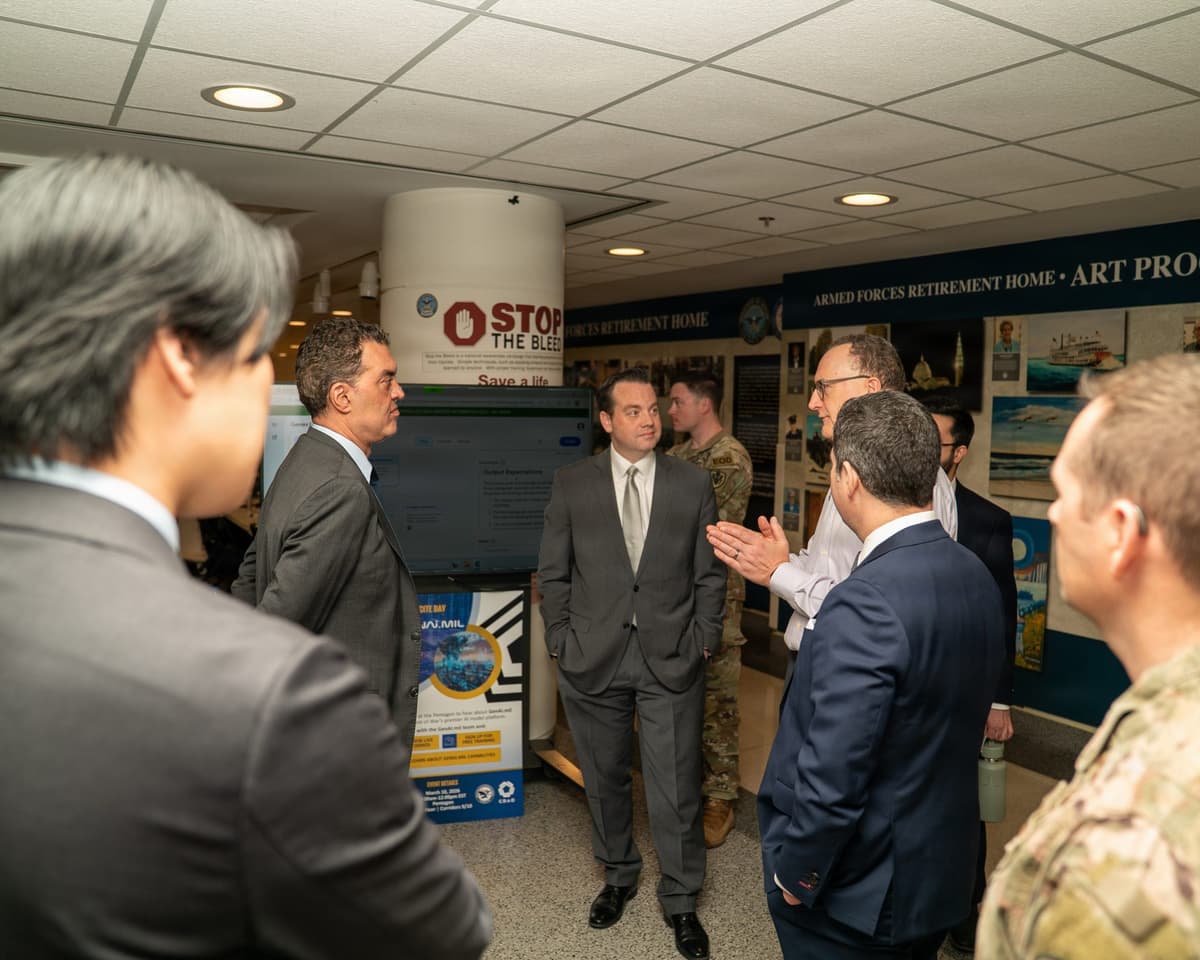
Yahoo Finance reported Google is in negotiations to deploy Gemini inside classified US Department of Defense environments, citing multiple sources.
The word "classified" is the point. It's the most sensitive US military data tier, handled only inside SCIFs — physically isolated facilities with no internet connectivity. Putting an AI model in there means inference happens on-premise with no data leaving the secure perimeter.
This is comparable in scope to OpenAI's ChatGPT for Government announced last month. Both companies are being officially certified as defense AI suppliers.
The contract reportedly includes prohibitions on use for autonomous weapons and domestic surveillance. That framing matters internally — Google's 2018 Project Maven backlash is still recent — and executives are positioning this as "defensive AI for civilian safety."
If the deal closes, the US government's AI procurement structure solidifies. Pentagon, CIA, NSA, Department of Energy — each agency is likely to sign its own multi-year contract with a primary AI supplier.
HumanX — Claude Mania
HumanX 2026 wrapped up in Las Vegas this week. 12,400 attendees — up 40% year over year. The vibe in one word: Claude.
Enterprise customers told the same story repeatedly: "Every serious company is running Claude Code." An Axios floor survey of 200 CIOs put the number at 77% using Claude as their primary workplace AI. OpenAI came in at 43%. Gemini 34%. Meta Llama 19%.
The sound bite everyone talked about came from Alexandr Wang (Meta's AI lead). In his keynote, he conceded "Claude is winning the enterprise transition fastest." An unusually candid acknowledgment from a direct competitor.
Patterns that crystallized on the floor:
- Enterprises moved past "which model to use?" They're running multi-model strategies: Claude + Gemini + internal fine-tunes
- Contract lengths are 24–36 months now, up from 12 months as the default
- AI share of enterprise IT budgets is projected to jump from 12% in 2025 to 23% in 2026
The Bigger Picture
Chain these three news items together and you see enterprise AI's market structure being written in real time.
Axis one: the Big 3 carving out territory. Microsoft owns large-enterprise heavy industrials (Stellantis, manufacturing). Anthropic owns developer and knowledge-work (Claude Code, enterprise agents). Google is pushing into government and public sector (Gemini-Pentagon). OpenAI, despite ChatGPT's consumer brand, is losing ground in enterprise — a reversal from 2024.
Axis two: data sovereignty gets formalized. Stellantis keeping ownership of its fine-tuned models. The Pentagon locking Gemini behind an air-gap. These are the same principle — "use the AI, but our data stays ours" — now written into actual contract clauses. Two years ago this was wishful thinking. Now it's standard.
Axis three: best-practice standardization. Conferences like HumanX matter because they spread the playbook. Two years ago, every company was on its own. Now there's a template: 5-year partnership, 100 co-developed tools, data sovereignty clauses, joint IP. Companies that follow the template will move 2–3x faster than those that don't.
What Actually Changes
The implications for individuals and startups are concrete:
Enterprise sales has fundamentally changed. The game used to be "show the demo, get the pilot." Now it's "structure the 5-year partnership." Contract attorneys, data governance consultants, change management specialists — these are now core roles inside enterprise AI sales teams.
For startups, this is double-edged. Upside: enterprise AI budgets are hitting $14M per company on average, so the TAM grew. Downside: when big companies sign exclusive 5-year contracts with Microsoft, Google, or Anthropic, third-party startups have to squeeze into the gaps. Generic AI products will struggle. Tools that embed deeply into a specific workflow will survive.
For working professionals, the practical shift is that "AI-focused" job titles are proliferating. Chief AI Officer. AI Transformation Lead. Model Ops Manager. Average comp is landing in the $280K–$420K range, with strong hiring demand for the next three years. Adding "enterprise AI integration" to your resume is genuinely valuable now.
And a note on the Korea angle. Korean conglomerates haven't yet signed multi-year AI partnerships at the Stellantis scale. Samsung, SK, and LG are buying time to build their own foundation models. That gap may become a liability by 2027. Watching how Korea's top 5 structure deals with foreign hyperscalers next year is one of the most important stories to track.