This Isn't a Quality Stamp — It's a Sales Channel
Here's the deal: on August 18, Korea's domestic AI chip companies announced they had been designated Excellent R&D Innovation Products by the Ministry of Science and ICT (MSIT). Rebellions, FuriosaAI, and DeepX all made the list. The certificate ceremony was held August 13 at Rebellions' headquarters, covering designations from 2025 through the first half of 2026.
Reading this as "Korean chips got validated" catches half of it. Innovation Product designation is not a technical certification program. It's a procurement program.
Here's what changes when you get it:
- Public institutions can buy via direct contract, with no competitive bidding
- Procurement timelines drop from 60 days to under 10
- The purchasing official is released from personal liability for losses
- The designation lasts 3 years, extendable to a maximum of 6
The third item does the most work in practice. A public sector buyer who purchased an unproven domestic product and hit problems was personally on the hook. So everyone picked the safe option — the already-validated foreign product. Remove that liability and the cost of choosing domestic disappears for the person making the call.
What Got Designated
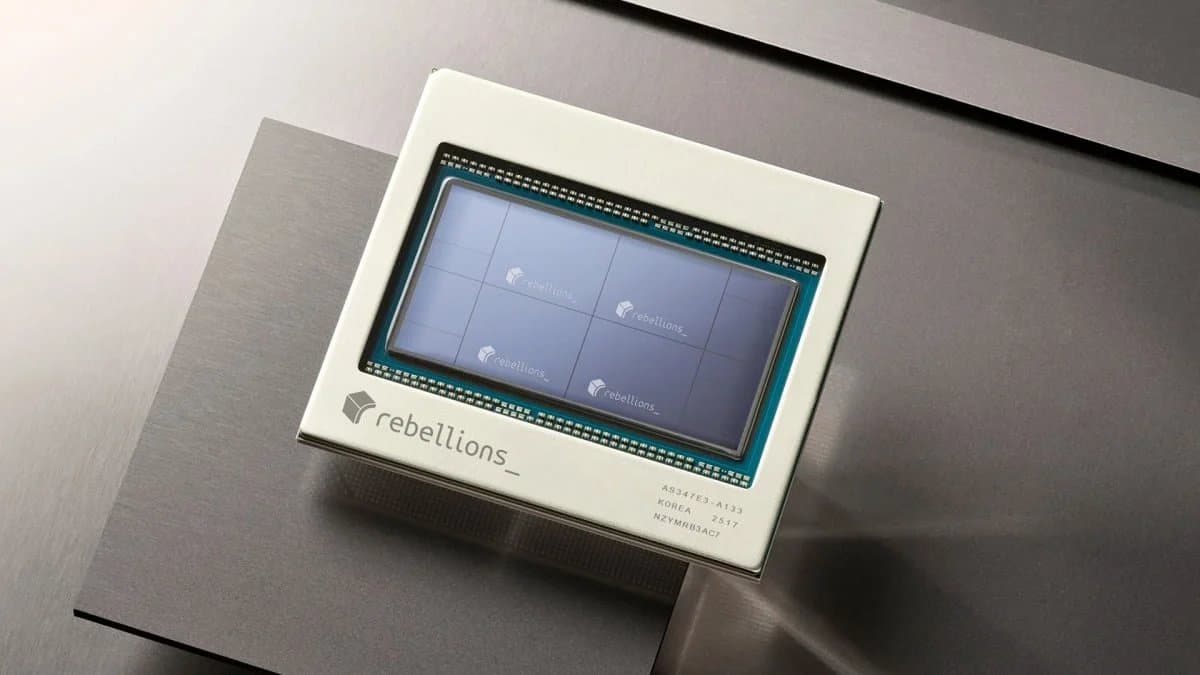
Rebellions had its server-class NPU — the ATOM-Max card and the ATOM-Max server — designated. An inference accelerator card for datacenters, and the complete server built around it.
DeepX had the DX-M1 and DX-H1 series designated. Different category: these are AI inference modules for the edge, not the datacenter — the things that go into CCTV, industrial equipment, and robots.
FuriosaAI was designated as well. The company has entered mass production on RNGD (Renegade), its second-generation inference chip.
Three companies covering three different layers is the shape of this designation. Rebellions on servers, DeepX on edge, FuriosaAI on datacenter inference. If the public sector wants to fill AI infrastructure with domestic silicon, the necessary layers are broadly present.
Brief introductions are in order. Rebellions, founded in 2020, designs datacenter inference NPUs, and became Korea's largest AI chip company after merging with SK Telecom-affiliated Sapeon. FuriosaAI, founded in 2017, followed its first-generation Warboy with RNGD, targeting datacenter inference. DeepX has focused on the edge — low-power inference chips for field devices rather than servers.
One line on what an NPU is: a processor specialized for neural network operations. GPUs were built for graphics and repurposed for AI as general-purpose parallel processors; an NPU is designed from the start to do matrix multiplies and activation functions well. That yields better power efficiency and potentially lower cost on the same workload, at the price of flexibility — a novel model architecture can leave an NPU scrambling.
How the Program Works
| Stage | Body | Function |
|---|---|---|
| Recommendation | Ministry of Science and ICT | Nominates strong products from national R&D output |
| Review and decision | MOEF Procurement Policy Deliberation Committee | Final Innovation Product designation |
| Procurement | Public Procurement Service | Provides the direct-contract route for institutions |
| Validity | — | 3 years base, 6 years maximum |
The logic runs like this. Products developed with national R&D funding frequently die at the commercialization stage because they can't land a first reference customer — not because performance was bad, but because nobody will be first. Make a public institution the first customer and that reference opens the private market.
AI semiconductors have this problem acutely. Nvidia and the CUDA ecosystem are the de facto standard, and adopting a new architecture means rebuilding software porting and operational know-how from scratch. Even at comparable performance, switching costs kill the deal. Breaking that wall by policy is the point of this measure.
Scale reveals the program's limits too. Public sector AI infrastructure budgets in Korea run in the tens to hundreds of billions of won, not trillions. A single large Korean conglomerate often buys more GPU than that in a year. There was never a scenario where public procurement alone makes these companies self-sustaining. The value here is reference, not revenue — and how fast that reference converts into private and overseas sales is the whole question.
Who Gets What Out of This
There's context for why this arrived now. The government has been discussing measures to open public markets to domestic AI semiconductors since early this year. As large projects like a national AI computing center got scheduled, the objection kept surfacing that the entire budget would flow out as foreign GPU purchases. Innovation Product designation is one concrete instrument from that discussion.
Rebellions gets reference expansion. It has already delivered to Gyeongsangnam-do provincial government and Ulsan Metropolitan City, with experience in public AI CCTV deployments and commercialized citizen-facing AI services. CEO Park Sung-hyun said the company had "proven its technology through commercialized public AI services and public AI CCTV delivery, and this designation will begin the real spread of domestic NPUs across the public sector." The difference is moving from winning contracts one at a time to having an institutional path.
DeepX gets a domestic base. It has secured $13 million in overseas orders and supplies NPUs for an Air Force base AI perimeter surveillance system. CEO Kim Nok-won said the designation would be the occasion to "expand the application of domestic AI semiconductors in Korea's public infrastructure." A company whose foreign revenue arrived first is opening the domestic public market late — and domestic references become fresh evidence when bidding into other countries' public procurement.
FuriosaAI gets demand timed to production. A public procurement channel opening as second-generation RNGD enters mass production is good timing. Semiconductors need early volume to bring unit costs down, and lower unit costs are what convince private customers.
Public institutions get speed and cover. Sixty days becoming ten matters in budget execution. And liability release is the condition that lets a buyer make a new choice at all.
Domestic server and SI vendors get a new combination. Delivering a domestic-NPU server into a public institution means hardware integration, OS support, and monitoring tool compatibility — system integrator territory, not chip company territory. More public demand creates work here. Rebellions getting both card and server designated reads as intent to absorb that layer itself.
The government gets reduced GPU dependence. This is an attempt to change a structure where much of the AI infrastructure budget leaves the country as foreign GPU purchases. Directing public demand to domestic firms to manufacture an early market is textbook industrial policy.
What Happened When Others Tried This
China's domestic chip procurement policy is the closest analog. By effectively mandating domestic semiconductors across the public sector and state-owned enterprises, China manufactured an early market for Huawei Ascend and Cambricon. Those companies got the time and capital to build their own software stacks. The cost was accepting performance inefficiency along the way, and international competitiveness remained a separate question.
Korea's earlier domestic software procurement policy produced mixed results. Preference points for domestic software in public procurement ran for years. Some categories produced viable domestic firms; others produced products that only sold into government — optimized for public procurement to the point of losing private-market competitiveness. That's the trap the three NPU companies need to watch.
The US CHIPS Act and defense procurement operate at a different scale, bundling manufacturing with defense demand to create an early market. The key variable was that procurement volume itself was large. Korea's public market is small in absolute terms, so the same effect isn't available. Reference value necessarily exceeds volume value here.
Japan's Rapidus is still in progress: massive government funding to build advanced process capability, with securing demand repeatedly flagged as the open problem. Making it is easier than selling it, everywhere.
The lesson common to all four: government procurement can supply starting capital but cannot manufacture product competitiveness. Prolonged protection tends to prevent competitiveness from developing at all. Capping designation at 3 years base and 6 years maximum is therefore a sensible structure. Whether private demand materializes inside that window is on the companies, not the policy.
The Real Gate Is Software
The channel is open. An open channel doesn't sell product. The remaining wall is software.
Moving an AI workload from GPU to NPU means compiling the model, optimizing kernels, and matching the serving stack. That work repeats for every new model, and new models arrive every few weeks now. Keeping pace requires substantial software headcount at a chip company.
Korean NPU vendors have invested here — PyTorch backend support, pre-optimized builds of major open-weight models, published compiler toolchains. Measured against the documentation, examples, and community answers CUDA accumulated over more than a decade, the gap remains large. It's the kind of gap money doesn't close quickly.
For public institutions this is a real adoption barrier too. Buying the chip on a direct contract got easy; the models to run on it and the staff to operate it are separate problems. For designation to convert into actual revenue, what gets delivered has to be a working system, not a chip. Rebellions getting card and server designated together reads exactly that way.
The competitor is still Nvidia. Opening a direct-contract path doesn't stop an institution from choosing a GPU for performance and ecosystem reasons. Innovation Product designation puts domestic products on the shortlist; it doesn't force the choice.
Domestic cloud operators are a variable. If Naver Cloud or KT Cloud offer instances backed by domestic NPUs, public institutions can use them without buying hardware. Subscribing to a service is a far lower adoption barrier than a hardware purchase.
For export, domestic public references become an asset. When bidding into another country's public procurement, "our own government runs this" is the strongest available argument. DeepX securing overseas orders before domestic designation inverted the usual sequence — and ends up holding both references.
So What Actually Changes
If you run public sector AI infrastructure, domestic NPUs are now a real option: direct contract, shorter procurement, liability released. Don't buy just the chip — write the scope of software support into the contract.
If you're an AI chip startup, knowing this program exists matters. A history of executing national R&D projects opens the MSIT recommendation path. Running the policy track in parallel with technical development pulls commercialization forward.
If you're an investor, don't read designation as booked revenue. A channel opened; no contract was signed. The metric to watch is public sector order count and value over the next six to twelve months.
If you're a developer, it's worth assessing the software stack maturity firsthand. As public demand grows, experience operating these chips acquires market value.
If you're in manufacturing with edge AI needs, DeepX's line being designated is a signal. An edge inference module validated in the public sector clears industrial adoption review far more easily. CCTV, inspection equipment, logistics robots — anywhere low-power inference is needed now has a domestic option.
If you're a research institution or university, an open procurement path also means easier access to experimental hardware. Few engineers have hands-on experience running models on Korean NPUs, so starting now puts you in a scarce category. Check the vendor's compiler toolchain and pre-optimized model list first.
Compressed to one sentence: this isn't a declaration that Korean AI chips are technically ready. It's a decision that the government will break the deadlock created by nobody wanting to be the first buyer. No first customer means no reference, and no reference means no second customer. Three years have been allocated to break that loop; failing to reach private and overseas markets inside it returns everyone to the same spot.
🥄 Three Things You're Probably Wondering
— Does designation obligate public institutions to buy? No. It makes direct contracts possible; it doesn't mandate purchases. An institution can still choose a foreign GPU. What changes is that with liability released, the psychological and administrative cost of choosing domestic drops sharply.
— How does performance compare to Nvidia? It varies by chip and by workload, so there's no one-line answer. These companies are targeting inference rather than training, and within inference, specific models under specific batch conditions. Head-to-head general-purpose comparison isn't what these products were designed for.
— Will this establish a Korean AI chip ecosystem? Too early to say. Public procurement manufactures an early reference, and Korea's public market isn't large in absolute terms. The real test is whether that reference opens private datacenters or overseas markets. The three-year designation window is effectively the timetable for finding out.
References
- Korean NPU makers designated Innovation Products (ZDNet Korea, 2026-08-18) — source for the ATOM-Max card and server and DX-M1/DX-H1 product names, the direct-contract / 60-to-10-day / liability-release / 3-year (6 max) benefits, and the quotes from both CEOs.
- Rebellions, FuriosaAI and DeepX designated as domestic NPU Innovation Products (Hankyung, 2026-08-13) — source for all three companies being designated together and the August 13 ceremony date.
- Rebellions formalizes public procurement for domestic NPUs (Wowtale, 2026-08-18) — Rebellions' delivery history with Gyeongsangnam-do and Ulsan and its public AI CCTV background.
- DeepX opens public procurement after global orders (VentureSquare) — source for DeepX's $13 million in overseas orders and the Air Force base AI perimeter surveillance supply.
- MSIT moves to activate public procurement of domestic AI semiconductors (BoanNews) — explains the MSIT recommendation to MOEF Procurement Policy Deliberation Committee decision process and the policy intent.
- MSIT Excellent R&D Innovation Product certificate ceremony (HelloT) — coverage of the August 13 ceremony and why 2025 and first-half 2026 designations were awarded together.
Numbers and criteria are as of announcement and may change. Investment calls are yours to make!