250 billion won — the number Korea just bet directly on a homegrown AI chip
Here's the deal: Korea's National Growth Fund will make a 250 billion won (~$180M+) direct investment from its advanced-strategic-industry fund into domestic AI chip fabless Rebellions. The emphasis is on "direct." This isn't a subsidy or a loan — it's a government fund taking a stake and betting alongside the company's growth. It frames AI chips not as "an industry to nurture" but as "a battlefield to ride into yourself."
The backdrop is a simple but heavy sense of crisis. Every computation in the AI era runs on GPUs, and that GPU market is effectively held by one company — Nvidia. For a nation that has made AI a national strategy, "depending 100% on imports for the core chip" is as precarious as importing all your energy. Price, supply, even export controls — all in someone else's hands. Korea is the world's strongest in memory (Samsung, SK hynix) but weak in AI compute chips (GPU/NPU); this is national capital filling that gap.
(Note: the exact timing of this announcement varies somewhat across sources, so treat it as approximate. The investment scale and the broad "K-NPU ecosystem" direction are confirmed via the government policy briefing.)
What makes the move notable isn't the won figure alone but the choice of weapon. Korea isn't trying to out-spend Nvidia on raw GPU performance — a fight almost nobody on earth is positioned to win. It's picking a flank: inference and physical AI, where power efficiency matters more than peak FLOPS, and where a determined national champion with a guaranteed first customer can carve out real share. Pairing capital with public demand and an open-source software push is a recognition that the last decade's lesson — that the moat is the software, not the silicon — has finally sunk in at the policy level. The question is whether a government can move fast enough to matter in a field where the incumbent ships a new generation every year.
The players — the National Growth Fund, Rebellions, and the NPU
The National Growth Fund is a large policy fund Korea set up to grow advanced and strategic industries. It injects capital directly into sectors where "the nation's future is at stake" — semiconductors, batteries, AI — backing the early, large-scale investment private capital alone can't carry. Plugging the advanced-strategic-industry fund directly into a specific company, as here, is a strong industrial-policy signal: "the government will make the market and prime the pump."
Rebellions is Korea's flagship AI chip startup. A fabless designer of inference-specialized NPUs, it has built everything from datacenter chips to power-efficiency-forward parts. Lately it's become the face of Korea's AI semiconductor ecosystem, the company representing "K-semiconductors for the AI era." That the government picked Rebellions out of many candidates for a 250B won investment is a choice to stake domestic NPU mass production on this company.
An NPU (Neural Processing Unit) is a chip specialized for AI computation. If a GPU is "an all-purpose workhorse for general parallel compute," an NPU is closer to "a specialist that picks out only the operations AI inference needs and runs them efficiently." It shines at inference rather than training — especially where power efficiency matters (edge, on-device, specialized environments). Korea choosing not "we'll beat Nvidia head-on in GPUs" but "we'll compete in the inference / physical-AI niche with domestic NPUs" is a realistic strategy.
What's the plan — what 250 billion won is meant to do
Here's the government's blueprint. It's not just an investment; it's a package that grows chip, software, and market together.
| Item | Detail |
|---|---|
| Investor | National Growth Fund (advanced-strategic-industry fund) |
| Target / size | 250B won direct investment in Rebellions |
| Chip goal | mass production of domestic NPUs for inference / physical AI |
| Performance goal | AI servers with 2x+ power efficiency vs foreign GPUs by 2030 |
| Software | open-source NPU software to counter CUDA |
| Initial market | demand created via public-institution pilot purchases |
| Physical-AI uses | warships, CCTV, police body cams, patrol robots |
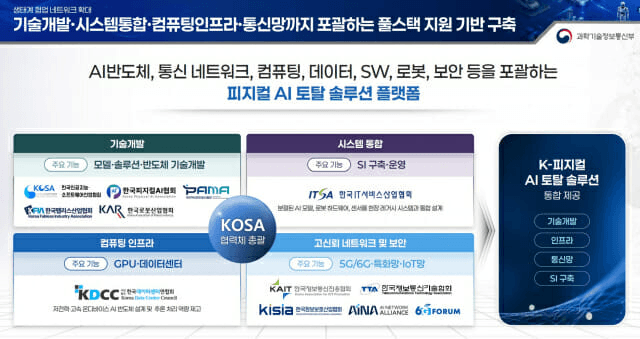
| Ecosystem | a "K-NPU" ecosystem bundling chip + software + demand |
Three pillars. First, the chip: a target to lift inference- and physical-AI-focused domestic NPUs into AI servers with more than 2x the power efficiency of foreign GPUs by 2030. Power efficiency maps directly to datacenter operating cost, so the play is to compete on "a chip that does inference more cheaply."
Second, software — the most important part. The real reason Nvidia is fearsome isn't the chip, it's CUDA. Because countless developers have written code on CUDA, even if they want to switch chips, the software wall keeps them. The government named this exactly, pledging to develop open-source NPU software that counters CUDA. The recognition: you can't just make a chip, you must open an ecosystem where developers can work on top of it.
Third, the market. However good the chip, it dies without buyers. So the government will directly create the early market via public-institution pilot purchases and deploy domestic NPUs first in physical-AI areas like warships, CCTV, police body cams, and patrol robots. It's the classic "government as first customer priming the pump" playbook.
Who wins — the government, Rebellions, the industry
For the government, the strategic payoff is technological sovereignty. As AI becomes core infrastructure for the economy and national defense, depending 100% on a foreign supplier for the core chip is a security risk. Using foreign chips in defense and policing — warships, body cams — is especially burdensome on supply-chain and security grounds. Fill those with domestic NPUs and the government secures economy and security at once.
For Rebellions, the decisive payoff is capital to cross the valley of death — plus a first customer. A chip startup's biggest walls are enormous production costs and the absence of early revenue; a 250B won direct investment and public pilot purchases lower both at once. With the government as a solid anchor customer, credibility for attracting private capital and going overseas rises too.
For Korea's AI industry, it lays a second bridge beyond memory. Korea is the world's strongest in AI memory like HBM but blank in compute chips. If a domestic NPU ecosystem takes root, Korea becomes one of the rare nations holding both "memory and compute" of AI semiconductors. Overlaid with Samsung's same-week industry-first 12-high HBM4E shipment, it's a picture of Korean semiconductors thickening their place in the AI value chain.
History — when a nation bets on chips
Governments growing a chip industry with capital has split into success and failure historically.
Win — Korea's memory rise. Korea pouring national capacity into DRAM in the 1980s–90s, overtaking Japan to become world No. 1, is the classic win. Large capital, talent development, and "capacity investment that endured the chicken game" combined. Lesson: in semiconductors, whoever has "capital that can endure" wins, and direct government investment supplies that staying power. But memory was a standardized-product capacity fight, while NPUs are a software-ecosystem fight — a different difficulty.
Caution — the limit of a chip without software. Around the world, chips billed as "GPU challengers" have appeared, but many were spurned for failing to clear the CUDA ecosystem. Match the chip's performance and you still get ignored if the tools, libraries, and frameworks for developers to code and run models on it are thin. Lesson: the government foregrounding "open-source NPU software" this time shows awareness of that trap. The ecosystem is harder than the chip, and that's where it's won or lost.
Challenge — the double edge of a protected home market. Creating an early market via public pilot purchases is good, but resting on "guaranteed domestic demand" risks never building global competitiveness. There are cases of firms surviving on government orders yet washing out in world markets. Lesson: public procurement is only the primer; Rebellions ultimately has to make a chip that sells on its own in foreign datacenter and enterprise markets. Protection is the starting line, not the finish.
Rivals' counter-play
Nvidia answers with the gravity of the CUDA ecosystem. However good a domestic NPU is, as long as the world's developers know CUDA, switching costs weigh heavily. Nvidia will make "moving to an NPU more expensive" via stronger software lock-in and full-stack systems. Korea's open-source NPU software strategy is precisely an attempt to counter that gravity.
Other nations' homegrown-chip drives walk a similar road. China pushes its own AI chip ecosystem via Huawei, Cambricon, and others; the US, Japan, and Europe each cry semiconductor self-reliance. Overlaid with the same-week report of China keeping its top AI talent at home, AI semiconductors have become a nation-versus-nation contest over industrial and technological sovereignty, not just corporate competition. Korea's K-NPU is one move on that larger board.
The relationship with domestic rival fabless firms and conglomerates is a variable too. Since the government singled out Rebellions, how it harmonizes or competes with other domestic AI chip firms or the in-house chip strategies of Samsung and SK will shape the ecosystem's health. "Backing one champion" can be efficient — or poison. Ecosystems ultimately grow stronger on diversity.
So what actually changes
For semiconductor and hardware professionals, it signals domestic NPUs heading into real mass production and field deployment. Korean AI chips' problem was always "the tech exists but the market doesn't"; a 250B won direct investment and public demand fill that gap. With clear applications fixed — warships, robots, CCTV in inference and physical AI — demand for related software and system integration opens alongside.
For developers and AI companies, it's the possibility of a choice beyond CUDA. If open-source NPU software takes root properly, a path opens to run inference workloads more cheaply on more varied chips. Ecosystem maturity takes time, of course, and early on the tools, docs, and community will be thin. But as more companies feel the cost of "single-vendor Nvidia dependence," the appeal of an alternative ecosystem grows.
For general readers and investors, it's a Korean edition of the AI-sovereignty contest. Chips are no longer mere components but national strategic assets. A government taking capital directly and betting on a specific company means the stakes have grown. Industrial cultivation is long, though, and the hardest gate — the software ecosystem — remains, so watch "whether the 2030 goal actually materializes" over the long haul rather than the "250B won" headline.